Employee Recognition: What It Is, Why It Matters, and How to Get It Right
A practitioner's guide to designing an employee recognition program that changes behavior, strengthens retention, and earns its place in the budget.
Quick answer
What is employee recognition?
Employee recognition is the practice of acknowledging an employee's effort, progress, or achievement in a way that is specific, timely, and personal. Done well, it reinforces the behaviors an organization wants repeated, strengthens retention, and gives every manager a low cost, high frequency tool for building performance.
Recognition holds an unusual place in most organizations. Every leadership team agrees it matters. Very few give it the same design discipline they apply to compensation, benefits, or sales incentives. The result is a program that exists on paper, runs on goodwill, and quietly loses relevance within a year.
The encouraging part is that recognition responds extremely well to design. It is one of the few Total Rewards levers where a small, well structured intervention produces visible change inside a single quarter. Organizations that get it right tend to share one habit. They treat recognition as a management practice with clear standards, clear ownership, and clear measurement.
This guide covers what employee recognition is, the forms it takes, why it moves business outcomes, and a practical sequence for building a program that lasts. It is written for CHROs, Total Rewards leaders, and HR business partners who want something they can implement, measure, and defend in front of finance.
Key takeaways
The six things worth remembering
- Employee recognition is an acknowledgment of contribution. It works when it is specific, timely, personal, fair, and anchored to company values.
- Recognition is a retention and performance instrument, so it deserves the same design rigor as any other reward program.
- Manager led recognition sets the standard. Peer led recognition creates the scale.
- Coverage matters more than volume. A program that reaches every role, level, and location outperforms one that celebrates the same visible few.
- Four numbers tell you whether the program is alive: giver coverage, receiver coverage, time to recognition, and distribution fairness.
- Recognition platform earns its cost once consistency across teams, geographies, and languages becomes the binding constraint.
What is employee recognition?
Employee recognition is the act of noticing what someone did, naming it clearly, and telling them why it mattered. Three qualities separate recognition that lands from recognition that passes unnoticed. It is timely, so it arrives while the work is still fresh. It is specific, so the person knows exactly which behavior earned it. It is personal, so it fits the individual rather than a template.
The definition is worth being strict about, because recognition is often confused with three adjacent practices. Each of those practices has its own purpose and its own place in the operating rhythm of a company.
How recognition differs from rewards, feedback, and performance management
Practice | Core purpose | Typical cadence | What it delivers |
|---|---|---|---|
Recognition | Acknowledge a contribution that has already happened | Continuous, in the moment | Reinforces behavior and builds belonging |
Rewards | Deliver something of tangible value for an outcome | Event based or milestone based | Creates a moment of financial or experiential value |
Feedback | Guide future behavior, both strengths and gaps | Regular, structured | Improves capability and clarity |
Performance management | Evaluate contribution against expectations | Cyclical, annual or half yearly | Informs pay, promotion, and development decisions |
Recognition and rewards work best as a pair. Recognition carries the message. Rewards carry the value. A recognition program that leads with the reward and forgets the message becomes a transactional catalogue. A program that carries the message consistently can run on a modest budget and still change how people work.
The main types of employee recognition
Most mature programs run several types of recognition side by side, each solving for a different need. Mapping them explicitly helps you see where your current program is strong and where it has gaps.
Type | What it looks like | Best used for |
|---|---|---|
Manager to employee | A direct, specific acknowledgment from the line manager | Setting the quality standard and reinforcing priorities |
Peer to peer | Colleagues recognizing each other through a shared channel or platform | Scale, cross team visibility, everyday contribution |
Values based | Recognition tagged to a named company value or behavior | Turning a values statement into observable practice |
Spot or instant | Immediate acknowledgment, sometimes with a small reward attached | Speed, effort under pressure, above and beyond moments |
Milestone and service | Tenure anniversaries, project completions, certifications | Marking commitment and shared history |
Team and program | Recognition of a squad, project team, or function | Collaboration and outcomes no individual owns alone |
Leadership and executive | Recognition from senior leaders, often company wide | Signalling strategic priorities and showcasing role models |
Career and development | Stretch assignments, learning budgets, visibility opportunities | Recognizing potential and investing in growth |
Infographic 01
The employee recognition landscape

Use this map to audit your current program. Plot what you actually run today, then look at the empty quadrants.

Why employee recognition matters to the business
Recognition earns its place in the Total Rewards portfolio because it moves four things that leadership teams already care about. The mechanisms are practical and easy to trace, which is what makes recognition straightforward to defend in a budget conversation.
It strengthens retention
People leave when they conclude their contribution is invisible. Recognition addresses that conclusion directly and repeatedly. When an employee hears specifically what they did well and why it mattered, the question of whether they are valued stops being ambiguous. Retention improves because the ambiguity that fuels quiet disengagement gets removed early, well before it becomes a resignation conversation.
It raises engagement and discretionary effort
Engagement rises when people can connect their daily work to something that matters. Recognition makes that connection explicit. A well written recognition message names the behavior, names the outcome, and closes the loop between effort and impact. That loop is what encourages people to bring more than the minimum to the next piece of work.
Recognition is one of the few reward levers that reaches every role, at every level, in every location.
It improves performance and productivity
Recognition works as a lightweight performance signal. It tells a team, in real time, which behaviors are worth repeating. Over a quarter that produces a compounding effect. People spend less time guessing at priorities, replicate what has already been shown to work, and course correct faster because the standard is visible in everyday practice rather than buried in an annual review.
It turns culture and values into observable behavior
Every company publishes a values statement. Recognition is the mechanism that turns those words into something employees can see. When collaboration is recognized publicly, collaboration spreads. When only individual wins are celebrated, the culture follows that signal instead. Tagging recognition to values gives leadership a direct, low cost lever on the behaviors that define how work gets done.
It strengthens the employee value proposition
Recognition is one of the few reward elements that every employee can access, in every role and at every level. That makes it a powerful equalizer within the employee value proposition. Compensation bands vary. Equity eligibility varies. Benefits utilization varies. A well designed recognition program reaches everyone, which is why it often carries more weight in employee perception surveys than programs that cost considerably more.
The five tests of recognition that works
Recognition programs succeed or fail on design quality rather than budget size. The five tests below give you a simple diagnostic. Run any recognition moment, or any program, against all five. Programs that pass four or five tests change behavior. Programs that pass three or fewer create a pleasant moment that fades quickly.
Infographic 02
The five tests of recognition that works

Test 1: Specific
Effective recognition names the exact behavior and its effect. Compare two versions of the same message. The first says, great work on the client presentation. The second says, the way you restructured the financial model in yesterday's presentation made the investment case obvious and helped us close the deal. The second version costs nothing more to deliver. It simply carries information, and information is what changes future behavior.
Test 2: Timely
Recognition delivered within days of the work carries far more weight than the same message delivered at a quarterly awards ceremony. Speed is what connects the acknowledgment to the memory of the effort. A useful internal standard is to aim for recognition within seven days of the contribution, and to measure how close the program gets to that mark.
Test 3: Personal
A reward or gesture that matches what the individual actually values carries more weight than a standardized catalogue item. Some people value public acknowledgment in a town hall. Others prefer a private note from someone whose opinion they respect. Some value learning budgets, others value time back. The same principle that drives flexible benefits applies here. Choice raises perceived value without raising cost.
Test 4: Fair
Recognition should be reachable from every role, level, and location. When acknowledgment consistently flows to the same visible functions, everyone else quietly concludes the program is not for them. Fairness does not require identical treatment. It requires a realistic path for every employee to be recognized for contribution that genuinely matters to the business. Coverage data is what makes fairness visible and correctable.
Test 5: Anchored
Recognition tied to company values reinforces the behaviors you want repeated, even when outcomes move for reasons outside anyone's control. A salesperson who loses a competitive deal while showing outstanding collaboration should still be recognized for the collaboration. Anchoring recognition to behaviors as well as results keeps the program honest across good quarters and difficult ones.
Test | What it requires in practice | What good looks like |
|---|---|---|
Specific | Name the behavior and the impact it created | Every message answers what happened and why it mattered |
Timely | Deliver close to the moment of contribution | Median time to recognition inside seven days |
Personal | Match the gesture to what the individual values | Employees choose their reward and their level of visibility |
Fair | Make recognition reachable across roles and locations | Coverage broadly even across teams, levels, geographies |
Anchored | Tag recognition to a stated value or priority | Every value in the values statement is actively used |
How to build an employee recognition program in 10 steps
The sequence below is deliberately ordered. Each step makes the next one easier, and the first six can be delivered inside a single quarter with existing tools and no new budget line.
- Define the behaviors you want to reinforce. Start with three to five behaviors drawn from your values or your current strategic priorities. Specific behaviors give people something concrete to recognize.
- Name an owner and a sponsor. Recognition needs one accountable owner in HR or Total Rewards and one visible executive sponsor who models the behavior publicly.
- Add recognition to existing one to one meetings. Two minutes at the top of a conversation that is already in the calendar. This is the highest return change available to most organizations.
- Open a peer channel. A dedicated channel in your collaboration tool, named clearly, with a stated expectation that everyone posts at least one recognition per week.
- Publish the specificity template. Give people a simple sentence structure: I want to recognize [name] for [behavior], which had [impact]. Templates make quality automatic.
- Train managers in a single short session. Thirty focused minutes on how to write specific recognition beats a half day workshop on why recognition matters.
- Track coverage from week one. Measure how many employees received recognition, how many managers gave it, and how quickly it followed the work.
- Review the numbers monthly. Look for teams with low coverage and treat it as a coaching opportunity rather than a compliance issue.
- Layer rewards in strategically. Attach tangible rewards to milestones and exceptional contribution. Keep everyday recognition free flowing and unbudgeted.
- Report business impact quarterly. Present retention movement, coverage trends, and values distribution to the leadership team, alongside the cost of the program.
Infographic 03
The 90 day recognition rollout


The manager layer: making recognition a leadership habit
Managers set the quality standard for recognition in an organization. Their teams read what gets acknowledged and calibrate their effort accordingly. Three practical moves turn recognition from something managers intend to do into something they actually do.
Train for specificity, not just frequency
Most recognition training asks managers to recognize more often. Adding a quality standard makes the same effort go much further. Teach the sentence structure, run two live practice rounds in the session, and give managers three worked examples from their own function. Managers who leave with a usable template start writing recognition that carries information, and information is what changes behavior.
Build it into the one to one
The most reliable recognition habit available to any organization is a short, regular one to one that opens with a moment of acknowledgment. That habit needs a calendar invite and a manager who shows up. Building recognition into a meeting that already exists removes the cognitive load that causes standalone programs to fade after the first month.
Measure giver coverage, not just receiver coverage
Track the percentage of managers who gave recognition in the last 30 days alongside the percentage of employees who received it. A program where most employees are recognized but only a minority of managers are giving recognition is being carried by a small group. Giver coverage is the single best early indicator of whether a program will still be running a year from now.
Coach the managers who are quiet
Low giver coverage usually reflects workload or uncertainty about what to say rather than indifference. Treat it as a development conversation. Share examples from peer managers, offer the template again, and check in a month later. Most managers move quickly once they see what good looks like in their own context.
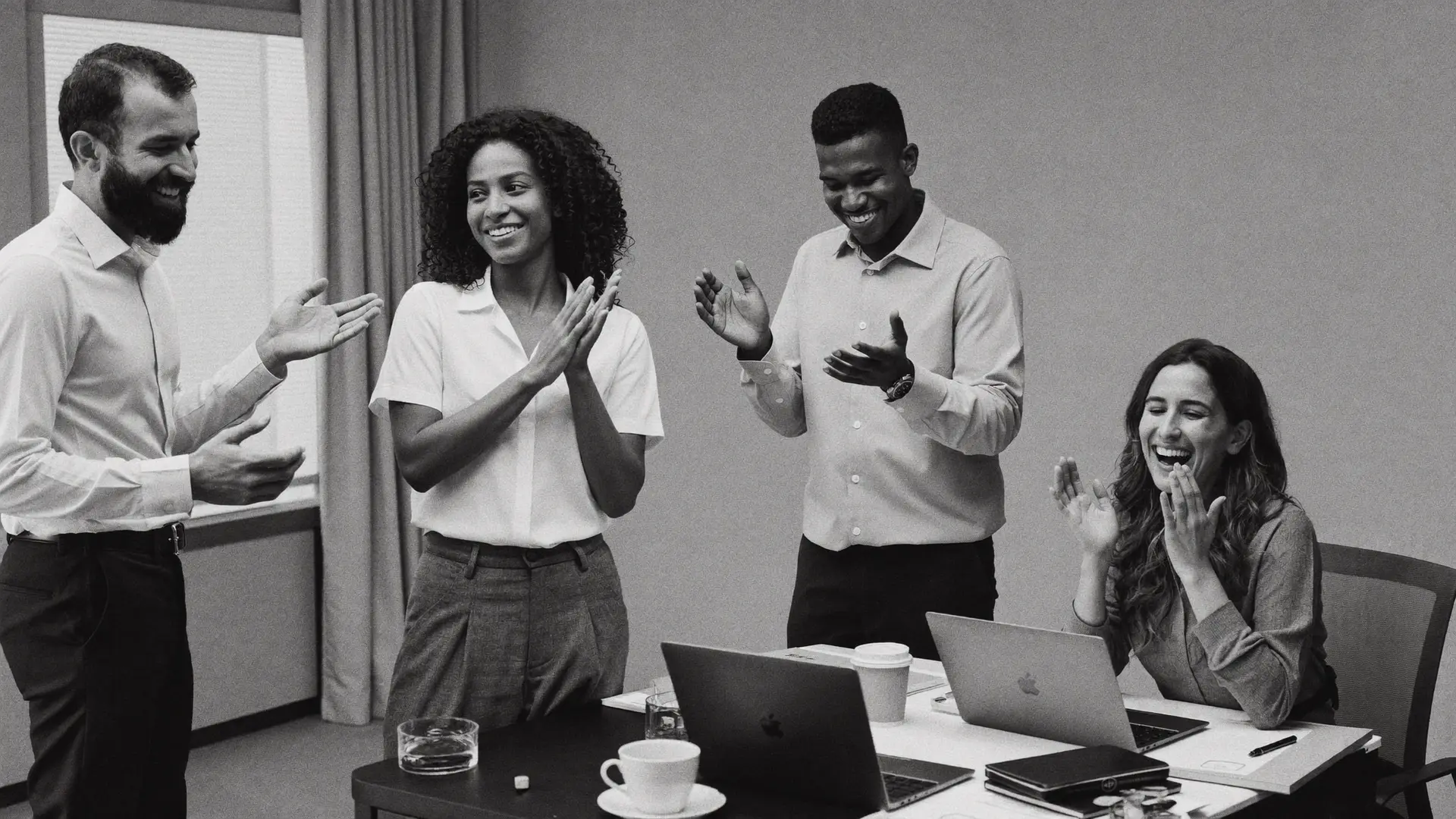
Peer recognition reaches the everyday contribution that managers never see.
The peer layer: where recognition finds scale
Peer recognition reaches contribution that managers never see. Colleagues notice the analyst who stayed on a call to unblock another team and the engineer who documented a fix so nobody else loses a day. Building a peer layer is what turns recognition from a program into a culture.
Create a zero friction channel
A dedicated channel in Slack, Teams, or your recognition platform costs almost nothing to set up. What determines whether it works is the norm around it. Set a clear expectation of one peer recognition per person per week, and track participation at team level so it becomes a shared habit rather than an individual performance metric.
Tag peer recognition to values
Give people a simple frame: recognize behavior that shows a company value in action. Tagging keeps peer recognition aligned to what the organization is trying to build and gives you clean data on which values are alive in practice. It also keeps the channel focused on contribution rather than becoming a general social feed.
Keep the distribution honest
Review peer recognition data for concentration. If the same names recur while whole teams stay quiet, the fix is usually visibility rather than enforcement. Rotate spotlight slots across functions, invite quieter teams to share wins in company forums, and make sure recognition from support and back office functions is as visible as recognition from customer facing ones.
Let senior leaders participate visibly
When executives post recognition in the same channel everyone else uses, the program gains credibility instantly. It signals that recognition is part of how the company operates at every level rather than something delegated to HR.
How to measure an employee recognition program
Recognition is often described as difficult to measure. In practice it produces clean, immediate data. The table below sets out the metrics worth tracking from the first week, along with the direction that indicates a healthy program.
Metric | What it measures | Healthy signal |
|---|---|---|
Receiver coverage | Percentage of employees recognized in the last 30 days | Rising steadily and broadly even across teams |
Giver coverage | Percentage of managers who gave recognition in the last 30 days | A clear majority of managers active every month |
Time to recognition | Median days between the contribution and the acknowledgment | Inside seven days and trending down |
Distribution fairness | Spread across roles, levels, locations, and demographics | No group persistently under represented |
Values mix | Share of recognition tagged to each company value | Every value used, with no single value dominating |
Peer to manager ratio | Volume of peer recognition relative to manager recognition | Peer volume growing as the program matures |
Budget utilization | Reward spend against plan, and cost per recognized employee | Predictable, with spend concentrated on milestones |
Retention differential | Turnover among recognized versus non recognized employees | A widening gap in favor of recognized employees |
Infographic 04
The recognition dashboard

Illustrative dashboard layout. Figures shown are sample values for design purposes.
Two of these metrics deserve particular attention. Distribution fairness is where recognition programs quietly develop equity problems, and it connects directly to the work most organizations are already doing on pay equity and pay transparency. Time to recognition is the metric that keeps the program feeling live, because a program with a slow median inevitably drifts back toward annual ceremonies.
Building the business case for recognition
Recognition budgets hold up far better when they are presented as retention investment rather than culture spend. Finance teams evaluate retention investment on familiar terms, and recognition compares well on those terms because the program cost is small and largely fixed.
The argument runs in four steps that any Total Rewards leader can assemble from data already in the HRIS.
- State your current voluntary turnover rate and the fully loaded replacement cost for your main role families, including recruitment, onboarding, and lost productivity during ramp.
- State the retention differential you expect between well recognized and poorly recognized employees, based on your own exit data and engagement survey cuts.
- State the full program cost, including platform licensing, reward budget, and the internal time required to run it.
- Show the break even point expressed in prevented departures. Most recognition programs break even on a very small number of retained employees, which is what makes the case straightforward.
A line item defended as culture spend is an easy cut. A line item defended as retention spend with a stated break even point gets protected.
Common employee recognition mistakes and how to fix them
Most recognition programs run into the same handful of design issues. Each one has a practical fix that can be applied without restarting the program.
What tends to happen | The fix that works |
|---|---|
Recognition is generic, so it reads as polite rather than meaningful | Publish the specificity template and coach managers to name the behavior and the impact in every message |
The same visible people are recognized repeatedly | Review coverage by team and level monthly, and give quieter functions dedicated spotlight slots |
Recognition arrives long after the work | Set a seven day internal standard and track median time to recognition as a live metric |
The program sits separately from daily work | Embed recognition into one to ones, team meetings, and retrospectives that already exist |
Rewards dominate and the message gets lost | Keep everyday recognition free and message led, and reserve tangible rewards for milestones |
Only outcomes get recognized, never behaviors | Tag every recognition to a company value so effort and collaboration remain visible |
Remote and field employees see less recognition | Default to written and asynchronous recognition so distributed employees have equal visibility |
The program has no owner after launch | Assign one accountable owner and put a monthly review of the four core metrics in their calendar |
Choosing an employee recognition platform
Not every organization needs dedicated recognition software on day one. Smaller teams can run an effective program on collaboration tools they already own. The decision point arrives when consistency becomes the binding constraint, which usually happens as headcount, geographies, and languages multiply.
When a platform starts to pay for itself
- You operate across multiple countries and need consistent recognition standards, currencies, and reward catalogues in each.
- You need coverage and fairness analytics that a chat channel cannot produce.
- Reward budgets need to be controlled, approved, and reported against plan.
- Tax and compliance treatment of rewards varies across your locations and needs to be handled correctly.
- You want recognition data to sit alongside compensation, benefits, and performance data rather than in a separate silo.
What to look for in an employee recognition platform
Capability | Why it matters |
|---|---|
Values based tagging | Turns recognition into usable culture data and keeps behavior visible |
Peer and manager flows | Supports both the quality layer and the scale layer in one place |
Coverage and fairness analytics | Shows you who is being missed while it is still correctable |
Budget and approval controls | Keeps reward spend predictable and auditable |
Global reward fulfilment | Delivers relevant, tax compliant rewards in every country you operate in |
Personalization and choice | Raises perceived value of the reward without raising cost |
Integration with the Total Rewards stack | Connects recognition to compensation, benefits, and performance context |
AI assistance | Helps managers write better recognition and decodes eligibility rules instantly |
How Tallect approaches recognition
Recognition that lives inside the rest of the reward picture
Tallect is a modular Total Rewards platform built by Total Rewards practitioners for Total Rewards teams. The Recognition module sits inside the same system as compensation planning, market benchmarking, flexible benefits, sales incentives, and ESOP and long term incentive management, which means recognition data lives next to the rest of the reward picture instead of in a standalone tool.
The platform is designed around the five tests in this guide. Values tagging is built into every recognition flow. Coverage and fairness analytics are available from day one. Reward budgets are controlled and reported centrally while remaining flexible locally. And in Tallect, the AI agent layer inside the platform, helps managers write specific recognition and decodes eligibility rules on the spot so nobody has to read a policy document to say thank you well.
5
design tests to pass
4
metrics that show it is alive
10
steps to a running program
90
days to design and launch
Employee recognition ideas that cost little and work well
The following ideas are all low cost, quick to launch, and consistent with the five tests. Most organizations can run five or six of them simultaneously without adding a budget line.
- Open every team meeting with two minutes of recognition, rotating who gives it.
- Write a short, specific note to one person a week and copy their manager.
- Create a values wall where recognition is grouped under each company value.
- Run a monthly spotlight on a support or back office function that rarely gets visibility.
- Give managers a small discretionary reward budget with no approval chain attached.
- Recognize the behavior behind a failed project when the behavior was exemplary.
- Ask new joiners at 90 days who helped them most, then recognize those people publicly.
- Celebrate learning milestones such as certifications and internal course completions.
- Let employees choose their own reward from a personalized menu rather than a fixed catalogue.
- Send recognition to someone's home rather than their desk when it marks a major milestone.
- Give time back as a reward, such as an early finish or a no meeting day.
- Invite recognized employees to present their work to the leadership team.
- Recognize teams for cross functional collaboration, not just individual delivery.
- Mark service anniversaries with something personal rather than something standard.
- Close every quarter with a short leadership message naming specific contributions from across the business.

When executives recognize people in the same channel everyone else uses, the program gains credibility instantly.
Frequently asked questions about employee recognition
What is employee recognition?
Employee recognition is the practice of acknowledging an employee's effort, progress, or achievement in a way that is timely, specific, and personal. It reinforces the behaviors an organization wants repeated and gives managers a continuous, low cost tool for building performance and belonging.
What is the difference between employee recognition and rewards?
Recognition is the message and rewards are the value attached to it. Recognition names what someone did and why it mattered. Rewards deliver something tangible such as points, vouchers, experiences, or time off. Recognition can run continuously at almost no cost, while rewards are usually reserved for milestones and exceptional contribution.
What are the main types of employee recognition?
The main types are manager to employee, peer to peer, values based, spot or instant, milestone and service, team and program, leadership or executive, and career and development recognition. Mature programs run several types together so that different kinds of contribution all have a visible path to acknowledgment.
Why is employee recognition important?
Recognition strengthens retention by removing the ambiguity about whether contribution is seen. It raises engagement by connecting daily work to impact. It improves performance by signalling in real time which behaviors are worth repeating. And it turns a values statement into observable everyday behavior.
How often should employees be recognized?
Aim for every employee to receive meaningful recognition at least once a month, and for the median gap between the contribution and the acknowledgment to stay inside seven days. Frequency matters, though specificity matters more. A monthly message that names a real behavior beats weekly generic praise.
What makes employee recognition effective?
Effective recognition passes five tests. It is specific about the behavior and its impact. It is timely. It is personal to the individual. It is fair and reachable across roles and locations. And it is anchored to a company value or strategic priority. Programs that pass four or five of these tests change behavior.
What is peer to peer recognition and does it work?
Peer to peer recognition lets colleagues acknowledge each other directly, usually through a shared channel or platform. It works because peers see everyday contribution that managers miss, and because it scales without adding to manager workload. It is the layer that turns recognition from a program into a culture.
How do you measure an employee recognition program?
Track four core metrics: receiver coverage, giver coverage, median time to recognition, and distribution fairness across roles, levels, and locations. Add values mix, peer to manager ratio, budget utilization, and the retention differential between recognized and non recognized employees as the program matures.
How much should a company budget for employee recognition?
Everyday recognition should cost close to nothing, because the message carries the value. Budget is needed for tangible rewards, platform licensing, and milestone programs. Size the reward budget against your role families and turnover costs, then present the case as retention investment with a stated break even point in prevented departures.
Does my company need an employee recognition platform?
Smaller, single location teams can run a strong program using collaboration tools they already have. A platform starts to pay for itself when you need consistency across multiple countries, coverage and fairness analytics, controlled reward budgets, compliant global fulfilment, or recognition data connected to your wider Total Rewards stack.
How do you recognize remote and hybrid employees fairly?
Default to written, asynchronous recognition so that distributed employees have the same visibility as people in the office. Use a shared channel rather than in room moments, review coverage by location every month, and make sure company wide forums feature contributions from every site.
How is recognition different from performance management?
Performance management evaluates contribution against expectations on a cycle and informs pay and promotion decisions. Recognition acknowledges contribution continuously and carries no evaluative weight. The two support each other. Recognition keeps the standard visible day to day, which makes the formal review conversation far less surprising.
What are the most common employee recognition mistakes?
The most common are generic praise with no named behavior, recognition concentrated on the same visible people, long delays between the work and the acknowledgment, a program that sits outside daily workflows, rewards that overshadow the message, and no accountable owner once the launch excitement fades.
How do you make recognition fair across roles and locations?
Fairness comes from coverage data. Review recognition distribution by team, level, location, and tenure every month, and treat gaps as a coaching opportunity. Give support and back office functions dedicated visibility, and make sure the criteria for recognition are reachable from every role rather than only from customer facing ones.
Can AI help with employee recognition?
Yes. AI helps managers write more specific recognition by prompting for the behavior and the impact, decodes eligibility and reward rules instantly so nobody has to read a policy document, flags teams with low coverage before the gap becomes visible, and surfaces distribution patterns that would otherwise take an analyst several days to find.
The bottom line
Employee recognition is a retention and performance instrument that happens to be inexpensive. The organizations that get it right treat it with the same design discipline they bring to compensation and benefits. They define the behaviors worth reinforcing, hold a clear quality standard, build the habit into meetings that already exist, open a peer layer for scale, and measure coverage every month.
Recognition that is specific, timely, personal, fair, and anchored to values produces measurable gains in retention and engagement at a fraction of the cost most organizations assume is necessary. The design work is what makes the difference, and the design work is entirely within your control.
This guide is general information for recognition program design and is not compensation consulting advice. Outcomes vary by organization, industry, and program design.