What the EU Pay Transparency Directive Means for Your Pay Bands
Every obligation in the EU Pay Transparency Directive depends on pay bands you can explain. Here is what yours need to hold up.
Directive (EU) 2023/970 appeared in the EU Official Journal on 17 May 2023. In many HR departments, the reaction sat somewhere between cautious acknowledgement and mild panic. The text is dense legislative prose. The summaries that followed ranged from “this is just salary posting” to “this will break everything”. Neither reading is quite right.
What the directive really does is force a reckoning that many organisations have avoided for years. Are their pay structures coherent enough to explain to the people inside them? These weaknesses all become a liability once employees have a legal right to ask where they sit in a range and why:
- pay bands that exist only in a spreadsheet
- ranges so wide they could swallow two different jobs
- grades that differ on paper but not in practice
This article covers what the directive requires, what it means for your pay band infrastructure, and what to do now that the June 2026 transposition deadline has passed.
The directive in plain terms
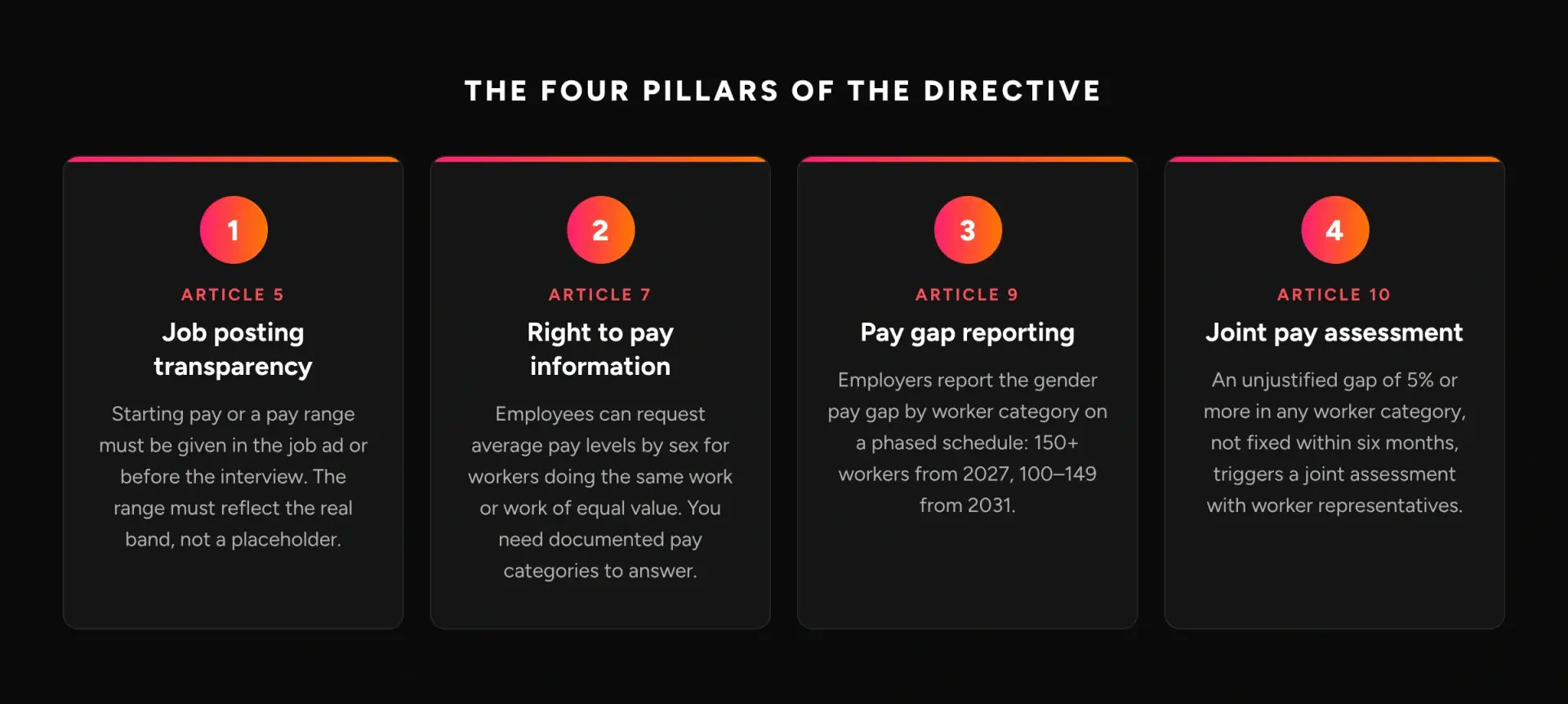
The full title is “Directive (EU) 2023/970 of the European Parliament and of the Council of 10 May 2023 to strengthen the application of the principle of equal pay for equal work or work of equal value between men and women through pay transparency and enforcement mechanisms”. It sits on top of existing EU equal pay obligations and adds four distinct layers of enforcement.
Job posting transparency. Before an interview, a candidate must be told either a specific starting salary or a salary range for the role. Employers cannot ask candidates about their pay history. This applies from the date each member state transposes the directive. The deadline for transposition was 7 June 2026.
The right to pay information. Employees can request the average pay level, broken down by sex, for workers doing the same work or work of equal value. The employer must respond within a reasonable time. This right also applies from transposition.
Pay gap reporting. Employers must report gender pay gap data at regular intervals, phased by size:
- 250 or more workers: the first report is due by 7 June 2027, covering 2026, and then every year.
- 150 to 249 workers: the first report is also due by 7 June 2027, and then every three years.
- 100 to 149 workers: the first report is due by 7 June 2031, covering 2030, and then every three years.
The joint pay assessment. Reporting may show a gender pay gap of 5% or more in any category of workers doing equal work or work of equal value. If the employer cannot justify that gap on objective, gender-neutral grounds, and does not fix it within six months, it must run a joint pay assessment with worker representatives. The assessment must lead to corrective action.
The four pillars your bands must support
Each of the directive’s four requirements places a different demand on your pay band infrastructure. The starting point for any compliance roadmap is understanding what each pillar needs from your data.
Reporting timeline: who acts when
The phased rollout gives smaller employers more time. But the job posting requirement and the right to pay information apply to all employers once their member state has transposed the directive.
Obligation | Who it applies to | When |
|---|---|---|
Job posting salary disclosure | All employers in EU member states | From transposition (deadline 7 June 2026) |
Right to pay information | All employers | From transposition (deadline 7 June 2026) |
First pay gap report | Employers with 150+ workers | 7 June 2027, covering 2026 |
First pay gap report | Employers with 100–149 workers | 7 June 2031, covering 2030 |
Joint pay assessment | Reporting employers with an unjustified gap of 5% or more | After a report shows the gap, if it is not fixed within six months |
What the directive says about pay categories
The directive uses “categories of workers performing the same work or work of equal value” as its unit of analysis for both the right to pay information (Article 7) and gender pay gap reporting (Article 9). Equal value must be assessed on objective, gender-neutral criteria, including skills, effort, responsibility and working conditions.
This matters because a pay category under the directive is not the same as a job title. An organisation with dozens of titles covering broadly similar work is expected to group those roles when it assesses or reports a pay gap. The directive also states that job evaluation systems used to define categories must not rely on criteria that discriminate, directly or indirectly, on grounds of sex.
- Member states had to transpose the directive into national law by 7 June 2026 (Article 34).
- The directive includes a right to compensation, a shift in the burden of proof and minimum penalty provisions (Articles 16, 18 and 23).
- Workers in non-standard or precarious employment remain covered (source needed).
A mandate for pay band infrastructure
Read the four pillars together and a pattern emerges. Every obligation depends on the organisation having a coherent, documented way of grouping jobs and attaching pay ranges to them:
- You cannot post a meaningful salary range in a job ad if your bands do not exist, or if they span 80%.
- You cannot answer an employee’s request for average pay by category if you have not defined the categories.
- You cannot report a pay gap by worker group if workers are not grouped.
In practice, many organisations that believe they have pay bands actually have market data attached to job codes, not a structured architecture. The band exists for a particular hire, not as part of a system. The directive closes that gap. Ranges that are defensible rather than cosmetic need to meet three tests:
- They are tied to a job evaluation framework.
- They are refreshed against market data on a defined cadence.
- They are applied consistently across roles that are genuinely comparable.
That is what pay architecture means here. It is not a single spreadsheet column but a logical chain: job families, career levels, grade structure and salary ranges tied to each grade. When that chain exists, meeting the directive’s requirements is largely a data-retrieval exercise. When it does not, compliance is a much bigger job than most organisations have planned for.
The problem with bands that are too wide
One response to the salary posting requirement is to post ranges so wide they reveal nothing. A band from 40,000 to 90,000, say, tells a candidate very little about what the role pays. The directive anticipates this. Member states will differ in how strictly they enforce it, but the pay information given must be based on objective, gender-neutral criteria (source needed). Enforcement bodies will have powers to investigate and impose penalties.
Wide bands create a second problem: they make a joint pay assessment more likely. If a band covers roles of genuinely different scope and seniority, pay differences between men and women inside it can look like systematic bias rather than legitimate grade differences. A well-defined grade structure with narrower, justified ranges makes it far easier to show that a gap within a category has an objective, gender-neutral explanation.
The directive does not set a maximum band width. But the logic of compliance pushes towards tighter, more deliberate ranges. That means doing the underlying job architecture work, not just adding a number to a job ad.
What compliance-ready bands look like
A few characteristics separate pay bands built for the pre-directive world from those that hold up now.
Bands tied to a job evaluation framework. You might use a points-factor system, a market pricing approach or a simpler internal levelling rubric. Either way, the ranges need to trace back to something more principled than “what we paid the last person in this role”. The framework becomes the gender-neutral criterion the directive requires when you group jobs and justify pay differences.
Documented pay categories that match the directive’s definition. Every organisation must decide how to define its “categories of workers performing the same work or work of equal value”. That is not a decision to make the week before your first report is due. It means looking at your job architecture and making deliberate grouping choices you can defend.
Ranges refreshed against market data on a clear schedule. Posting a range benchmarked four years ago creates reputational and legal exposure. Compliance-ready pay programmes have a defined cycle for market data review. They also have clear rules for when ranges are updated and communicated.
A process for out-of-band pay. Almost every organisation has employees paid above or below their grade range, because of long tenure, market exceptions or leftovers from an acquisition. The directive does not ban this, but it requires you to explain it. A defensible process for documenting and reviewing out-of-band pay is part of compliance.
How Tallect surfaces readiness gaps before an audit
The directive creates a specific kind of risk that traditional compensation reporting rarely shows. Some structural patterns look acceptable in aggregate but reveal problems when broken down by gender within pay categories.
- Pay category mapping. Tallect’s AI groups roles by the characteristics of the work: scope, complexity, required qualifications and accountability. It does not group them by title. This exposes fragmentation, where the same work sits under several codes with different names. The result is a more accurate version of the job grouping the directive requires than manual title-matching.
- Within-category gap detection. The AI monitors pay distributions within each category and flags gender pay gaps that approach or pass the 5% threshold before they appear in a formal report. HR teams get time to investigate and correct, instead of finding the gap in a published disclosure.
- Band coverage analysis. Tallect identifies roles whose posted or internal range is so wide it hides meaningful pay differences. That is a signal to tighten the grade structure before ranges go into job ads.
- Out-of-band concentration signals. The AI detects when out-of-band pay is concentrated in one gender within a category, even when the category’s overall gap looks neutral. A joint pay assessment is likely to surface that kind of concentration.
Common compliance gaps to fix now
Most organisations are not starting from zero. They have some band structure, some market data and some sense of their gender pay gap. The gaps that cause the most difficulty are more specific than “we have no pay architecture”.
- Levels exist on paper but are not applied consistently. A senior associate in one business unit does the same work as an associate in another. Once the directive requires you to define categories of workers doing “the same work or work of equal value”, that inconsistency becomes visible.
- Pay data and HR data sit in separate systems that have never been cleanly linked. Calculating a gender pay gap by worker category means combining role, grade and pay data in a way many organisations have never done at scale.
- The band structure was designed for a domestic market and never reviewed against the directive’s idea of equal value. Roles paid very differently may be comparable under an objective job evaluation. Then the pay difference needs a justification, not just acceptance.
- No one owns pay band maintenance. Ranges were set in a particular year and have drifted since, with no formal update process. When an employee uses their right to pay information, “our ranges are from 2021” is not a satisfying answer.

Building a directive-ready pay band in Tallect
Tallect’s Total Rewards platform provides the infrastructure for each stage of directive preparation:
- Pay category builder. Define and document worker categories tied to your job architecture. You can export category definitions for employee communications and reporting submissions.
- Real-time gap monitor. Track gender pay gaps by category continuously, with configurable thresholds that alert you as a category nears the 5% trigger, not only when a report is due.
- Band width analyser. Review every active range for width, market alignment and how clearly it differs from adjacent grades. This is the groundwork for posting defensible ranges in job ads.
- Reporting module. Generate the gender pay gap reports the directive requires, formatted for the member states where you operate. Each report has an audit trail linking the figures to their source data.
Key takeaways
- The transposition deadline has passed. Member states had to transpose Directive (EU) 2023/970 by 7 June 2026. Salary posting and the right to pay information apply to all employers from transposition.
- Reporting starts in 2027 for larger employers. Employers with 150 or more workers report from June 2027, and those with 100 to 149 workers from June 2031.
- A 5% gap can trigger a joint pay assessment. An unjustified gap of 5% or more in any worker category, if not fixed within six months, triggers a mandatory joint pay assessment.
- Categories follow equal value, not titles. The directive’s worker categories are defined by the same work or work of equal value, so your pay categories need to reflect a genuine job evaluation, not title groupings.
- Posted ranges must be real. Ranges posted in job ads must be real and applicable. Cosmetically wide ranges that reveal nothing invite regulatory scrutiny.
- Four compliance gaps are most common:
- inconsistent levelling
- disconnected data systems
- bands never reviewed against equal-value principles
- no formal process for band maintenance
- Closing the gaps takes architecture work. It means doing the underlying job architecture work, not just adding a number to a job ad template.
Frequently asked questions
When did the EU Pay Transparency Directive take effect?
Directive (EU) 2023/970 appeared in the EU Official Journal on 17 May 2023. Member states had to transpose it into national law by 7 June 2026. Salary posting and the right to pay information apply from the date each member state transposes it.
Do employers have to put salary ranges in job ads?
Before an interview, a candidate must be told either a specific starting salary or a salary range for the role. This can be in the job ad or shared separately. Employers also cannot ask candidates about their pay history.
What can employees ask for under the directive?
Employees can request the average pay level, broken down by sex, for workers doing the same work or work of equal value. The employer must respond within a reasonable time. Answering accurately requires documented pay categories.
Which employers must report their gender pay gap, and when?
Employers with 250 or more workers report by 7 June 2027, covering 2026, and then every year. Employers with 150 to 249 workers also report first by 7 June 2027, then every three years. Employers with 100 to 149 workers report first by 7 June 2031, covering 2030.
What triggers a joint pay assessment?
Three conditions together trigger a joint pay assessment:
- a gender pay gap of 5% or more in any category of workers doing equal work or work of equal value
- no justification for the gap on objective, gender-neutral grounds
- no fix within six months
The employer must then run the assessment with worker representatives and take corrective action.
Is a pay category the same as a job title?
No. The directive’s unit of analysis is “categories of workers performing the same work or work of equal value”. An organisation with many titles covering broadly similar work is expected to group those roles. Equal value is judged on skills, effort, responsibility and working conditions.
Does the directive set a maximum pay band width?
No. But very wide bands cause two problems. Ranges posted in job ads become meaningless. And within-band gaps can look like bias rather than grade differences, which makes a joint pay assessment more likely. Compliance pushes towards tighter, more deliberate ranges.
Can employees still be paid outside their pay band?
Yes. The directive does not ban out-of-band pay, but you must be able to explain it. A documented process for recording and reviewing out-of-band pay is part of being compliance-ready.
What are the most common compliance gaps?
There are four:
- levels that exist on paper but are not applied consistently
- pay data and HR data in separate systems
- bands never reviewed against the directive’s idea of equal value
- no formal owner or process for band maintenance
Where should an employer start?
Start with job architecture: job families, career levels, a grade structure and salary ranges tied to each grade. Once that chain exists, answering the directive’s requirements is largely a data-retrieval exercise.
Know where your pay bands stand
Tallect maps your pay structure against the directive’s requirements, surfaces category gaps and keeps your ranges current. See it working on your own data.