
How Job Architecture Supports Pay Transparency
Pay ranges only make sense when they attach to clearly defined roles. Here is how job families, levels, grades and bands make transparency defensible.
Most companies that run into trouble with pay transparency share a common starting problem: their job structure is inconsistent. Titles have multiplied without any coordinating logic. Two people doing work of the same scope and complexity can carry different titles in different departments. They can also sit in different pay grades and be measured against different criteria. When HR tries to run a pay equity review, or finance asks for a clean cost model by role type, the categories are too noisy to use reliably.
Job architecture resolves that. It is the organised framework of job families, career levels and pay grades that describes how roles relate to one another across the organisation. It is not an org chart, because org charts show reporting lines. Job architecture describes three things:
- the nature of the work
- the level of contribution expected
- where each role sits relative to the value it delivers
Done properly, job architecture gives every part of the business a shared vocabulary for talking about roles. It also gives HR the foundation to attach pay ranges to something coherent and defensible.
What job architecture includes
People sometimes use “job architecture” as a loose synonym for levelling or job titling, but it is more specific than that. A complete job architecture has four connected components, and each one does a distinct job.
Job families and subfamilies group roles by the type of work they involve. Engineering, Finance, HR, Sales and Legal are job families. Within Engineering, you might have subfamilies for Software Development, Infrastructure, Data and Security. The family structure creates the first layer of comparability. Roles within a family can be compared with each other, and with market benchmarks in the same family.
Career levels define the progression within a family. Most companies use some version of a spectrum that runs through four stages:
- early-career individual contributors
- senior specialists
- management
- director and executive levels
The critical thing is that each level has defined criteria for scope of work, degree of autonomy and impact on the business. Those criteria make a level meaningful rather than just a label.
Grade structure maps roles to a set of compensation grades. A grade is a market position: it tells you where a role should sit relative to external benchmarks. Grades move you from “we pay based on what we can negotiate” to “we pay based on where this role sits in our defined structure”.
Pay bands are the salary ranges attached to each grade. A band has a minimum, a midpoint and a maximum, and each does a different job:
- New hires usually enter somewhere in the lower half.
- The midpoint is the target competitive pay for a fully proficient performer in that grade.
- The maximum is the ceiling. Above it, someone would need to move up a grade to see further base pay growth.
Why architecture comes before ranges
Companies sometimes want to go straight to publishing salary ranges, whether on job postings, in offer letters or in answer to employee questions. The instinct is understandable. Pay transparency is widely discussed, candidates increasingly expect it, and several jurisdictions now require it. But publishing ranges before you have a coherent job architecture often creates more confusion than it resolves.
The practical problem is this. A pay range is only useful if it attaches to a clearly defined role at a clearly defined level. “Senior Manager” may mean different things in different parts of the business, with different scopes, team sizes and seniority. Then the range you publish for Senior Manager is not really a range for one thing. It is a blended number that does not show what any particular Senior Manager is paid, or should be paid.
Worse, employees will compare their pay with published ranges and find inconsistencies. The natural conclusion is that the company is either misleading them or has lost control of its own pay practices, and both damage trust. The architecture needs to exist first, so that ranges describe something real. Then the company can explain, in plain terms, why two people with similar-sounding titles are paid differently. They are at different levels, in different grades, for reasons the architecture makes visible.
What AI surfaces that manual review misses
When Tallect’s AI processes a company’s role inventory, it clusters roles by the actual characteristics of the work rather than by job title. Those characteristics are scope, decision authority, span of influence and skill requirements. This reveals title fragmentation: roles that are functionally equivalent but named differently across departments, which have drifted into different grades over time. Manual audits rarely catch this, because they start from the title, and the title looks distinct even when the work is not.
The AI also analyses the shape of pay distributions within grades, not just individual pay points. Sometimes most people in a grade are bunched near the maximum rather than spread across the range. The AI flags that as a structural compression signal. It means there is little room left for merit differentiation within the grade. It also tends to come before retention problems in roles where high performers see no financial path forward without a level change.
A third function is market lag detection. As survey data updates each cycle, the AI compares each grade’s current band midpoint with the refreshed market percentile target. Grades whose midpoints have drifted furthest from target are surfaced first. These are the grades generating the most uncompetitive offers, often before the hiring team links offer declines to band positioning.
How levels create comparator groups
Pay equity analysis compares pay across demographic groups while controlling for legitimate factors: role type, level, tenure, performance and location. Job architecture provides the first two controls. Without it, you cannot tell two things apart: whether two employees with similar-sounding titles do comparable work, or whether one is operating at a higher level with broader scope and accountability.
When levels are clearly defined, HR can run a pay equity review with confidence. The question becomes: among all employees at Level 3 in the Software Development subfamily, is there a pay gap by gender or race that legitimate factors cannot explain? That is a clean, answerable question. Without level definitions, the comparison is muddier, the results are less reliable and any fix is harder to target.
This matters beyond internal reviews. EU member states had to bring the EU Pay Transparency Directive into national law by June 2026. The directive requires employers to identify “workers performing the same work or work of equal value”. Job architecture is how you put that requirement into practice. It is not enough to say the work is similar. You need documented criteria that define what “equal value” means in your organisation.

Designing grade bands that work
A pay band is not just a number attached to a grade. The design of the band carries assumptions about career progression, market positioning and how the company rewards performance. Those assumptions need to be deliberate.
Band width. The percentage spread from minimum to maximum is a meaningful choice. Many companies use a 50% spread, where the maximum is 150% of the minimum (source needed). Narrower bands signal less differentiation within a grade. Wider bands give more room for experience and performance differences, but they can hide the point when someone has outgrown their grade. The width should reflect your philosophy, not just the range of salaries you happen to pay today.
Midpoint. The midpoint should anchor to a market benchmark. That is typically the 50th percentile of your chosen comparator group, though companies that want to lead the market set it at the 60th or 75th. Whatever the target, revisit the midpoint every year. Markets move, and a midpoint that was competitive three years ago may now sit below the median for the roles it covers.
Overlap. Some overlap between adjacent grades is normal and expected. It means an experienced employee in Grade 4 can earn more than a new hire in Grade 5, which reflects reality. But excessive overlap usually means the levelling criteria are not differentiated enough. An example is when the whole range of one grade sits inside the range of the grade above. If Grades 4 and 5 are nearly interchangeable in pay and role criteria, they should probably be one grade.
What UK gender pay gap data shows
The UK introduced mandatory gender pay gap reporting in April 2017 for organisations with 250 or more employees. It created the first large-scale annual dataset of employer-level pay gaps across an entire economy. Organisations with formal job grading systems, where bands are documented and applied consistently across functions, report narrower gaps. They also make more progress year on year than organisations where pay rests mainly on manager judgement (source needed).
The reason is structural rather than cultural. Grade structures create the comparator groups that pay equity analysis needs. When an employer can clearly identify roles of equal value, the analysis produces clean, actionable findings. When the structure is unclear, the analysis gets stuck in definitional disputes before any fix can start. Are these two roles really comparable?
The same pattern appears beyond the UK. Mandatory pay reporting tends to produce larger and faster gap reductions in organisations that already have grade-based frameworks (source needed). They can act on findings straight away, instead of spending the first cycle building the infrastructure to understand them.
Where job architecture goes wrong
Organisations that have built job architecture without getting what they hoped for tend to show the same failure patterns.
- Title sprawl. This is the most common problem. Over time, departments create unique titles to attract candidates, reward tenure or please an individual employee. A company can end up with hundreds of distinct job titles and no coherent way to group them. Building architecture on top of this, without first cleaning up the title inventory, just formalises the mess.
- Grade compression. This happens when a company uses too few grades. If five grades cover everyone from entry level to director, each grade is too wide to be useful. People at very different levels of contribution and market value land in the same grade. Pay conversations become incoherent, and the structure gives little guidance on career progression.
- Backward-designed bands. This may be the most damaging problem. The band is built from the current salaries of the people in the role, rather than from market data and level criteria. The result validates the past instead of guiding the future. If pay inequities already sit in current salaries, a backward-designed band bakes them into your official structure.
- Inconsistent application across functions. This is common where HR is decentralised. If Engineering and Finance use different criteria to assign grades, the grades are not comparable across the company. The architecture then cannot do its core job: enabling pay equity analysis across functions.
Building or fixing your architecture
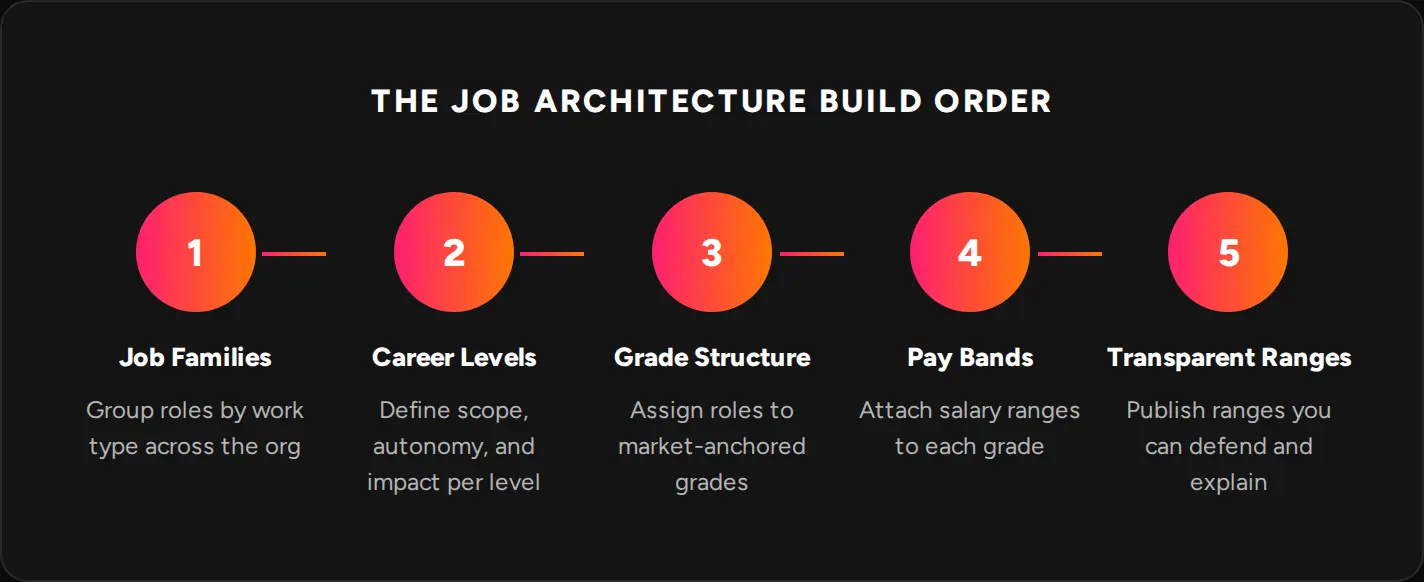
Order matters, whether you are starting from scratch or overhauling a broken structure. It is tempting to start with pay ranges and work backwards, but that leads to the backward-design problem above.
- Run a job analysis. Document the actual work done in each role family. What decisions do people make? What scope do they manage? Who do they influence? This is tedious, but it cannot be skipped. The criteria you draw from it are what separate one level from the next.
- Define the levels. Set a level structure for each family. Most companies find six to eight levels per family is enough. Write the criteria for each level in language a manager can apply to a real person doing a real job. Avoid abstract phrases like “leads with vision” that no one can apply consistently.
- Assign grades. Map each level in each family to a grade in your grade structure.
- Source market data. Use published compensation surveys for each grade, and set your target percentile.
- Calculate the bands. Only now set band minimums, midpoints and maximums. This order makes your structure reflect market reality and defined criteria rather than inherited pay history.
From job architecture to pay transparency in one platform
Tallect’s Job Architecture module walks you through the full build: job family definition, level criteria, grade mapping and pay band setting. Every step links to live market data from Tallect’s compensation benchmarking database. As you map roles to grades, the platform shows market percentile comparisons automatically. Your bands then reflect current data rather than a survey you ran two years ago.
Once the architecture is in place, the Transparency module generates pay range disclosures for each grade. They are formatted for job postings, offer letters or employee-facing documents. The architecture is the same data layer that powers the pay equity analytics. So a change to the structure flows through the analysis in real time, and you are not maintaining two separate systems that drift apart.
Key takeaways
- Job architecture is the foundation. It covers job families, career levels, grades and pay bands, and it makes pay transparency coherent and defensible.
- Architecture comes before ranges. Publishing salary ranges before you have a clean job architecture often creates confusion. Ranges only carry meaning when they attach to clearly defined roles and levels.
- Levels create comparator groups. Pay equity analysis needs them. Without them, you cannot control for legitimate factors when comparing pay across demographic groups.
- Band design needs deliberate choices. Width, midpoint anchoring and overlap all matter. Bands should be built from market data and level criteria, not from current salaries.
- Four failure modes undermine the architecture: title sprawl, grade compression, backward-designed bands and inconsistent application across functions.
- The EU directive makes it a compliance prerequisite. Its requirement to identify “work of equal value” means job architecture is no longer just best practice.
- Build in the right order: job analysis, level criteria, grade assignment, market data, band calculation. Only after that should you disclose ranges.
Frequently asked questions
What is job architecture?
Job architecture is the organised framework of job families, career levels, grades and pay bands that describes how roles relate to one another across an organisation. It describes the nature of the work, the contribution expected and where each role sits relative to the value it delivers. It is not an org chart, which shows reporting lines.
What are the four components of job architecture?
A complete job architecture has four connected parts:
- Job families and subfamilies group roles by the type of work.
- Career levels define progression within a family.
- Grades set each role’s market position.
- Pay bands attach a minimum, midpoint and maximum salary to each grade.
Why should job architecture come before publishing salary ranges?
A pay range is only useful if it attaches to a clearly defined role at a clearly defined level. If a title means different things in different parts of the business, the published range is a blended number that describes no one accurately. When employees find those inconsistencies, trust suffers.
How does job architecture support pay equity analysis?
Pay equity analysis compares pay across demographic groups while controlling for legitimate factors. Job architecture provides two of those controls: role type and level. With clear levels, you can ask a clean question. For example: is there an unexplained gap among all Level 3 employees in one subfamily?
How does job architecture help with the EU Pay Transparency Directive?
The directive requires employers to identify workers performing the same work or work of equal value. Job architecture puts that into practice. It gives you documented criteria that define what “equal value” means in your organisation, rather than a claim that the work is similar.
How wide should a pay band be?
Band width is a deliberate choice that should reflect your pay philosophy. Narrower bands signal less differentiation within a grade. Wider bands allow more room for experience and performance, but can hide when someone has outgrown their grade.
Where should a pay band’s midpoint sit?
The midpoint should anchor to a market benchmark, typically the 50th percentile of your comparator group. Companies that want to lead the market set it at the 60th or 75th. Revisit it every year, because markets move.
Is it a problem if pay bands overlap?
Some overlap between adjacent grades is normal. It lets an experienced employee in one grade earn more than a new hire in the grade above. Excessive overlap is the warning sign, such as one grade’s whole range sitting inside the next. It usually means the levelling criteria are not differentiated enough.
What is a backward-designed pay band?
It is a band built from the current salaries of the people in the role, rather than from market data and level criteria. It validates the past instead of guiding the future. Any pay inequities in current salaries get baked into the official structure.
How many career levels should each job family have?
Most companies find six to eight levels per family is enough. What matters more is that each level has explicit criteria a manager can apply to a real person doing a real job.
This article is for information only and is not legal, regulatory or compensation consulting advice. Pay transparency and job architecture requirements vary by jurisdiction and organisation. Work with qualified HR and legal professionals when designing or changing your compensation structures.
Build pay transparency on a solid foundation
Tallect’s Job Architecture module gives you the structure, the market data and the analytics to make pay transparency something you explain with confidence, not something you apologise for.