
How Total Rewards Statements Support Retention and Offer Acceptance
Most employees don't know what their employer spends on them, and most candidates judge an offer by one number. Both are fixable.
A candidate receives an offer. The number looks fine, not great. They think about it for a few days, compare it to another company's offer or to what they are currently earning, and decline. Two months later, they see a LinkedIn post from a friend who joined that same company and is raving about the stock options, the health coverage, and the annual learning budget. The candidate's calculation was missing most of the relevant information.
This happens constantly, and it is almost entirely preventable. Total rewards statements make the full picture visible. Not just base salary, but the medical premium the employer covers, the PF contribution, the equity grant, the flexible working arrangement that has a real monetary value, the learning budget. When candidates see the complete employer investment, the decision they are making looks different.
The same logic applies to existing employees. Someone who has been at the company for three years is offered a competing role with a salary 15% higher. They think about it seriously. What they are not thinking about is the unvested equity sitting in their portfolio, the employer-paid health coverage for their family, or the three extra paid leave days they have accumulated. A total rewards statement, seen regularly, means those things are in the calculation before a recruiter's message even arrives.
The offer acceptance gap
When a candidate evaluates a job offer, they almost always benchmark it against base salary alone. This is not a character flaw. It is what happens when base salary is the only number that is clearly communicated. Variable pay is described in vague terms. Benefits are listed in a PDF with no monetary context. Equity, if mentioned at all, is presented as a grant size with no reference to current valuation or vesting schedule.
The result is that candidates accept and decline offers based on a fraction of the actual compensation package. Companies lose strong candidates not because their offer is uncompetitive, but because the offer as communicated looks uncompetitive.
- Most candidates say total compensation clarity is a major factor in offer acceptance decisions (source needed).
- Many HR leaders admit they don't send a full total rewards breakdown at the offer stage (source needed).
- Offer acceptance improves when a total rewards statement accompanies the offer letter (source needed).
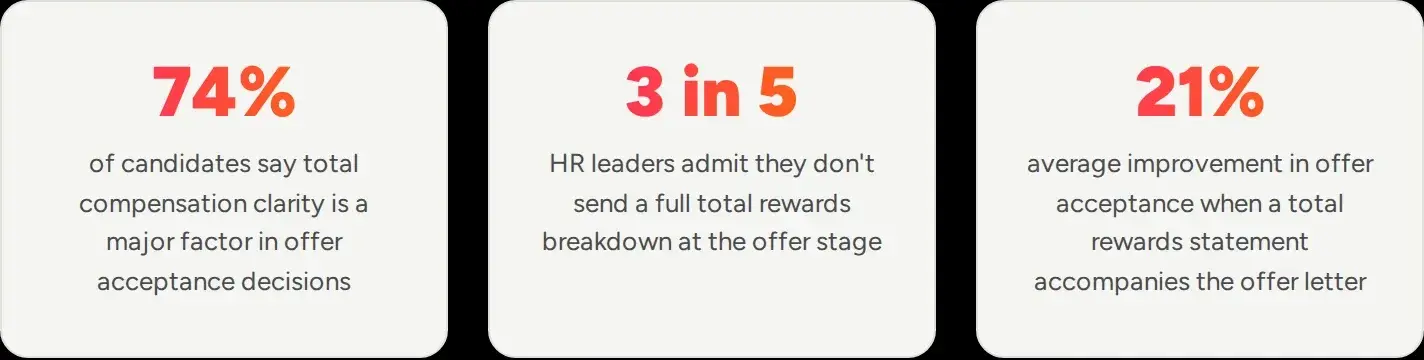
The gap between what the company spends on an employee and what the employee perceives they receive is often large (source needed). That is not a small discrepancy. It is a significant competitive disadvantage in every offer conversation and every retention risk situation, and it is entirely a communication failure, not a compensation failure.
AI at work: matching the statement to what the candidate actually values. AI-assisted platforms can now personalise the emphasis of a total rewards statement based on signals from the candidate's application or interview conversation. A candidate who mentioned family coverage during the interview sees health benefits prominently; one who asked about growth gets their learning budget and equity schedule upfront. Same underlying data, different framing, more relevant first impression.
How statements change retention
Most retention conversations happen too late. An employee has already accepted a counter-offer in their head before the manager is even aware they were considering leaving. By the time HR is looped in, the decision is typically made.
Total rewards statements shift this dynamic by keeping the full package visible throughout the employment relationship, not just at the moment of joining. An employee who reviews their total rewards statement annually knows what they have. They are doing the full calculation when a recruiter calls, not just the base salary comparison.
"The most expensive retention conversation is the one that starts with a resignation letter. Statements are the tool that prevents that conversation from happening."
The effect is most pronounced for employees with significant unvested equity, employer-funded benefits, or tenure-linked benefits like additional leave or pension contributions that increase with years of service. These are the employees most at risk of undervaluing what they have, because the value of these benefits is not visible day to day.
AI at work: flagging retention risk before the resignation arrives. Platforms with AI-powered compensation intelligence can identify employees whose total rewards package has fallen furthest below current market benchmarks for their role and level, before those employees begin looking. This gives HR teams the opportunity to intervene with a statement update, a compensation review or a direct conversation rather than reacting to an unexpected resignation.
When statements do the most work
Timing matters as much as content. A statement sent at the wrong moment, or never at all, produces very different results from one delivered when the employee or candidate is actively making a decision.
1. At the offer stage
The highest-impact moment. A candidate weighing two offers has a specific question in mind: which is worth more? A total rewards statement that shows the full employer investment, broken into components with real numbers, answers that question completely. Companies that do this consistently report meaningfully higher acceptance rates on competitive offers.
2. During onboarding
A new joiner in their first month is still forming their view of the organisation's value as an employer. A statement delivered in the first two weeks reinforces the decision they made and surfaces benefits they may not have had time to explore yet. It also establishes the expectation that this is a company that communicates about compensation clearly.
3. After each compensation review cycle
Annual salary reviews are often framed around the base salary movement. A statement that accompanies the review letter shows the full picture: how the base changed, how the employer's contribution to benefits changed, how unvested equity has accumulated. The increase in total employer investment is almost always larger than the salary movement alone suggests.
4. When market benchmarks shift significantly
In periods when competitor pay is moving fast, employees who are not seeing their own package in full are most vulnerable to a distorted view of how they compare. A proactive statement during these periods, benchmarked against current market data, is a retention action. It is not a reaction to a resignation. It is a reason not to have one.
What the data shows
Total rewards statements are not a nice-to-have. The evidence behind them makes a consistent case for why they belong in every hiring and retention strategy.
- Employees who receive regular total rewards statements say they feel more valued by their employer than those who don't (source needed).
- Employees who reviewed their full total rewards package within their first 90 days show higher 18-month retention (source needed).
- Many employees who resigned say they didn't know the full value of their benefits until after they left (source needed).
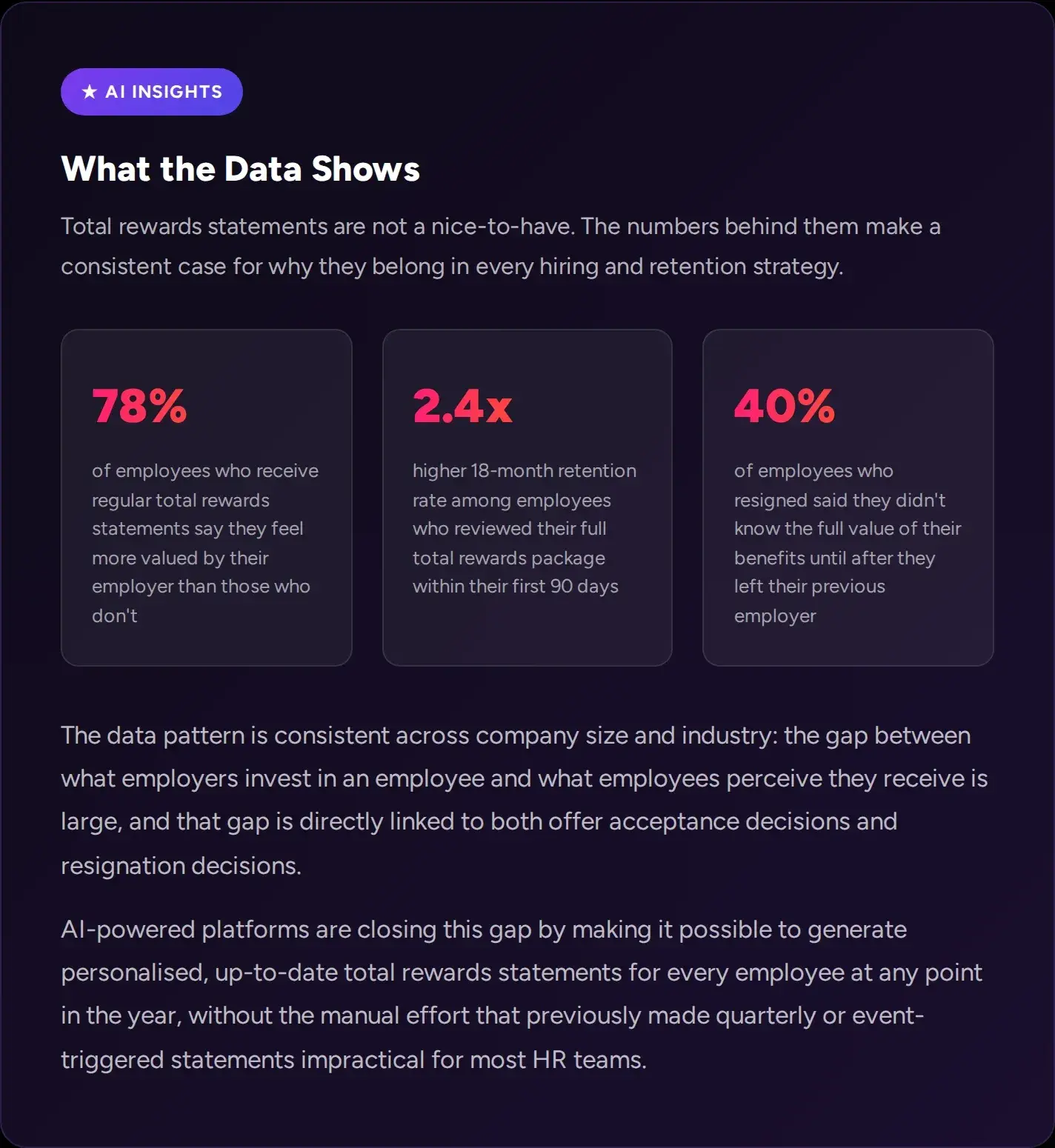
The data pattern is consistent across company size and industry: the gap between what employers invest in an employee and what employees perceive they receive is large, and that gap is directly linked to both offer acceptance decisions and resignation decisions.
AI-powered platforms are closing this gap by making it possible to generate personalised, up-to-date total rewards statements for every employee at any point in the year, without the manual effort that previously made quarterly or event-triggered statements impractical for most HR teams.

What makes a statement work
A total rewards statement is only useful if it is specific, current, and formatted in a way that makes the numbers easy to read. Vague statements with estimated ranges or benefits described in general terms do not do the job. They create uncertainty rather than clarity.
The most effective statements share a few consistent characteristics. They use actual figures, not at-target or estimated amounts, where specific numbers are available. They include every category of employer investment, not just base salary and one or two headline benefits. They translate abstract benefits into monetary terms, so an employee can see what the employer's health insurance contribution is worth in rupees or dollars per year rather than as a percentage of premium. And they are updated to reflect current market benchmarks, so the comparison to what the employee could earn elsewhere is honest and grounded.
Component | Share of total employer investment |
|---|---|
Base salary | 58% |
Variable pay / annual bonus | 11% |
Equity (annualised grant value) | 9% |
Health, life and insurance | 8% |
Provident fund / retirement | 7% |
Paid leave (monetised) | 5% |
L&D, perks and flexibility | 2% |
Caption: Illustrative breakdown for a senior individual contributor at a mid-size technology company. Actual figures vary by organisation, location and seniority.
In a breakdown like this, base salary is only part of what the employer actually spends. The rest, the benefits, the equity, the contributions, the flexible arrangements, sits invisible unless a statement makes it explicit (source needed). That invisible portion is often the most differentiated part of what one employer offers versus another.
AI at work: generating personalised statements at scale without manual effort. The reason most HR teams only produce total rewards statements annually, if at all, is the manual effort involved in pulling data from multiple systems and formatting it for each employee. AI-powered platforms automate this process: they pull live data from HRMS, payroll, benefits administration and equity management systems, calculate each employee's personalised package, and generate a formatted statement that is ready to send without HR touching a spreadsheet. What previously took weeks for a team of two can happen in an afternoon for a company of five hundred.
Common mistakes that miss the mark
A badly constructed statement can undermine confidence in compensation rather than build it. These are the patterns that consistently reduce the impact of statements that are otherwise well-intentioned.
Showing ranges instead of actual numbers. "Your health benefit is worth Rs 40,000 to Rs 80,000 per year" is not useful. The employee's actual health cover premium is a specific number. Use it.
Leaving out benefits that are hard to quantify. Hybrid working, wellbeing days, and learning budgets are often omitted because they feel difficult to express in money. They are not. Hybrid arrangements have a commuting cost saving that can be calculated. Wellbeing days have a per-day salary equivalent. Learning budgets are actual spending figures. The effort to include them is worth it.
Updating annually and only annually. The most valuable statement is one that arrives when an employee is actively thinking about their options. Annual statements are better than nothing, but statements triggered by compensation reviews, vesting events or significant market movements do the retention work at exactly the right moment.
Formatting that buries the headline number. The total employer investment figure should be prominent. If an employee has to read through four pages to find out that their employer spends Rs 28 lakh a year on them, the statement has already lost its impact.
Frequently asked questions
When in the hiring process should we send a total rewards statement?
The offer stage is the single most impactful moment. Send the statement alongside the offer letter, or in a separate document that accompanies it, so the candidate has the full picture while they are actively making a decision. Some companies also send a lighter version earlier in the process, during final-round interviews, to differentiate before another company makes an offer. The earlier it arrives, the more it shapes the candidate's perception of the total package value.
Should we include equity in the statement if the company is pre-IPO and the value isn't clear?
Yes, but label it carefully. Show the grant size, the vesting schedule, and the current valuation if one exists from a recent funding round. If no valuation is available, show the grant at par value and note clearly that this represents the current accounting figure rather than a market estimate. Omitting equity entirely because its value is uncertain leaves out one of the most important parts of the offer, and candidates will notice that omission.
Can total rewards statements actually move offer acceptance rates?
The evidence from companies that track this consistently is that acceptance rates improve when statements accompany offers, particularly in competitive hiring situations where the base salary is close between two options. The effect is largest for candidates who are comparing offers from companies in different industries or company stages, where the non-salary components differ significantly. A candidate weighing a startup offer against a corporate one is making a very different calculation once the full package is visible.
What do we include that most companies leave out?
The most commonly omitted components are: employer contributions to health insurance premiums (which employees often don't see as employer spending because it's deducted at source), flexible or hybrid working arrangements expressed as a monetary saving, paid leave monetised at the employee's daily rate, learning and development budgets, and wellness or lifestyle benefits with a clear per-year value. Most statements include base salary, variable pay and retirement contributions. The difference between an average statement and an effective one is whether it includes the rest.
How do we handle the statement if we know the package isn't competitive?
Honestly, and with context. A statement that shows a package against current market benchmarks, even when the comparison is unfavourable, is more useful than one that shows numbers without context. It gives the HR team a factual basis for the compensation review conversation and gives the employee a clear picture rather than a vague sense that they might be underpaid. Burying the data never solves the underlying problem. Statements do not create compensation issues; they surface them, which is the starting point for fixing them.
Should statements look different for different employee levels or functions?
The core format should be consistent so employees across the company can compare their statements and trust that the methodology is the same. The content will naturally vary because the components differ: a senior leader with significant equity and a variable pay structure has a different statement from an entry-level employee whose package is mostly base salary and benefits. The format can be standardised while the contents are personalised. The goal is that every employee's statement shows every component that applies to them, calculated the same way.
What format works best for sharing statements with candidates and employees?
PDF remains the most practical format for external sharing with candidates, since it renders consistently across devices and can be saved for reference. For existing employees, a digital portal that allows them to view their current statement and compare it to previous years is more useful, because it adds the context of how the package has changed over time. If a portal is not available, a well-formatted PDF sent directly by email is the next best option. The format matters less than the quality and completeness of the data in it.
How often should existing employees receive their total rewards statement?
Annual is the baseline, and it is better than nothing. Quarterly is better, particularly for employees with equity or variable pay that changes meaningfully across the year. The most effective approach is event-triggered: a statement sent after a compensation review, after a vesting event, or when a significant shift in market benchmarks has occurred. Event-triggered statements reach employees at the moments when they are most likely to be actively thinking about their package, which is when the information does the most work.
How do we deal with benefits whose monetary value is difficult to calculate?
Use a consistent, documented methodology and state it clearly. For hybrid working, calculate the number of days saved per year under the arrangement and multiply by a standard commuting cost estimate; show your working. For wellbeing days, use the daily base salary equivalent. For benefits like an Employee Assistance Programme, use the employer's cost, not a speculative employee-value figure. The goal is to be defensible and consistent, not to maximise the headline number. Employees who later challenge a benefit's value will trust the statement less if the methodology is opaque.
What's the difference between a total rewards statement and a compensation letter?
A compensation letter states the terms of employment: salary, bonus target, equity grant, notice period. It is a contractual document. A total rewards statement is a communication tool: it shows the full monetary value of the employment relationship, including benefits, employer contributions, non-cash perks and their aggregate value, often alongside a market comparison. The two serve different purposes. A compensation letter answers the question "what are the terms?" and a total rewards statement answers "what is this worth?" Both belong in the offer process, and only one of them is typically sent.
What is the biggest reason total rewards programmes fail to reduce turnover?
Statements that arrive too late, too infrequently, or with not enough detail to be meaningful. A statement that shows salary, one benefits line and a note that equity details are available on request is not doing the retention work. The programmes that produce measurable outcomes are the ones where the statement is complete, current, personalised, and sent at the moments when employees are actively thinking about their options rather than as a once-a-year HR exercise. The content has to be good enough that an employee who receives a competing offer reaches for their statement before they reach for their phone to call a recruiter back.