
Compensation-Informed Hiring: Why Offer Strategy Should Start With Total Rewards
Most hiring processes benchmark one pillar and guess the rest. Here is what a data-driven total-rewards offer looks like.
Quick answer:
An offer strategy built on base salary alone competes on one pillar when candidates are comparing all five. Compensation-informed hiring means benchmarking every component of total rewards and presenting the full value of the package, not just the base number.
The moment an offer goes out, a number gets approved, a letter gets sent, and everyone waits to see if the candidate says yes. The number that dominates that process is almost always base salary, because base salary is easy to benchmark, easy to approve, and easy to compare against the last person hired.
The candidate on the other end is doing something different. They are comparing the whole package — health plan, bonus structure, equity, flexibility, development pathways — and they have more information to do it with than any previous generation of job seekers. Employees no longer compare offer letters; they compare entire packages. An offer strategy still built around base salary alone is optimising the one variable the candidate has stopped treating as the whole story.
This guide makes the case for compensation-informed hiring: building offer strategy on total rewards rather than base pay alone, where the base-salary-first habit comes from, and what it costs to keep running it.

What total rewards actually covers
The term gets used loosely, and the looseness is part of the problem. Total rewards is the entire value proposition an organisation puts in front of a current or prospective employee — every financial and non-financial element that influences whether someone joins and stays.
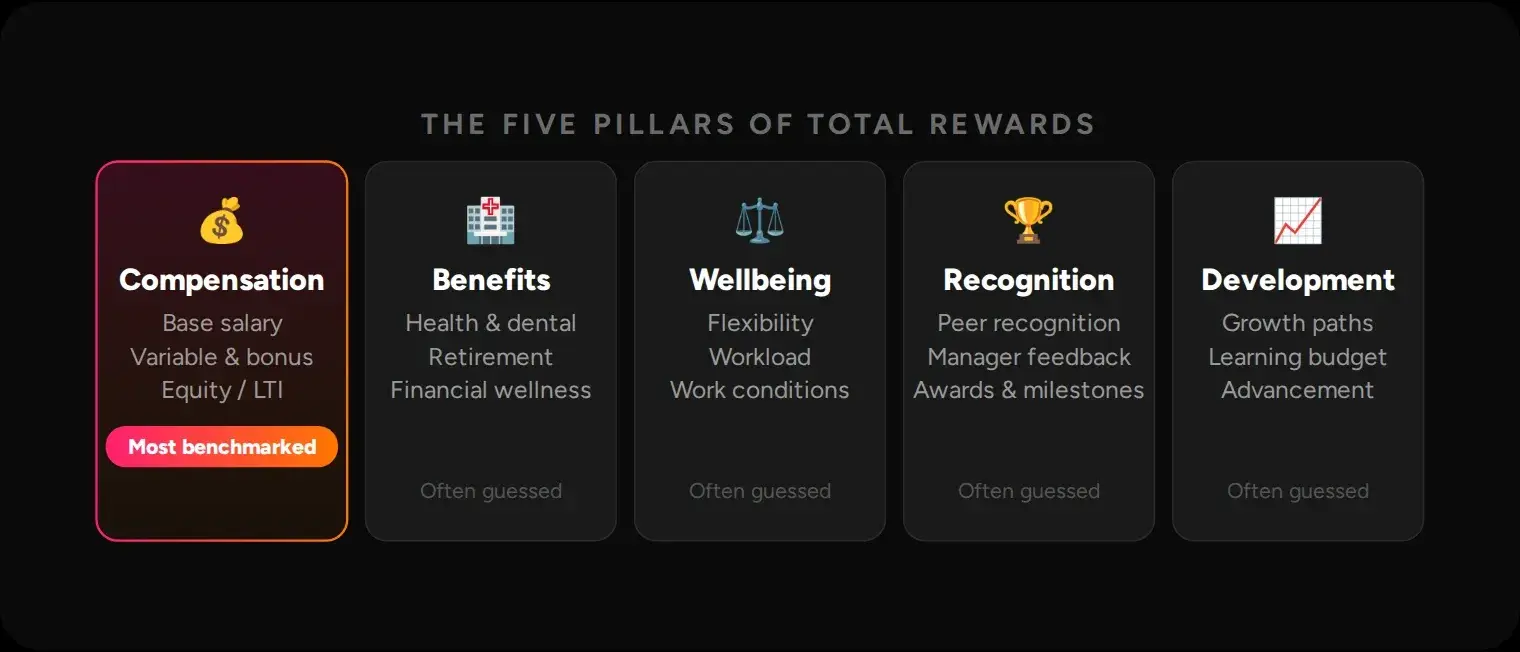
It is not salary plus benefits treated as an afterthought. The framework covers five distinct components:
- Compensation: base salary, variable pay and bonuses, and equity or long-term incentives.
- Benefits: health, retirement, and an expanding set of wellbeing and financial-wellness offerings.
- Wellbeing and flexibility: the conditions of work itself — remote or hybrid options, workload, hours.
- Recognition: how contribution is acknowledged and rewarded beyond pay.
- Career development: growth paths, learning investment, and advancement opportunity.
Base salary is one element of the first component. An offer strategy that treats it as the whole is competing on roughly a fifth of what the organisation actually has to offer, and the fifth that competitors can most easily match with a larger number.
Why the base-salary habit persists
If total rewards is the real currency of hiring, why do offers still revolve around base pay? Because of a data asymmetry between the components, and it is worth naming precisely.
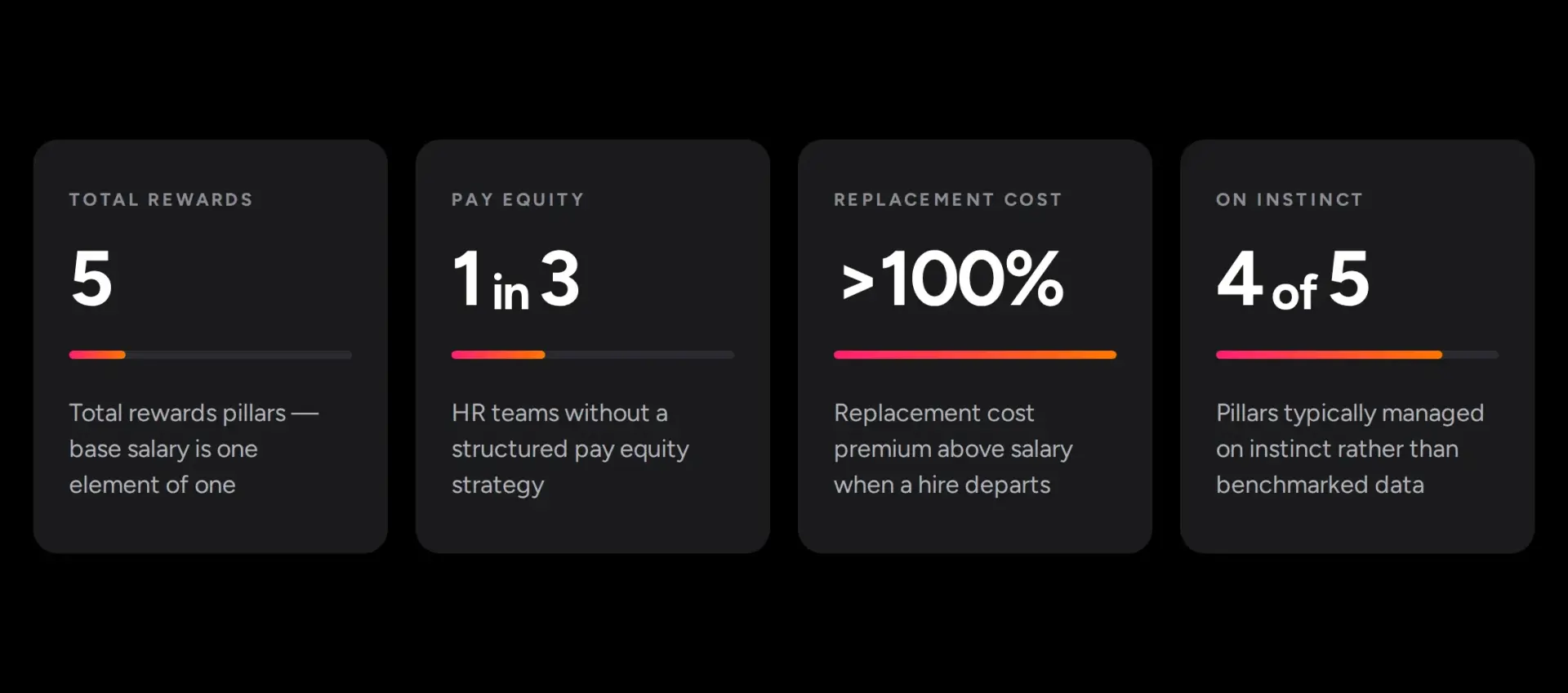
Compensation benchmarking gets a real process: annual survey data, percentile targets, band reviews, sign-off from Finance. Benefits benchmarking, if it happens at all, is usually a broker conversation and a rough sense of what feels adequate. Equity gets reviewed when someone raises a red flag. Bonuses get modelled on last year's payout.
The result is a hiring process where one pillar is data-driven and the rest are managed on instinct. An offer defaults to the number the organisation can defend with data, which is base pay. The other components are harder to benchmark, so they get left out of the offer conversation — which means the organisation is also leaving out the dimensions where it may actually have a competitive edge.
An offer defaults to the number the organisation can defend. Four out of five pillars get left to instinct, and instinct does not make it into the offer conversation with any confidence.
Three costs hiding inside every offer
Competing on the most expensive axis
Base salary is the component a competitor can most easily match. Fighting for talent purely on base means running the most replicable battle while carrying the full cost of losing: replacement costs for a mis-hire or departure run well beyond the salary line once recruiting, onboarding, and lost productivity are counted. Competing on total rewards means competing on dimensions the rival would have to reconstruct from the inside not just write a larger number.
Accumulating pay equity risk
When offers are made without structured pay ranges, two candidates hired for the same role receive different packages. That creates internal inequity and future correction costs at the moment the two hires compare notes — which, under expanding pay transparency rules, they increasingly can and do. The offer that felt like a win in the moment becomes a pay-equity liability the day it is discovered. Research from SHRM finds one in three HR professionals have no pay equity strategy to catch this before it compounds.
Missing the benefits gap
As base pay becomes more equitable under transparency legislation, much of the real divergence in offer value moves to components not subject to disclosure. Consider a straightforward comparison: an employee on a lower base with a comprehensive, employer-paid health plan can be in a stronger financial position than one on a higher base with high out-of-pocket costs. Benefits quality materially affects employees' actual financial security — and an offer strategy blind to it is blind to where much of the competitive value now sits.

The lifecycle mismatch
There is a subtler reason total rewards belongs at the centre of hiring, and it comes from research on how rewards function across tenure.
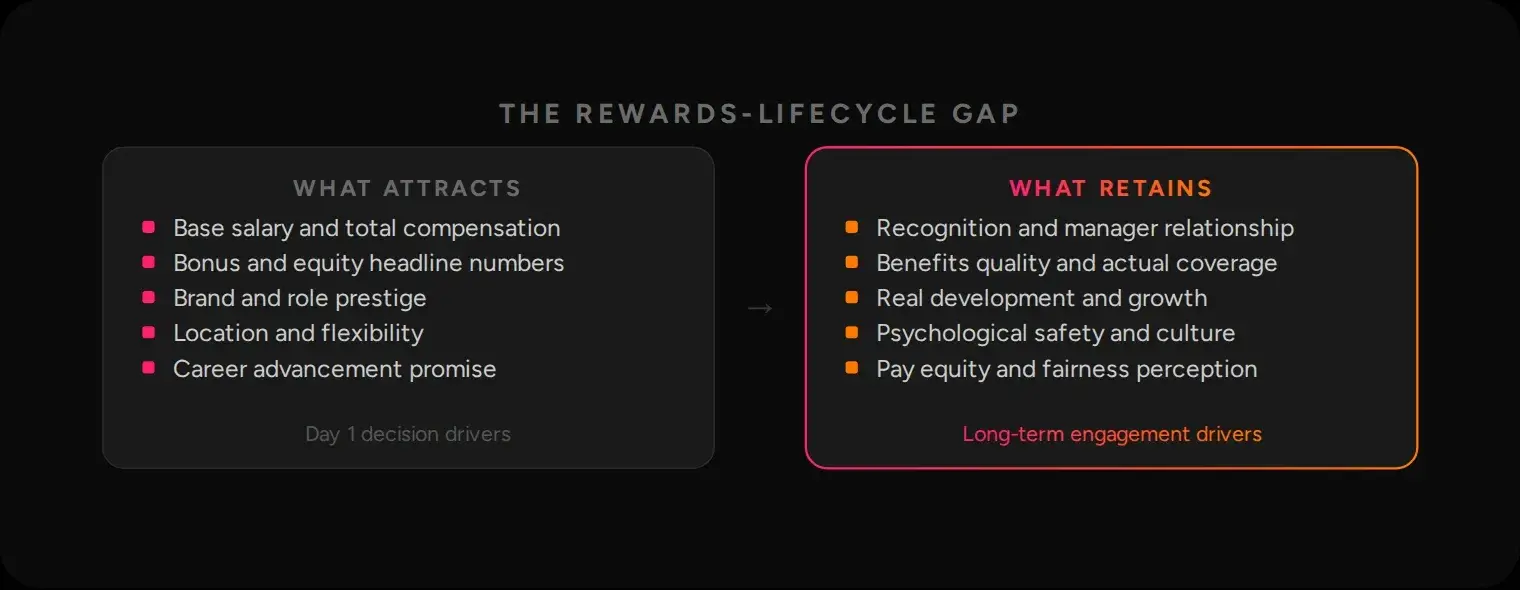
WorldatWork's 2026 research identifies a rewards-lifecycle gap: the rewards that attract candidates to a role are often not the same rewards that drive engagement or the decision to stay as people advance and move through different life stages. Yet many organisations treat their total rewards offering as a static set of policies rather than a living proposition.
The hiring implication is sharp. Attract someone purely on base salary and you have recruited on a dimension that is not what retains them, and you have told them nothing about the rewards that will actually matter once they are inside the organisation. An offer built on total rewards does two things at once: it competes for the hire, and it sets accurate expectations about the full value proposition that will drive engagement later. An offer built on base salary alone competes for the hire and then leaves the new joiner to discover the rest by accident.
How AI is changing offer decisions
For most of the past decade, whole-package benchmarking was impractical for teams without large survey budgets or dedicated compensation analysts. Benefits data was fragmented. Equity ranges shifted too fast to capture. Bonus benchmarks required an annual survey cycle with a six-month lag, by which time the data was already stale for fast-moving markets.
AI is closing that gap. Compensation platforms now use machine learning to aggregate live market signals across base pay, equity, benefits design, and bonus structure — producing a real-time view of what comparable offers look like across all pillars, not just salary. AI-powered offer tools can flag in seconds whether a proposed package sits above or below the market on each component, and surface where the organisation's actual advantage lies so the offer conversation can lead with it.
Predictive models are also beginning to surface which components of a package carry the highest retention impact for specific role families and career stages — removing some of the guesswork from the lifecycle mismatch. The shift is from an annual survey to a living data feed. Which means the data asymmetry that pushed offers toward base salary is, for the first time, genuinely solvable without a team of analysts running manual benchmarking every quarter.
Compensation-informed hiring in practice
1. Lead with total compensation, not just base
Total compensation includes base salary, bonuses, equity, and the monetary value of benefits. Candidates consistently underestimate benefits and equity when comparing offers. If the full value is not presented explicitly, it gets mentally discounted — and the organisation loses credit for spend it is already making. Present a total compensation number, then break it down component by component.
2. Anchor offers to structured pay ranges
Structured ranges prevent the two-candidates-same-role inequity and are increasingly required under pay transparency legislation. They also make offers faster: when ranges are predefined, there is less internal negotiation about what the number should be and more time spent on the conversation that matters — why this role, why this organisation, and what the package as a whole represents.
3. Benchmark every pillar, not just pay
Better offers start with better data across all components. That means bringing benefits, equity, and bonus into the same evidence-based process that base pay already enjoys. The whole offer gets built on data rather than one pillar on data and four pillars on instinct.
4. Connect offers to workforce planning
Offers made without full cost visibility produce inconsistency and surprise headcount overruns. Compensation-informed hiring ties each offer to the workforce plan, so it is consistent with the others and within budget before it is extended — not discovered to be out-of-band after the fact.
5. Name the non-financial value explicitly
Flexibility, development, and recognition are part of the package the candidate is comparing whether or not they appear in the offer letter. Naming them in the offer conversation competes on dimensions a rival cannot easily match with a bigger base number, precisely because they are woven into the culture of the organisation rather than printed on a payslip.
Highlights
- Total rewards has five components. Base salary is one element of one — the one competitors can most easily match.
- When offers lack structured ranges, two hires in the same role receive different packages, building a pay-equity liability from day one.
- AI now aggregates live market signals across all five pillars, making whole-package benchmarking achievable without a dedicated survey cycle.
- An offer built on total rewards does double duty: it competes for the hire and sets accurate expectations about what will actually retain them.
A note on the data: Total rewards frameworks, cost multiples, and survey findings vary by source, methodology, and year; figures here are illustrative benchmarks rather than fixed values. Pay transparency and pay-equity obligations differ by jurisdiction and change frequently. This is general information for compensation and hiring strategy, not legal or financial advice. Confirm pay-disclosure and equity requirements with qualified counsel for each jurisdiction where you hire.
Frequently asked questions
What is the difference between total compensation and total rewards?
Total compensation is the monetary value of a package — base salary, variable pay, equity, and the financial value of benefits. Total rewards is broader: it adds recognition, development, and wellbeing, which carry no direct price tag but still influence the decision to join and, more significantly, to stay. An offer letter typically covers total compensation. Total rewards shapes the candidate's overall perception of the employer value proposition.
How do we benchmark benefits if survey data is hard to find?
Start with publicly disclosed employer-paid premium structures and deductible levels, then layer in broker market data for your region and sector. AI-driven compensation platforms now aggregate benefits benchmarks alongside pay data, significantly reducing the manual research burden. The goal is to move from "this feels competitive" to "we know where we sit on the market for each component."
Why do one in three HR teams lack a pay equity strategy?
Usually because building one requires bringing together compensation data, job architecture, and performance data that sit in different systems. Without a single connected view it is hard to identify gaps consistently or track whether corrections have worked. Pay transparency legislation is forcing the issue — disclosure requirements make unexplained gaps visible, which is prompting many organisations to build equity strategies for the first time rather than manage it as an exception-handling exercise.
How do we present total rewards to candidates without overwhelming them?
Lead with total compensation as a headline number, then break it down: base, expected bonus at target, equity (grant value or current-price approximation), and the employer-paid portion of benefits. One page. Complexity signals confusion; a clean single view signals confidence. The non-financial elements — development budget, flexibility policy, recognition programme — work best as a brief verbal addition to the written offer rather than a financial line in the same document.
Does pay transparency change what needs to go into an offer?
Yes, meaningfully. Once base salary ranges are disclosed, much of the differentiation between competing offers moves to the components not covered by transparency requirements — benefits design, equity terms, bonus mechanics, and the non-financial elements. Which is precisely why those components need to be benchmarked and named explicitly, not left to instinct. The organisations that build a competitive advantage in the transparency era are the ones that have data and a story across all five pillars, not just the one now visible on the posting.