
Compensation Philosophy: How to Write One Your Managers Will Actually Use
More than nine in ten companies say they have one. Barely half their employees could tell you what's in it - and that gap is costing you.
Quick answer:
A compensation philosophy is a written statement that answers the "why" behind every pay decision your managers make. Most organizations say they have one - but a third have never put it in writing, and half their employees couldn't explain it. The fix: state a real market position, take an explicit stand on pay equity and performance, translate it into your actual salary bands, and communicate it like employees are going to ask. Because now, with pay transparency law and public benchmarking data everywhere, they will.
Ask most HR leaders whether their organization has a compensation philosophy, and the answer is almost always yes. Ask them to produce it, in writing, and the confidence drops noticeably. That gap between having one and actually using one is the entire subject of this guide.
A compensation philosophy is a formal statement that reflects an organization's compensation strategy and provides a framework for designing, administering, and communicating compensation programs consistently. It exists to answer the "why" behind pay decisions - creating a structure so that every manager isn't making it up fresh, and inconsistently, every single time a salary question lands on their desk.
Having one vs using one
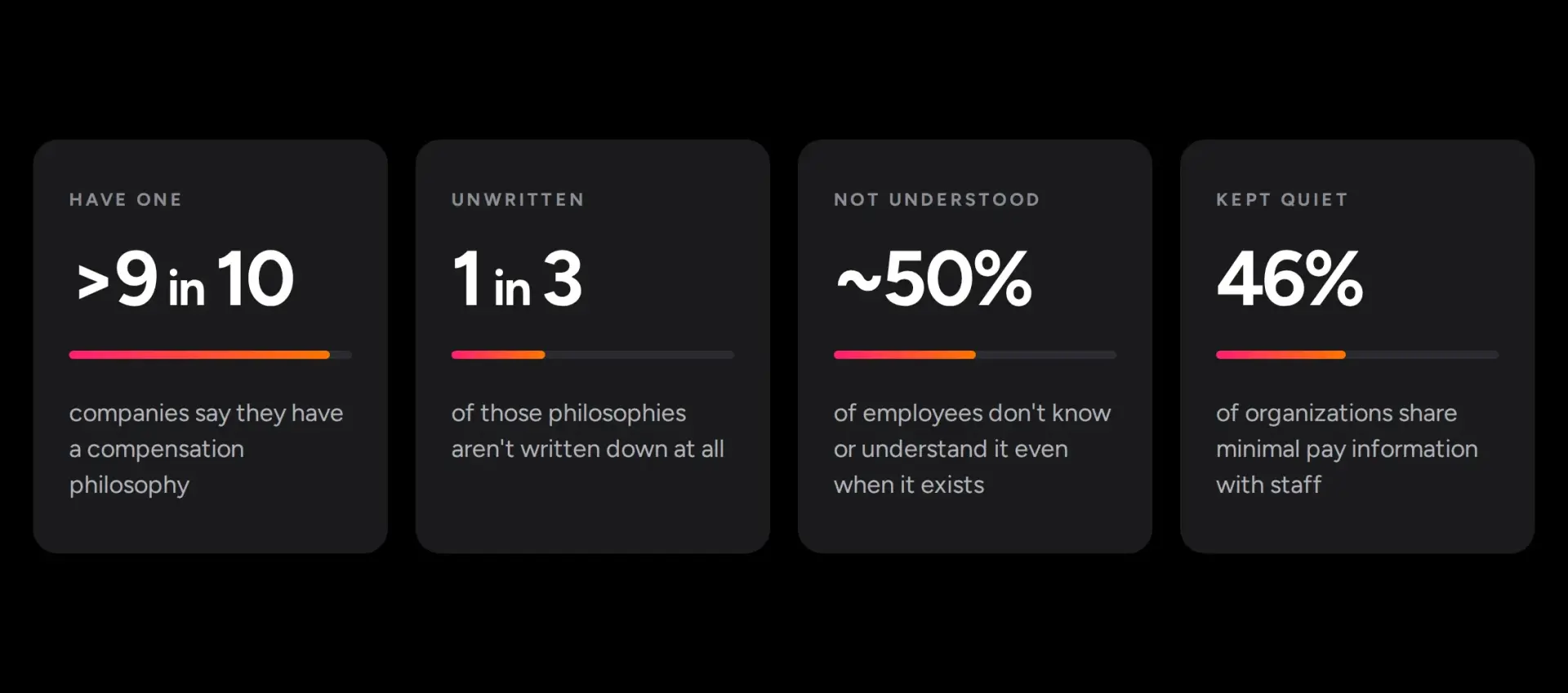
The data here is more damning than most HR leaders expect. Research finds that more than nine in ten companies have a compensation philosophy - but that doesn't mean their philosophies are doing anything useful (source needed). The same research found that nearly one in three compensation philosophies aren't in writing at all, and among the ones that are, about half of employees don't even know or understand them.
The communication failure compounds the documentation failure. The same research found that 46% of organizations share minimal pay information with their employees, and even among organizations that communicate more, more than half of employees still don't understand what they're being told.
Most organizations have something they'd call a compensation philosophy in a strategy deck or an HR policy folder - unwritten in any usable form, poorly communicated even when it exists, and functionally invisible to the managers who are supposed to apply it every time they make a pay decision. A philosophy that lives only in the compensation team's head is not a philosophy. It's a set of habits nobody else can be held to.

What a compensation philosophy is for
SHRM describes the philosophy as the foundation upon which all compensation programs are built. WorldatWork treats it as a required precursor to building defensible pay structures at all. Neither frames it as an optional communications document - both treat it as load-bearing infrastructure.
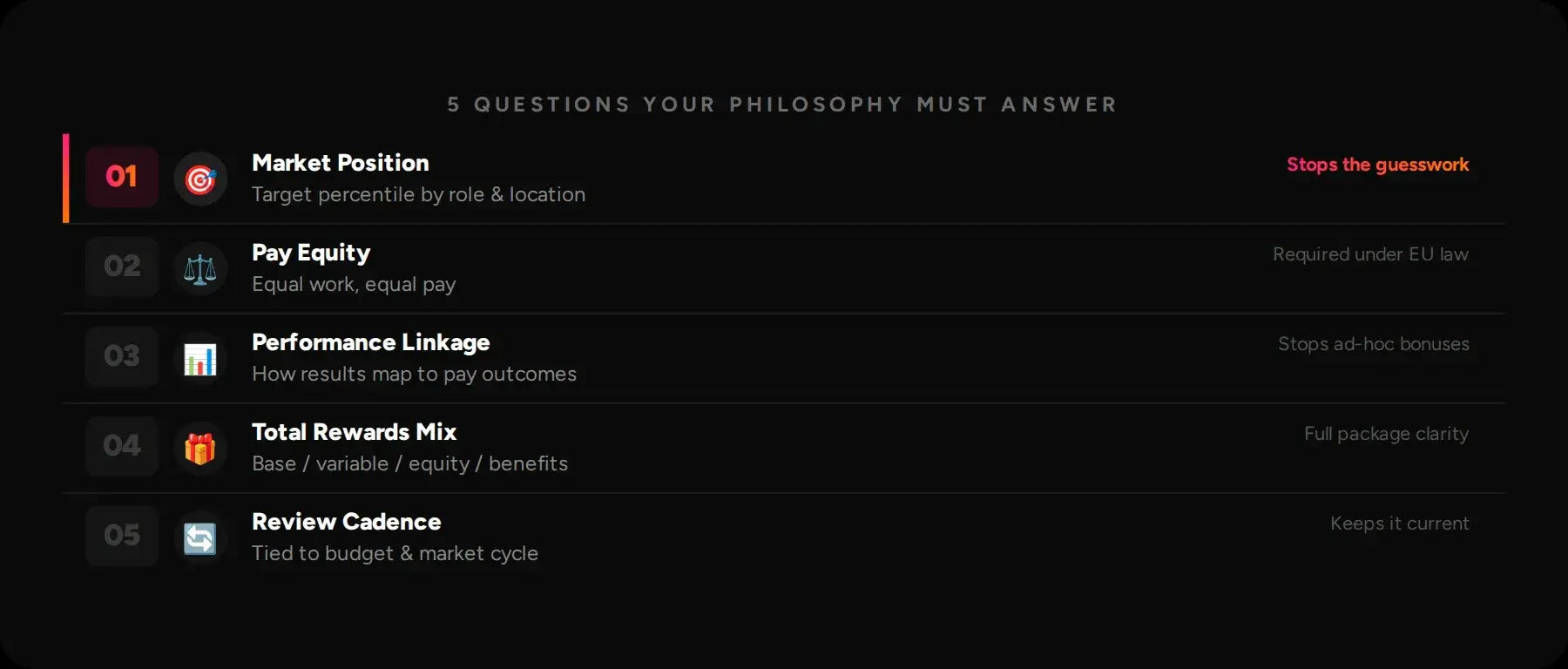
In practical terms, a compensation philosophy needs to take an explicit position on questions that otherwise get answered inconsistently, manager by manager, decision by decision:
- Market positioning. Does the organization aim to lead the market, match it, or lag it - and does that answer change by role, level, or location?
- Pay equity and fairness. How does the organization ensure people doing the same work get paid the same, regardless of who negotiated harder on their first day - a question made sharper by the EU Pay Transparency Directive's June 2026 requirements.
- Performance and pay. How individual or company performance translates into bonuses and incentive pay. The philosophy has to take a position, not leave it to manager discretion.
- The total rewards mix. How much weight base salary, variable pay, equity, and benefits each carry - and who is eligible for what.
From philosophy to pay decision
A philosophy that stays abstract never reaches the manager making an actual offer. The translation from principle to practice runs through a specific, structured sequence:
- Define organizational objectives. Leadership decides whether the priority is attracting scarce technical talent, controlling fixed labor costs, retaining institutional knowledge, or some weighted combination - and states explicitly which one wins when they conflict.
- Select a market reference point. Using salary survey data, the organization picks its target percentile. A technology company competing for engineers might target the 75th percentile; a resource-constrained nonprofit might reasonably target the 50th. Neither is wrong - what's wrong is not deciding, and having every manager guess independently.
- Translate the reference point into structure. The chosen percentile becomes actual salary ranges and bands, so the abstract positioning statement becomes a concrete number a manager can act on.
- Build the governing rules on top of the structure. How merit increases interact with position-in-range, how promotions are priced, how off-cycle adjustments get approved - all of this should trace back to the same stated objectives, not be improvised fresh each cycle.

Where AI changes the game
For most of the history of compensation planning, the hardest parts were also the most manual: pulling survey data, building band structures, running pay equity analyses, and then trying to keep it all current as markets moved. The result was philosophies that were accurate when written and quietly stale six months later - with nobody having the time or data to notice.
AI doesn't change what a good compensation philosophy should say. But it radically changes how fast you can build one, how accurately you can enforce it, and how quickly you can catch when reality has drifted from the stated position.
Tallect AI (inTALLECT): how AI agents make compensation philosophy operational. Tallect's AI agents don't just surface data - they apply your philosophy's rules automatically, so the gap between "what we say" and "what we do" closes in real time rather than at the next annual review.
- Market Benchmarking Agent - continuously pulls real survey data across roles and geographies, flags when a band has drifted outside the philosophy's stated percentile target, and surfaces the gap before a manager makes a misinformed offer.
- Pay Equity Agent - runs automated equity analysis across the organization, identifies unexplained pay disparities for the same role and level, and generates the audit-ready documentation the EU Pay Transparency Directive requires.
- Budget Optimization Agent - models the cost of funding the stated market position in your next salary cycle, so the philosophy stays tethered to what you can actually spend - not to what looked right two budget cycles ago.
- Governance Agent - monitors manager pay decisions in real time, flags any that fall outside the philosophy's approved exception parameters, and creates an approval trail that proves consistent application if the philosophy is ever challenged.
The practical implication: an AI-supported compensation philosophy isn't just a document. It becomes a live operating system - one that checks manager decisions against the stated rules, resurfaces the philosophy at the moment it's most relevant (during an offer, a merit cycle, a promotion decision), and keeps the gap between principle and practice measurably narrow.
What makes managers use it
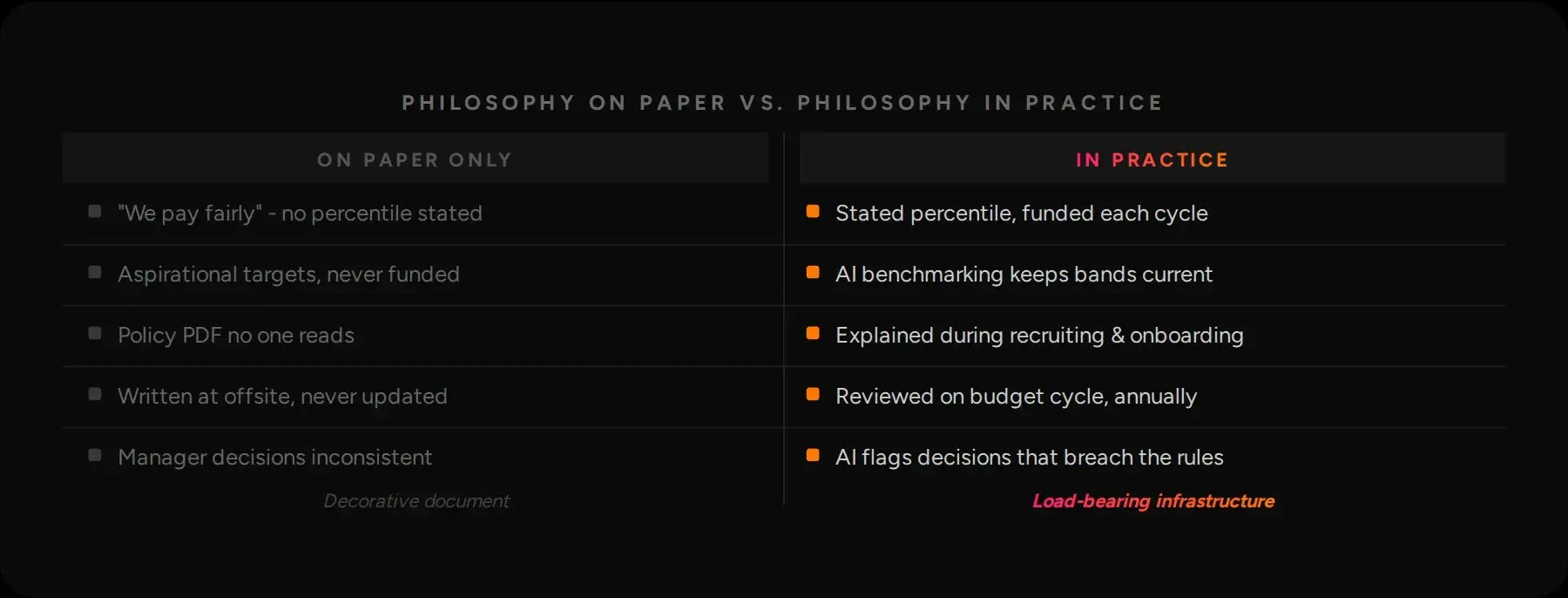
A philosophy document that sits in a shared drive and gets opened once a year during planning season isn't functioning as intended. The difference between a philosophy that shapes real decisions and one that's decorative usually comes down to a few concrete design choices.
It has to answer real questions, not state values
"We believe in paying our people fairly" is a value statement, not a philosophy. It gives a manager nothing to act on when they're deciding between a 3% and a 6% increase for two people with different tenure and different market movement in their role. A usable philosophy states the market percentile target, the weighting of performance versus position-in-range, and the escalation path for exceptions - specific enough that two different managers, given the same facts, would land on similar decisions.
It has to be communicated, not just published
Given that roughly half of employees don't understand their organization's compensation philosophy even where one exists, publishing a document is not the same as communicating a philosophy. Making job candidates aware of the philosophy during recruiting, and giving current employees an accessible explanation - not just a policy PDF - is what closes the awareness gap. An open-door approach, where employees feel able to ask how their pay was determined, does more to build the sense of fairness the philosophy is meant to create than the document itself.
It has to be current, not aspirational
A philosophy that states a 75th-percentile market target the organization hasn't actually funded in three budget cycles isn't a philosophy - it's a source of manager credibility problems. The document needs to reflect what the organization can and will actually fund, reviewed on the same cycle as the budget itself, not written once during a strategy offsite and left untouched. This is where AI-driven budget modeling earns its keep: when your compensation platform can model the real cost of funding your stated position, aspirational targets become funded commitments or get revised honestly.
A philosophy your managers can actually use is one that answers their next hard pay decision - not one that describes your values in the abstract.
Why this is more urgent now
Two forces have raised the cost of not having a real, usable compensation philosophy - and they're both accelerating.
The first is pay transparency law. The EU Pay Transparency Directive, effective for member states from June 2026, requires employers to explain pay differences on objective, gender-neutral criteria. A philosophy that was never written down, or that exists but doesn't actually govern real decisions, offers no defense when that explanation is required. This isn't a future concern - it's a present audit risk for any organization with European operations.
The second is that employees now have the tools to check the story themselves. With expanding salary transparency and easy access to market data through platforms like Levels.fyi, Glassdoor, and LinkedIn Salary, employees can compare their compensation against public benchmarks without waiting for HR to volunteer the information. A philosophy that isn't honest about market positioning - or isn't actually being followed in practice - gets contradicted by outside data faster than it used to.
The combination is significant: external pressure is making it harder to be vague, and internal scrutiny is making it harder to be inconsistent. A compensation philosophy that's vague and inconsistently applied is no longer just an HR process problem. It's a retention, legal, and employer brand problem simultaneously.
A practical drafting sequence
Getting a usable compensation philosophy written doesn't require a six-month project. It requires making six specific decisions in order:
- Get leadership to explicitly rank objectives - talent attraction, cost control, retention - rather than listing all three as equally important. When they conflict (and they will), the ranking determines which one wins.
- Pick the market reference point per role family, using real survey data, not an aspirational number nobody has funded. An AI benchmarking tool can do this in hours; doing it by hand from salary surveys takes weeks.
- Write the pay equity and performance-linkage positions in plain, specific language a manager could quote back correctly after one reading. If you can't say it simply, you haven't decided it clearly enough yet.
- Translate the philosophy into the actual salary structure - bands and ranges that managers use every day, not an abstract statement disconnected from the numbers they actually work with.
- Build a communication plan, not just a document - include it in recruiting conversations and make it genuinely accessible to current employees, not buried in an onboarding packet that nobody re-reads.
- Set a review cadence tied to the budget cycle, so the philosophy is re-validated against what the organization can actually fund every year. An AI-supported platform can make this continuous rather than annual.
Key takeaways
- Nine in ten organizations claim a compensation philosophy; a third have never written it down, and half their employees can't explain it.
- A usable philosophy answers real questions - specific market percentile, explicit pay equity stance, clear performance-to-pay translation - not abstract values.
- The operational chain runs: leadership objectives → market reference point → salary bands → governing rules for every manager decision.
- AI benchmarking, pay equity analysis, and governance tools close the gap between what the philosophy says and what managers actually do - in real time, not at year-end review.
- EU Pay Transparency Directive obligations (from June 2026) require documented, objective criteria for pay differences - a philosophy that isn't in writing offers no legal defense.
- Publishing a document isn't the same as communicating a philosophy. If employees can't explain it, managers won't apply it consistently.
Frequently asked questions
What is the difference between a compensation philosophy and a compensation policy?
A compensation philosophy is a set of principles - it answers why and where the organization wants to position itself on pay. A compensation policy is operational - it answers how: the specific rules, approval limits, job leveling criteria, and band widths managers actually work within.
The philosophy comes first. Without it, policies have no governing logic. Two HR teams can produce wildly different pay policies from the same market data if their underlying philosophy - on market position, performance linkage, and pay equity - was never made explicit.
How often should a compensation philosophy be reviewed?
At minimum, annually - tied to the budget cycle. The philosophy has to be grounded in what the organization can actually fund that year. A philosophy that commits to the 75th percentile when funding only supports the 50th creates the exact credibility problem it was designed to prevent.
Beyond the annual review, a significant business event - an acquisition, a major hiring push in a new market, a shift in workforce composition - should trigger an off-cycle check. The philosophy underpins every individual pay decision, so if the business changes meaningfully, the philosophy needs to keep up.
Do small companies need a compensation philosophy?
Yes - arguably more than large ones. A large organization with hundreds of HR staff and a team of compensation specialists can absorb inconsistency through sheer coordination overhead. A 40-person company cannot. When there are only a handful of hiring managers, one poorly anchored offer sets a precedent that ripples through the entire salary structure.
For a small company, the philosophy doesn't have to be long. It can be a single page that answers: where do we want to land on market data, how does performance affect pay, and how do we talk about this with candidates and employees. That is enough to prevent the most common and costly mistakes.
Does the EU Pay Transparency Directive require a written compensation philosophy?
The Directive (effective from June 2026) doesn't use the phrase "compensation philosophy," but it requires employers to document and disclose the "objective, gender-neutral criteria" used to determine pay and pay progression. That is functionally what a well-written philosophy provides.
Without a documented philosophy, employers face a gap: they will be asked to explain pay differences and will have no governing document to point to. Regulators and courts are not required to accept post-hoc rationalizations. A philosophy written before an audit is evidence; one written after is a liability.
Should the compensation philosophy be shared with employees?
Yes - though the level of detail shared can vary. The principles (market position, performance linkage, equity stance, review cadence) should be accessible to all employees. The specific band widths and job leveling criteria are often shared with managers and with employees on request, rather than published broadly.
The test is practical: if an employee asks "how does the company decide what to pay people?" a defensible answer should exist beyond "it depends." Sharing the philosophy turns that question from a source of anxiety into a straightforward conversation.