How to Make ESOPs More Valuable for Employees: A Global Guide to Equity Compensation (2026)
How equity compensation works, best practices for vesting and communication, and ESOP rules in India, the Middle East, Europe and the US.
Quick answer:
Most equity plans do not fail because the lawyers drafted them badly. They fail because employees receive a grant letter they cannot interpret, no modelling tool to understand what it might be worth, and a vesting schedule that is explained once at onboarding and never mentioned again. This guide covers the actual mechanics of ESOPs, the seven mistakes companies consistently make, and the regional tax and legal rules for India, the UAE, Europe, and the US. The goal is straightforward: help you design and run an equity plan that employees actually understand and value.
What are ESOPs and how do they work?
An Employee Stock Ownership Plan, ESOP, gives employees the right to own a stake in the company they work for. In practice, this usually means issuing stock options: the right to buy shares at a predetermined price (the exercise price, or strike price) at a future date. If the company grows and its share value rises, the employee profits from the difference between the exercise price and the current value.
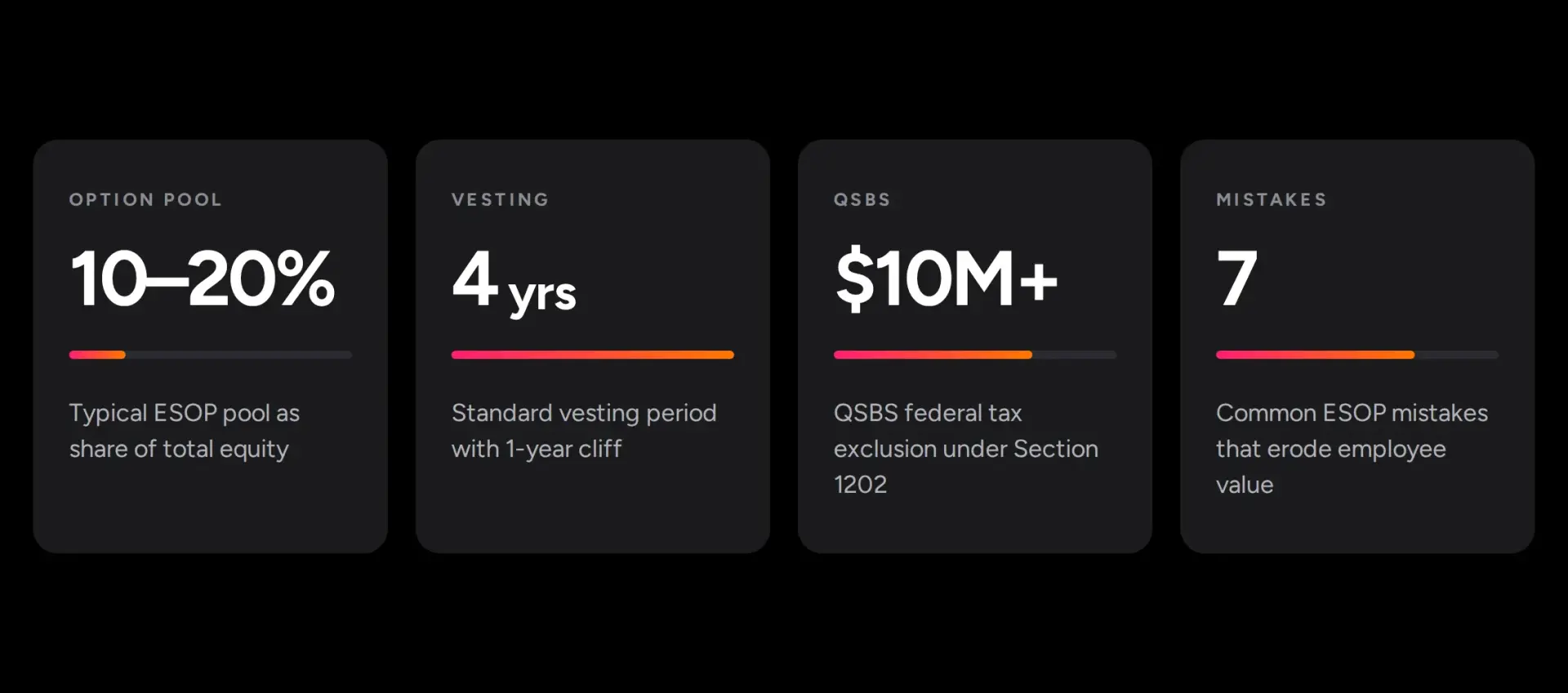
The mechanics work like this. A company creates an option pool, a reserved block of equity, typically 10 to 20 percent of the fully diluted share count. From that pool, individual grants are issued to employees. Each grant specifies the number of options, the exercise price (usually the fair market value at time of grant), the vesting schedule, and the expiry period, typically ten years from the date of grant.
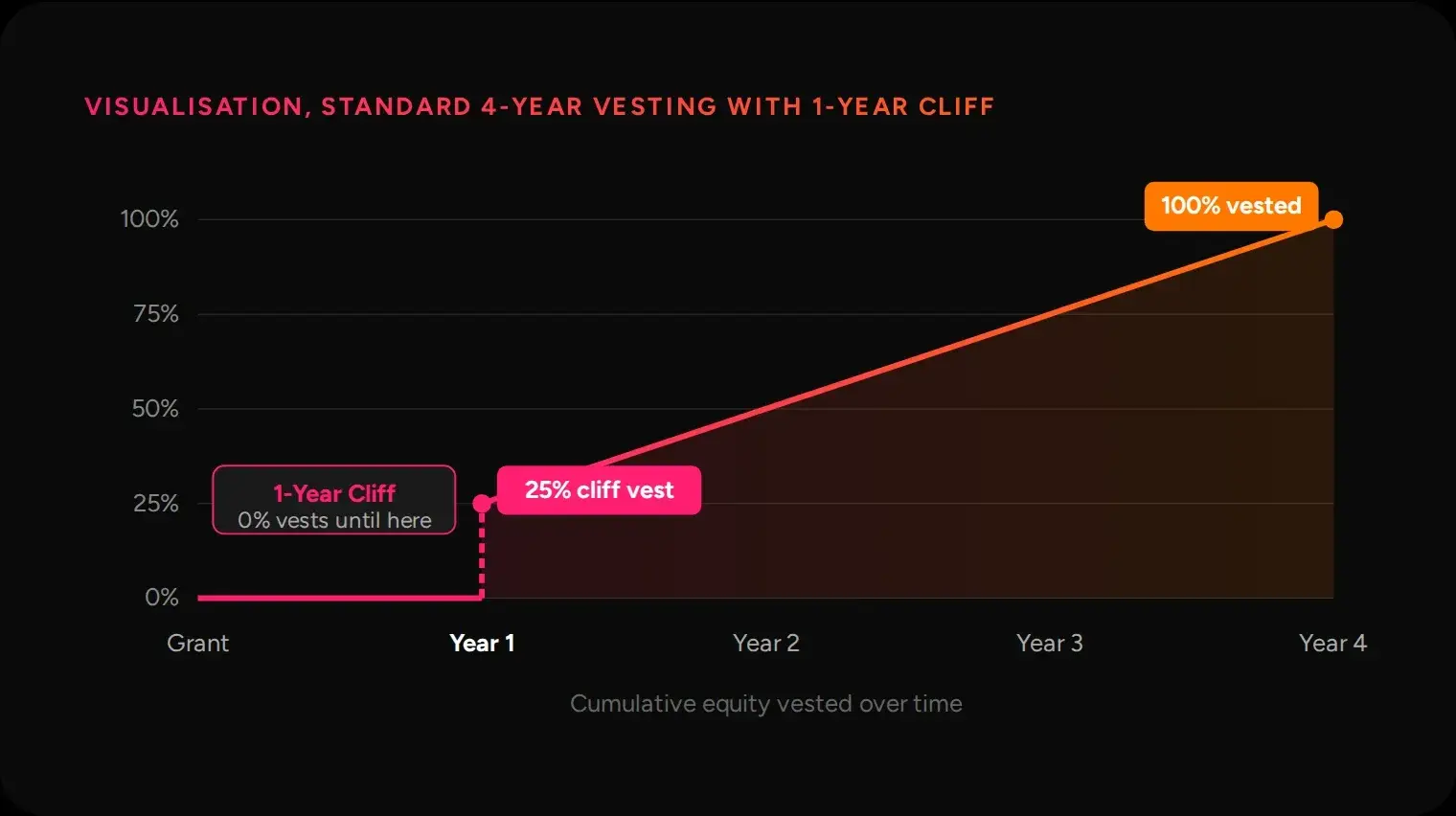
Employees don't own shares the day they receive a grant. They earn the right to exercise (buy) those options over time through vesting. The most common structure is a four-year vest with a one-year cliff: nothing vests in the first twelve months, then 25 percent vests at the one-year mark, and the remaining 75 percent vests monthly or quarterly over the following three years.
When an employee eventually exercises their options, they pay the exercise price to receive actual shares. Those shares then have value only if there's a liquidity event, a company acquisition, an IPO, or a secondary share sale. Without a realistic path to that moment, options can expire worthless. That's why the design of an ESOP matters just as much as the grant itself.
Types of equity compensation
Not all equity is created equal, and understanding the landscape helps employees and HR teams make sense of what they're actually offering or receiving.
Employee Stock Options (ESOPs)
The right to buy shares at a fixed price in the future. Value depends on the company growing beyond that price. Common in early-stage startups where the share price is low, making the options affordable to exercise later.
Restricted Stock Units (RSUs)
A promise to deliver actual shares once vesting conditions are met, usually time-based or milestone-based. No exercise price. The employee simply receives shares at vesting. RSUs are more common at later-stage companies and public firms, where a guaranteed share is more valuable than an option.
Phantom Stock and SARs
Cash-settled instruments that mimic equity without transferring actual shares. Phantom stock pays cash equivalent to the value of a notional share stake. Stock Appreciation Rights (SARs) pay the gain in value over a reference price. Both avoid the legal complexity of actual share issuance, useful in markets where foreign ownership of equity creates regulatory friction.
Employee Stock Purchase Plans (ESPPs)
Programs allowing employees to buy company shares at a discount, often 10 to 15 percent below market price, through payroll deductions. Most common in public companies in the US and Europe. ESPPs provide immediate, tangible value without the uncertainty of options.
Equity is only as valuable as the information surrounding it. An option grant without context is just a document.
Five elements that make ESOPs valuable
- Transparent valuation. Employees need to understand how their options are being valued today, and what that means for potential future value. Regular 409A valuations in the US, or equivalent FMV assessments elsewhere, should be shared in plain language, not buried in legal documents. When employees understand the current value and the assumptions behind it, equity feels real.
- Sensible vesting design. Standard four-year vesting with a one-year cliff works well for most companies, but it's not universal. High-demand roles may benefit from more front-loaded vesting. Post-exit employees need extended exercise windows, the industry default of 90 days is punishing and forces people to choose between leaving and paying a large exercise bill. A 5-to-10 year exercise window post-departure is increasingly seen as standard at employee-friendly companies.
- Proactive, plain-language communication. Grant letters written by lawyers for lawyers do not help employees make decisions. Companies that invest in equity education, personalised modelling tools, regular "equity town halls," and manager-led conversations about vesting, see significantly higher perceived value from the same options budget. The grant itself is table stakes; the conversation around it is the benefit.
- A credible liquidity path. Options with no realistic exit are essentially theoretical. Companies should be honest about the timeline to liquidity, whether that's a planned IPO, secondary sale programs, or strategic acquisition. Secondary market platforms have made partial liquidity a real option for more companies. Communicating this clearly, even if the timeline is uncertain, builds trust more effectively than silence.
- Right-sized pool management. A pool that's too small creates retention risk as the company grows. A pool that's too large dilutes existing shareholders unnecessarily. Most growth-stage companies land between 10 and 20 percent, but the right size depends on hiring plans, stage, and funding structure. Refreshes, additional grants to retain existing employees, should be built into the plan from the start, not treated as an afterthought when someone threatens to leave.
AI in ESOP valuation: real-time FMV tracking and automated valuations. Traditional 409A valuations happen annually or at funding events, a cadence that can leave employees working from stale numbers for months. AI-powered valuation tools are beginning to change this. By continuously ingesting comparable transaction data, revenue multiples, and industry benchmarks, these systems can generate near-real-time FMV estimates between formal valuations. For HR teams, this means employees can get a more accurate picture of their equity's current worth at any point in the year, reducing uncertainty and making the grant feel more tangible. The formal 409A process still requires a qualified appraiser, but AI is shortening the gap between those snapshots.
ESOP management at scale
Many companies launch their first ESOP program using spreadsheets. That works up to a point, roughly 20 to 30 employees and one or two grant rounds. Beyond that, manual equity management becomes a genuine liability.
The risks accumulate quietly. Errors in vesting calculations. Outdated cap tables sent to investors. Options granted to departing employees that never get cancelled. Exercise windows missed because no automated reminder fired. Each of these represents either real financial cost or serious legal exposure.
Dedicated equity management software handles vesting calculations, cap table maintenance, exercise processing, and regulatory reporting in an integrated system. For companies operating across multiple jurisdictions, this is not optional, it's the only realistic way to stay compliant with different tax reporting deadlines, local currency requirements, and disclosure obligations.
The threshold for switching is usually headcount-driven: 30 to 50 employees, or the first grant round involving employees in more than one country. At that point, the cost of a purpose-built platform is marginal compared to the risk of getting it wrong.
Seven common ESOP mistakes
- Setting the exercise price too high. An exercise price at or near the current value is fine; one above it creates an underwater option that employees will never exercise, and it functions as demotivation rather than incentive.
- Using a 90-day exercise window post-departure. This forces employees to either stay (even if they want to leave) or walk away from vested options they can't afford to exercise. Extended exercise windows are a meaningful, low-cost improvement to your equity offering.
- Never communicating vesting status. Employees who don't know how much is vested, what it's worth, and when the next vest date is have no reason to value the grant. Regular equity statements, even simple ones, drive perceived value significantly.
- Ignoring dilution in future rounds. Employees who joined at Series A expecting significant ownership often experience painful dilution by Series C. Honest conversations about dilution, including how anti-dilution provisions work and what pro-rata rights mean, prevent resentment later.
- Maintaining one global grant structure. What works for US employees (ISOs with AMT exposure) is not the same as what works for Indian employees (two-stage taxation under perquisite rules) or UK employees (EMI schemes with separate HMRC conditions). One-size-fits-all ESOP design fails everyone equally.
- Granting too late in tenure. Options granted to an employee after two years of service often don't vest until year six. By then, many high performers have left. Front-loading grants for new joiners, or offering an early exercise provision, keeps equity relevant throughout a typical employment tenure.
- No refresh program. Founding-era employees whose options are fully vested have no equity-based reason to stay. Refresh grants, additional options or RSUs issued to retain people beyond their initial vest cliff, are the most underused tool in the equity compensation toolkit.

India: ESOP rules and tax
India has developed one of the most active ESOP ecosystems in emerging markets, driven by a booming startup sector and growing sophistication among employee populations around equity. The tax treatment, however, is uniquely structured, and often misunderstood.
Two-stage taxation
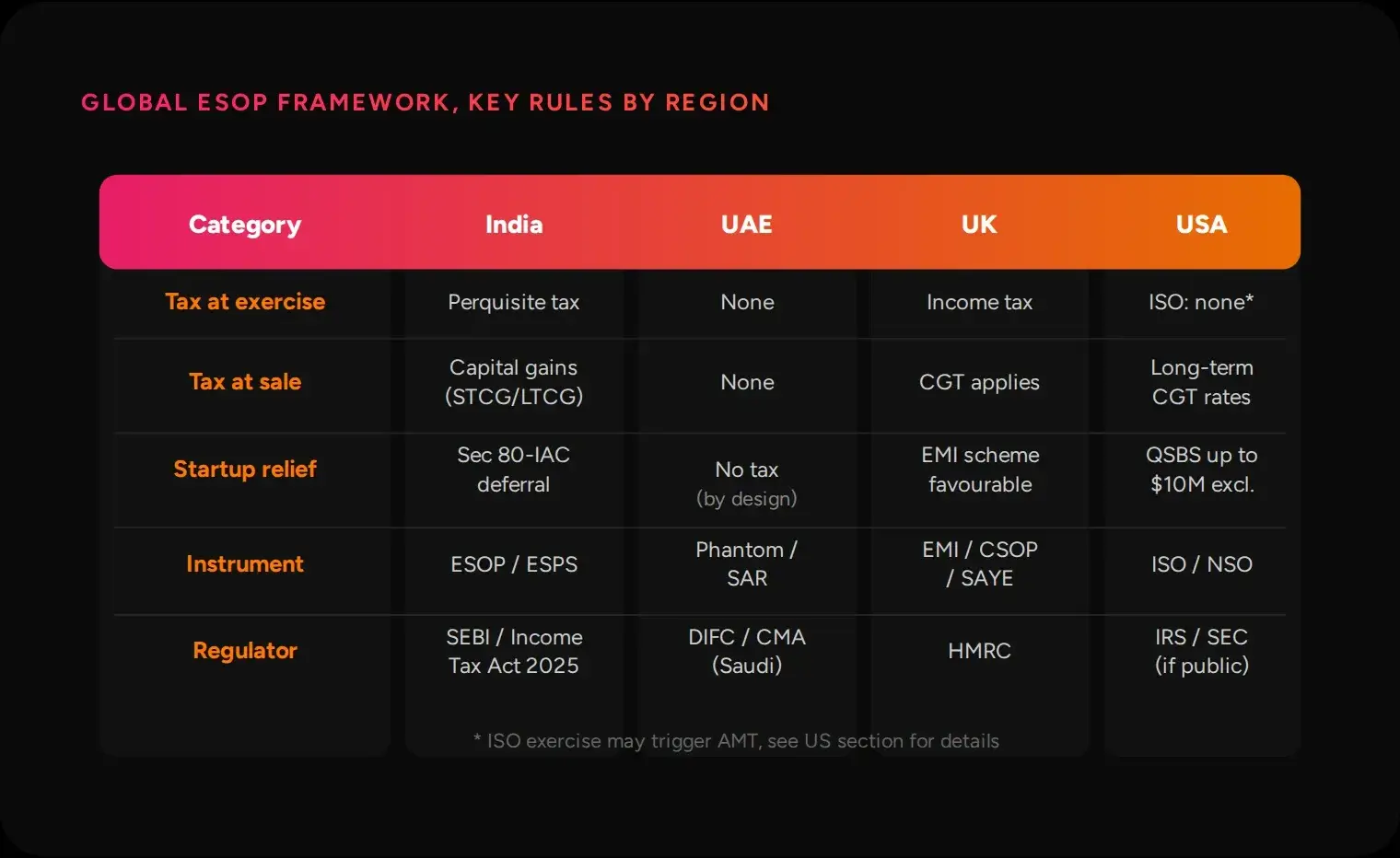
Indian employees face tax at two distinct points. First, at exercise: the difference between the exercise price and the fair market value at the time of exercise is treated as a perquisite, income from employment, and taxed at the individual's marginal income tax rate, which can reach 30 percent plus surcharges. Second, at sale: any gain made between the value at exercise and the eventual sale price is taxed as capital gains, either short-term (STCG) if held less than 12 months, or long-term (LTCG) if held longer.
Section 80-IAC deferral for DPIIT-recognised startups
A significant relief is available to employees of startups registered with the Department for Promotion of Industry and Internal Trade under the Startup India scheme. These employees can defer the perquisite tax at exercise, instead of paying when they exercise, they pay when they eventually sell the shares or leave the company (whichever comes first, up to 48 months from exercise) (source needed). This is meaningful because it removes the cash-flow problem of paying tax on notional gains before any liquidity exists.
Income Tax Act 2025 changes
The Income Tax Act 2025 brought additional clarity to the treatment of ESOPs for startup employees, including expanded eligibility criteria for the deferral provision and clarified guidance on FMV calculation methodologies (source needed). Companies and employees should review grants made in 2025 and beyond under the updated framework, particularly around the definition of qualifying startups and the documentation required to claim deferral.
For private companies, FMV is typically determined by a Category I Merchant Banker registered with SEBI. For listed companies, the FMV is the average of opening and closing prices on the date of exercise on the relevant stock exchange.
AI in employee equity education: personalised equity dashboards and grant communication at scale. One of the most persistent problems with ESOP programs is that employees receive a grant letter, file it away, and forget about it. AI-powered equity education platforms are beginning to change this by delivering personalised, contextualised information about each employee's equity position. These tools can model "what would my options be worth if the company raises at a $500M valuation?" scenarios, send automated vesting reminders, and surface the right tax information based on the employee's jurisdiction. For companies with employees in multiple countries, this kind of intelligent, localised communication at scale was previously only possible with a large dedicated team, AI is democratising access to it.
Middle East: UAE and Saudi Arabia
The Middle East represents a unique opportunity for equity programs, and a unique set of structural constraints. The most immediately attractive feature: the UAE has no personal income tax, meaning that equity gains in the hands of employees are not taxed at the individual level. This makes equity compensation extraordinarily powerful in absolute terms. A grant that would deliver $100,000 net after taxes in London might deliver the full $100,000 in Dubai.
UAE structure considerations
Despite the tax advantage, actually delivering equity to UAE-based employees of foreign companies requires careful structuring. The UAE does not have a mature framework for private share ownership in the same way the US or UK does. Many companies with UAE operations use holding company structures, typically a DIFC (Dubai International Financial Centre) or ADGM (Abu Dhabi Global Market) entity, to issue options or restricted stock to UAE employees, with those entities providing the legal clarity needed for grant documentation and exercise mechanics.
Phantom stock and SARs are also widely used in the UAE precisely because they pay out in cash, avoiding the complexity of share transfer, foreign ownership rules, and cap table management across borders.
Saudi Arabia
Saudi Arabia's Capital Markets Authority (CMA) has been progressively opening equity participation to a broader base of employees. Companies listed on Tadawul (the Saudi Exchange) can offer share plans to employees under CMA rules. For private companies, the holding company model is again common, with Saudi employees receiving phantom equity or options on a foreign holding entity rather than shares in the local operating company directly. The Saudi Vision 2030 agenda has created renewed interest in employee ownership as a retention and motivation tool, particularly in the high-growth tech and financial services sectors.
Europe: UK, France, Germany and beyond
Europe is not a single equity jurisdiction, it is dozens of distinct legal and tax systems sitting under a loosely harmonised regulatory umbrella. Companies with European operations need country-specific analysis, but there are standout regimes worth understanding in detail.
United Kingdom: EMI schemes
The UK's Enterprise Management Incentive (EMI) scheme is widely regarded as one of the most employee-friendly equity structures anywhere in the world. Qualifying companies can grant options with no income tax or National Insurance at exercise (unlike standard options), and only capital gains tax at sale, at the lower entrepreneur's relief rate of 10 percent if Business Asset Disposal Relief conditions are met (source needed). The scheme requires HMRC approval, has company size limits (gross assets below £30 million, fewer than 250 full-time employees), and options must be exercised within 10 years of grant. For qualifying UK startups, EMI is almost always the right instrument.
France: BSPCE
France offers the Bons de souscription de parts de créateur d'entreprise (BSPCE), a startup-specific warrant structure with highly favourable tax treatment. Gains are taxed at a flat rate of 12.8 percent (plus social charges) at sale rather than as income. BSPCE is available only to companies incorporated in France within the last 15 years with certain ownership and revenue criteria, but for qualifying startups it is a significant competitive advantage in attracting talent.
Germany and Netherlands
Germany introduced a reformed ESOP tax framework in 2021 that deferred the tax point from exercise to the earlier of sale, cessation of employment, or ten years after grant, addressing the longstanding "dry income" problem where employees owed tax on equity they couldn't sell (source needed). The Netherlands similarly allows deferral under certain conditions. Both markets have seen a significant uptick in startup equity adoption since these reforms, though complexity in implementation means legal counsel remains essential.
EU Pay Transparency Directive
The EU Pay Transparency Directive, which member states are implementing through 2026, requires companies with 100 or more employees to disclose pay ranges for roles and report gender pay gaps (source needed). While equity compensation is not always within the scope of direct pay reporting obligations, companies should be reviewing how variable pay, including equity grants, is being distributed across gender and seniority lines, as regulators and employees are increasingly asking those questions.
United States: ISOs, NSOs and QSBS
The US has the most developed equity compensation ecosystem in the world, with well-established legal infrastructure, active secondary markets, and broad familiarity among employees in the tech sector. It also has the most complex tax landscape for equity, specifically because of the distinction between Incentive Stock Options and Non-Qualified Stock Options.
Incentive Stock Options (ISOs)
ISOs offer preferential tax treatment: no ordinary income tax at exercise, and only long-term capital gains tax at sale (if the shares are held for two years from grant and one year from exercise). The catch is the Alternative Minimum Tax. Exercising ISOs triggers an AMT preference item, the spread between exercise price and FMV counts as income for AMT purposes even though no cash changes hands. In high-value exercises, this can create a significant tax bill with no corresponding liquidity.
ISOs also have a $100,000 annual limit: the value of ISOs that can vest in any single calendar year is capped at $100,000 (based on the FMV at grant date). Options above this threshold automatically convert to NSOs for that year, losing the ISO tax advantage.
Non-Qualified Stock Options (NSOs)
NSOs are simpler and more flexible. The spread at exercise is taxed as ordinary income in the year of exercise. The company gets a corresponding tax deduction, which is why NSOs are often preferred for executives and consultants. NSOs can be granted to non-employees; ISOs cannot.
QSBS and Section 1202
Qualified Small Business Stock under Section 1202 is one of the most powerful tax provisions available to startup employees and early investors. If shares qualify as QSBS and are held for more than five years, up to $10 million in gains (or 10 times the adjusted basis, whichever is larger) may be excluded from federal capital gains tax entirely (source needed). Conditions include: the company must be a C-corporation, must have gross assets below $50 million at time of issuance, must be engaged in a qualifying active business (not services, finance, or hospitality), and the shares must be acquired at original issuance. Many startup employees don't realise they may be holding QSBS until they're preparing to sell.
AI in global ESOP compliance: multi-jurisdiction tax and regulatory compliance automation. Running an ESOP across India, UAE, UK, and the US simultaneously means tracking four different tax regimes, multiple reporting deadlines, and distinct documentation requirements, all of which change regularly. AI-driven compliance platforms are beginning to map grant events, exercise dates, and sale transactions to the correct reporting obligations in each jurisdiction automatically. These tools don't replace legal counsel, but they dramatically reduce the manual overhead of compliance tracking: flagging when a Form 3922 is due in the US, when an HMRC EMI notification window is open in the UK, or when an Indian employee's perquisite tax deferral period is approaching its 48-month limit. For companies with globally distributed equity plans, this kind of automated compliance monitoring is shifting from a "nice to have" to a basic operational requirement.
Making ESOPs work globally
Global equity programs fail more often at the communication layer than at the legal or tax layer. The legal structure can be perfect. The tax treatment can be optimised. And none of it matters if employees don't understand what they have, don't know when it vests, and can't answer the simple question: "How much is this worth to me?"
The companies that get this right tend to share a few practices. They treat equity communication as a continuous process, not a one-time grant event. They build modelling tools that let employees stress-test scenarios, what happens to my options if we raise a Series B at twice the current valuation? What do I owe in tax if I exercise and the company gets acquired next year? They invest in manager training so that direct reports can have informed, honest conversations about vesting status and liquidity timelines.
They also keep the documentation simple. A one-page equity summary, the number of options, the strike price, the vesting schedule, the current estimated value, and the next vesting date, is more valuable than a 30-page option agreement that no one reads. The agreement still needs to exist. But it should not be the primary communication vehicle.
Finally, the best global equity programs are built with genuine equity in mind, not just legal equity, but fairness. Pool allocations that systematically favour leadership over contributors, exercise windows that only people with savings can afford to use, communication that only reaches English speakers, these design choices don't just feel unfair. They undermine the entire point of issuing equity to employees in the first place.
Equity compensation works when employees can answer three questions: what do I have, when do I get it, and what might it be worth? Most global equity programs stumble on all three. The mechanics are sound. The legal documentation is thorough. But the communication, the modelling tools, and the ongoing education are treated as afterthoughts rather than design requirements. That is what separates the equity plans that actually drive retention from the ones that look good in an offer letter and are forgotten six months into the job.
Disclaimer: This article is intended for informational purposes only and does not constitute legal, tax, or financial advice. ESOP regulations and tax treatments vary significantly by jurisdiction and may change. Companies should seek qualified legal and tax counsel when designing, implementing, or communicating equity compensation programs in any jurisdiction.