Fair Pay is the New Superpower: Why Pay Equity is a Competitive Advantage in 2026
Pay equity isn't just compliance. Companies that get fair pay right attract better talent, retain longer, and build stronger employer brands.
Quick answer:
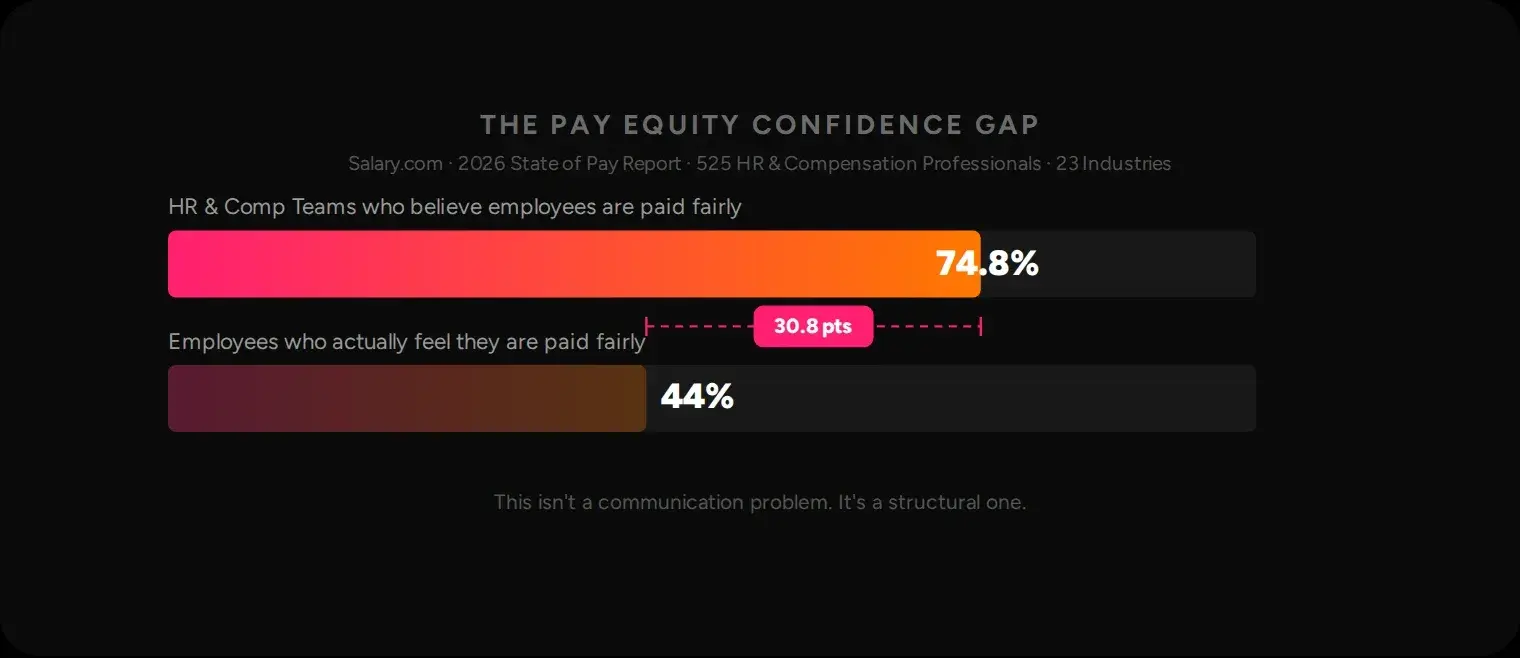
The most revealing number from Salary.com's 2026 State of Pay report: 74.8% of HR professionals believe their employees are paid fairly. Only 44% of employees agree. That 30-point gap isn't about dishonest communication. It's what happens when compensation decisions are made without job architecture, when total rewards statements don't exist, and when managers have no training to explain how pay is set. This guide covers the structural work that closes that gap, and why the companies building that structure are seeing real advantages in hiring, retention, and regulatory compliance.
For most of the last decade, pay equity sat in the same category as data privacy: everyone agreed it mattered, almost no one built actual infrastructure around it. Annual audits ran. Compliance teams showed up when there was a lawsuit or a regulator inquiry. Compensation decisions, meanwhile, happened in spreadsheets, in manager conversations nobody documented, and in offer negotiations that varied wildly depending on how hard a candidate pushed back.
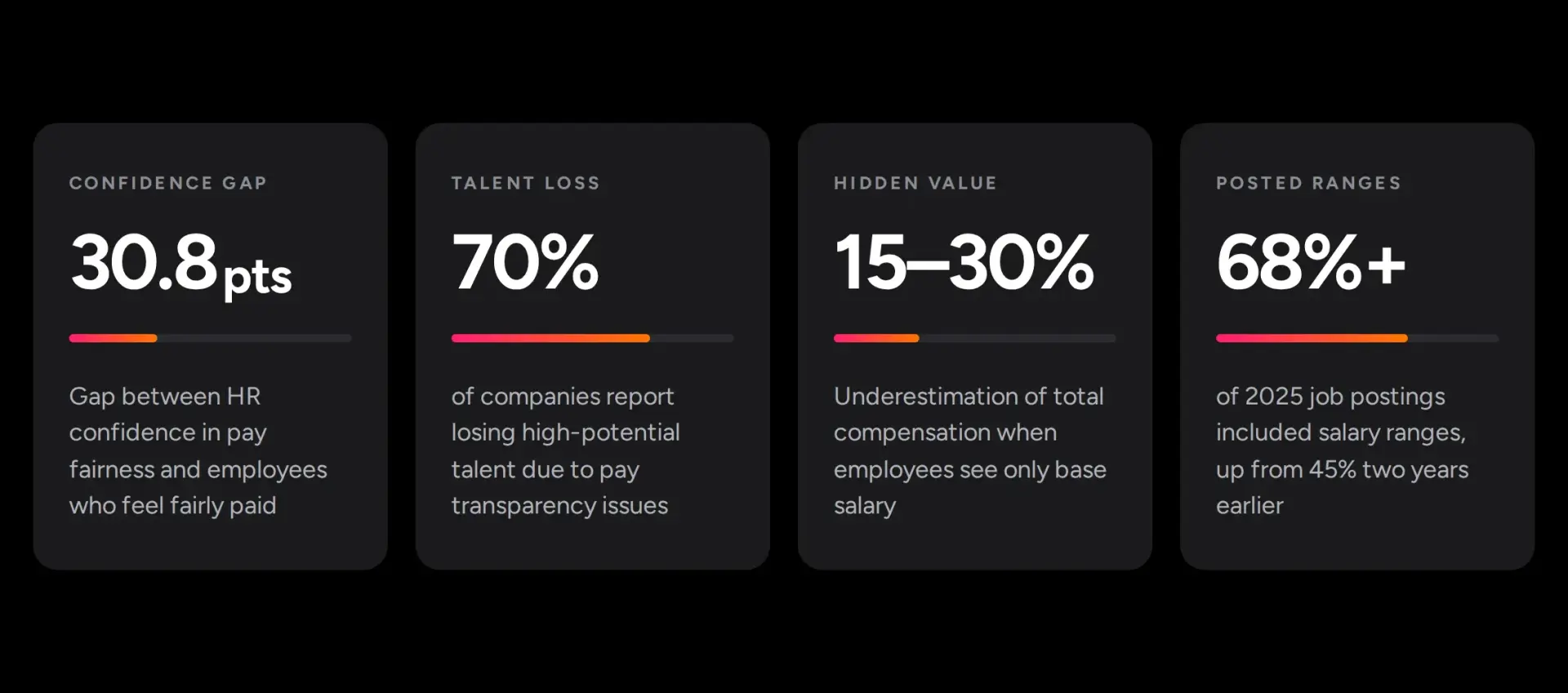
That approach stopped working around the same time candidates started doing real research before their first interview. By 2026, 70% of companies report losing high-potential talent because of transparency issues and perceived pay inequities (source needed). Nearly half of job seekers skip listings that don't include salary ranges outright (source needed). Pay transparency laws have passed or are pending across the EU, the US, the UK, Canada, and Australia. The pressure is no longer just internal. It is coming from regulators, from boards, and from candidates who know what the role pays before they walk in the door.
What has shifted is not attitude. Most HR leaders already believed their pay was fair. The problem, as Salary.com's 2026 data makes clear, is that the structures needed to make that belief credible to employees were not there. That is what this article is about.

The 31-point confidence gap
Here's the most revealing number from Salary.com's 2026 State of Pay Report, which surveyed 525 HR and compensation professionals across 23 industries: 74.8% of HR professionals believe their employees are paid fairly. But only 44% of employees actually share that view.
That's a 30.8-point confidence gap. And the research found it isn't coming from dishonest communication, it's a structural problem with three root causes.
- No total rewards visibility: Only 46% of organisations provide total rewards statements. More than half of all workers never see the complete picture of what their employer invests in them. They evaluate pay on base salary alone, consistently underestimating total compensation by 15 to 30%.
- Managers can't explain pay decisions: 69% of organisations train managers to conduct performance evaluations. Only 52% train them on how to discuss compensation, the exact topic employees are most likely to raise the moment a review ends.
- No structured pay bands: Without clear, market-benchmarked salary bands tied to a documented job architecture, every compensation decision becomes ad hoc. That's where unexplained gaps creep in, and it's where trust breaks down.
Talent attraction
Job seekers are asking tougher questions about pay practices. How do you ensure pay equity? Are salary ranges for similar roles transparent? If you don't have strong answers, you lose candidates to competitors who do. Gen Z candidates in particular are significantly more likely to apply for a role if the salary range is posted.
More than 68% of job postings in 2025 included salary ranges, up from 45% in 2023 (source needed). That shift happened in two years. The market expectation has moved, and it's not moving back.
Retention
When employees feel they're paid fairly, they stay longer. Salary.com's research found that 70% of people say pay transparency boosts satisfaction at work. When pay decisions are based on clear factors, experience, role, performance, employees have more confidence in leadership. When they can see a clear path to earning more through defined career ladders and pay bands, they have a reason to stay and grow rather than leave to get a raise elsewhere.
The retention math is also straightforward. Replacing a mid-level employee typically costs 50 to 200% of their annual salary when you account for recruitment, onboarding, and the time it takes for someone new to reach full productivity (source needed). Fixing pay equity is significantly cheaper than the turnover it causes.
The "I'm underpaid" conversation often evaporates the moment someone sees their full rewards statement, base, bonus, equity, benefits, insurance, and employer pension contributions in one place.
AI in pay gap detection: from annual audit to real-time monitoring. Traditional pay equity audits are slow, expensive, and retrospective. By the time HR teams pull data from multiple systems, reconcile it, and run regressions, they're looking at gaps that have often been compounding for 12 months or more.
AI-powered compensation platforms change this. Rather than running a once-a-year audit, the system continuously monitors every hire, promotion, and compensation adjustment against relevant pay bands and comparable employee profiles. When a potential gap appears, it's flagged before the offer letter is signed, not discovered a year later.
- Simultaneous analysis across thousands of records, controlling for role, level, location, performance, and tenure
- Real-time flagging of anomalies at the point of decision, not 12 months later in an annual review
- Pattern detection across gender, ethnicity, and tenure dimensions that would take weeks to surface manually
- Automated documentation trail for each decision, critical for audit readiness under the EU Pay Transparency Directive
Employer brand
Fair pay practices are increasingly visible. Mandatory pay gap reporting in the EU starts in 2027 for companies with 150+ employees. Public salary range disclosures are required in California, New York, Colorado, and Washington. Growing third-party transparency through Glassdoor and Levels.fyi means your compensation practices are no longer private.
Companies known for fair pay attract better candidates, receive more applications, and build stronger reputations in their markets. Companies that get caught with unexplained gaps face reputational damage that takes years to undo.
Risk reduction
The regulatory landscape is tightening. The EU Pay Transparency Directive requires all member states to transpose it into national law by June 2026. Unjustified pay gaps above 5% trigger mandatory audits with worker representatives. Critically, the burden of proof has flipped to the employer: you have to demonstrate your pay decisions are justified, not just claim they are. In the US, the EEOC and state-level agencies are increasing enforcement. Failure to manage equal pay creates risks related to legal challenges, penalties, and significant reputational damage.
Getting fair pay right
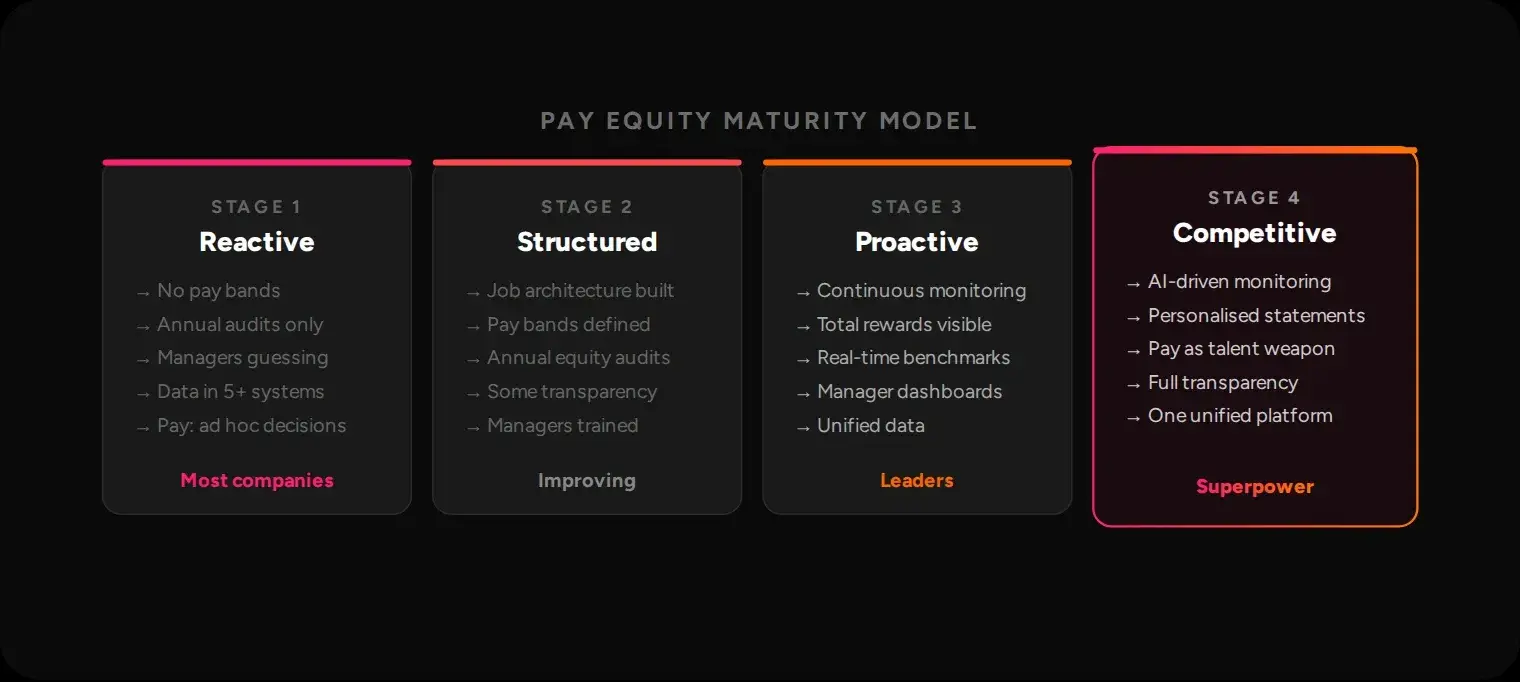
Fair pay isn't a one-time audit. The companies that are getting this right have built it as an ongoing operating discipline, something that runs continuously rather than a painful annual project. Here's what that looks like in practice.
The five disciplines of pay equity
- Structured job architecture. Every role mapped to a level, every level with a market-benchmarked pay band. When someone asks "how is my pay decided?" the answer is documented and defensible, not "we matched your last salary."
- Continuous pay equity audits. Not annual, continuous. Every hire, promotion, or adjustment checked against the band and against comparable employees. Gaps caught before they compound, not discovered 12 months later in a retrospective analysis.
- Total rewards visibility. Employees see the complete picture: base plus bonus plus equity plus benefits plus insurance plus recognition. When someone can see the company invests 25 to 40% beyond base salary, "I'm underpaid" becomes "I had no idea the company invested this much in me." (source needed)
- Manager enablement. Managers trained and equipped to have compensation conversations. They understand the band structure, they can explain where someone sits and why, and they can articulate what it takes to move up. This isn't a once-a-year training session, it's embedded in how managers operate.
- Transparent communication. The compensation philosophy is stated clearly: how pay is determined, what market data is used, how bands are structured. This doesn't mean publishing every salary, it means having the structure to explain every pay decision if asked.
AI in market benchmarking: real-time pay benchmarking, without the quarterly survey lag. Traditional market benchmarking runs on survey data that's collected quarterly, compiled over weeks, and published months after the underlying salaries were reported. By the time you're building next year's salary bands from this year's survey, the market may have already moved.
AI-driven benchmarking changes the update cycle. By continuously ingesting job posting data, public compensation disclosures, and cross-industry compensation signals, the system keeps your pay bands current rather than stale:
- Pay bands that reflect current market conditions, not last quarter's survey data
- Instant flagging when a role's market rate has drifted outside your current band, so you catch retention risks before they become departures
- Role-level and location-level granularity that broad compensation surveys rarely provide
- Scenario modelling: "If we adjust this band to P50, what's the budget impact across the team?"
The technology question
Most companies that struggle with pay equity don't have a philosophy problem. They have an infrastructure problem.
Compensation data sits in the HRMS. Equity data lives in a cap table tool. Benefits information is scattered across vendor portals. Recognition data exists in a separate platform. Bonus calculations happen in spreadsheets. When HR tries to run a pay equity audit or generate a total rewards statement, they're pulling data from five different systems and hoping it reconciles. It often doesn't.
This is where a unified Total Rewards platform changes the game. When compensation planning, equity management, benefits administration, recognition, and pay transparency all live in one system, pay equity analysis becomes something you can do continuously rather than a painful annual project. Total rewards statements are generated automatically. Pay band compliance is checked in real time. And managers have a dashboard they can use in every compensation conversation.
AI in total rewards communication: personalised total rewards statements at scale. One of the highest-impact things a company can do for pay equity perception is show every employee the complete picture of what the organisation invests in them. Employees consistently underestimate total compensation by 15 to 30% when they only see their base salary figure. The "I'm underpaid" conversation often evaporates the moment someone sees their full rewards statement.
AI-powered generation changes this at scale:
- Statements generated automatically for every employee, personalised to their specific compensation mix
- Plain-language explanations of each component, not just the number, but why it's structured the way it is
- Triggered delivery timed to performance reviews, promotions, or annual compensation cycles
- Manager summaries alongside each statement, so managers walk into review conversations fully prepared to discuss total compensation
The bottom line
The companies getting pay equity right in 2026 are not the ones with the best messaging around fairness. They are the ones that built job architecture before regulators forced them to, that give employees total rewards statements rather than expecting them to trust a number they cannot verify, and that trained their managers to actually explain how pay is set. Those structural investments are what close the 31-point confidence gap.
Most employees are not asking for more money. They are asking to understand why they are paid what they are paid. That is a structural problem with a structural solution. The companies investing in that structure are attracting better candidates, retaining longer, and spending less repairing reputational damage from pay discrimination claims and leaked comp data. The business case is there. So is the operational path to get there.
Frequently asked questions
What is pay equity and how is it different from pay equality?
Pay equality means paying people the same amount for the same job. Pay equity is broader: it means ensuring pay is fair and justifiable across roles, levels, genders, and demographics, with no unexplained gaps. Pay equality is a binary check. Pay equity is an ongoing structural discipline that requires job architecture, market benchmarking, regular audits, and transparent communication to get right.
Why do employees feel underpaid even when companies are paying at or above market?
Usually because of visibility. Employees evaluate their compensation based on base salary alone, they don't see the bonus structure, equity value, benefits, insurance, or recognition rewards the company invests in them. Salary.com's 2026 research shows employees consistently underestimate total compensation by 15 to 30%. The solution isn't always paying more. It's showing employees the complete picture through total rewards statements.
What does the EU Pay Transparency Directive mean for companies with European employees?
From June 2026, all EU member states must have the directive transposed into national law. Companies with 150 or more employees must publish gender pay gap reports starting in 2027 using data from 2026. Any unjustified pay gap above 5% triggers a mandatory joint pay assessment with worker representatives. The burden of proof flips to the employer, you have to demonstrate your pay decisions are justified, not just claim they are.
How often should a company run pay equity audits?
The companies getting this right run them continuously, not annually. Every time a new hire is made, a promotion happens, or a comp adjustment is approved, it should be checked against the relevant pay band and against comparable employees. Annual retrospective audits catch problems after they have compounded. Continuous checks catch them before they become gaps, and this is only practical when your compensation data lives in a single system rather than across multiple disconnected tools.
What is the first step a company should take to improve pay equity?
Build a structured job architecture. Map every role to a level, and assign a market-benchmarked pay band to each level. This is the foundation everything else sits on. Without it, compensation conversations have no anchor and pay equity audits have nothing to compare against. Companies that skip this step and go straight to pay transparency initiatives end up exposing inconsistencies they don't have the structure to explain or fix.
Disclaimer: This blog is for informational purposes only and does not constitute legal or compliance advice. Regulatory requirements vary by jurisdiction and are subject to change. Consult qualified legal and HR professionals for advice specific to your organisation.