Flexible Benefits Platforms: Personalise Benefits Without Losing Cost Control
Fixed packages built for the median employee produce median results. How HR teams give employees real choice within a capped, predictable budget.
Quick answer:
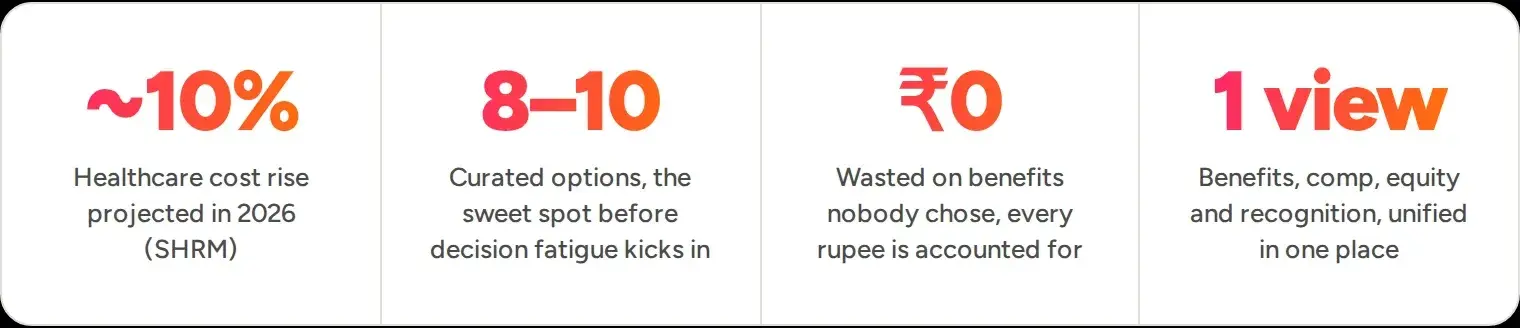
A flexible benefits platform lets you set a fixed per-employee budget, a benefits wallet, and let employees choose from a curated menu of 8 to 10 options that matter to them: mental wellness, childcare, upskilling, fitness, remote work support, financial planning, and more. Every rupee goes toward something they actively chose. Total spend stays predictable because the wallet is capped. Utilisation goes up because relevance goes up. The companies still running fixed plans are paying for benefits their employees barely use, while the ones who've made the switch are getting better retention numbers and cleaner data to show their boards
What flexible benefits look like in practice
Let's be honest about what's happening inside most companies right now. HR puts together a benefits package at the start of the financial year: health insurance, PF, maybe a wellness programme, maybe a meal card. Same package for every single person. The 24-year-old developer who just wants a gym membership gets the same deal as the 45-year-old working parent who desperately needs better childcare support.
The data backs this up: Mercer's 2025 research found that 43% of employees are enrolled in at least one benefit they have never used. That is not a communication problem. It is a design problem.
In 2026, this is no longer just an HR nuisance. Healthcare costs are projected to rise roughly 10 percent this year according to SHRM's latest reporting. Employees are far more vocal about what they value. Benefits have become a real talent differentiator, not just a compliance checkbox that gets renewed automatically each April.
The shift toward flexible benefits is a correction. And the mechanics are simpler than most vendors make them sound.
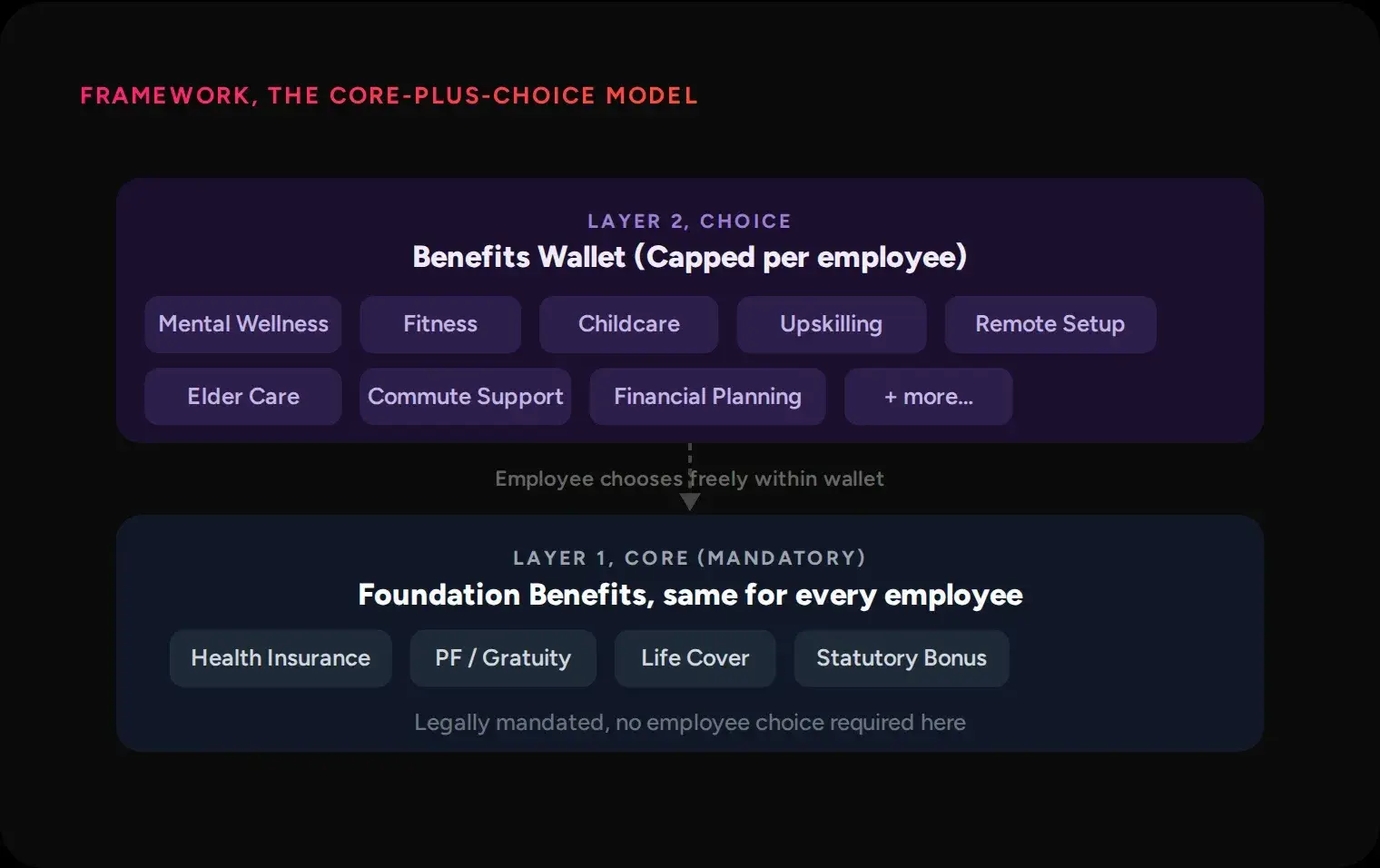
The model works in two layers. First, there's a foundation: every employee gets the same core of health insurance, provident fund, gratuity, life cover, and the legally mandated essentials. No changes there. Second, on top of that, each employee gets a defined allowance. Think of it as a benefits wallet. They choose from a curated menu of options relevant to your specific workforce: mental wellness support, fitness memberships, childcare assistance, upskilling and learning budgets, remote work equipment, commute support, financial planning, elder care. The employee picks what matters to them. The company controls total spend because the wallet amount is capped per head.
This is the core-plus-choice model, and it's become the default approach for companies that are serious about benefits design in 2026. Some companies go further with Lifestyle Spending Accounts (LSAs), where the allowance can cover an even broader range of categories with fewer restrictions. Others use tiered plans, where employees choose between benefit bundles based on their life stage. The right model depends on your company size, workforce demographics, and how much administrative complexity you're prepared to take on.
Personalisation without admin chaos
The number one objection HR leaders raise when this comes up is: "This sounds like an administrative nightmare." And five years ago, they'd have been right. Running flexible benefits manually, tracking who chose what, calculating tax implications for different options, managing claims across multiple vendors, was painful.
But that's not the world we're operating in now. The platforms available today handle all of that behind the scenes. Eligibility rules, tax treatment, vendor payments, claims processing, compliance checks, all automated. The employee sees a clean, app-like experience where they pick what they want. The HR team sees dashboards, not spreadsheets.
The real design question isn't about administration. It's about curation. Research consistently shows that too many choices lead to decision fatigue, which kills utilisation rates. Effective flexible benefits programmes limit options to a small set of meaningful choices and use default selections to support employees who prefer simplicity (source needed).
Smart curation means looking at who your employees actually are. If 60 percent of your workforce is under 30, prioritise upskilling, fitness, and financial planning. If you have a significant number of working parents, childcare and elder care should be prominent. If your team is distributed, remote work setup and commute flexibility matter more than office perks nobody uses. The menu should reflect your actual workforce, not a generic template from a vendor brochure.
AI in benefits personalisation: using workforce data to design the right menu. AI-powered benefits platforms analyse workforce demographics, historical claims data, engagement patterns, and lifecycle stage signals to recommend which benefit categories belong in your menu, and at what wallet size. Instead of guessing what a 28-year-old in Bengaluru versus a 42-year-old in Mumbai might value, the system surfaces that data automatically. It identifies which current benefits are being claimed at less than 30 percent utilisation, which categories are chronically oversubscribed, and where employees in specific cohorts are spending their wallets. The result is a menu that's built around actual usage, not assumptions, and it improves every renewal cycle as more data accumulates.
The counterintuitive cost story
Here's what surprises most CFOs when they first look at flexible benefits seriously: they often cost the same as, or less than, the traditional fixed benefits package they're already running.
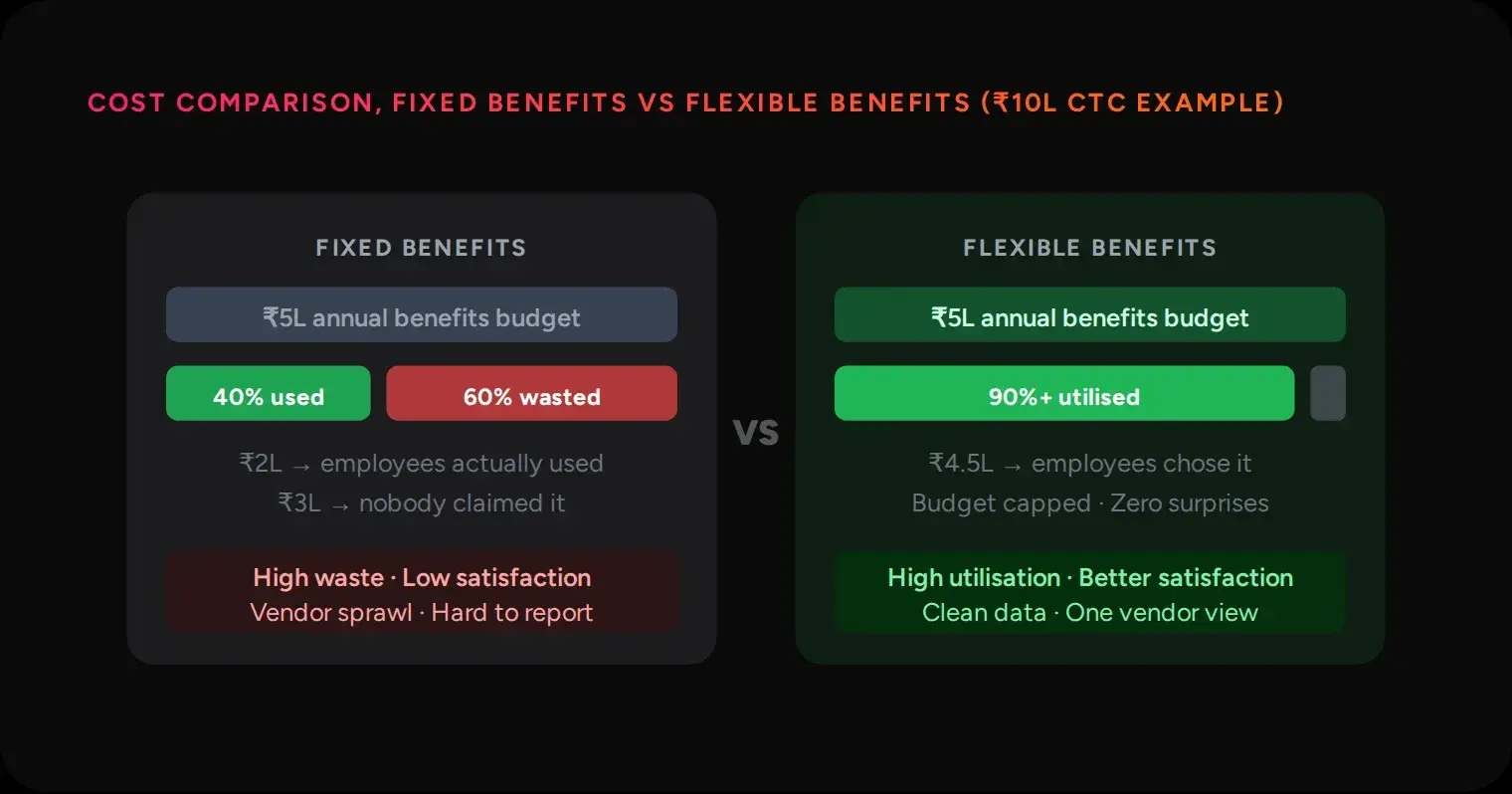
The logic is clear, even if it's counterintuitive. With fixed benefits, you're paying for plans most employees don't use. That wellness programme with 8 percent enrolment? Still in your budget. That insurance tier nobody opted into? Still a line item. Those office perks for a team that's 70 percent remote? Still being paid for. You're paying for availability, not actual use.
With flexible benefits, every rupee goes toward something the employee actively chose. Utilisation goes up because relevance goes up. Waste goes down. And because the wallet amount is capped per employee, total spend is predictable, with no surprises at renewal time.
According to Compt's 2026 Benefits Trends Report, companies that consolidate disconnected perks into a single flexible structure such as an LSA are seeing better utilisation, lower vendor sprawl, and benefits spending that goes further. The key insight: when programmes are simpler and more flexible, participation rises. And higher participation means the budget is actually working.
For finance teams, the case is simple. The benefits wallet is capped per employee, so total spend stays predictable. Instead of chasing claims across six disconnected vendor portals, the platform gives you real-time data on exactly what each budget segment is going toward, consolidated in one place. That makes board reporting significantly less painful.
"The average company pays for benefits that many of its employees never use (source needed). A flexible model does not increase your spend. It redirects it toward things employees actually chose."
Where integration goes wrong
This is where it gets important for Total Rewards leaders, and where most implementations fall short.
Most flexible benefits platforms are sold and deployed as standalone tools. They handle benefits reasonably well in isolation. But they don't connect to your compensation data, your ESOP data, your recognition programmes, or your pay transparency framework. The result? You've added another disconnected tool to a stack that already has your HRMS, a separate compensation planning spreadsheet, an ESOP portal, an R&R platform, and manual reporting processes. Benefits becomes yet another silo.
The real power of flexible benefits kicks in when it's part of a unified Total Rewards view. When you can show an employee their complete picture, base salary plus bonus plus ESOP value plus benefits allocation plus recognition rewards, all in one place, the conversation changes entirely. Offer negotiations become clearer because candidates see everything. Retention conversations have real data behind them. Leadership gets a single dashboard showing total rewards cost per employee, without anyone stitching spreadsheets together at the end of each quarter.
This is the approach at Tallect. Benefits aren't a standalone module sitting in isolation. They're part of a consolidated Total Rewards platform where compensation planning, ESOP management, pay transparency, recognition, and benefits all connect into one system. The whole point is that your HR and finance teams shouldn't need to log into five different tools to understand what you're spending on each person, and whether it's actually working.

Don't skip compliance
Flexible benefits introduce tax complexity that can trip up HR teams if the platform doesn't handle it properly. In India specifically, Flexible Benefit Plans (FBPs) can offer tax savings for employees. Components like meal allowances, fuel reimbursements, and health insurance contributions can be tax-exempt or partially exempt depending on the tax regime the employee chooses (source needed). But each component carries regulatory caps and specific documentation requirements; get those wrong and you've created a compliance liability rather than a benefit.
For companies with global teams, it gets more complicated. Tax treatment varies substantially by country. Benefits that are tax-exempt in India may be fully taxable in the UK. LSA categories that work in the US may have different substantiation rules depending on where the employee is based. A good flexible benefits platform should handle all of this automatically, applying jurisdiction-specific tax calculations, managing regulatory caps, and handling documentation requirements without HR needing to maintain separate processes for each country.
Whatever platform you choose, tax handling should not be a manual process. If your HR team is manually calculating tax implications for every benefit claim, you've just traded one administrative problem for another.
For Indian companies: Flexible Benefit Plans can offer real tax savings. Meal allowances, fuel reimbursements, health insurance contributions, and LTA can be structured to reduce employee tax liability, subject to the employee's tax regime and annual caps (source needed). Each component has regulatory caps and requires proper documentation. This needs to be handled by your platform before it becomes an audit issue, not after.
AI in compliance management: automated tax and regulatory handling across jurisdictions. AI-powered compliance engines apply the right tax rules to every benefit claim automatically: FBP component caps for India, LSA substantiation rules for the US, country-specific exemption thresholds for global teams. When a new regulatory update comes through, the system updates its rules without HR needing to reconfigure anything. It also flags exceptions in real time: if a claim would push an employee over their FBP meal allowance cap mid-year, the system catches it before it becomes a problem rather than after the annual audit reveals a discrepancy. For companies managing benefits across five or more countries, this kind of automated, jurisdiction-aware compliance isn't a luxury. It's the only approach that actually scales.
What to look for in a platform
The market for flexible benefits platforms has gotten crowded quickly. Here are the questions that actually separate platforms worth implementing from those that create new problems to replace old ones.
Does it integrate with your existing systems? The platform should connect to your HRMS, payroll, and ideally your compensation and equity data. If it creates another data silo, it's not solving the real problem; it's adding to it.
Does it handle compliance automatically? Tax calculations, regulatory caps, and documentation requirements should be handled by the system, not by your HR team. Ask vendors specifically about FBP handling for India, and LSA rules if you have international employees.
Is the employee experience actually good? The best platform in the world is useless if employees find it confusing. Look for clean UI, mobile access that works, and guided decision-making that helps employees choose without overwhelming them. Adoption is everything.
Can you control budgets at a granular level? You should be able to set different benefit allowances by seniority level, location, department, or any other dimension that matters to your organisation. A flat per-head wallet is a starting point, not a sophisticated approach.
Does it give you data you can actually act on? Real-time dashboards showing what's being utilised, what's being ignored, and where the gaps are. This is how you evolve your benefits strategy year over year instead of just renewing whatever you had last year.
Does it fit into your Total Rewards strategy? Benefits don't exist in isolation. The platform should connect to, or at minimum integrate with, your broader rewards infrastructure, so employees see the full picture and HR has one source of truth.
Six questions for your flex benefits partner
- HRMS and payroll integration. Can it connect to your existing stack without a custom engineering project? Ask for specific integration references, not just API documentation.
- Automated compliance handling. Does the system apply FBP caps, LSA rules, and country-specific tax treatment automatically? Who maintains the regulatory rule set when laws change?
- Employee UX and mobile access. Can an employee choose their benefits in under five minutes on a phone? Request a live demo with a real employee user, not a polished sales walkthrough.
- Granular budget controls. Can you set different wallet sizes by level, location, and department independently? Or is it one flat amount for everyone?
- Utilisation dashboards. What does the analytics layer actually show? Ask to see a real client's dashboard, not a demo dataset that was built to look impressive.
- Total Rewards integration. Does it connect to compensation, equity, and recognition data, or does it sit as yet another standalone module your team has to manage separately?
AI in benefits analytics: real-time utilisation intelligence, not just dashboards. The difference between a reporting dashboard and an AI-powered analytics layer is what happens with the data. A dashboard tells you that your wellness benefit had 34 percent utilisation last quarter. An AI layer tells you that utilisation drops to 8 percent among employees who joined in the last six months, suggests this correlates with onboarding information gaps rather than low interest, and recommends a targeted communication nudge for that cohort before the next wallet window closes. It also flags, before your annual renewal, which benefit categories are consistently underutilised across the board, so you can swap them out rather than renewing something that isn't working. The goal isn't more data. It's data that drives a specific action.
The bottom line
The move to flexible benefits is not complicated in theory. You set a per-employee budget, define the benefit categories, choose the platform, and let employees allocate their own wallet. The complexity is in the execution: picking a platform that integrates with your HRMS, handles GST compliance, and actually works on mobile for a distributed workforce.
The companies doing this well are not spending more. They are spending differently, with real data showing what the spend is producing. The ones still running fixed plans from 2020 are paying for gym memberships in cities where nobody uses them, for life insurance nobody enrolled in correctly, and for manual claims processes that consume a large share of an HR team's week (source needed). That is a fixable problem. But it requires treating benefits design as seriously as salary design, which most companies still do not.
Frequently asked questions
What is a flexible benefits programme and how is it different from a standard package?
A standard benefits package gives every employee the same set of benefits regardless of individual needs. A flexible benefits programme gives each employee a defined budget, a benefits wallet, and lets them choose from a curated menu of options. The company controls total spend by capping the wallet amount per employee. The employee gets benefits that are actually relevant to their life. Both sides benefit from the arrangement: the company spends the same or less, and employees get meaningfully higher value because they're choosing what matters to them.
Do flexible benefits cost more than traditional fixed benefits?
Not necessarily, and often they cost the same or less. With fixed benefits, companies pay for programmes that many employees never use. With flexible benefits, every amount goes toward something the employee actively chose, which drives utilisation up and waste down. Because the benefit wallet is capped per employee, total spend is predictable. The shift is from paying for availability to paying for actual use, and that distinction usually improves the budget picture significantly.
What is a Lifestyle Spending Account (LSA) and how does it work?
A Lifestyle Spending Account is a flexible employer-provided benefit where the company allocates a set amount per employee that can be spent across a broad range of categories: fitness, mental health, learning, childcare, home office setup, and more. Unlike health spending accounts, LSAs are typically taxable but offer maximum flexibility. The employee submits claims or uses a linked card to access the funds. LSAs are growing rapidly because they address the diversity of employee needs that a single fixed benefit can never cover, particularly for organisations with distributed or multi-generational workforces.
How do flexible benefits work for companies with employees in multiple countries?
This is where platform selection matters most. Tax treatment of benefits varies significantly by country: what is tax-exempt in India may be taxable in the UK, and LSA categories compliant in the US may have different substantiation rules in the EU. A good flexible benefits platform handles jurisdiction-specific tax calculations automatically, applies the right documentation and substantiation rules by location, and lets HR configure different benefit menus by country without creating separate administration processes for each. Without that capability built into the platform, global flexible benefits quickly become a compliance headache rather than an advantage.
How should a company decide which benefits to include in its flexible menu?
Start with your workforce demographics. Look at age distribution, family status, employment type, and location. Survey employees directly; the gap between what HR assumes employees want and what employees actually value is often significant. Keep the menu to 8 to 10 curated options rather than offering everything at once, since too many choices lead to decision fatigue and lower utilisation. Review the menu annually using data on what was actually claimed versus what was ignored, and evolve the offering based on real usage rather than assumptions. A menu that's right for year one should look meaningfully different in year three as you learn how your workforce actually spends.