
How to choose a peer group for market benchmarking
The data you use is only as good as the companies you compare yourself to. A wrong peer group quietly distorts every pay decision you make.
Most compensation benchmarking problems are not data problems. They are peer group problems. Companies spend weeks selecting a survey vendor, negotiating access, and cleaning job codes. Then they compare themselves against a peer group that does not actually represent the labor market they compete in. The result is benchmarks that feel authoritative but point in the wrong direction.
Choosing the right peer group is more consequential than which survey you buy, how many data points you pull, or how precisely you match job descriptions. A well-defined peer group built on the right dimensions produces useful benchmarks even from imperfect data. A poorly defined one produces misleading benchmarks from the best data available.
This guide walks through the dimensions that matter, the mistakes that are most common, and how to structure a peer group definition that holds up under scrutiny.
Why peer groups go wrong
The default peer group for most companies is a mix of three things: companies they have heard of, companies that show up in broad industry filters, and companies that appeared in a business school case study at some point. This approach is intuitive and almost entirely wrong.
The companies you compete with for talent are not necessarily the companies you compete with in your product market. A fintech startup competes for engineers with every well-funded startup in the region, not just other fintechs. A regional hospital competes for nurses with other regional healthcare employers, not national health systems with completely different pay scales and benefits packages.
Peer group definition needs to start with a single question: who is actually taking your candidates, or who are your candidates leaving for? The answer to that question shapes everything else.
The four dimensions
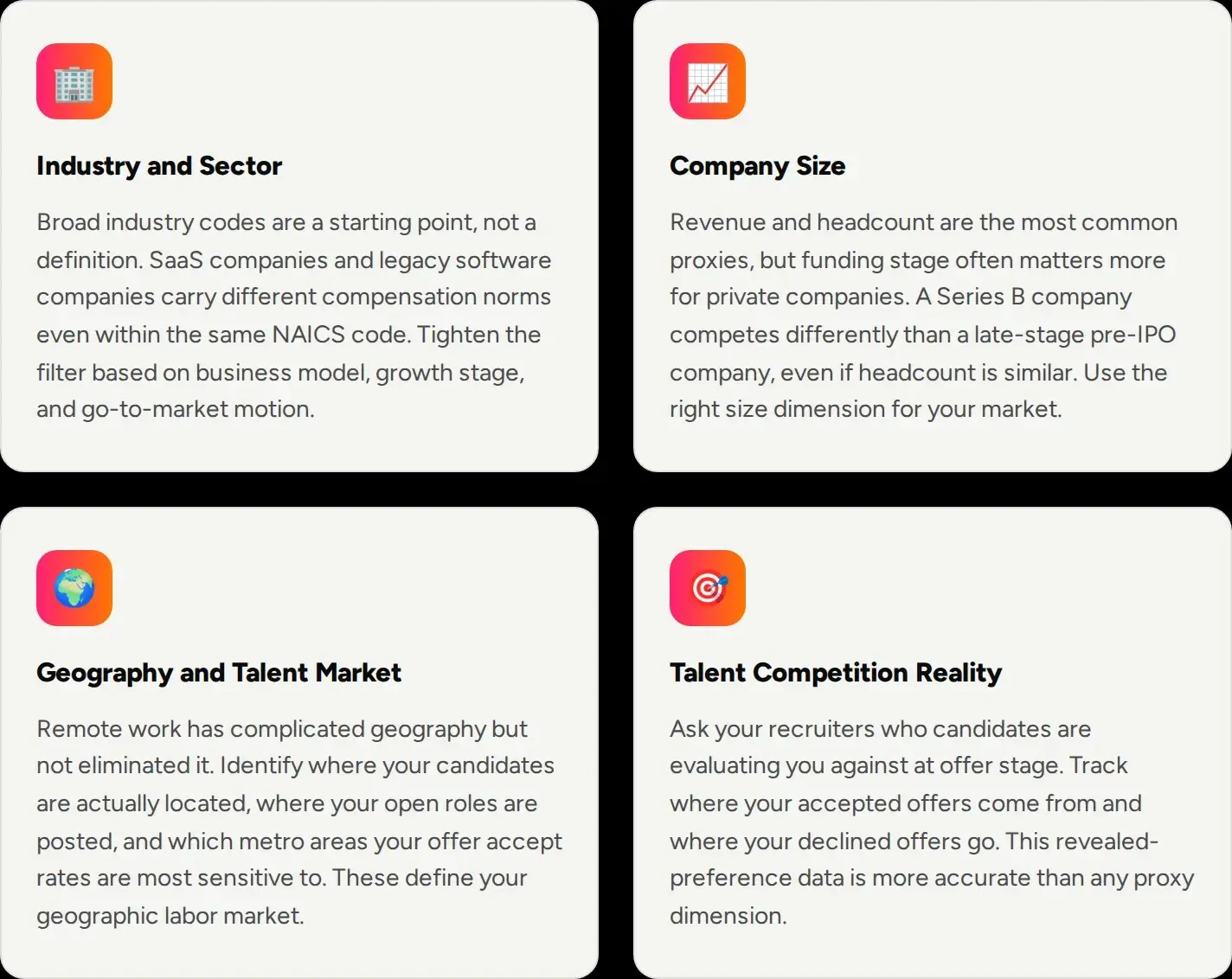
A defensible peer group is built by intersecting four dimensions. No single dimension is sufficient on its own, and overweighting any one of them produces distortions that are difficult to detect until something goes wrong.
Industry and sector
Broad industry codes are a starting point, not a definition. SaaS companies and legacy software companies carry different compensation norms even within the same NAICS code. Tighten the filter based on business model, growth stage, and go-to-market motion.
Company size
Revenue and headcount are the most common proxies, but funding stage often matters more for private companies. A Series B company competes differently than a late-stage pre-IPO company, even if headcount is similar. Use the right size dimension for your market.
Geography and talent market
Remote work has complicated geography but not eliminated it. Identify where your candidates are actually located, where your open roles are posted, and which metro areas your offer accept rates are most sensitive to. These define your geographic labor market.
Talent competition reality
Ask your recruiters who candidates are evaluating you against at offer stage. Track where your accepted offers come from and where your declined offers go. This revealed-preference data is more accurate than any proxy dimension.
Common peer group mistakes
These are the errors that show up most often. They tend to be self-reinforcing, because the benchmarks they produce look plausible even when they are wrong.
- Using public company filings as a peer group for a private company. Public companies have different equity compensation structures, total rewards philosophies, and pay transparency obligations. If you are a $150M ARR company benchmarking against public software companies, you are comparing against organizations with structurally different compensation designs.
- Selecting peers based on brand recognition. A company that appears on a technology survey does not automatically belong in your peer group. Selecting peers by name recognition introduces survivorship bias and prestige skew. That pulls benchmarks upward without a matching signal from your actual labor market.
- Ignoring role-level variation. The right peer group for a mid-level product manager may not be the same as the right peer group for a principal engineer. Some roles compete in narrow, specialized labor markets. Others compete broadly. A single peer group definition applied to all roles flattens this variation.
- Treating peer groups as permanent. A peer group set two years ago may no longer reflect your competitive reality. Market consolidation, remote hiring, funding stage changes, and headcount growth all shift which companies you actually compete against for talent.
- Building on aspiration rather than evidence. Benchmark against who you want to be, not who you currently compete against, and you will systematically overpay in some areas and underpay in others. The goal is accuracy, not inspiration.
A structured approach
Rather than starting from a vendor's default filter set, work through these dimensions sequentially. Each step should narrow your list based on evidence, not assumption.
Step | What to define | Data source | Applies to all roles? |
|---|---|---|---|
1. Industry filter | Business model, growth stage, go-to-market | Internal classification and survey segmentation | Yes |
2. Size filter | Revenue band, funding stage, headcount range | Crunchbase, PitchBook, LinkedIn headcount | Yes |
3. Geography filter | Metro areas, remote eligibility, office locations | ATS location data, offer letter geography | Yes |
4. Talent competition filter | Companies appearing at offer stage | Recruiter interviews, ATS disposition codes | Role-specific |
5. Validation check | Sample size adequacy, outlier removal | Survey provider data counts | Yes |
Automated peer group discovery
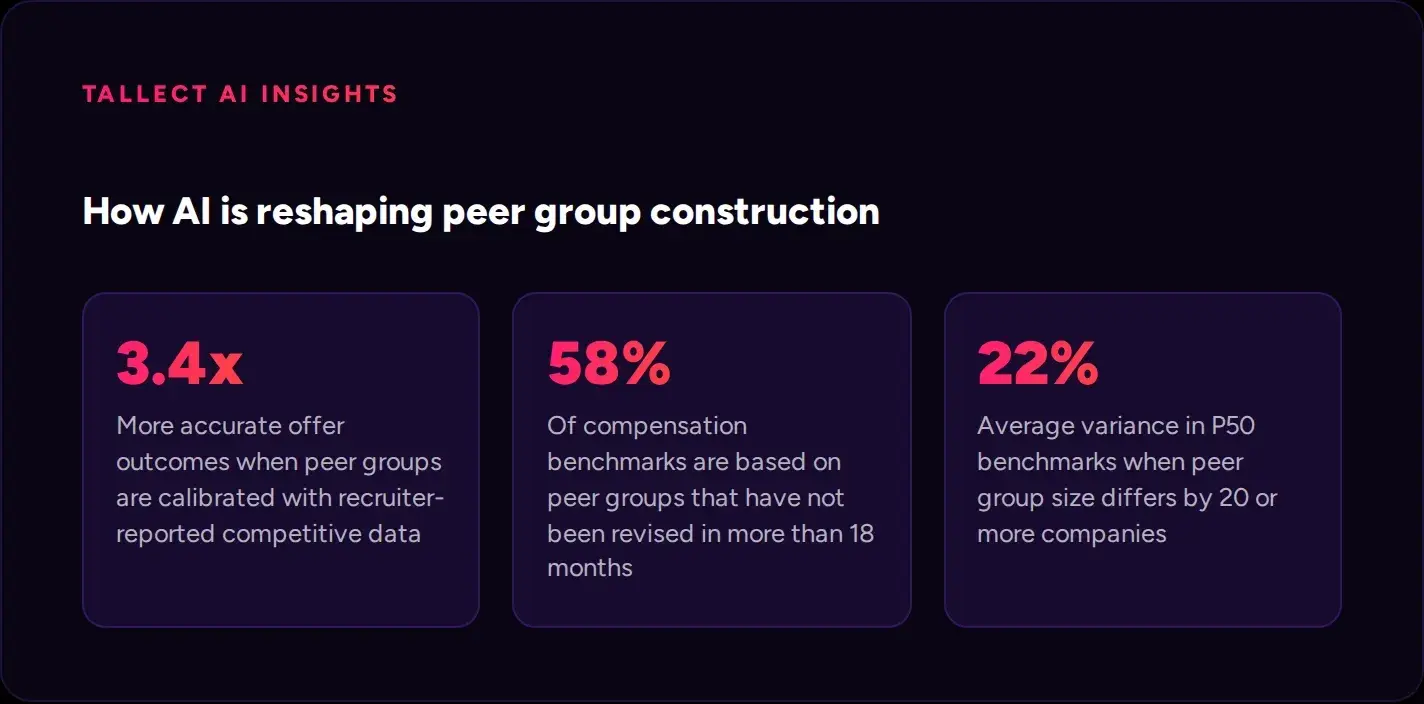
Tallect's AI engine maps your actual competitive landscape by analyzing offer acceptance and rejection patterns across your hiring history. It surfaces companies that appear repeatedly at offer stage and segments them by role family and seniority. It then recommends peer group configurations that reflect where you actually compete for talent rather than where you assume you do.
How many companies to include
There is no universal answer, but there are floor and ceiling considerations. Too few peers and your benchmarks are sensitive to individual company outliers. Too many and you dilute the signal by including companies that are genuinely not competing with you for the roles you are trying to benchmark.
A reasonable range for a single peer group is 20 to 60 companies for general benchmarking. For highly specialized roles in narrow labor markets, you may need to accept a smaller group and supplement with alternative data sources. For broad job families like operations or marketing, you may find that a larger group with tighter dimension filters produces more reliable results.
The more important consideration is whether the peer group size is consistent across the roles you are benchmarking. Inconsistent peer group sizes make it difficult to compare benchmarks across functions. They also create internal equity challenges that are hard to explain to employees.
The companies on your peer list should be the ones your recruiters are actually mentioning in debrief calls, not the ones that make your board deck look ambitious. — Kunal Chandra, Founder and CEO, Tallect
Dynamic peer group sizing
Static peer group definitions break down as your company grows and as the labor market shifts. Tallect continuously monitors peer group adequacy by tracking data confidence intervals for each role family. When peer group size drops below the threshold for statistically reliable benchmarks, the system flags the gap and suggests companies to add based on current competitive overlap signals.
Variation across role families
One of the most underappreciated complexities in peer group design is that the right peer group varies meaningfully by role family. Engineers in specialized domains compete in global or national labor markets. Customer success managers often compete in tighter regional markets. Finance and legal roles may compete against a mix of industry peers and large professional services firms.
A single peer group definition applied uniformly across all roles is almost certainly wrong for some portion of your workforce. In practice, define your peer group dimensions separately for each major role family. Then validate them with the recruiters who are closest to those markets.
- Engineering: wider geographic scope, tech-industry-specific peers, higher weight on funding stage and technical brand.
- Sales: industry vertical matters more, base/variable split norms vary widely, and regional market dynamics are significant.
- Corporate functions (HR, Finance, Legal): often compete against a mix of industry peers and large professional services firms; total compensation design differs significantly.
- Specialized technical roles (Data Science, AI/ML): extremely narrow labor markets and global competition; peers are often determined more by technical reputation than industry.
Role-level peer group segmentation
Tallect automatically segments peer group recommendations by role family, recognizing that the competitive landscape for engineers differs fundamentally from that for sales or operations roles. Each segmented peer group is calibrated against actual competitive data for that role type, rather than applying a single organizational peer group across all functions.
Validating your peer group
Once you have defined your peer group, validate it before running benchmarks against it. Validation means checking that the peer group produces benchmarks that correspond to what you observe in your actual labor market. Say your peer group tells you P50 for a senior engineer is $155K, but your competitive offers are landing at $185K. Then the peer group is miscalibrated, not the market.
Run a quick sense check across three vectors:
- Offer competitiveness: do your accepted offer rates improve at P50, or do you need to go to P75 to win?
- Turnover concentration: are departures concentrated in roles where your peer group may be systematically under-representing the market?
- Recruiter input: does your talent acquisition team recognize the companies on your list as actual competitors?
If any of these checks come back negative, revise the peer group definition before trusting the benchmarks it produces.

Frequently asked questions
How often should I update my peer group?
At minimum, annually. In practice, review peer group composition whenever your company goes through a significant change, such as a new funding round, an acquisition, a major headcount expansion, or a shift in hiring geography. Peer groups that lag these changes produce benchmarks that are accurate for the company you were, not the company you are.
Should my compensation peer group match my recruiting brand peer group?
Not necessarily. Your recruiting brand peer group reflects who you want to be compared to in the talent market. Your compensation peer group should reflect who you actually compete with for talent. These overlap but are not identical. Conflating them tends to inflate compensation benchmarks based on aspirational rather than actual competition.
What if my peer group is too small for statistical reliability?
You have a few options:
- Loosen one of your peer group dimensions, typically size or geography, to grow the group.
- Use a broader industry benchmark as a secondary reference and weight it against your primary peer group.
- Supplement survey data with job posting data, which often has better coverage for specialized roles.
Acknowledge the limitation and do not treat the resulting benchmarks as more reliable than they are.
Can I use different peer groups for different decisions?
Yes, and in many cases you should. Your peer group for setting base salary bands may reasonably differ from your peer group for equity benchmarking. Equity competition is often more concentrated in specific company types, such as high-growth, venture-backed firms, than base salary competition. The key is being explicit about which peer group applies to which decision, so your benchmarks are internally consistent.
How do I handle companies that are borderline inclusions?
Run the benchmarks with and without the borderline companies and check whether their inclusion materially changes the result. If including them moves P50 by more than 5 to 8 percent, you have a material peer group decision to make. If their inclusion changes nothing material, include them for coverage and note them as secondary peers in your methodology documentation.
Do I need to disclose my peer group methodology to employees?
It depends on your pay transparency commitments. If you tell employees that pay is benchmarked to a specific percentile, they may reasonably want to know what that percentile is measured against. The cleaner approach is to document your methodology internally in enough detail to explain and defend your peer group choices. Be prepared to share the framework, if not the full company list, with employees who ask.
What is the difference between a peer group and a comparison group?
In practice these terms are often used interchangeably. Some practitioners do separate them: a peer group is the companies you directly compete with for talent, while a comparison group is a broader set used for trend analysis. For compensation benchmarking, the peer group definition matters more. You want the set of companies your candidates are actually considering, not a broad market average.
How do I build a peer group without hiring data?
Start with a hypothesis-based peer group built on industry, stage, size, and geography. Then validate it quickly by asking your recruiters what companies candidates are interviewing with, and by checking LinkedIn for where your early hires came from. Within two to three hiring cycles you will have enough signal to refine the group based on actual competitive data rather than assumptions.
Should I include companies that set market norms but rarely compete with us?
Only if you are willing to accept that their compensation norms will influence your benchmarks. Large, high-paying anchor companies, such as major tech firms and large financial services companies, can skew benchmarks significantly if included in a peer group for a smaller company. A better approach is to track what those companies pay separately as a market ceiling reference, without including them in your primary benchmarking peer group.
How does remote work affect peer group geography?
For roles that are genuinely remote-eligible across your organization, expand your geographic filter to include companies that are competing for the same remote talent pool. In practice this means your peer group may shift from a regional set to a national or global set for certain role families. For roles that are location-specific, your geographic filter should remain narrow.
What if our recruiters disagree about who our competitors are?
That disagreement is useful information. It often reflects genuine variation in competitive dynamics across role families or geographies. Rather than resolving the disagreement by picking a winner, use it as a signal that you need role-family-specific peer group definitions rather than a single organizational peer group. Let the recruiters closest to each market define the competitive set for that market.