Keeping HR Policies Consistent Across Many Countries
How growing organisations build a layered HR policy architecture that holds together across borders while respecting local employment law.
When a company operates in one country, HR policy is a paperwork problem. When it operates in twelve, it becomes a strategic one. The cost of getting it wrong shows up in tribunal rulings, audit findings and the kind of employee confusion that quietly erodes trust.
Most organisations instinctively reach for one of two extremes:
- Centralise everything. One global handbook that ignores local nuance.
- Decentralise everything. Each country team writes its own policies and nobody compares notes.
Neither works well past a certain scale. What works is a layered architecture: a global floor of non-negotiable principles, with structured room for local adaptation built in from the start.
This article sets out how to build that architecture and keep it working as headcount grows.
Why consistency is harder than it looks
Most HR leaders know in the abstract that employment law differs between countries:
- Germany’s Works Constitution Act gives employee representatives formal co-determination rights over certain policy changes.
- French labour law sets specific procedures for disciplinary matters.
- UK employment tribunals apply reasonableness standards quite different from what a US at-will framework assumes.
What gets underestimated is how far these differences reach into policy text. A grievance policy written with one legal system in mind may be unenforceable, or even create liability, in another. The challenge is not just knowing that the rules differ. You also need to know which parts of your policies reflect universal principles, and which embed assumptions that only hold in one place.

Six consistency challenges teams face
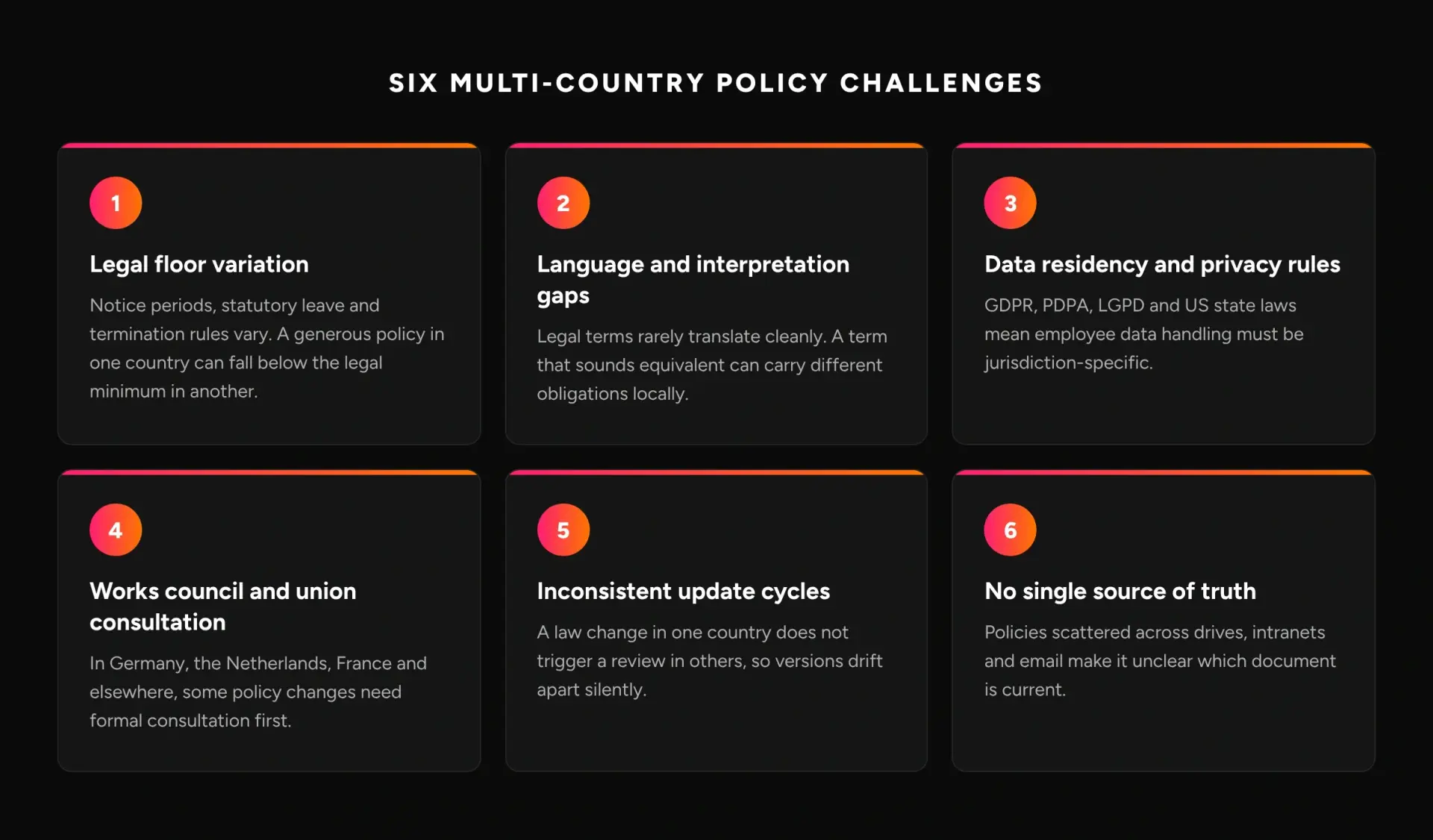
- Legal floor variation. Minimum notice periods, statutory leave entitlements and termination procedures vary widely. A policy that is generous in one country may fall below the legal minimum in another.
- Language and interpretation gaps. Translated policies carry translation risk. Legal terms do not always have direct equivalents, and a term that sounds equivalent may carry different obligations locally.
- Data residency and privacy rules. GDPR in Europe, PDPA in Singapore, LGPD in Brazil and various US state laws mean that how you handle employee data must be jurisdiction-specific. So must what your policies say about it.
- Works council and union consultation. In Germany, the Netherlands, France and elsewhere, some policy changes need formal consultation with elected employee representatives before they can take effect.
- Inconsistent update cycles. When each country manages its own version, a law change in one jurisdiction does not trigger a review in the others. The versions then drift apart without anyone noticing.
- No single source of truth. When policies sit in shared drives, intranets and email threads across countries, it becomes unclear which document is current, for employees and auditors alike.
Building a layered policy architecture
The practical solution is to separate what must be consistent from what must be local, and to make that separation explicit in how policies are structured. A workable framework has three layers.
Layer 1: Global standards
These are the principles and commitments that apply identically everywhere. They reflect company values, ethical commitments and obligations that apply to the whole company, wherever employees sit. Examples include:
- anti-corruption
- data handling principles
- the code of conduct
- whistleblower protections
This layer should not contain jurisdiction-specific procedural detail.
Layer 2: Regional adaptations
Some regions share a legal framework, and the EU is the clearest example. A regional layer lets you write one adaptation that serves several countries, without a separate document for each. GDPR provisions, for instance, can be handled once at European level rather than repeated twelve times.
Layer 3: Country-specific provisions
This layer covers what is genuinely local:
- statutory entitlements
- required procedures
- mandatory notice periods
- consultation obligations
These provisions reference and build on the global and regional layers rather than standing alone.
How global frameworks handle local variation
The OECD Guidelines for Multinational Enterprises (2023 update) recommend that multinationals adopt a consistent global framework for core labour standards. Those standards include freedom of association, non-discrimination and fair wages. Multinationals should still observe local legal requirements wherever they go beyond that floor.
The ILO’s Tripartite Declaration of Principles concerning Multinational Enterprises makes a similar split. It separates universal principles, which always apply, from procedural provisions, which are adapted by jurisdiction.
Both frameworks support the layered model: a shared foundation is achievable and expected, but procedural uniformity across every country is not.
Global, local or hybrid
The hardest editorial work in a multi-country policy review is deciding where each provision belongs. This framework helps teams make that call systematically.
Policy area | Approach | Rationale |
|---|---|---|
Code of conduct and ethics | Global | Reflects company values and must be identical everywhere |
Anti-bribery and corruption | Global | The UK Bribery Act 2010 and US FCPA apply extraterritorially |
Annual leave entitlement | Local | Statutory minimums vary: five weeks (25 days) in France, no federal minimum in the US |
Disciplinary procedures | Hybrid | Principles are global; specific steps and timelines are local |
Parental leave | Local | Statutory provisions vary enormously; company enhancements can be global |
Data handling and privacy | Hybrid | Principles are global; specific obligations (GDPR, PDPA, LGPD) are regional or local |
Termination procedures | Local | Notice periods, severance and fair-reason requirements differ by jurisdiction |
Flexible working | Hybrid | Eligibility principles are global; statutory rights, such as the UK’s flexible working law, are local |
Caption: Where common HR policy areas sit in a layered architecture.
Keeping policies consistent over time
Architecture only works if it is maintained. Most multi-country policy problems are not design failures at launch. They are maintenance failures in the months and years afterwards, as laws change, headcount grows and the people who designed the original structure move on.
Three practices make ongoing maintenance sustainable.
Assign clear ownership at each layer
The global layer needs an owner, usually the CHRO or Global HR Director. That person keeps the global layer current and makes sure country layers stay aligned with it. Each country layer needs a local owner who tracks law changes and raises anything that affects local provisions.
Keep a change log from day one
Every change to every policy document should record a date, a reason and an approver. Without that, nobody can tell what the policy said at the time of a particular event, whether during an audit or after a dispute. Auditors routinely ask for evidence that policies existed and were communicated at specific points in time.
Run periodic cross-country reviews
At least once a year, the global and regional owners should pull the full policy inventory and check for drift: places where country versions have moved away from the global layer without anyone intending it. A law change in one country may have implications for others that nobody picked up at the time.
How Tallect surfaces cross-country policy drift
Tallect monitors the policy inventory across all jurisdictions and flags divergence that needs review:
- Related-policy checks. When a country policy is updated, Tallect’s AI scans other countries’ policies for provisions on the same subject and flags them for a consistency check.
- Translation drift. Semantic analysis compares the intent of provisions across language versions and flags translated text that may have drifted from the source meaning.
- Below-standard provisions. The system detects when a country provision falls below the current global standard, for example a local document that still references a superseded global commitment.
- Ownership gaps. Country or regional policies with no owner review logged within a set period trigger alerts before the next audit cycle.
- Statutory changes. When a statutory change is logged, Tallect identifies the country provisions that cover the affected area and queues them for review by a lawyer or HR owner.
[Upload image: office-company-policies-boards.webp | Alt: An open-plan office with company policy boards displayed between rows of desks.]
Works councils and consultation
In many European jurisdictions, some policy changes cannot simply be announced. They must first go through formal consultation with elected employee representatives. Germany’s Betriebsrat, France’s Comité social et économique and the Netherlands’ Ondernemingsraad each have consultation rights over changes that affect working conditions.
Failing to consult when required creates legal exposure. It can also make the policy change unenforceable in that jurisdiction, even if it was lawfully adopted everywhere else. Consultation can take weeks or months, depending on the change and the representatives involved.
In practice, global policy update timelines need to include consultation lead times for the affected jurisdictions. Suppose a company rolls out a global update with a two-week implementation window. That timeline will not work in Germany or France unless consultation has already been completed.
Multi-country policy management in Tallect
- Policy library. Stores global, regional and country policies in one version-controlled repository, with clear parent-child links between layers.
- Jurisdiction tagging. Each provision is tagged by jurisdiction, so a change to the global layer automatically surfaces the country documents that need review.
- Consultation tracking. Works council and union consultation requirements are logged per country. Tallect sends automatic reminders when a planned change triggers a consultation obligation.
- Audit trail. Every policy version is kept with its timestamp, approver and reason for change. Auditors can access it without manual retrieval.
What employees actually need
A well-designed policy system is invisible to most employees. What they need is a simple answer to a simple question: which rules apply to me, right now, in my country?
That answer should be one click away, not buried in a global handbook with footnotes pointing to country annexes. The best systems give each employee a personalised policy view based on their location and role. A manager in the Netherlands sees the policies that apply in the Netherlands. They are not left reading around pages of American legal assumptions to find the European carve-outs.
This is not a cosmetic concern. When employees cannot easily find the policies that apply to them, they either stop trying or apply the wrong policy to their situation. Both create risk.
Key takeaways
- Layers are the only sustainable model. A global floor, regional adaptations and country-specific provisions are what make multi-country HR policy manageable.
- Make the global–local split explicit. Build the distinction into policy structure rather than managing it informally through footnotes or exceptions.
- Maintenance matters more than design. Assigned ownership, change logs and periodic cross-country reviews matter more than the initial design.
- Build in consultation time. Jurisdictions with works councils or union consultation obligations need lead time in policy update timelines.
- Give employees a local view. Employees need a personalised policy view for their location, not a global document they must interpret.
- Auditors want history. They expect evidence that policies were current, communicated and version-controlled at specific points in time, not just that policies exist today.
Frequently asked questions
What is a layered HR policy architecture?
It separates policies into three layers:
- Global standards. These apply identically everywhere, such as the code of conduct and anti-corruption.
- Regional adaptations. These serve several countries with shared law, such as GDPR across the EU.
- Country-specific provisions. These cover genuinely local rules, such as statutory leave and notice periods.
Should HR policies be centralised or decentralised?
Neither extreme works well at scale. A single global handbook ignores local law, and fully separate country policies drift apart. A layered model combines a global floor of principles with structured room for local adaptation.
Which HR policies should be global?
Policies that reflect company values or apply to the whole company wherever employees sit. Examples are the code of conduct, anti-bribery and corruption, data handling principles and whistleblower protections. Anti-bribery is global partly because the UK Bribery Act 2010 and the US FCPA apply extraterritorially.
Which HR policies should be local?
Policies driven by statutory rules that vary by country. Examples are annual leave entitlement, parental leave and termination procedures, including notice periods, severance and fair-reason requirements.
What is a hybrid policy?
A hybrid policy keeps the principles global and puts the specific steps or obligations at country or regional level. Disciplinary procedures, data privacy and flexible working are common examples.
Why do translated HR policies create risk?
Legal terms do not always have direct equivalents. A term that sounds equivalent may carry different obligations locally, so a translated policy can drift from the intent of the original.
Do policy changes need works council approval?
In many European countries, some changes need formal consultation with elected employee representatives first. Germany, France and the Netherlands are examples. Skipping consultation where it is required creates legal exposure. It can also make the change unenforceable in that country.
How often should multi-country policies be reviewed?
At least once a year, the global and regional owners should review the full policy inventory for unintended drift between country versions and the global layer. Each country owner should also track local law changes as they happen.
What should a policy change log record?
Every change should record the date, the reason and the approver. Auditors routinely ask for evidence of what a policy said, and how it was communicated, at a specific point in time.
How should employees access multi-country policies?
Through a personalised view based on their location and role, ideally one click away. Employees should not have to read a global handbook and work out which country annexes apply to them.
One policy platform for every country
Tallect keeps your global HR policies version-controlled, jurisdiction-tagged and audit-ready, so consistency is a feature of your system, not a manual effort.