
Version Control for HR Policies and Why Auditors Ask About It
Auditors want to know what your policy said on a given date, who approved it and how it was shared. Here is how to answer them.
Most HR teams know they need written policies. Fewer have thought about what it means to have a policy, as opposed to simply having a document. The difference matters in three situations:
- when you face an audit
- when you defend a dismissal
- when a data privacy regulator asks what your retention policy said eighteen months ago
Version control means treating your policies as records. In practice, that means three things:
- creating a dated, numbered version whenever something changes
- keeping the history of what the policy said at each point in time
- recording who approved each change and why
It is standard practice in software development. In HR, it is still surprisingly rare.
This article explains why that gap creates risk, what auditors actually look for, and how to close the gap without turning every policy update into a bureaucratic exercise.
What version control means for HR
In software, version control is a formal discipline. Tools like Git preserve the full history of every change to a codebase. HR does not need that level of technical sophistication, but the logic is the same. For any policy document, you want to be able to answer:
- What is the current version, and when did it take effect?
- What did the previous version say, and when was it replaced?
- Who reviewed and approved this version?
- Was this version communicated to employees, and do we have evidence of that?
- What triggered the change: a law update, a business decision or an audit finding?
A version-controlled policy system can answer all of these quickly. One without version control often cannot answer any of them reliably.
What a version record contains
Each version of a policy should carry enough information to answer those questions. Nobody should have to rebuild the history from memory or email threads.
Field | What it records |
|---|---|
Version number | A sequential identifier (v1.0, v1.1, v2.0) or date-based reference that makes the order of versions clear |
Effective date | The date from which this version applied, which is distinct from when it was drafted or approved |
Superseded date | The date this version was replaced by the next one (blank for the current version) |
Author or owner | The person or team responsible for the content of this version |
Approver | The person or body that formally approved this version for publication |
Change summary | A short description of what changed from the previous version, and why |
Jurisdictions | The countries or entities this version applies to, if you operate in more than one |
Communication record | Evidence that employees were told about this version, with dates, ideally linked to acknowledgement records |
Caption: The fields a complete HR policy version record should include.
What auditors look for
“Auditor” covers a lot of ground:
- Internal audit checks that policies are properly maintained as part of risk management reviews.
- External auditors check certain HR policies during financial audits under IFRS or US GAAP. These are policies that affect accounting estimates, such as bonus structures, leave accruals and share-based payments. Auditors check that they are documented and have appropriate controls.
- Employment lawyers and tribunals are not auditors in the formal sense, but they ask the same kinds of questions when disputes arise.
In all of these settings, the questions cluster around the same six concerns.
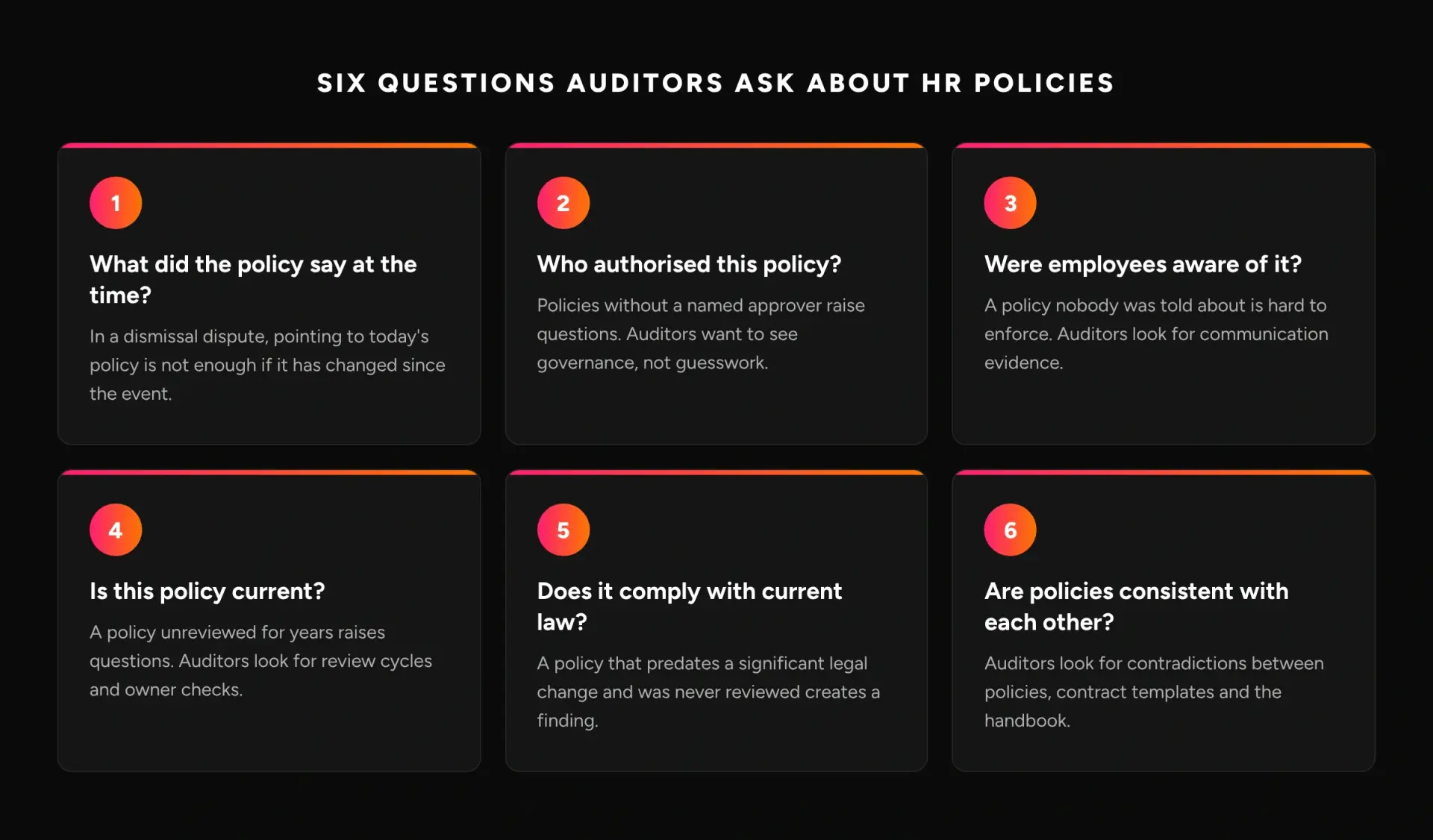
What did the policy say at the time?
In a dismissal dispute, the question is whether the policy in force at the time of the event was followed. If the policy has changed since, pointing to the current version is not enough.
Who authorised this policy?
A policy without a named approver raises questions about whether it reflects company decision-making or one person’s view. Auditors want to see governance, not guesswork.
Were employees aware of it?
A policy employees were never told about is hard to enforce and hard to rely on in a dispute. Auditors and tribunals look for evidence of communication alongside the policy text.
Is this policy current?
A policy that has not been reviewed in several years raises questions. Auditors look for review cycles and evidence that owners have checked the policy is still accurate.
Does it comply with current law?
Where the law has changed, auditors expect policies to have been updated. A policy that predates a significant legal change and has not been reviewed creates a finding.
Are policies consistent with each other?
Auditors look for internal contradictions. One policy may say something different from another, or an HR policy may conflict with a contract template or the employee handbook.
When audit standards reference HR documentation
ISO 9001:2015. The quality management standard requires documented information to be controlled. Documents must stay legible, obsolete versions must be identified and kept from unintended use, and changes and current revision status must be identified. ISO 9001 covers quality systems broadly, but many organisations extend the same discipline to HR policies within their certification scope.
The Sarbanes-Oxley Act. Sections 302 and 404 require public companies to maintain adequate internal controls over financial reporting. That includes controls over HR processes that affect the financial statements, such as payroll, bonus and equity. In a SOX review, auditors will typically ask for the current version of the relevant HR policies. They may also ask for the version history, to confirm the controls were in place at period-end.
Building the practice step by step
- Version everything you have now.
- Create a policy register.
- Define an approval workflow.
- Keep superseded versions.
- Link versions to employee communications.
- Schedule regular reviews.
1. Version everything you have now
Treat your current policy documents as version 1.0, or whatever version fits, with notes on any earlier history you know about. Date them, name their owners and log them in a central register. This baseline is your starting point. It does not need to be perfect, but it needs to exist.
2. Create a policy register
A policy register lists every active policy document with five details:
- its current version
- its owner
- its last review date
- its next scheduled review date
- its status
Auditors use the register to judge whether your policy management is systematic rather than ad hoc. A shared spreadsheet can work at small scale. A dedicated platform works better as you grow.
3. Define an approval workflow
For each category of policy, decide who must review and approve changes. A change to the travel expense policy might need finance and HR sign-off. A change to a disciplinary procedure might need legal and the CHRO. Document these workflows and follow them consistently. Approvals that happen over email and are never formally recorded do not count as an audit trail.
4. Keep superseded versions
When a policy is updated, never delete or overwrite the old version. Keep it, clearly marked as superseded, with its effective and superseded dates recorded, so it is available when needed. Disputes and audits often concern past periods, not the current state of your policies.
5. Link versions to employee communications
When a policy changes, record how and when employees were told. Each of these creates evidence:
- an email to all staff with the new policy attached
- a mandatory acknowledgement in an HR system
- an update published in the employee portal
Linking the policy version to the communication record lets you show two things: that the policy existed, and that employees knew about it.
6. Schedule regular reviews
Review a policy periodically even if it has not changed, to confirm it is still accurate and compliant. Annual reviews suit most policies. Areas of fast regulatory change, such as data privacy and flexible working, may need more frequent checks. Log the review itself, even when nothing changes. That log shows active management rather than passive neglect.
How Tallect automates version control
Manual version discipline works while someone is actively doing it and breaks down when they are not. Tracking changes, archiving old versions and logging approvals all depend on that person. Tallect builds version control into the policy workflow itself:
- Automatic versions. Every change to a policy creates a new version automatically. It records the timestamp and the editor, and prompts for a change summary, so changes are less likely to go unlogged.
- Retrieval by date. Superseded versions are kept and retrievable by date range. Answering “what did this policy say on 14 March 2023?” takes a search, not a hunt through archives.
- Built-in approvals. Changes need sign-off from the configured approvers. The approval is logged against the version record, not left in an email inbox.
- Review alerts. The AI flags policies nearing their scheduled review date, and those where the owner has not logged a review in the expected period. Those gaps get caught before auditors find them.
- Linked communications. When a policy update is shared with employees through the platform, the distribution is logged against that version. That creates an integrated audit trail.

The most common failures
Most organisations with version control problems do have a system. It is an informal one that breaks down under pressure. These are the most common failure patterns.
The working document problem
Policies sit in shared drives under names like “Anti-Harassment Policy FINAL v3 UPDATED.docx”. With no formal versioning, you cannot tell which version was active on a given date without digging into file metadata. That metadata is easily lost or corrupted when files are moved or renamed.
The email approval problem
Policy changes are approved over email, but the emails sit in someone’s inbox, not attached to a policy record. When that person leaves, or their inbox is cleared, the evidence of approval disappears. The policy exists, but the approval trail does not.
The one-version problem
Superseded policies are deleted when new versions are published. The organisation can show what its current policy says. It cannot show what the policy said at the time of the event now in dispute.
The no-communication-record problem
Policy updates go out by email with no acknowledgement process, so nobody knows whether employees received and read them. If an employee later claims not to have known about the policy, the organisation cannot show otherwise.
Version control features in Tallect
- Automatic versioning. Every saved change to a policy creates a new version record, keeping the full edit history without manual effort.
- Historical retrieval. Any past version of any policy can be retrieved by date, version number or approver. Audit responses that used to take hours take minutes.
- Approval log. Each version carries a complete approval record: who was asked to review, who approved and when. The record is linked to the policy text rather than held separately in email.
- Communication tracking. Policy distributions are recorded against the relevant version. You can show that whichever version was in force at a given time had been communicated to employees.
Key takeaways
- Version control answers three questions about any policy. What did it say on any past date, who approved it, and how were employees told?
- Auditors ask about version history in four settings: employment disputes, data privacy audits, SOX compliance reviews and ISO certification assessments.
- The usual failure is an informal system, not no system. Shared drive files and email approvals break down over time or under scrutiny.
- Keep superseded versions, never delete them. Disputes often concern past periods, when the current policy is irrelevant.
- Attach approvals to versions. Approval records belong with the policy version, not in email inboxes that change hands when people leave.
- Log every review, including no-change reviews. The log shows the policy inventory is actively managed.
Frequently asked questions
What is version control for HR policies?
It means treating policies as records. You create a dated, numbered version whenever something changes, keep the history of what each version said, and record who approved each change and why.
Why do auditors ask about HR policy versions?
Disputes and audits often concern past periods. Auditors and tribunals want to know four things:
- what the policy said at the time
- who approved it
- whether employees were told about it
- whether it was current and compliant
What should a policy version record include?
A complete record has eight fields:
- version number
- effective date
- superseded date
- owner
- approver
- change summary
- the jurisdictions it covers
- a communication record showing employees were told
Should old versions of HR policies be deleted?
No. Keep superseded versions, clearly marked, with their effective and superseded dates. If old versions are deleted, the organisation cannot show what its policy said at the time of an event in dispute.
Are email approvals enough for an audit trail?
Usually not. Approvals that sit in someone’s inbox can disappear when that person leaves or the inbox is cleared. Record each approval against the policy version it applies to.
What is a policy register?
A policy register lists every active policy with its current version, owner, last review date and next scheduled review date. Auditors use it to judge whether your policy management is systematic.
How often should HR policies be reviewed?
Annually suits most policies. Fast-changing areas such as data privacy and flexible working may need more frequent checks. Log every review, even when nothing changes.
How do you prove employees knew about a policy?
Link the policy version to a communication record. That could be an all-staff email with the policy attached, a mandatory acknowledgement in an HR system or an update in the employee portal. Then record the date.
Does ISO 9001 apply to HR policies?
ISO 9001:2015 requires documented information within a quality management system to be controlled, including version identification and handling of obsolete versions. Many organisations extend the same discipline to HR policies within their certification scope.
How does SOX relate to HR policies?
Sarbanes-Oxley sections 302 and 404 require public companies to maintain internal controls over financial reporting. That covers HR processes that affect the financials, such as payroll, bonus and equity. Auditors may ask for policy version history to confirm the controls were in place at period-end.
Audit-ready HR policies, built in
Tallect keeps a complete version history for every policy document, so when auditors ask, the answers are already there.