Elder Care and Caregiving Benefits for Your Workforce
More employees now care for ageing parents alongside their jobs. Here is how to design caregiving benefits that people actually use.
For years, the conversation about working caregivers focused almost entirely on childcare. That is understandable. Childcare is expensive and its timing is predictable, because most employees become parents in their late twenties and thirties. It has also attracted significant policy attention in most developed economies. But the picture is increasingly incomplete.
Elder care means supporting an ageing parent, spouse or other relative who can no longer live fully independently. It is a growing workforce issue in every industry and at every level of seniority. The demographics are straightforward: in most OECD economies the population is ageing and life expectancy has risen. Employees who were once the youngest in their families are now the generation supporting parents in their seventies, eighties and beyond.
The business impact is real. Employees with elder care responsibilities often:
- reduce their hours
- decline relocations
- miss work for care emergencies
- eventually leave roles that cannot accommodate them
Building benefits that address this is not charity. It is a retention and productivity lever that most total rewards teams have not yet fully pulled.
Who counts as a carer
“Carer” or “caregiver” covers a wide range of situations, which is one reason benefit design is harder than for childcare. At one end are employees who spend a few hours a week helping an elderly relative with practical tasks, such as shopping, transport and appointments. At the other end are employees who provide intensive personal care, may live with the person they care for, and are effectively running a second household. Most carers fall somewhere in between.
Elder care is the most common form. But the carer workforce also includes employees supporting disabled or chronically ill adult relatives, and those caring for disabled adult children beyond the usual childcare years. The design challenge is to help meaningfully across this whole range, without making employees prove the most intensive version of their situation to qualify.
What caregiving benefits look like
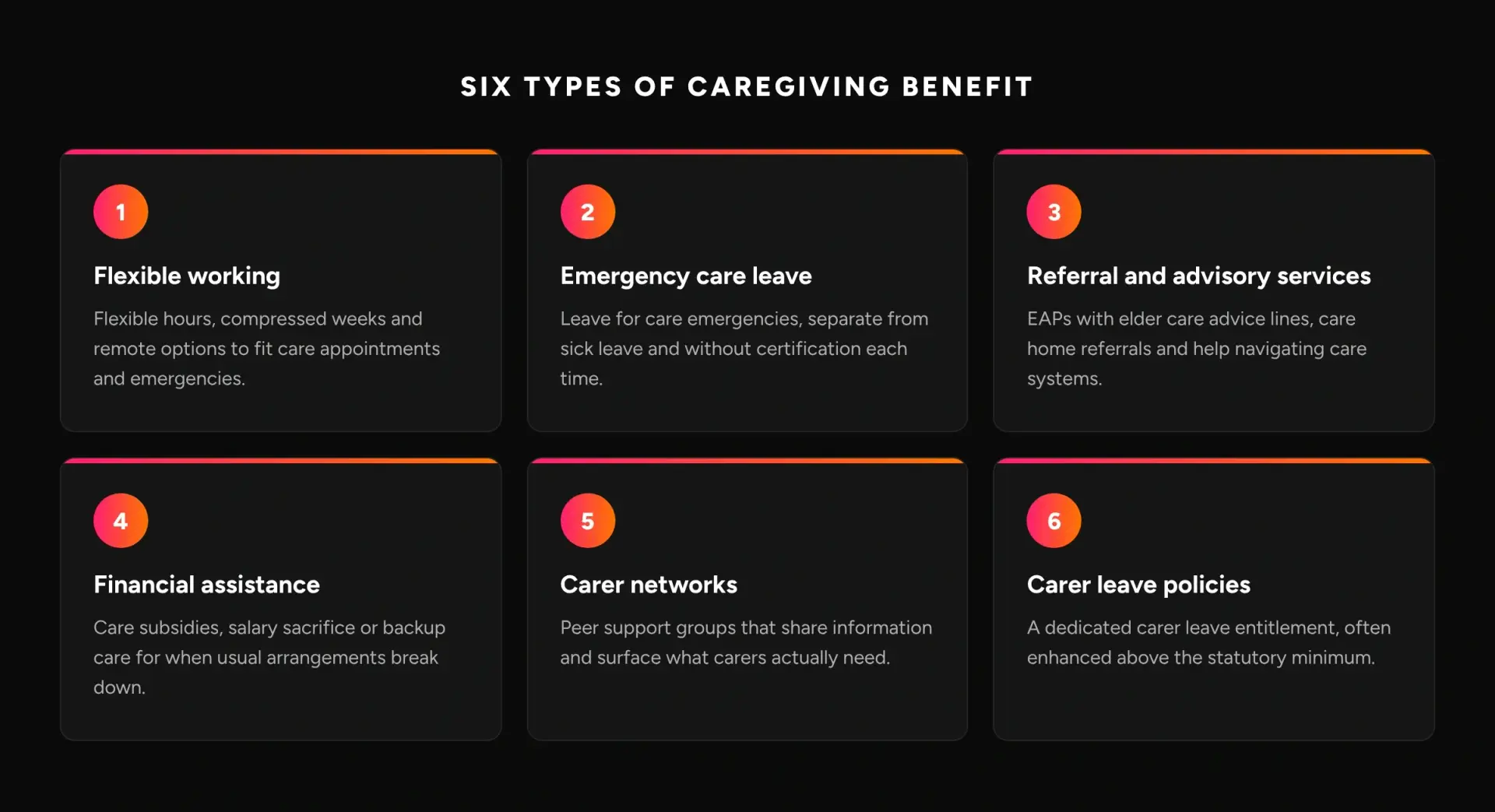
Flexible working arrangements
Flexible hours, compressed weeks and remote work let employees attend care appointments, handle unpredictable emergencies and fit their working day around their care. Carers often rate flexibility as more valuable than financial support (source needed).
Emergency care leave
This is paid or unpaid leave for care emergencies, separate from general sick leave. Some organisations offer a set number of care emergency days a year, without needing medical certification each time.
Referral and advisory services
Some employee assistance programmes (EAPs) offer specialist elder care support:
- elder care advice lines
- care home referral services
- guidance on navigating care systems
They help employees find the right care arrangements without spending their own working hours on research.
Financial assistance
This is direct support towards care costs, in one of three forms:
- Salary sacrifice arrangements
- Employer-paid care subsidies
- Backup care: short-term professional care that steps in when usual arrangements break down. It is the elder care equivalent of emergency childcare.
Carer networks and peer support
Internal employee resource groups for carers offer peer connection. They also give the employer a channel to share information about benefits and policy updates. Networks surface what employees actually need, which feeds back into benefit design.
Carer leave policies
This is a dedicated carer leave entitlement, separate from other leave types. Employees can use it without classing it as sick leave or annual leave. Some jurisdictions now have statutory carer leave, and many employers offer more than the statutory minimum.
What the law requires
Statutory carer rights vary widely. Some jurisdictions have explicit carer leave. In others, carers rely on general flexible working rights or unpaid emergency leave. The table covers the main frameworks as of 2024, so check for later changes before relying on it.
Jurisdiction | Statutory carer provision | Notes |
|---|---|---|
UK | Carer’s Leave Act 2023: one week of unpaid carer’s leave a year, from April 2024 | Covers employees with a qualifying care relationship, from day one. The right to request flexible working is also a day-one right from April 2024 |
EU | Work-Life Balance Directive (2019/1158): at least 5 working days of carers’ leave a year | Implementation varies by member state. The transposition deadline was August 2022 |
Germany | Pflegezeitgesetz (Care Leave Act): up to 6 months’ leave to care for a close relative | Up to 10 days’ short-term absence for acute care emergencies. Longer leave can be combined with Familienpflegezeit |
Japan | Family care leave: up to 93 days in total per family member | Can be split into up to 3 periods. Family care leave benefits are paid through employment insurance |
Australia | Fair Work Act: 10 days’ paid personal/carer’s leave a year (full-time) | Carer’s leave comes from the same pool as sick leave. Employees can also take 2 days’ unpaid carer’s leave and 2 days’ compassionate leave per occasion, paid for permanent staff |
USA | FMLA: up to 12 weeks’ unpaid leave to care for a parent, spouse or child with a serious health condition | Employers with 50+ employees; employees need 12 months’ service and 1,250 hours. Some states, such as California and New York, offer paid family leave |
Canada | Employment Insurance: Family Caregiver Benefit for Adults, up to 15 weeks | Paid at 55% of insurable earnings, up to a maximum. Job-protected leave rules vary by province |
Caption: Statutory carer provisions in seven major jurisdictions, as of 2024.
Why elder care is a growing workforce issue
Across OECD economies, workforce participation among people aged 45 to 64 is high and growing. At the same time, more people in that group have parents in their eighties (source needed). That creates a caregiving pinch point. It hits employees just as they tend to be in senior roles, when they are most expensive to replace.
Carers UK, which runs the Employers for Carers network, estimates from carer surveys that a substantial share of carers are of working age (source needed). Exact figures vary by country and survey method.
The demographic data points one way: the overlap between employment and elder care is growing, not shrinking, in most developed economies. For workforce planning, the implication is clear. Even an employer without many elder carers today will almost certainly have them within the next five to ten years.
Building a benefit people use
The most common failure in caregiving benefits is low use. The programme exists on paper and is listed in the benefits handbook, but the employees who need it do not know about it. This is partly a communication problem and partly a cultural one.
The cultural barrier
Many employees with caring responsibilities do not see themselves as “carers”. They see a family obligation, not something that warrants workplace support. They may be reluctant to disclose something that feels personal, especially where disclosure might look like a request for special treatment. Benefits that require formal registration as a carer, or documents for every use, add friction that keeps uptake low.
The organisations that get the most use from caregiving benefits make care responsibilities a normal topic. They do it in three ways:
- training managers
- having senior employees talk openly about their own situations
- running carer networks that make the topic feel less exceptional
The visibility problem
Emergency care resources need to be found quickly, under stress, in the middle of an unexpected care situation. A benefit that takes three minutes of portal navigation to find is less useful than one pinned at the top of the relevant section with clear signposting. When you design the benefit, ask how an employee in a care emergency would find and use it. That is a useful test.
Manager awareness
Line managers are usually the first point of contact when an employee is dealing with a care situation. If managers do not know what support exists, or have not been trained for sensitive conversations, they cannot point employees to the right help. Briefing managers on caregiving benefits costs little and directly lifts uptake.
How Tallect surfaces caregiving benefit use
Most HR teams struggle to pull together the data needed to understand how caregiving benefits are used, and where the gaps are. Tallect provides continuous visibility:
- Utilisation analysis. Tallect tracks uptake across caregiving-related benefits, such as flexible working requests, carer leave and EAP contacts. It shows whether benefits are reaching the people who need them or sitting unused.
- Segmentation. Some employee groups may be underusing support, such as senior roles, certain countries or longer-tenured staff. That may point to awareness or cultural barriers rather than a lack of need.
- Retention links. The AI looks for patterns between carer leave, flexible working requests and later retention. HR teams can then make the case for investment using their own workforce data.
- Cost modelling. Tallect compares the cost of enhanced caregiving support with estimated turnover costs in the relevant employee segments, giving benefit decisions a data-based footing.
- Cross-country comparison. Tallect flags where the same benefit is structured differently across countries, exposing inconsistencies that may create equity issues between locations.
Caregiving in total rewards strategy
Caregiving benefits are often treated as a welfare or wellbeing matter rather than a total rewards question. That framing undersells their retention value and makes them harder to fund. A more useful frame is that they reduce a specific attrition risk. That risk is losing experienced employees who cannot manage both their job and their care responsibilities. It is concentrated in the employee groups that are most expensive to replace.
Employees in their forties and fifties have built up institutional knowledge, client relationships and technical expertise. They are also the group most likely to be caring for an ageing parent. Losing them to a competitor with more accommodating caregiving policies is a real loss of talent and knowledge, even if it is hard to quantify.
A total rewards statement can show caregiving support alongside health insurance, pension contributions and other valued benefits. That signals the organisation has thought about the whole employee experience, not just the working day.
Caregiving benefits in Tallect
- Total rewards visibility. Caregiving benefits appear in total rewards statements alongside pay, so employees see the full value of their package. These include flexible working, leave entitlements, EAP access, backup care and financial support.
- Statutory compliance tracking. Carer leave law keeps changing, as with the UK Carer’s Leave Act and the EU Work-Life Balance Directive. Tallect tracks statutory minimums by country and flags where employer provisions need updating.
- Leave management. Carer leave is managed in the same system as other leave types, with clear categories and employee access. Employees know what they are entitled to, and managers can approve requests without policy uncertainty.
- Benefit audits. HR teams can audit caregiving provisions across countries to find gaps, inconsistencies or places where the employer’s offering falls below the statutory minimum.
Key takeaways
- Elder care is growing. Demographic change is widening the overlap between employment and care responsibilities in most developed economies.
- Benefits range widely. They run from flexible working and emergency leave to financial help and specialist advice. Employees most consistently value flexibility.
- Statutory carer leave is spreading. It now exists in the UK (one week a year, from April 2024) and across the EU (at least 5 days under the Work-Life Balance Directive). Germany, Japan and Australia also have it, and it is increasingly appearing in North America.
- Low uptake is the main failure. It is often driven by reluctance to identify as a carer and by poor visibility of what is available.
- Manager awareness is a cheap lever. Training managers is low-cost and has a high impact on access to support.
- Frame it as retention. Caregiving benefits are best framed as a retention investment in experienced employees, not purely a welfare measure.
- Make it visible in statements. Total rewards statements that show caregiving benefits help employees see the full value of their package and signal the organisation’s intent.
Frequently asked questions
What are caregiving benefits?
Caregiving benefits support employees who care for an ageing, disabled or chronically ill relative. They include:
- flexible working
- emergency care leave
- elder care advice and referral services
- financial help such as care subsidies or backup care
- carer networks
- dedicated carer leave
Who counts as a carer at work?
Anyone supporting a relative who cannot live fully independently. That ranges from a few hours a week of practical help to intensive personal care. It includes elder care, care for disabled or chronically ill adult relatives, and care for disabled adult children.
Is carer’s leave a legal requirement in the UK?
Yes. Under the Carer’s Leave Act 2023, employees with a qualifying care relationship can take one week of unpaid carer’s leave a year, from April 2024. It is a day-one right.
What does the EU require for carers?
The Work-Life Balance Directive (2019/1158) requires member states to provide at least 5 working days of carers’ leave a year. The transposition deadline was August 2022, and implementation varies by country.
Is US family caregiving leave paid?
Not under federal law. FMLA gives up to 12 weeks of unpaid, job-protected leave to care for a parent, spouse or child with a serious health condition, at employers with 50 or more employees. Some states, such as California and New York, offer paid family leave.
What is backup care?
Backup care is short-term professional care that steps in when an employee’s usual care arrangements break down. It is the elder care equivalent of emergency childcare.
Why do caregiving benefits often go unused?
There are three main reasons:
- many employees do not see themselves as carers, or are reluctant to disclose
- the benefits are hard to find in a hurry
- managers do not know what support is available
How can employers increase uptake of caregiving benefits?
Make the topic normal through manager training, senior employees speaking openly and carer networks. Make emergency resources easy to find. Avoid requiring formal registration or documents for every use.
Why should total rewards teams care about elder care?
Elder care responsibilities are concentrated among employees in their forties and fifties. They hold much of the organisation’s knowledge and relationships, and they are expensive to replace. Caregiving support reduces the risk of losing them.
Should caregiving benefits appear on a total rewards statement?
Yes. Showing caregiving support alongside pay, health insurance and pension contributions helps employees see the full value of their package. It also signals the organisation has thought about the whole employee experience.
Support your carers, retain your people
Tallect helps you design, manage and communicate caregiving benefits that reflect what your workforce needs, in every country you operate in.