
Financial Wellness Benefits and What Employees Actually Use
Many employers offer financial wellness programmes. Far fewer know which parts employees actually use, and why the rest sit idle.
Financial wellness has quietly become one of the fastest-growing areas in total rewards (source needed). A decade ago, it meant little more than a retirement plan and perhaps a financial adviser hotline. Today it can cover:
- emergency savings programmes
- student loan repayment assistance
- debt consolidation tools
- budgeting apps
- earned wage access
- financial coaching
The list has grown, but growth alone does not tell you whether any of it is working.
The more honest question is what employees actually use. That means what people click on, call about, log into and come back to when they are trying to make sense of their money. It does not mean what sits in the benefits guide or what HR presented at enrolment.
That question matters more than almost any other in benefits design. Underused programmes cost as much as used ones, and sometimes more once vendor minimums and admin overhead are counted. Knowing which programmes get real traction, and why, is what separates a financial wellness strategy from a financial wellness checklist.
Why financial wellness became a priority
The shift happened gradually, then all at once. Employees with high personal debt, volatile housing costs and thin emergency savings were coming to work distracted. Managers noticed. So did HR, when it showed up in engagement scores and exit interviews.
At the same time, behavioural economics started shaping HR thinking. People under financial stress show reduced working memory and less capacity for complex decisions (source needed). That is not a moral failing; it is a cognitive load problem. When much of your mental bandwidth goes on covering rent or paying down a credit card, less is left for the work you are paid to do.
Employers began to see financial wellness not as a perk but as a lever. Reducing some of that background financial anxiety could improve focus, cut absenteeism and lower turnover. The effect would be strongest in the lower and middle pay ranges, where financial pressure tends to be most acute.
Financial worry does not just affect mood. It occupies working memory in ways that reduce the quality of decisions on unrelated tasks. Employees with cash-flow anxiety are not less capable. They are working under a cognitive load that limits their available bandwidth. Benefits that ease that load can improve concentration, error rates and general work quality, well beyond the financial benefit itself.
The programmes that are now standard
Most mid-sized and large employers now include some of these in their benefits mix.
Retirement savings with matching contributions. These remain the anchor of most financial wellness programmes. They are also among the best used, partly because participation is often the default. The employer match also gives an immediate, easy-to-understand incentive.
Emergency savings programmes. These are a newer addition. Employees set aside a small amount each pay period into a separate, accessible savings account. The aim is a buffer that stops small financial emergencies becoming large debt events.
Student loan repayment assistance. This has grown substantially, particularly in the US. There, the SECURE 2.0 Act lets employers match student loan repayments as if they were retirement contributions (source needed). For employees with substantial education debt, this can feel more relevant than retirement contributions, especially early in their careers.
Financial coaching and counselling. Employees get access to a certified financial planner or counsellor, through scheduled sessions or on demand. Typical topics include budgeting, debt management, saving for a home and retirement readiness.
Earned wage access. Sometimes called pay on demand, this lets employees draw wages they have already earned before the normal payday. It is particularly valued in hourly and shift-based workforces, where mismatches in cash timing can cause real hardship.
Financial literacy resources. Articles, calculators, videos and webinars are the most passive part of most financial wellness offerings. Employees have to seek them out themselves.

What employees actually engage with
This is where an honest account gets uncomfortable for many HR teams. The programmes with the highest participation tend to have the least friction or the strongest immediate financial incentive. The more abstract the benefit, the lower the engagement.
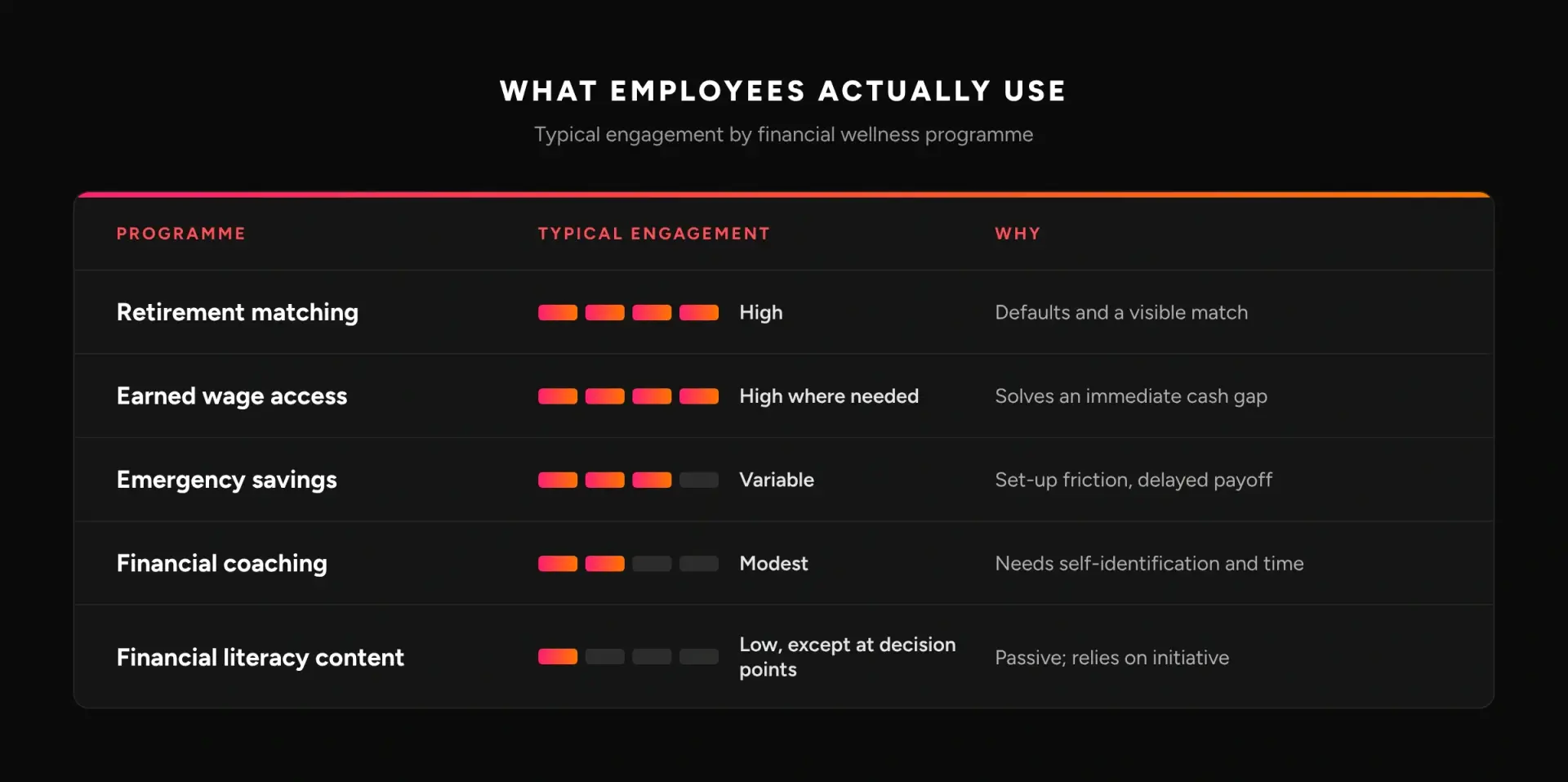
Retirement matching is used at high rates because skipping it means visibly losing the match. Many plans also enrol employees by default, which greatly improves uptake. Behavioural economics has shown repeatedly that defaults matter more than almost any other design choice in savings programmes (source needed).
Earned wage access tends to see strong engagement where it is most needed: among hourly workers, shift workers and people with irregular expenses. When the financial pain is immediate, the tool that addresses it gets used. Use of these programmes is typically high and steady.
Emergency savings programmes show more variable engagement. Employees who have never had a savings buffer often respond well once they see the account growing. But setting up automatic contributions takes effort, and the payoff is a benefit people hope never to need. So some groups only engage after an emergency, when they wish they had.
Financial coaching sees modest use in most programmes. That is not because it lacks value. Employees have to recognise a financial problem, seek help and spend time in a conversation many find stressful or embarrassing. That is a lot to ask. Coaching tied to life events tends to get better uptake than coaching that relies on employee initiative, such as a new hire’s first 90 days or the enrolment window.
Financial literacy content usually sees low sustained engagement, except at specific moments. Engagement rises when an employee is making a benefits decision and needs to understand an option. It is valuable supporting material, but rarely something people seek out on an idle Tuesday.
Timing matters more than the message
Most financial wellness programmes are introduced at one of two moments:
- Onboarding, when new employees are swamped with information
- Enrolment, when attention is on health cover and everything else competes for it
Neither is when people are most open to thinking about financial wellness. Employers with higher engagement tend to send financial wellness messages when finances are already on people’s minds. Examples are after a life event, at a promotion or pay change, or during a period known to raise financial questions. When the message lands matters more than what it says.
The utilisation gap
Benefits professionals use the term “utilisation gap” for the space between the programmes offered and the programmes used. In financial wellness, that gap is often wide, and expensive.
Closing it starts with understanding why it exists. The usual reasons are not what HR teams tend to assume. It is rarely that employees do not care about their finances. The real reasons are simpler and more fixable.
Awareness. Many employees do not know that a coaching service exists. They may not know they can access earned wages before payday, or that their employer helps with student loans. Benefits guides are long and enrolment presentations move fast. A 45-minute session nine months ago is rarely top of mind when the moment of need arrives.
Trust. Employees under the most financial stress are often reluctant to signal difficulty to their employer, even through a supposedly confidential channel. Two design choices help:
- programmes that stress privacy and independence from HR reporting lines
- delivery through a third-party provider with clear data separation from the employer
Relevance. A 28-year-old with student debt and no savings finds retirement planning far less compelling than budgeting tools or debt guidance. A 52-year-old nearing retirement feels the reverse. A one-size programme presented to everyone in the same way speaks to nobody’s actual situation.
How Tallect finds where engagement is missing
Tallect’s AI continuously analyses financial wellness engagement data across the workforce to surface patterns that aggregate reports hide. It can:
- show which employee segments engage with which programmes
- flag groups with near-zero uptake of offerings that should be relevant to them, based on demographic and tenure signals
- identify the points in the employee lifecycle when financial wellness queries and benefit interactions spike
This lets HR teams stop sending the same financial wellness information to everyone at fixed intervals. Instead, they can send the right information to the right group at the moment its behaviour suggests it is most likely to engage.
Designing for actual use
The programmes that get used have one thing in common: they meet people where they are, financially and emotionally.
Reduce friction. This is the most reliable lever. Every extra step between an employee and a financial benefit lowers the chance they complete it. Three things meaningfully improve uptake:
- single sign-on
- mobile access
- a plain-language explanation of what a programme does and how to start
A programme buried four clicks deep in a benefits portal, behind a login the employee cannot remember, will not be used, however valuable it is.
Use default enrolment where you can. Defaults consistently produce higher participation than opt-in designs. This is well established for retirement savings and is increasingly applied to emergency savings too. The easiest path gets taken most often, so making the beneficial choice the default greatly improves outcomes.
Link support to life events. Some moments of financial transition often spark a genuine wish for guidance:
- a new baby
- buying a home
- a promotion
- a divorce
Benefits platforms that surface relevant financial wellness resources at these moments see much higher engagement than those that wait for employees to go looking.
Personalise, even modestly. Suppose an employee has listed student debt on their benefits profile. A targeted reminder about loan repayment help is far more likely to land with them than a generic financial wellness newsletter. The bar for meaningful personalisation is not high. It just requires using the data the organisation already holds.
What the numbers miss
Utilisation metrics capture a lot, but they miss some of the biggest wins. Take the employee who had one coaching session, restructured their budget and stopped feeling the low-level anxiety that was affecting their focus. Or take the person who set up automatic emergency savings two years ago and never thought about it again. Then the car repair came, and they found they could cover it.
At their best, financial wellness benefits are almost invisible in hindsight. They work quietly, and the employees who gain most often do not connect the outcome back to the employer programme behind it. That is worth remembering when you judge return on investment. A lack of visible crises is a legitimate outcome. It just does not generate a report.
Key takeaways
- Breadth does not equal use. Financial wellness has grown from retirement plans to a broad set of programmes covering debt, savings, cash flow and literacy, but offering more does not mean more gets used.
- Low friction wins. Programmes with immediate, tangible incentives and little friction, such as retirement matching and earned wage access, consistently outperform those needing more initiative or patience.
- Three things explain the gap. The gap between what is offered and what is used is usually down to awareness, trust and relevance to the employee’s life stage.
- Three levers lift engagement. Default enrolment, links to life events and lower friction are the most reliable ways to improve it.
- AI makes communication proactive. AI analysis of usage patterns can show which groups need which programmes and when, so communication can be proactive rather than passive.
- Metrics miss real outcomes. Reduced anxiety, better decisions and avoided financial crises are real results that rarely show up cleanly in utilisation data.
Frequently asked questions
What are financial wellness benefits?
They are employer programmes that help employees manage money, covering:
- retirement savings with matching
- emergency savings
- student loan repayment help
- financial coaching
- earned wage access
- financial literacy resources
Which financial wellness benefits do employees use most?
Programmes with low friction and an immediate incentive. Retirement matching is used at high rates, helped by default enrolment and a visible match. Earned wage access sees strong use among hourly and shift workers.
Why is financial coaching underused?
Employees have to recognise a financial problem, seek help and spend time in a conversation many find stressful or embarrassing. Coaching tied to life events, such as a new hire’s first 90 days or the enrolment window, tends to get better uptake.
What is the utilisation gap in benefits?
It is the gap between the programmes an employer offers and the ones employees actually use. In financial wellness it is often wide and costly, because unused programmes still carry vendor and admin costs.
Why don’t employees use financial wellness benefits?
The main reasons are awareness, trust and relevance:
- Awareness. Employees often do not know the programme exists.
- Trust. They are reluctant to signal financial difficulty to their employer.
- Relevance. The programme does not match their life stage.
What is earned wage access?
It lets employees draw wages they have already earned before the normal payday. It is particularly valued in hourly and shift-based workforces, where timing mismatches can cause real hardship.
Does default enrolment improve participation?
Yes. Defaults consistently produce higher participation than opt-in designs. This is well established for retirement savings and is increasingly used for emergency savings programmes too.
When should employers promote financial wellness programmes?
At moments of financial relevance: after a life event, at a promotion or pay change, or during periods known to raise money questions. Onboarding and enrolment are crowded moments, when people are least receptive.
How can employers build trust in financial wellness programmes?
Stress privacy and independence from HR reporting lines. Delivering the programme through a third-party provider with clear data separation from the employer also helps.
How do you measure the ROI of financial wellness benefits?
Utilisation data is a start, but it misses outcomes such as reduced anxiety, better decisions and avoided crises. A lack of visible financial emergencies is a legitimate result, even though it does not appear in a report.
See what your employees actually use
Tallect gives you the utilisation insight to invest in financial wellness programmes that work, and retire the ones that do not.