
Eight Signs Your Global HR Policies Need a Review
Policy problems surface in grievances, failed audits and calls from country managers. Here are eight signs a review cannot wait.
Most policy problems do not announce themselves. They surface in a grievance, a failed audit or a call from a country manager saying “this policy does not work here”. If you know the warning signs, you can act before the consequences arrive.
There is no shortage of HR policy review checklists. Most tell you to check that your policies are up to date, compliant and communicated. That is all true, but it does not help you prioritise when you have dozens of policies across many countries and a team with limited time.
A more practical approach is to know the specific signs that mean a review cannot wait. These are the conditions likely to cause real problems if left alone, not ones that are merely less than ideal in theory. This article covers eight of them.
The eight warning signs
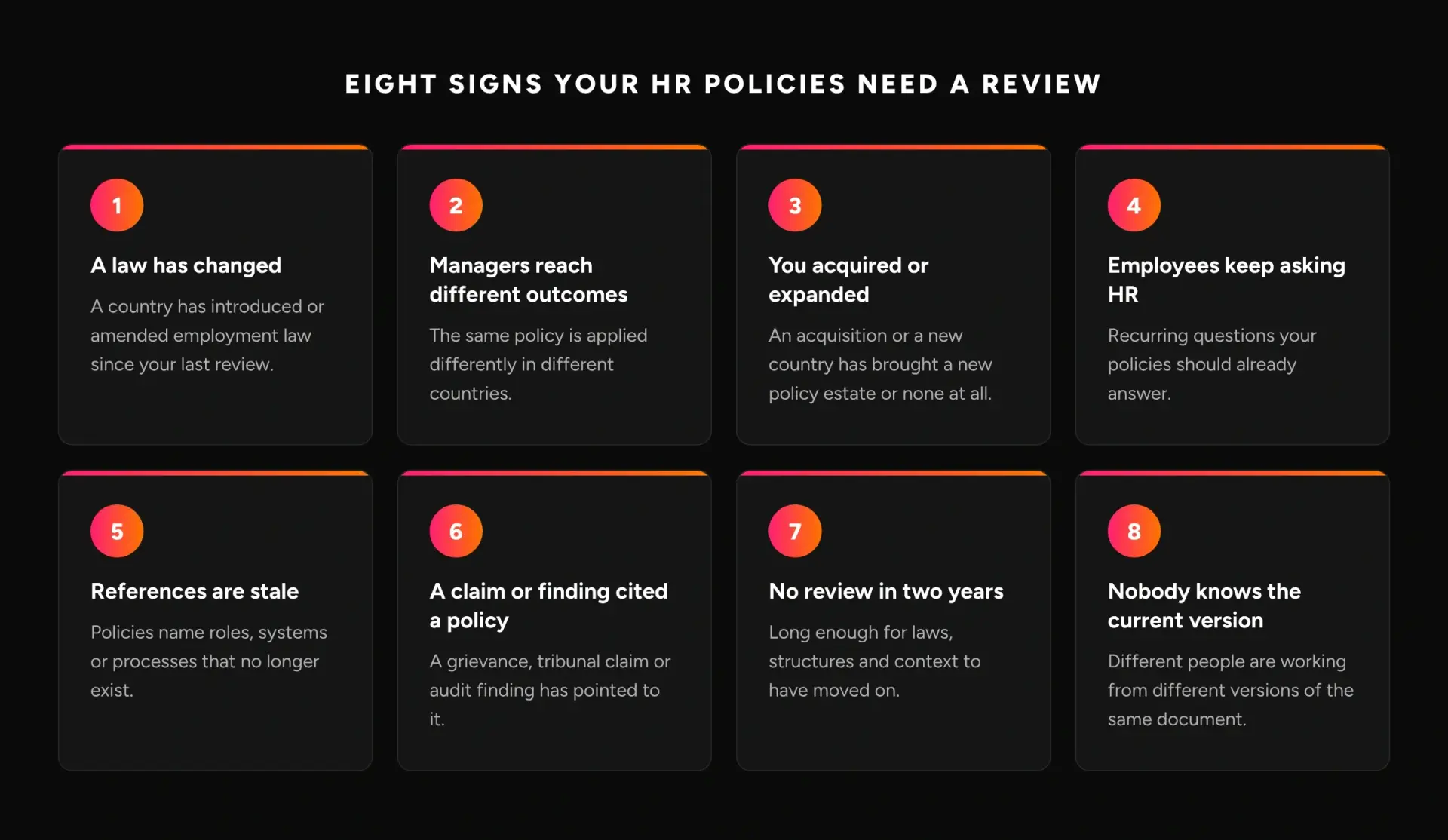
1. A country has changed its employment law
A country introduced or significantly amended employment law after your policy’s last review. This is the clearest trigger for a review. It is also the easiest to miss when the change happens outside your main operating base. Common sources of outdated policy include:
- changes to parental leave law
- wider flexible working rights
- new data privacy frameworks
- changes to termination procedures
Suppose a policy says employees are entitled to X weeks of parental leave, but the law now requires Y. The policy is not just inaccurate. Employees may receive less than their legal entitlement, and the organisation may be liable. A law change in any country where you operate should trigger an immediate check of every policy provision that touches the affected area.
2. Managers apply the same policy differently
Similar conduct can lead to a written warning in one country and dismissal in another. When that happens, there is a policy problem. The policy may be ambiguous, the guidance behind it may be thin, or managers may never have been trained on it.
Inconsistent application creates unfairness and suggests the policy is not working as a management tool. If outcomes correlate with protected characteristics, it also exposes the organisation to discrimination claims. The fix is not always a rewrite. Sometimes the policy text is fine and the supporting guidance or training is missing. Either way, it warrants investigation.
3. You have acquired a company or entered a new country
Acquisitions and expansion are consistent sources of policy gaps. An acquired company brings its own policy estate, which may be more complete than yours, less complete or simply different. A new country operation usually starts with no local policies at all, relying on a global handbook that was not written with that jurisdiction in mind.
Both situations need deliberate policy work:
- An acquisition needs a policy comparison and a harmonisation plan.
- A new country needs a local law review followed by country-specific policies.
Neither should wait until an audit or a dispute forces the issue.
4. Employees keep asking HR what your policies should answer
The same questions may keep reaching HR, about leave entitlements, what counts as a performance improvement plan or how expenses are approved. That signals one of three problems:
- the relevant policies are hard to find
- they exist but do not answer the question clearly
- employees do not know they exist
Recurring HR queries are an underused diagnostic tool. Track the categories of questions and check whether each has a clear, accessible policy answer. That is a lightweight way to find the gaps causing the most day-to-day friction.
5. Policies reference roles, systems or processes that no longer exist
Organisations change faster than their policies. Some references break a policy outright:
- A restructured role. The policy names a Head of HR Operations, but that role was restructured two years ago.
- A retired system. The policy requires sign-off in a system decommissioned when you moved to a new HRIS.
When managers hit these references, they either ignore them and do something that may not be appropriate, or escalate to HR every time. Stale references are easy to spot in a review but accumulate quickly when reviews do not happen. A policy that is internally consistent and accurate, even if imperfect, is far more useful than one that points to things that no longer exist.
6. A grievance, claim or audit finding has cited a policy
When a policy becomes the subject of a legal proceeding or formal audit finding, review it, whatever the outcome. Even if the organisation wins, the scrutiny reveals something about the policy’s clarity, its implementation or the training around it.
An audit finding about a gap in a data privacy policy is a diagnostic event. So is a tribunal claim that turns on how a disciplinary procedure is read. Acting on it is due diligence. Ignoring it leaves you exposed to the same issue again.
7. Policies have not been reviewed in more than two years
This is the least dramatic sign, but it is real. Two years is long enough for employment law to change in several jurisdictions and for your structure to shift. It is also long enough for the operating context your policies assumed to move on. Treat any policy unreviewed for two years or more as possibly outdated until confirmed otherwise.
For most organisations, a reasonable baseline is:
- an annual review for actively used policies, such as disciplinary, leave, data privacy and code of conduct
- a review every two years for lower-risk policies
Log each review, even when nothing changes.
8. Nobody is sure which version is current
HR, managers or employees may be unsure which version of a policy is current, or may be working from different versions of the same document. That is a version control failure that needs immediate attention, not an administrative nuisance. Suppose a manager applies an older version of a disciplinary policy in good faith, and the current version has materially different requirements. The outcome of that process is then on shaky ground.
The immediate fix is to set one authoritative location for current policies and clearly mark every older version as superseded. The longer-term fix is a version control system that makes this confusion structurally impossible.
How to prioritise the work
Not every sign is equally urgent, and most HR teams cannot review everything at once. A practical framework weighs two factors:
- how likely the gap is to be causing active harm, such as legal liability, operational friction or employee confusion
- how many people it affects
Urgency | Signs | What to do |
|---|---|---|
Highest | A law change, an active claim or finding, a new country or acquisition | Review before anything else, however stretched the team is |
Moderate | Inconsistent application, stale references, recurring HR questions, version confusion | Schedule a review within a defined period; do not defer it |
Lower | Reviewed within the past two years, with no known issues | Add to the rolling annual review cycle |
Caption: A simple way to rank policy reviews by urgency.
The cost of delayed reviews
His Majesty’s Courts and Tribunals Service publishes statistics on employment tribunal claims in the UK. Unfair dismissal claims make up a significant share of the caseload, and many turn on procedural questions (source needed). Did the employer follow its own disciplinary policy? Was the procedure fair? Did the employee get a proper chance to respond?
Individual outcomes vary, but the thread running through employment law is consistent. An employer faces a harder defence in either of two situations:
- it cannot show that its own documented procedure was followed
- it cannot produce the version of the procedure in force at the time
Documented, current, accessible policies are not a compliance checkbox. They are practical protection in employment disputes.

Making the review stick
A one-time review clears the backlog but does not stop it building again. Organisations with well-run policy estates share three habits:
- every policy has an assigned owner
- there is a scheduled review calendar with real accountability
- policy changes are treated as events that need proper documentation and communication, not informal updates
They also tend to catch problems earlier, because they monitor the signs above instead of discovering them after the fact. Country law changes are flagged when they are enacted, not when they become the subject of a claim. Version confusion is prevented by design rather than detected after it causes an error.
How Tallect detects review signals automatically
Waiting for a grievance or audit finding to expose a policy gap is the most expensive way to find one. Tallect surfaces review signals continuously:
- Overdue reviews. Tallect flags any policy past its scheduled review date with no review logged. Policies in jurisdictions with frequent regulatory change come first.
- Statutory changes. When a statutory change is logged for a jurisdiction, Tallect identifies that country’s policies covering the affected area and queues them for review before the change takes effect. Affected areas include leave entitlements, termination procedures and data handling.
- Cross-country divergence. Comparison analysis shows where similar policies in different countries have diverged in ways that suggest inconsistency, not just legitimate local adaptation.
- Stale after a big change. The AI flags policies last reviewed before a major organisational event that may have made them stale, such as an acquisition, a restructuring or a move to a new HR system.
- Query patterns. Tallect links employee queries to policy coverage. HR can see which questions generate the most queries and check whether the relevant policy answers them clearly.
Policy review management in Tallect
- Review scheduling. Each policy has a next review date and an owner. Tallect sends reminders as the date approaches and logs the review once it is done.
- Risk prioritisation. Policies are surfaced for review based on jurisdiction risk, time since the last review, and whether they cover areas affected by recent organisational or regulatory change.
- Cross-country view. HR teams can compare how the same policy area is handled across countries, spotting unintended divergence or compliance gaps at a glance.
- Change impact analysis. When one policy is updated, Tallect identifies other policies that reference the same provisions and surfaces them for a related review.
Key takeaways
- Law changes trigger immediate reviews. A law change in any country where you operate should trigger a review of the affected policies straight away, not at the next annual cycle.
- Inconsistent outcomes are a diagnostic signal. When managers applying the same policy reach different outcomes, something in the policy or its guidance is not working.
- Acquisitions and new countries need deliberate work. Extending the global handbook to cover them is not enough.
- Recurring HR queries reveal gaps. They are an underused signal of policy gaps or accessibility problems.
- Claims and findings always trigger a review. Review any policy cited in a legal proceeding or audit finding, even when the outcome is favourable.
- Version confusion needs a structural fix. A better file naming convention will not solve it.
- A rolling calendar prevents a new backlog. Without real accountability for reviews, the backlog rebuilds after a one-time clean-up.
Frequently asked questions
How often should global HR policies be reviewed?
A reasonable baseline is annual reviews for actively used policies, such as disciplinary, leave, data privacy and code of conduct. Lower-risk policies can be reviewed every two years. Treat any policy unreviewed for two years or more as possibly outdated.
What should trigger an immediate HR policy review?
Three things should move a policy to the top of the queue:
- a change to employment law in any country where you operate
- a grievance, tribunal claim or audit finding that cites the policy
- an acquisition or entry into a new country
Why does a law change in one country matter so much?
If a policy promises less than the law now requires, employees may receive less than their legal entitlement, and the organisation becomes liable. Parental leave, flexible working, data privacy and termination rules are common examples.
What does inconsistent policy application tell you?
If similar conduct leads to different outcomes in different countries, the policy may be ambiguous, its supporting guidance may be thin, or managers may not have been trained on it. It can also expose the organisation to discrimination claims.
What HR policy work does an acquisition need?
An acquisition needs a comparison of the acquired company’s policies against yours, followed by a harmonisation plan. Do not wait for an audit or a dispute to force the issue.
How can recurring HR questions help a policy review?
Track the categories of questions reaching HR, then check whether each has a clear, accessible policy answer. Repeated questions usually mean a policy is hard to find, unclear or unknown to employees.
Should a policy be reviewed if the company won the case?
Yes. Even a favourable outcome shows that the policy was scrutinised. That scrutiny reveals something about its clarity, implementation or training, so a review is still due diligence.
How do you fix confusion over which policy version is current?
In the short term, set one authoritative location for current policies and mark every older version as superseded. In the long term, use a version control system that makes the confusion structurally impossible.
How should HR teams prioritise policy reviews?
Weigh two factors: how likely the gap is to cause active harm, and how many people it affects. Review law changes, active claims and new countries first. Schedule moderate issues within a set period, and add the rest to the rolling annual cycle.
How do you stop the review backlog building again?
Give every policy an owner and keep a scheduled review calendar with real accountability. Treat every policy change as an event that needs proper documentation and communication.
Find policy gaps before audits do
Tallect surfaces review signals continuously, so your team can act on policy gaps before they become disputes or findings.