India's New Wage Code 2025: What Every HR and Compensation Leader Needs to Know
India's four new Labour Codes went live on November 21, 2025. What changed for salary structures, PF and gratuity, and what companies face now.
Quick answer:
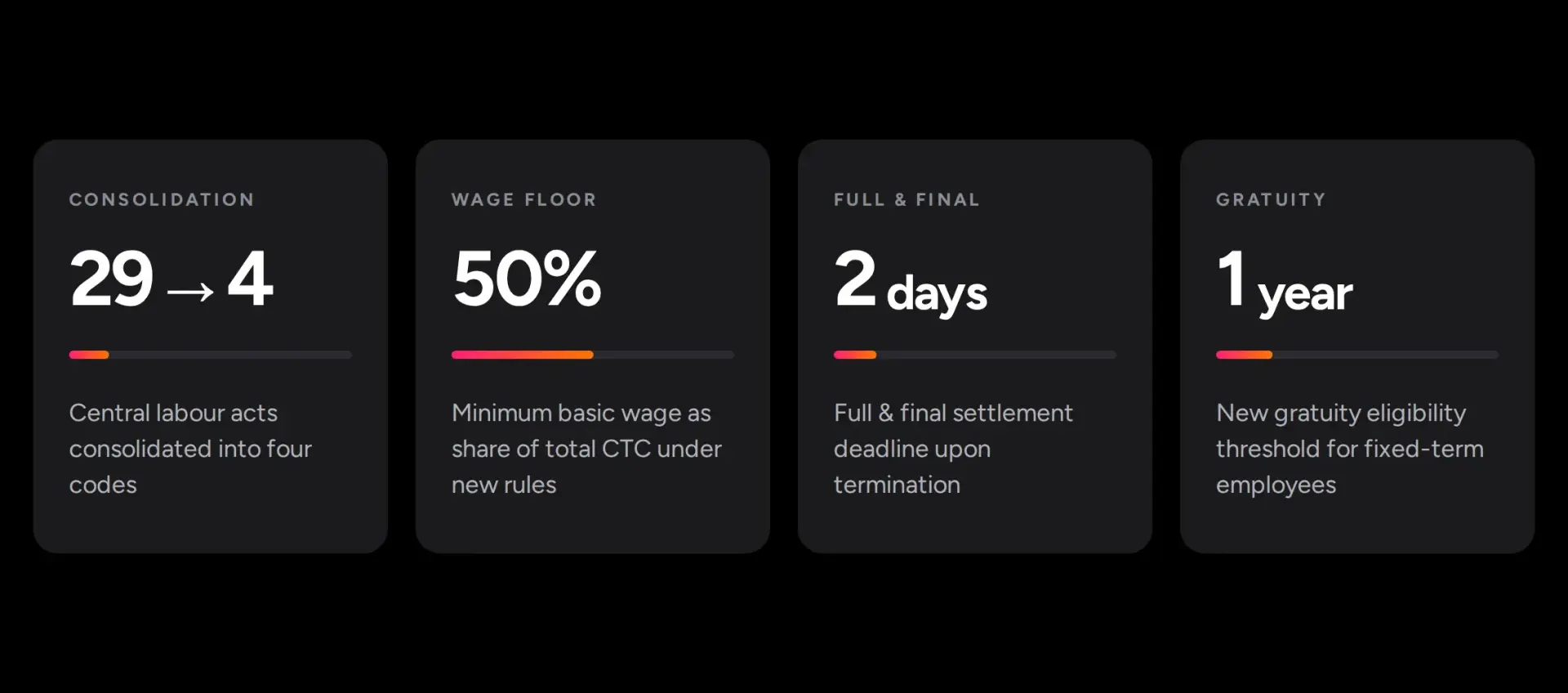
India replaced 29 separate labour laws with four unified codes on November 21, 2025. The change that matters most for payroll: wages must now equal at least 50% of an employee's CTC. For companies running 30–35% basic salary structures, this isn't a tweak, it's a rebuild. PF costs rise, gratuity obligations expand, take-home pay may fall, and state-level rules are still arriving. The companies that act now, auditing structures, modelling scenarios, and communicating with employees before changes land, are in a far better position than those waiting for perfect regulatory clarity that may not come until 2027.
What are the four new Labour Codes?
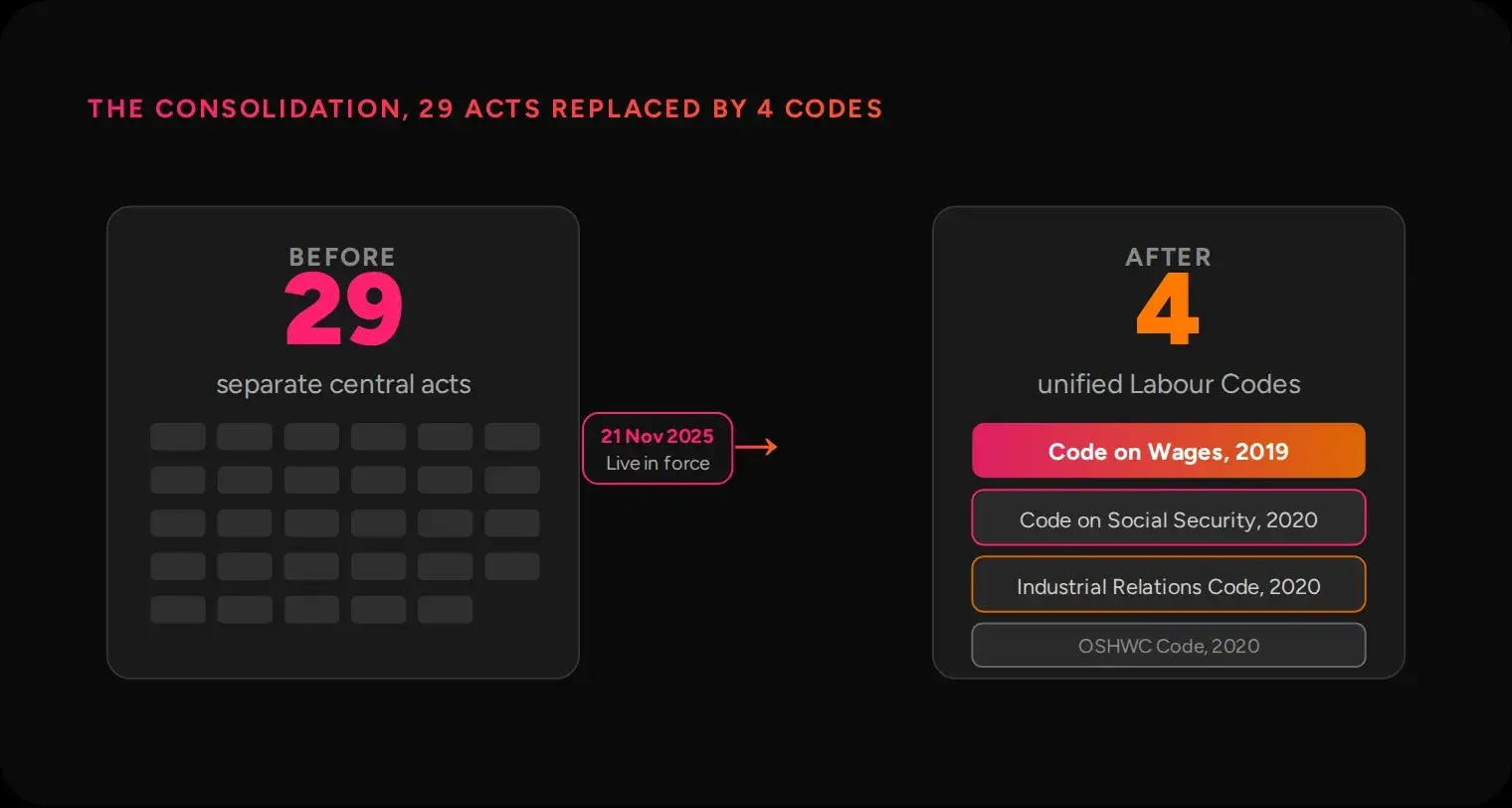
India's labour law system had accumulated 29 separate central acts over several decades, each with its own definitions, compliance deadlines, and state-level variations. HR teams spent years managing overlapping provisions, inconsistent enforcement, and payroll calculations that required a different interpretation depending on which state the office was in.
On November 21, 2025, the Government of India brought all four new Labour Codes into force simultaneously, consolidating that entire body of law into a single unified framework. The four codes are:
- Code on Wages, 2019: Replaces the Payment of Wages Act, Minimum Wages Act, Payment of Bonus Act, and Equal Remuneration Act. Establishes a uniform wage definition, minimum wage floors, bonus rules, and equal pay provisions.
- Code on Social Security, 2020: Consolidates the EPF Act, ESI Act, Maternity Benefit Act, Gratuity Act, and five others. Expands coverage to gig workers and platform workers for the first time.
- Industrial Relations Code, 2020: Replaces the Industrial Disputes Act, Trade Unions Act, and Industrial Employment (Standing Orders) Act. Governs hiring, retrenchment, trade unions, and workplace dispute resolution.
- Occupational Safety, Health and Working Conditions Code (OSHWC), 2020: Consolidates 13 acts including the Factories Act and Contract Labour Act. Covers safety standards, working hours, leave entitlements, and women's right to work night shifts.
Of the four, the Code on Wages carries the most immediate payroll implications. Everything downstream, PF calculations, gratuity, bonus, leave encashment, flows from how wages are now defined under this code.
The new definition of 'wages'
This is the change that will force most companies to restructure their salary architecture. Under the old system, Indian companies had become very creative with how they packaged CTC. A typical salary might show 30 percent basic salary, with the remaining 70 percent split across HRA, special allowance, LTA, conveyance, food coupons, education allowance, and a range of other components. The explicit purpose was to keep PF contributions, calculated on basic salary, artificially low, while keeping take-home pay artificially high.
The 50% minimum basic wage rule
Under the Code on Wages, 2019, "wages", defined as basic pay plus dearness allowance plus retaining allowance, must now constitute at least 50 percent of an employee's total CTC. If allowances exceed 50 percent of CTC, the excess is added back into wages for the purpose of calculating all statutory entitlements.
In plain terms: the era of 30 percent basic, 70 percent allowances is over.
For companies where basic salary has been sitting at 30 to 35 percent of CTC, this isn't a minor adjustment. It requires fundamental salary restructuring for large portions of the workforce. Since PF is calculated at 12 percent of wages, a higher wage base means higher PF contributions for both employers and employees.
What this means in practice
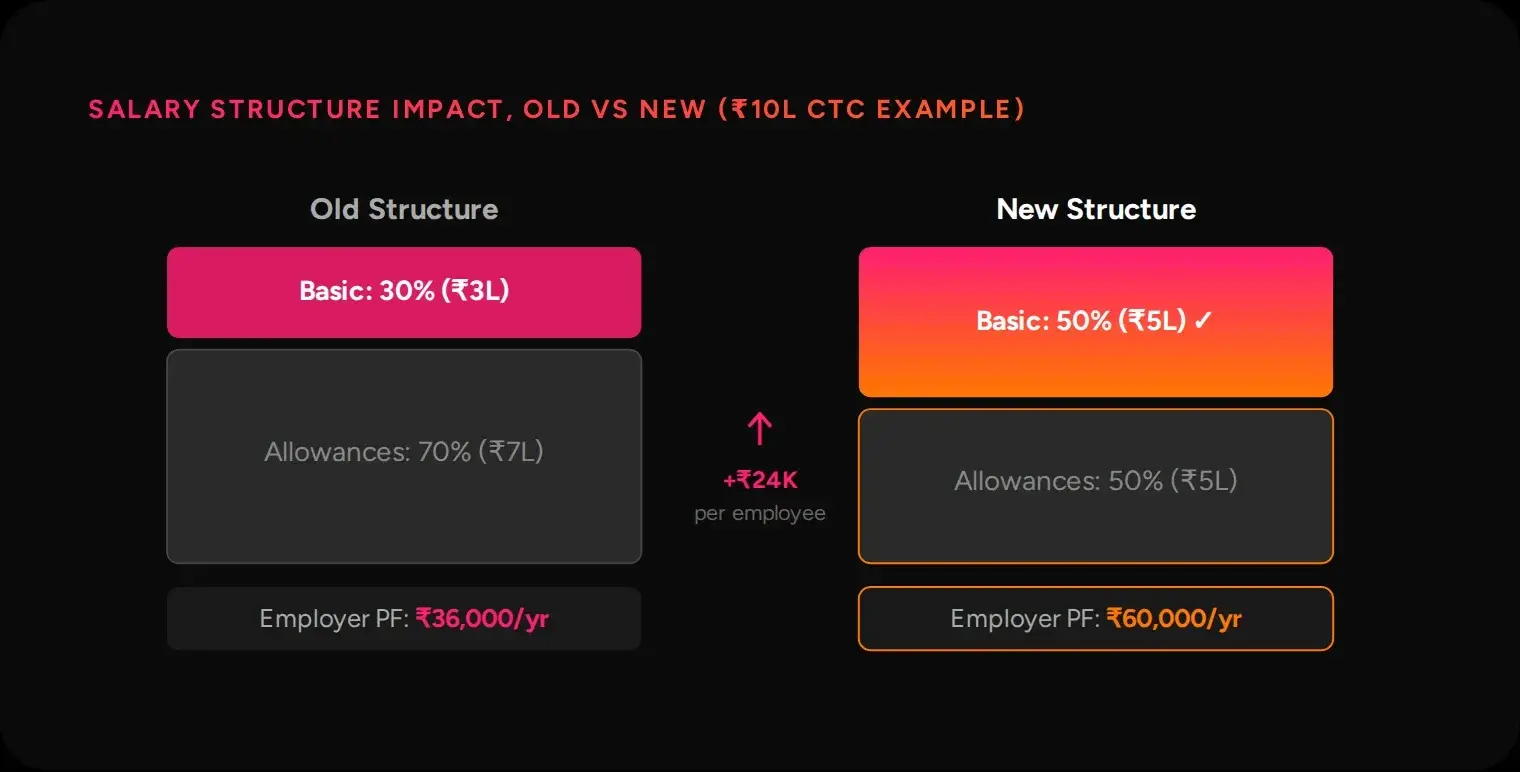
Consider an employee on ₹10,00,000 CTC. Under the old structure, basic might have been ₹3,00,000, 30 percent. Employer PF contribution: ₹36,000 per year. Under the new code, basic must be at least ₹5,00,000, 50 percent. Employer PF: ₹60,000 per year. That's a ₹24,000 increase in employer cost per employee from PF alone. Across a 1,000-person workforce, that's ₹2.4 crore in additional annual employer PF contributions, before touching gratuity, bonus, or leave encashment.
The employee side sees higher PF deductions too, which means lower take-home on the same CTC unless the company increases the overall CTC to compensate. That's precisely the difficult choice most HR teams are navigating right now.
Higher PF and gratuity contributions
Because the wage base is now larger, every statutory entitlement calculated on wages increases automatically. It's a cascade effect. Provident Fund contributions, 12 percent of wages for both employer and employee, apply to a significantly higher base. Gratuity, calculated at 15 days' wages per year of service, means meaningfully larger payouts over time. The same logic applies to statutory bonus, overtime pay, and leave encashment, all calculated on wages.
For employees, the long-term social security outcome is genuinely better. More PF accumulation over a career, larger gratuity on exit, broader protections. The argument for this change is sound. The problem is the transition, and the short-term impact on take-home pay and employer cost that the transition creates.
The effect is uneven across the workforce. Junior employees with lower CTCs and already relatively high basic salaries may need minimal restructuring. Senior employees and executives, whose compensation packages were often most aggressively structured around allowances to minimise statutory costs, will require the most significant redesign.
AI in salary structure analysis: automated identification of non-compliant salary structures. Manually auditing thousands of employee salary structures to identify those where basic pay falls below 50 percent of CTC is a time-intensive exercise prone to errors, especially when different business units use different payroll systems. AI-powered compensation platforms can ingest the full employee dataset, flag every non-compliant structure, and model the PF, gratuity, and bonus impact of different restructuring approaches, across salary bands, grades, and locations, in minutes rather than weeks. For companies with large workforces or complex allowance architectures, this kind of automated analysis is the difference between a structured, prioritised response and a scramble.
Gratuity eligibility expanded
Under the old Gratuity Act, employees became eligible for gratuity only after five years of continuous service. The Code on Social Security reduces this threshold to one year for fixed-term employees.
This changes the economics of fixed-term employment in a fundamental way. Many Indian companies used fixed-term contracts as a cost-management tool, the five-year gratuity threshold meant that most fixed-term arrangements carried no gratuity liability at all. That calculation no longer works. A fixed-term employee who completes 12 months now earns gratuity entitlement.
For companies that rely heavily on fixed-term contracting, in technology services, manufacturing, hospitality, and consulting, this means revisiting workforce planning assumptions and budgets from the ground up. The cost model that underpinned fixed-term hiring has changed, and contracts structured before November 2025 need to be reviewed against the new framework.
Timely wage payment enforced
Under the new codes, wages for monthly wage cycles must be paid by the 7th of the following month. In cases of termination, whether resignation, dismissal, or retrenchment, full and final settlement must be completed within two working days.
This is a meaningful tightening. The 45-day F&F settlement window that was commonplace across Indian companies is now out of compliance. For HR operations teams that have built workflows around the old timelines, this requires process changes rather than just policy updates. HRMS and payroll platforms need to be reconfigured. Approval chains need to be shortened. Companies with multi-state operations need to be particularly careful, since late payment penalties are real and enforceable.
Gig and platform workers covered
One of the most structurally significant changes in the new codes is the formal recognition of gig workers, platform workers, and unorganised sector workers under the social security framework. For the first time in Indian labour law, these categories of workers have explicit legal recognition and social security entitlements.
Aggregators, companies like food delivery platforms, ride-hailing services, and logistics networks, may be required to contribute 1 to 2 percent of their annual turnover, capped at 5 percent of total payments to platform workers, toward a dedicated social security fund for this workforce. The precise mechanics are still being finalised at the rule-making stage, but the direction is clear: companies that rely on platform workforces now have regulatory obligations toward those workers that didn't exist before November 2025.
This has implications beyond pure platform companies. Any Indian business that uses third-party manpower, contract workers, gig-economy talent, or vendor workforces in core or near-core activities needs to review those arrangements under the new framework. The definition of who counts as a platform worker or gig worker is broader than many companies initially assumed.
Women's night shifts permitted
The OSHWC Code formally permits women to work night shifts, with their consent and subject to specific employer safety obligations. This removes a long-standing ambiguity that had played out inconsistently across states and industries. Some states had already notified their own provisions permitting women's night work; others had not. The new code creates a uniform national position.
For companies in manufacturing, healthcare, hospitality, and technology, sectors that operate around the clock, this opens up workforce planning options that were previously complicated by regulatory uncertainty. The obligation on employers is meaningful: documented consent, safe transportation arrangements, adequate safety infrastructure on premises, and a grievance redressal mechanism specifically for night-shift workers. The right exists; the compliance burden is on the employer to enable it responsibly.
The implementation timeline
This is where the honest answer gets complicated. The codes are legally in force, they are not aspirational targets or consultation drafts. But full implementation across India's 28 states and 8 union territories is not yet complete, and the detailed rules that govern exactly how companies must comply are still being finalised at both the central and state levels.
Milestone | Date | Status |
|---|---|---|
All four Labour Codes notified by Central Government | November 21, 2025 | Done |
Central draft rules published for public comment | December 30, 2025 | Done |
30/45-day public consultation period | January–February 2026 | Done |
Final Central rules expected to be notified | April 1, 2026 (expected) | In progress |
State-level rules: advanced states (Karnataka, Maharashtra, Gujarat, UP, MP) | Early 2026 | Partially done |
State-level rules: remaining states and UTs | Expected mid-2026 | Pending |
Full nationwide implementation with unified compliance infrastructure | To be determined | Pending |
What this creates in practice is a dual compliance environment. The new codes are legally in force, employers cannot simply ignore them. But until the detailed rules arrive, existing regulations technically continue to apply in most areas except where the new codes directly conflict with them. For a payroll team or HR leader, this means preparing for the new regime while continuing to comply with the old one in areas where the new rules haven't yet been finalised. It's an uncomfortable position, and it's the reality most companies are operating in through 2026.
The companies waiting for all state rules to be finalised before acting are accumulating backdated compliance exposure from November 21, 2025 onward.
What companies are experiencing
The on-the-ground implementation story is significantly more complex than the government announcement suggests. Here is what HR and compensation leaders across Indian companies are navigating right now.
Challenge 1: The 'wages' definition is still being argued
The single most common source of confusion is the interpretation of the new wage definition. What exactly counts as wages? What qualifies as an allowance that can be excluded? If excluded components exceed 50 percent, how is the excess calculated? These sound like technical questions but they directly determine PF liabilities. Get the interpretation wrong and you're creating backdated compliance exposure for every employee below the threshold since November 21, 2025.
The ministry has been issuing clarifications, but companies report that the clarifications are creating new questions. Several industry bodies have formally requested further guidance. Law firms are publishing differing interpretations. Companies that need certainty before restructuring payroll are stuck waiting for an authoritative answer that hasn't fully arrived.
Challenge 2: State-level patchwork
India has 28 states and 8 union territories. Each must issue its own rules and minimum wage notifications under the new codes before full implementation applies in that state. Some states, Karnataka, Maharashtra, Gujarat, Uttar Pradesh, Madhya Pradesh, have moved faster. Others are still in the process of drafting. For a company with operations in 10 states, this means 10 different implementation timelines, 10 different minimum wage notifications, and potentially 10 different interpretations of the same central code. The compliance burden hasn't decreased; it's just changed shape.
Challenge 3: Take-home pay reduction without CTC increase
When basic salary is raised to 50 percent of CTC without a corresponding CTC increase, the take-home pay of many employees actually decreases. More money goes into PF, which is technically a long-term benefit, but that's cold comfort for an employee managing an EMI or rent payment. Companies are facing the genuinely difficult task of explaining to employees that their monthly take-home has decreased even though their CTC hasn't changed. In practice, many mid-size and large companies are choosing to increase CTC to protect take-home, absorbing the additional cost themselves. Smaller companies and MSMEs are finding this much harder to do.
Challenge 4: Legacy salary structures and documentation
Many Indian companies built their salary structures over years with the explicit goal of minimising PF liability. Complex allowance architectures, HRA, special allowance, conveyance, food coupons, LTA, education allowance, were designed for exactly this purpose. These structures are now non-compliant. Unwinding them requires not just recalculating payroll, but also issuing revised appointment letters, updating employment contracts, getting employee sign-offs, and updating HRMS systems. For a company with 5,000 employees, that's a significant operational exercise, particularly when legal certainty on some definitional questions is still pending.
Challenge 5: Contract labour redefinition
The new codes restrict contract labour engagement for core activities of a business. But the definition of "core activities" is ambiguous, and companies are genuinely unsure whether their current vendor and contractor arrangements are compliant. Companies using third-party manpower heavily, in logistics, retail, facilities management, and tech support, are reviewing their vendor arrangements from scratch.
Challenge 6: System readiness
Payroll software, HRMS platforms, and compliance tools need to be updated to handle the new wage definition, new PF calculations, new gratuity structures, and new compliance documentation. Many vendors released updates after November 21, but companies report that getting everything reconfigured, tested, and validated for their specific structure has taken months, not days. This is a real operational bottleneck for companies trying to get into compliance quickly.
AI in payroll compliance: real-time wage definition monitoring and recalculation. The new wage code's 50% rule requires continuous monitoring, not a one-time fix. Every time an employee's CTC changes (promotion, increment, variable pay revision), the system needs to verify that the basic salary still meets the threshold, recalculate statutory contributions on the new base, and flag exceptions before they create a compliance breach. AI-powered payroll platforms can handle this continuously, across the entire workforce, automatically flagging every new hire, promotion, or salary revision that would take an employee below the 50% threshold. For companies managing thousands of employees across multiple states with different minimum wage notifications, this kind of automated compliance monitoring isn't a luxury, it's the only scalable approach.
Six steps for CHROs
- Audit your salary structures immediately. Identify every employee whose basic salary is currently below 50% of CTC. Quantify the PF, gratuity, and bonus exposure if you restructure now versus in six months. This is the most urgent exercise, every month without action is a month of backdated exposure accumulating from November 21, 2025.
- Model three restructuring scenarios. Scenario one: raise basic to 50% and absorb the cost through a CTC increase. Scenario two: raise basic to 50% and reduce allowances proportionally, keeping CTC flat but reducing take-home. Scenario three: partial adjustment with proactive employee communication and a phased timeline. Most companies are landing on a version of options one or three, option two creates the most employee relations friction.
- Identify your fixed-term employee population. Map everyone on fixed-term contracts and understand your new gratuity exposure after one year rather than five. Adjust workforce planning budgets accordingly. Fixed-term contracting as a cost-saving mechanism no longer works the same way it did before November 2025.
- Review contractor and gig worker arrangements. Map all categories of non-permanent workforce and assess what the new social security obligations mean for each category. If your organisation uses significant contract manpower in anything that could be characterised as a core business activity, get legal advice on the current arrangements.
- Communicate with employees before changes land. Employees who see a reduced take-home salary without prior explanation will interpret it as an error, a pay cut, or worse. Town halls, plain-language FAQs, and manager-led conversations should precede any payroll changes. The communication burden here is real, the message is inherently complicated ("you earn more in the long run but less this month") and it needs to land well.
- Set up ongoing state-level monitoring. Assign someone to track state notifications and minimum wage updates throughout 2026. This is not a one-time exercise. State rules will continue to be issued through the rest of the year, and each new notification may require a fresh review of local compliance status. Companies with operations in many states should consider a dedicated tracking function rather than ad hoc monitoring.
AI in employee communication: personalised messaging about salary restructuring at scale. Explaining salary restructuring to thousands of employees, in a way that is accurate, reassuring, and tailored to each individual's specific situation, is a communication challenge that manual processes handle poorly. An employee earning ₹5L CTC with a 45% basic faces a different conversation than one earning ₹30L CTC with a 28% basic, even though both are affected by the same rule. AI-powered HR communication tools can generate personalised restructuring explanations for each employee, showing exactly what changes, why, and what their new take-home and long-term benefit position looks like, delivered through the channels employees actually use. This reduces the volume of reactive queries, builds trust in the process, and ensures every employee receives the same quality of explanation regardless of whether they have a manager who understands the technicalities.
The bottom line on timing: India's New Labour Codes are legally in force. The companies waiting for all state rules to be finalised before taking any action are accumulating backdated compliance exposure from November 21, 2025 onward. A practical compliance programme based on the central code provisions, with adjustments as state rules arrive, is the only defensible position. Waiting for certainty is not a strategy; it's an exposure that compounds monthly.
Disclaimer: This article provides general information about India's new Labour Codes for HR and compensation professionals and does not constitute legal advice. The regulatory landscape is evolving rapidly, with state-level rules still being finalised across India. Companies should seek qualified legal and compliance counsel to assess their specific obligations. Sources referenced include Ministry of Labour and Employment guidance, DLA Piper GENIE analysis (February 2026), BDO India (December 2025), KPMG India (December 2025), PwC India, and Payroll.org.