
Using market and internal pay data to set the right offer
One data source is never enough. Here is how to read market and internal pay data together and land on an offer you can defend.
Most hiring teams have a compensation problem that looks like a data problem but is actually a process problem. They pull a number from a salary survey, check whether it fits loosely inside the grade band, and call it done. Or they go the other way: they anchor entirely on what existing employees make and ignore what the market is doing outside the building. Both approaches produce offers that either lose good candidates or quietly build internal equity problems that have to be untangled later.
The fix is not more data. It is knowing how to use the two types of data you already have access to, together, in the right sequence.
Why most offers start in the wrong place
A lot of companies follow a default pattern. The recruiter gets a requisition, looks up the grade band attached to the role, and works backward from the midpoint. Market data was baked into the band at some point, probably at the last band review, which may have been 18 months ago. The band itself may never have been properly calibrated. And the recruiter making the offer has no real view of where the people already doing this job sit within that band.
That is a lot of assumption stacked on top of assumption. When the offer falls flat, everyone is surprised. But they should not be.
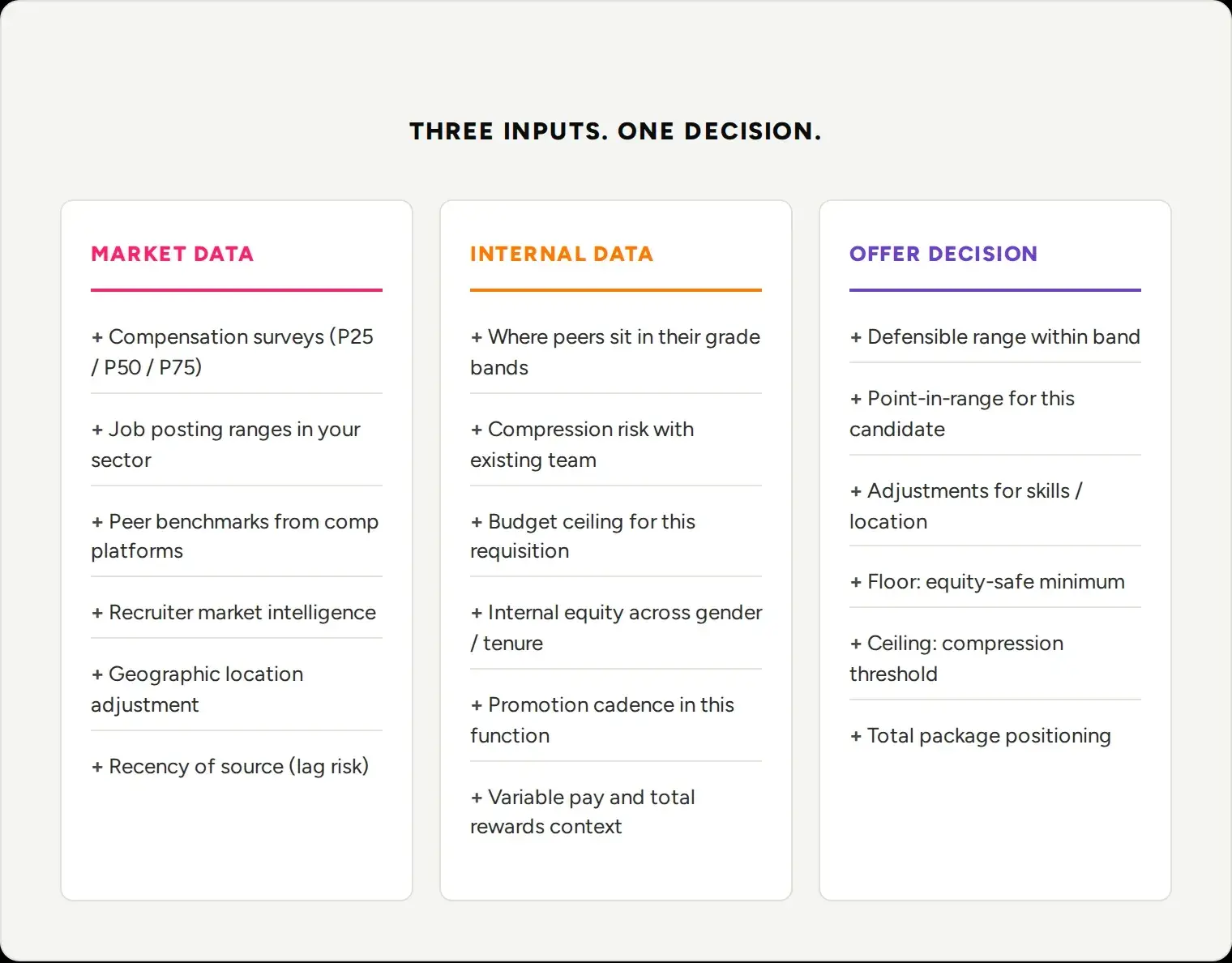
Good offer-setting starts with two separate questions:
- What does the market say someone with this profile should be paid right now?
- What does our own internal data tell us about where this offer should land relative to our existing team?
Only after you have answered both do you land on the number.
What market data is, and is not
Market data gives you a picture of what other employers are paying for comparable work in comparable markets. Salary surveys from compensation data providers, disclosed ranges from public job postings in your sector, and peer compensation benchmarks all belong in this bucket. Each source has a different lag, a different sample size, and a different level of role specificity.
- Broad salary surveys, the kind published by compensation consultancies, tend to be comprehensive but six to twelve months old by the time you read them.
- Job posting data is more current but noisier. Companies post wide bands, and some include variable pay while others do not.
- Peer benchmarks from compensation data platforms give you a tighter peer group, but depend on the quality of participation.
None of these sources tells you what to pay. They tell you what the market distribution looks like. The relevant reference points are the 25th, 50th, and 75th percentiles for your peer group. A company positioning itself as a market leader on pay typically targets P75. A company that competes on other things, such as culture, growth or stability, might reasonably target P50. It then accepts some attrition risk from pay alone.
The mistake is treating these percentiles as hard numbers rather than as benchmarks that set a range of reasonable positions. Market data defines the territory; it does not pick the spot.
Tallect AI insight
Analysis of hiring outcomes across industries consistently shows a pattern (source needed). Companies that rely on a single compensation data source are significantly more likely to make offers outside the candidate's expected range. That source might be a survey, a job board scrape, or an internal band. The mismatch goes both ways. Offers that are too low get declined. Offers that are unnecessarily high create internal compression faster than most HR teams expect. The gap between what candidates expect and what first offers deliver is rarely about total package size. It is usually about the base figure, and base is the number that depends most on current, calibrated market data.
Read your internal pay picture first
Internal pay data is the half of this equation that most companies underuse. Before you look at what the market says, you should know three things about your own house.
Where do your current employees in this function or level actually sit within their grade bands? Not where the policy says they should sit, but where they actually are. Say a band has a midpoint of 18 LPA, but most of the team is clustered between 14 and 15 LPA. That tells you the band is probably stale, or was never used properly. Offering a new hire 17 LPA creates an instant equity problem with people who have been there for years.
What is the compression risk? Compression happens when new hires come in close to or above longer-tenured employees. It is corrosive, and people find out. When it happens systematically, it tells the existing team that loyalty does not pay. The only way to get a market-rate adjustment, it seems, is to leave and come back. Suppose the senior developer working alongside your new junior hire is already at the top of the band. Then you have a band problem the new offer alone will not solve. At least you can see it before you make it worse.
What is your current budget position for this role and this team? Market data might say the right number is 20 LPA. If the most you can offer is 17 LPA, no amount of benchmark analysis changes that. What internal data should tell you is whether 17 LPA puts this new hire in a defensible position relative to their peers, or sets up a morale issue from day one.

When market and internal data conflict
This is the scenario that makes recruiters uncomfortable. Market data says a strong candidate should be paid 22 LPA. Your internal bands top out at 19 LPA, and your best people in that function are already at 18 LPA.
There are three honest responses. "Offer 19 LPA and hope for the best" is not really one of them.
- Revisit the band. Is it stale? If the market has moved and your band has not been updated in two years, you have a band problem, not just an offer problem.
- Adjust the total package. If base is constrained, can equity, a performance component, or other parts of the offer close the gap?
- Be honest with the candidate and with yourself. If the number you can offer is materially below where they need to be, pushing the hire through creates a short-tenure risk. That costs more than walking away from the requisition.
The worst outcome is making an offer you know is below market, not saying so, and watching the person leave within nine months when they realise. That is a recruiter failure, but also a data failure. The right internal data, surfaced at the right moment, would have flagged the mismatch before the search ever started.
Tallect insights
Tallect's compensation module shows both sides in one view: the market percentile benchmark for a role, next to the actual pay distribution of your current employees in that cohort. Say you pull up a candidate for a senior product role. You can immediately see that your P50 market anchor is 21 LPA and that your current senior PMs are clustered between 17 and 19 LPA. You can also see that an offer above 19 LPA would create compression with three team members who have been in seat for over two years. You should not be assembling that by hand in a spreadsheet at the point of offer. It should be there before the job is posted.
The point-in-range decision
Once you have defined a defensible offer range, say 18 to 21 LPA based on market position and internal equity, you still need to decide where this candidate lands within it. This is where a lot of companies default to gut feel, which is where bias enters.
The point-in-range decision should be based on:
- the candidate's assessed proficiency against the role requirements
- their experience with the specific technical or domain skills the role demands
- external factors that affect their real market value, such as a competing offer or a specialised background
Candidates who come in fully ready to perform on day one typically land higher in the range. Those who will need six to twelve months to build context reasonably land lower, even if they are strong.
What the point-in-range decision should not be based on: what the person was making before, how urgently you need to fill the seat, or how assertively the candidate negotiated. That last one matters most. Research shows that negotiation behaviour varies by demographic group (source needed). Companies that adjust offers according to how hard someone pushed back end up with pay equity problems that trace back to the offer stage.
Tallect AI insight
Pay equity audits across mid-size companies often reveal that gaps between men and women in the same role trace mainly to differences at the offer stage, not to performance review outcomes (source needed). The same pattern shows up across other demographic lines. The offers themselves were rarely discriminatory in intent. They were made by individuals using inconsistent inputs and subjective point-in-range decisions. The structural fix is a documented, criteria-based framework for where in a range any candidate lands. Apply it consistently, make it visible to whoever approves the offer, and review it periodically for fairness across groups. Companies that do this cut their risk at the audit stage. More importantly, they make fairer offers from the start.
Making this repeatable
The goal is not to make one good offer. It is to make consistently good offers across every recruiter, every function, and every market cycle. That requires a process, not just awareness. The process has four elements:
- Refresh market benchmarks on a schedule, not just when someone complains the bands are out of date. If your data is more than twelve months old, assume it is stale for any hot role category.
- Surface internal pay data during requisition approval, before the search starts. A recruiter should know the internal context before they brief a candidate on what the role pays.
- Write down the criteria for point-in-range placement and use them consistently, rather than leaving it to individual judgement.
- Track offer outcomes: acceptance rates, counter-offers, and time in role before departure. That shows whether your calibration is actually working.
Most companies do none of these things systematically. They make compensation decisions one at a time, from a standing start, with inconsistent inputs. It is not a talent problem. It is a process and infrastructure problem, and it is entirely solvable.
Key takeaways
- Using only market data or only internal data to set offers produces the wrong number more often than not. You need both.
- Market data defines a territory, the P25 to P75 range. It does not pick your number. Your internal equity picture and budget position do that.
- Before any offer, know where your current employees in that cohort sit within their bands, and quantify the compression risk of a new hire coming in above them.
- When market rates and your internal bands conflict, fix the band. Do not paper over a structural problem with a one-off exception.
- Point-in-range placement should be criteria-based, documented, and consistently applied. Relying on negotiation behaviour or urgency builds bias and equity risk in at the source.
- Refresh market data on a schedule. Stale benchmarks baked into old grade bands cause offer failures that look like recruiter errors but are really data infrastructure failures.
- Track offer outcomes over time. A low acceptance rate or early attrition often traces back to how the original offer was calibrated.
Frequently asked questions
Which is more reliable: salary surveys or job posting data?
Neither is definitively better; they serve different purposes. Salary surveys from compensation data providers tend to have more rigorous methodology and cleaner role definitions, but carry a six-to-twelve-month lag. Job posting data is more current but noisier. Companies post ranges that may include variable pay, signing bonuses, or location differentials without flagging them. The most reliable approach is to use both: surveys for structural benchmarking, and posting data to check how the market is moving right now. If a survey puts P50 for a role at 18 LPA and comparable employers are posting 21 to 24 LPA, investigate that gap before you set your offer range.
How often should grade bands be updated?
At a minimum, once a year. In fast-moving roles, such as software engineering, data science and some specialist sales functions, twice a year is more appropriate given how quickly market rates shift. Many organisations only update bands when someone escalates a problem: a string of declined offers, a senior hire flagging compression, a retention issue. By then, the damage is already building up. Put band reviews on your compensation calendar rather than treating them as a reactive exercise.
What if our band is well below market for a role we need urgently?
You have three options, none of them painless:
- Revise the band now. If the market moved and your band did not, the band is wrong, and fixing it is the right structural response even if the timing is inconvenient.
- Make a time-limited exception for the hire, with a plan to bring the band in line at the next review.
- Revisit whether the role can be structured differently, through scope, seniority level or total package, to bridge the gap.
What you should avoid is making a below-market offer while telling yourself the candidate will not find out, or will stay anyway for the culture or growth. Some will. Most will not.
How should we handle a strong candidate with a much higher competing offer?
Start by checking the competing offer is real; candidates occasionally inflate numbers in negotiation. If it is genuine, check that you are comparing like with like. Base only, base plus equity, and base plus variable plus benefits can look very different once everything is laid out. If the external offer truly is above your ceiling and the total package cannot close the gap, be honest about it. Counter-offering well beyond your calibrated range to win a bidding war usually damages internal equity and sets a poor precedent. Sometimes the right answer is to let the candidate go rather than compromise your pay structure.
What should decide where in a range a candidate lands?
The main criteria should be assessed proficiency against the role requirements, domain experience that directly applies to the work, and specialised skills or certifications that are genuinely scarce. Secondary factors can include cost-of-living adjustments for distributed roles, and validated data on how comparable external talent is priced right now. These should not be criteria: the candidate's previous salary, how hard they negotiated, or how urgently you need to fill the seat. Document your criteria in advance and apply them consistently to all candidates for similar roles. Then review where candidates land to check for patterns across demographic groups.
How do we prevent compression when new hires earn more than long-tenured staff?
Prevention works best before the offer, not after. Show your existing team's pay distribution during the requisition process, so you can see the compression risk clearly. If a market-rate hire creates equity issues, discuss adjusting existing salaries at the same time as the hire decision, not six months later when someone complains. Companies that put new hire offers and existing employee pay on separate calendars keep ending up with compression problems. They are the same budget conversation.
Can internal pay equity audits inform individual offers?
Yes, and this is one of the most practical uses of pay equity work. An audit that reveals a gender or tenure-based pay gap in a function tells you where to be more careful on future offers into that cohort. Say women in your engineering team sit mostly in the lower half of their grade bands. That data should shape how you position offers to women engineering candidates from now on. Using audit findings to calibrate future offers is how you close structural gaps over time, rather than just documenting them.
Should candidates be told what percentile of the market our offer represents?
In markets where salary ranges are disclosed, as more laws now require, candidates can work this out themselves. Proactively sharing your pay philosophy builds more trust than staying opaque. For example: "We target P50 of our peer group, with movement to P75 linked to demonstrated performance." Candidates who understand your framework and accept an offer within it are less likely to feel aggrieved later. The risk comes when someone joins and discovers the offer was at P25 when you implied it was competitive. Being open about your philosophy is better for retention, even where no law requires you to disclose a number.
How should we handle location for distributed or remote roles?
Location adjustments remain one of the more contested areas of compensation strategy. Some companies pay a single national rate wherever the employee sits. Others apply location-based differentials using cost-of-labour indices. Neither approach is universally right. What matters is that you pick a policy, apply it consistently, and are open about it with candidates. Imagine you quietly reduce an offer for a candidate in a lower-cost city. They accept, then learn that a colleague in a higher-cost city is paid more for the same work. That creates serious retention and morale risk. Whatever your policy, it should be one you are comfortable explaining out loud.
What is the biggest sign that an offer process is broken?
Offer acceptance rates below 70% in a function, or a pattern of hires leaving within their first year, are strong warning signs. Both usually trace back to the offer stage. The number was wrong, the total package was misrepresented, or the candidate's expectations were not properly managed. The other major sign is existing employees complaining about new hire salaries. Any of these should trigger a review of how offers are calibrated, not just how recruiters communicate them. The problem is usually in the inputs, not the delivery.
Disclaimer: The information in this article is for general informational purposes only and should not be treated as legal, financial, or compensation consulting advice. Compensation strategies, legal requirements, and labour regulations vary by geography and industry. Always consult qualified HR, legal, and compensation professionals before making decisions about pay practices or offer strategies.