Six points to check before extending a job offer
A lot can go wrong between "we want to hire this person" and the letter going out. Most of it is preventable with a pre-offer checklist.
The moment you decide someone is the right hire, there is a natural pull toward getting the offer out fast. Speed feels like urgency, and urgency feels like you are taking the candidate seriously. But offers that go out without the right internal checks tend to create problems. Sometimes those come immediately, when the offer is declined. Sometimes they come weeks or months later, when a pay equity issue surfaces or a missed legal requirement comes to light.
None of these checks take long. The issue is that without a consistent process, they get skipped. Not because anyone is careless, but because the default is to treat sending the offer as the finish line rather than the start of a more careful final lap.
Here are the six things worth verifying before the letter goes out.
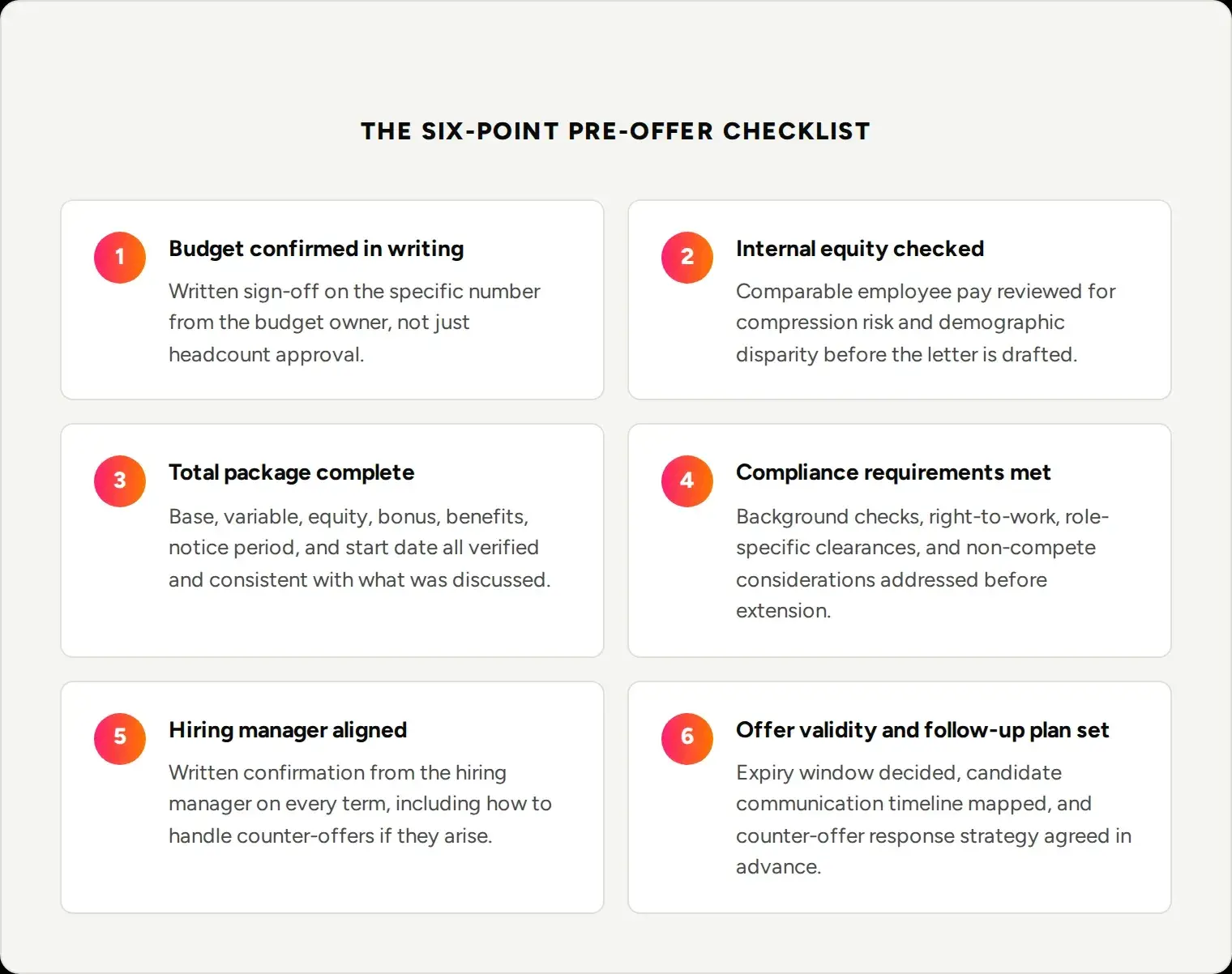
Check | What to verify |
|---|---|
1. Budget confirmed in writing | Written sign-off on the specific number from the budget owner, not just headcount approval |
2. Internal equity checked | Comparable employee pay reviewed for compression risk and demographic disparity before the letter is drafted |
3. Total package complete | Base, variable, equity, bonus, benefits, notice period and start date all verified and consistent with what was discussed |
4. Compliance requirements met | Background checks, right-to-work, role-specific clearances and non-compete considerations addressed before extension |
5. Hiring manager aligned | Written confirmation from the hiring manager on every term, including how to handle counter-offers |
6. Validity and follow-up plan set | Expiry window decided, candidate communication timeline mapped, counter-offer strategy agreed in advance |
Caption: The six-point pre-offer checklist.
1. Budget approval in writing
This sounds obvious, but it is skipped more often than you would expect. A hiring manager says "let's make an offer" in a debrief call, and the recruiter takes that as budget sign-off. It is not. Budget approval for a specific salary figure, not just for the headcount, needs to come from whoever owns the compensation budget. It needs to be documented before the offer is prepared.
The failure mode looks like this. The offer goes out at 20 LPA and the candidate accepts. Then finance comes back and says the approved budget for this role was 17 LPA. Now you have two bad options. You can pull back on a verbal commitment, which damages your reputation with the candidate and may create legal exposure. Or you can absorb the difference and set a precedent that budget overruns get approved after the fact.
The fix is a simple step: written sign-off on the specific offer number from the budget owner, before the letter is prepared. Not approval in principle. The actual number.
2. Internal equity checked
Before any offer leaves the building, someone should look at what comparable employees in the same function and level are currently making. Not as a formality, but as a genuine check on whether the offer creates an equity problem with the existing team.
Two failure modes matter here:
- Compression: a new hire coming in at or above a more tenured colleague doing the same or more complex work.
- Demographic disparity: say women in the function are clustered at the lower end of the band, and the new offer to a male candidate is at the top. The offer itself becomes the next data point in an equity gap you may already have.
Neither of these is obvious without looking at the data. Both are visible if you do.
The point is not to cap offers at the lowest comparable salary in the team. It is to make the offer with open eyes, and to flag in advance if internal adjustments should accompany the hire, rather than waiting until someone complains six months later.
Tallect AI insight
Compensation analytics tools that apply machine learning to internal pay distributions point to a consistent finding (source needed). Most statistically significant pay equity gaps within companies trace back to the offer stage, not to later performance reviews or promotion decisions. When offers are made without structured equity checks, gender and tenure-based pay gaps build up across hiring cycles. That happens not through deliberate bias, but through inconsistent inputs. Automated pre-offer equity flagging surfaces disparity risk before a letter goes out, and studies suggest it reduces equity-gap-creating offers compared with manual review (source needed). The value is not in blocking offers. It is in giving decision-makers visibility they would not otherwise have before the commitment is made.
3. The total package is complete
Offers get declined for reasons that have nothing to do with base salary:
- a candidate expected an equity component and does not see one in the letter
- a notice period clause conflicts with their current contract
- the probation period is twice the industry norm
- benefits were discussed verbally but did not make it into the written offer
Before the letter goes out, check that every element discussed during the process is reflected accurately:
- base salary
- variable pay structure and target percentage
- equity, if applicable, with the vesting schedule
- joining bonus, with any clawback terms
- benefits enrolment
- notice period obligations in both directions
- start date
These are not afterthoughts. They are the full package the candidate is evaluating. Mismatches between what was discussed and what appears in the letter are among the most avoidable causes of declined offers and post-acceptance fallout.
Also check that the offer letter template itself is current. Legal requirements for employment contracts change, and a template drafted two years ago may be missing disclosures that are mandatory today.
4. Compliance and documentation
Depending on your jurisdiction and the role, there may be pre-offer or pre-joining requirements that cannot be waived. Examples include background verification authorisation, completed reference checks, right-to-work documents, and a non-compete review if the candidate is coming from a competitor. Some of these must happen before an offer is extended. Others can be conditions of the offer. None of them should be discovered after the offer is accepted.
In roles with specific regulatory requirements, such as finance, healthcare, or roles with access to sensitive data, the consequences of getting this wrong go beyond awkwardness. Imagine extending an offer to someone who later fails a mandatory clearance that should have been a condition of the offer. That puts both the company and the candidate in a poor position.
A simple question to ask before the letter goes out: is there any requirement for this role or candidate that could prevent or delay the hire, and has it been addressed?
Research highlight
Studies of offer process quality and early attrition find a consistent pattern (source needed). Candidates who receive offers with errors are more likely to leave within their first twelve months, even when the errors are later corrected. Typical errors are misquoted salary figures, missing benefits, wrong start dates, and absent contract clauses. Receiving a flawed offer shapes how a new hire sees the organisation's attention to detail and its reliability as an employer. First impressions formed through the offer letter last. An offer that needs amending before it is signed is not just an administrative inconvenience. It is a retention risk that begins before the person's first day.
5. The hiring manager is aligned
The recruiter and the hiring manager can walk out of the same debrief with different assumptions about the offer. The recruiter heard "let's hire her" and started preparing the letter. The hiring manager assumed there would be another conversation about salary before anything was finalised. Or the hiring manager knows the candidate has a higher competing offer and expects the offer to come in above band, while the recruiter prepares something within standard parameters.
A brief written check-in with the hiring manager before the offer goes out prevents this. Even a message will do: "Confirming we are making an offer at X base with Y variable, start date Z. Does this match your expectation?" Without it, the misalignment surfaces at the worst possible moment. That might be after the candidate has seen a number they are unhappy with, or after a counter-offer conversation the hiring manager was not briefed on.
It also creates shared ownership. If the offer is declined and you need to decide whether to negotiate, the hiring manager needs to be part of that call. They cannot be if they were not aligned on the original terms.

6. Validity window and counter-offer plan
Once the letter goes out, you are in a negotiation whether you planned for it or not. An offer validity window creates a natural close without seeming pushy. Three to five business days is typical for mid-level roles, and up to a week for senior hires. Without one, the situation is open-ended: the candidate can gather competing offers while you wait.
More importantly, decide the counter-offer response strategy before the letter goes out, not in the middle of a conversation with the candidate. Answer these questions first:
- If the candidate asks for 15% more, does the hiring manager have authority to flex?
- Is there budget to move on base, or would you respond with more variable pay or an earlier equity cliff?
- Is there an absolute ceiling you will not go above, and what is your plan if they decline?
Having these conversations in advance takes twenty minutes. Having them in real time costs far more, in time, in internal confusion, and sometimes in the hire itself. Picture the candidate waiting on a response, the hiring manager in a board meeting, and the recruiter making calls on the fly.
Tallect insights
Tallect's offer management module runs these checks as a structured pre-offer workflow before an offer letter can be generated. It covers budget approval status, the internal equity flag, total package completeness, compliance documentation status, and hiring manager sign-off. Teams using the workflow report fewer offer amendments after extension, faster acceptance cycles, and cleaner audit trails when pay decisions are reviewed (source needed). The checks are not a gate that slows down hiring. Built into the process, they actually shorten the time between the verbal decision and the signed offer, because every stakeholder is aligned before the letter is drafted.
Key takeaways
- Budget approval for the specific salary figure, in writing, is different from headcount approval. Treat them as separate steps.
- Internal equity checks before an offer, not after, are the only way to catch compression and demographic pay gap risks before they are locked in.
- Every element discussed with the candidate should appear in the letter. Gaps between the verbal discussion and the written offer are a leading cause of declines and early attrition.
- Compliance requirements depend on the role and the jurisdiction. Ask explicitly whether any requirement could block or delay the hire, and address it before extending.
- Get written alignment with the hiring manager on all terms, including the counter-offer strategy, before the letter goes out, not after the candidate responds.
- Setting a validity window and the negotiation ceiling in advance keeps the process clean and prevents reactive decisions that break the budget.
- The six checks together take less time than fixing a declined offer, an equity complaint, or a compliance breach after the fact.
Frequently asked questions
Who should run these six checks?
In most organisations, the recruiter coordinates the process and makes sure every check is done before the letter goes out. But specific checks need specific owners:
- the budget owner or finance business partner signs off on the number
- the hiring manager confirms the terms and the counter-offer strategy
- the HR or legal team verifies compliance requirements
The recruiter does not need to own all of these. They need to make sure none of them is skipped. A shared checklist or workflow tool makes this more reliable than individual memory or informal coordination.
How long should a job offer stay open?
For most mid-level professional roles, three to five business days is appropriate and has become the norm in many sectors. For senior or specialist roles, where the candidate may need to negotiate notice periods or evaluate equity terms carefully, five to seven business days is reasonable. An offer left open indefinitely implicitly invites the candidate to gather competing offers while you wait, which weakens your position. That said, if a candidate asks for more time for a legitimate reason, being rigid rarely helps. It might be a family situation or a pending clearance from their current employer. Build in flexibility, but start with a default window.
What if a new hire would come in above existing employees?
Address it before making the offer rather than hoping no one notices. You have two realistic options:
- Adjust the existing employees' salaries as part of the hiring decision, treating the market signal as the trigger for an overdue correction.
- Bring the new hire in at a number within the existing team's range, with an honest conversation about the band and growth path.
What you should not do is make the offer knowing the compression exists and plan to deal with the fallout later. People find out. The resulting morale damage is much harder to repair than the salary adjustment would have been.
When should we use a conditional offer?
A conditional offer is one extended subject to specified checks being completed. It is appropriate when a required pre-employment verification cannot be finished before the candidate needs a commitment. Background checks, degree verification, professional licence confirmation, and right-to-work documents are commonly handled this way. Spell out the conditions clearly in the offer letter itself. The candidate needs to understand what "subject to" means in practice: the offer is real but contingent, and they should know what happens if a condition is not met. A conditional offer is not a way to lock a candidate in while you do checks you should have started earlier. It is a legitimate tool when the sequence really cannot be compressed.
How do we handle a candidate who asks for more than our ceiling?
Be direct. Try: "We are not in a position to move beyond this number on base, but here is what we can offer instead." Then be specific about the alternative. Do not make the candidate feel bad for asking. Counter-offers are normal, and candidates who negotiate are often the ones who will do the same on your behalf in their new role. If the gap is truly too large to bridge, say so clearly. Something like "I do not think we can get to where you need to be on this, and I respect your position" is far better than stringing out a negotiation that leads nowhere. You preserve the relationship and your time.
Is it risky to make a verbal offer before the letter is ready?
In many jurisdictions, an accepted verbal offer can form a binding contract even before the written letter is signed. Candidates have brought claims after verbal offers were rescinded (source needed). If you make a verbal offer, make sure the number you quote is the number in the letter. Also make sure the budget and equity checks are already done. The verbal offer should not be a placeholder while you work out the details. It should confirm terms you have already finalised internally.
What must legally appear in a job offer letter?
This varies by jurisdiction, so no single list applies everywhere. In India, offer letters typically state the role, compensation, start date, probation period, and notice period. In some US states, specific pay disclosures are now mandatory (source needed). In the UK, a written statement of employment particulars is required by law within set timelines. The practical answer is to have HR and legal review your offer letter template every year against current requirements in every jurisdiction where you hire. A template that was compliant two years ago may not be today.
How should we deliver the offer: by email, call or formal letter?
The best practice is a call first, with the written letter the same day or within 24 hours. The call lets the recruiter read the candidate's immediate reaction before the formal document is in their hands. Is it enthusiasm, hesitation, or a concern to address? It also creates a moment of real human contact in an otherwise paperwork-heavy process. Send the written letter promptly after the call. Sitting on it for days creates anxiety, and sometimes prompts the candidate to speed up competing opportunities. Move fast once you have made the verbal offer.
What if the hiring manager changes the terms after the candidate accepts?
This is serious, with possible legal and reputational consequences depending on how material the change is and how it is handled. Minor corrections, such as a typo in the start date, can usually be handled with a corrected letter and a brief explanation. Material changes after acceptance can amount to a breach of the offer and expose the company to a claim. Examples include cutting the salary, changing the role scope, or altering the variable pay structure. The candidate may also simply withdraw and pursue other opportunities. Prevention is the only reliable strategy. Make sure the terms are final before the letter is extended, and that the hiring manager cannot change them after acceptance.
How do we make the offer feel good, not just correct?
The checks exist to protect both the company and the candidate from foreseeable problems. They do not compete with a warm offer experience; they make it possible. A candidate who receives a complete, accurate, thoughtfully written offer from a recruiter who has clearly prepared sees a well-run company that cares about them. Compare that with an offer that arrives with the wrong salary, missing benefits, and a correction email two days later. The process is the impression. Getting the six checks right is not bureaucracy. It is the foundation for a first experience the candidate actually wants to tell people about.
Disclaimer: The information in this article is for general informational purposes only and does not constitute legal, HR, or compliance advice. Employment laws, offer requirements, and compensation regulations vary significantly by geography, industry, and company size. Always consult qualified legal and HR professionals before finalising offer processes or documentation for your organisation.