
Salary history bans: what they prohibit and what changes for hiring
More places now restrict what employers can ask about prior pay. Here is what these bans cover, and how hiring works without the old anchor.
There is a specific moment in most job interviews that hiring managers stopped noticing because it became standard practice so long ago. The candidate is asked what they are currently earning. They give a number. That number becomes the floor. The offer is built around it. This cycle has repeated across almost every industry for decades, and it has a structural problem: it perpetuates whatever the candidate was paid before, including any historical undervaluation.
Salary history bans exist to interrupt that cycle. They prohibit employers from asking candidates about prior compensation. In many jurisdictions, they also stop employers using that information even if a candidate volunteers it unprompted.
If you are hiring into a jurisdiction that has enacted one of these restrictions, your process needs to change more than you might think. If you are hiring in India, where no equivalent law currently exists, the mechanism behind these bans is still worth understanding. The companies competing for the same talent often already operate this way, and the problem the bans address is not exclusive to any one market.
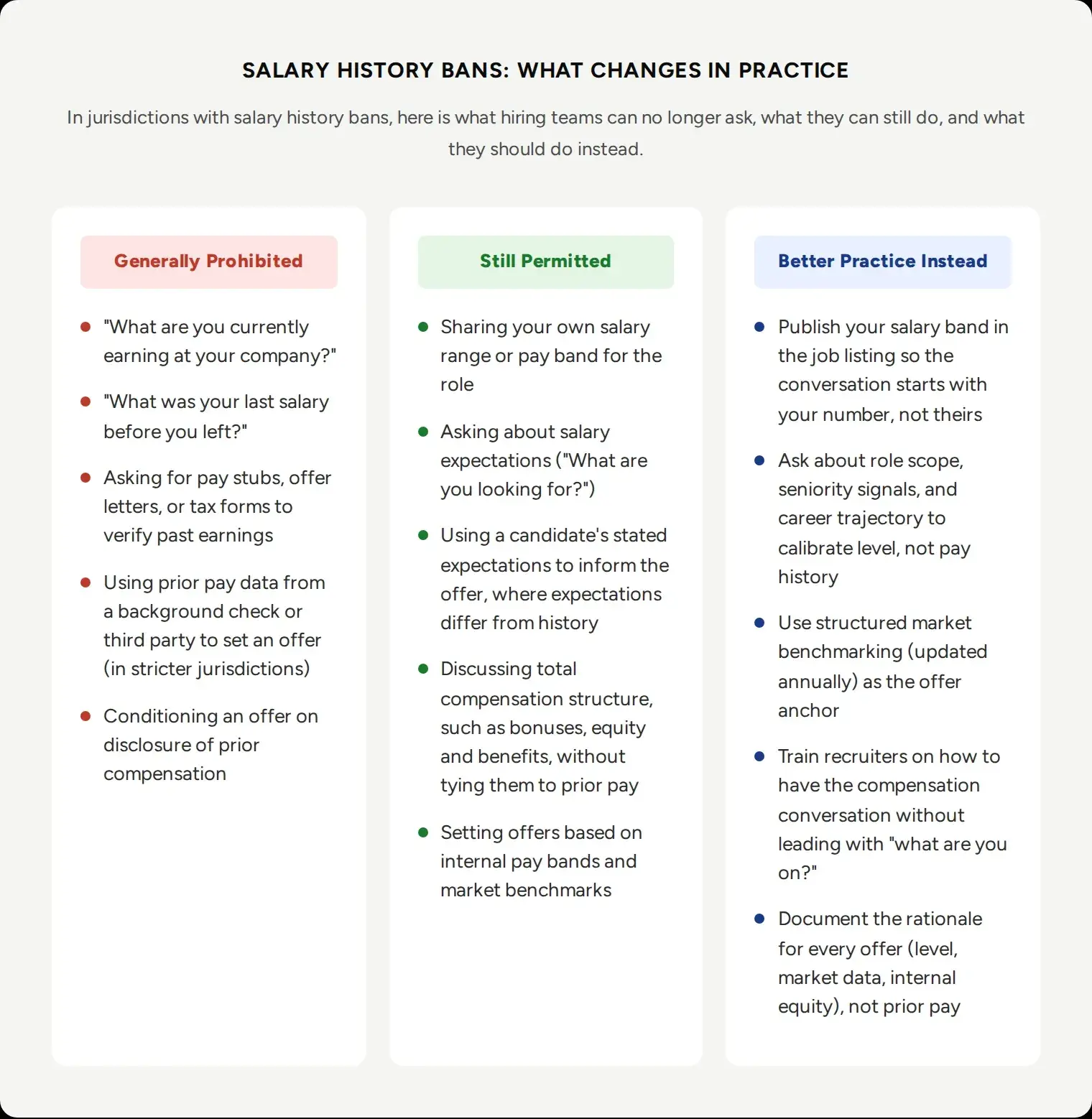
What salary history bans prohibit
The specifics matter here, because "salary history ban" is used loosely to describe several different things that have quite different implications for how you hire.
At the narrowest end, a ban prohibits the employer from asking about prior or current compensation. The candidate can volunteer it, and the employer can use it. At the broader end, some laws prohibit using voluntarily disclosed salary history to set compensation, full stop. Some bans apply only to base salary; others extend to bonuses, equity, and benefits. Some cover only state or city government employers; others apply to every employer of a certain size.
In the United States, many states and localities have enacted some form of restriction, including California, New York, Massachusetts, Illinois, and New Jersey (source needed). Several of these go further than just prohibiting the question. California, for instance, requires employers to provide a pay scale to candidates who ask, whether or not a salary history question was ever raised (source needed). The UK does not have a specific ban, but the Equality Act 2010 creates obligations that push compensation practices in a similar direction.
India has no equivalent legislation as of 2026. That said, multinational companies hiring here routinely apply their most stringent jurisdiction's policy globally. So many candidates in Indian cities already meet hiring processes that will not ask about their current CTC. If you are hiring against those companies, your practices are being compared to theirs.
The problem these bans try to solve
The mechanism is straightforward once you see it. A candidate who has been underpaid carries that underpayment into every subsequent role unless someone in the hiring chain deliberately breaks the cycle. An offer built on prior salary does not reflect what the role is worth. It reflects what the previous employer paid, which may have been shaped by negotiation skill, timing, desperation, or plain historical bias.
Women and candidates from underrepresented groups are more likely to have been underpaid relative to peers doing equivalent work. They are also more likely to have employment gaps that further compress their historical earnings. Asking about salary history does not just reflect existing inequality. It compounds it, offer by offer, across an entire career.
The compounding makes this worse over time. If someone was underpaid at 25, they are likely to be underpaid at 30, because every subsequent offer started from an already-compressed number. By 40, when the market would in theory correct it, the gap has widened significantly. The correction is then much more expensive for any one employer to make alone. Salary history bans are an attempt to interrupt the compounding before it gets that far.
Tallect AI insight
Research from the Boston University School of Law tracked compensation outcomes in US states before and after salary history bans were enacted. In the first year after a ban, wages rose for women relative to men in the same roles, and by more again for Black workers (source needed). The effect did not come from employers suddenly paying more. It came from removing prior salary as a ceiling. When offers are built on market data and role scope rather than historical pay, the distribution of who gets what changes. That is exactly what the legislation was designed to do.
What changes when you cannot ask
More than most hiring teams expect, especially if the previous salary question was doing more work in your process than you realised.
You need a compensation framework that does not depend on an outside anchor. If you cannot use what the candidate was earning to calibrate the offer, you need to know what the role is worth in the current market and be willing to pay it. This sounds obvious. In practice, a lot of companies have used salary history precisely because it let them avoid doing that work. The candidate's current pay was a convenient shortcut that passed the accountability for the number to the previous employer. Take that shortcut away and you have to make an actual decision.
Your recruiters need new scripts for the early pay conversation. The instinct to ask "what are you on?" is strong. Sometimes it is a genuine rapport-builder; often it is a quick way to gauge whether the candidate is in range before investing more time. Without it, the alternative is sharing your range first. That requires a range you can actually share, which brings you back to the compensation framework problem.
Your offer rationale has to be explicit. This is the change that often gets overlooked. When you can point to a structured pay band, a market benchmark, and a level calibration as the basis for an offer, you have an audit trail. When all you can say is "we offered 15% above what they were making", you have a problem. It surfaces the moment someone asks why two people doing the same job are paid differently. Salary history bans speed up the need for that audit trail, whether or not your jurisdiction requires it.
The objection hiring teams have
Most of the resistance to salary history bans from hiring managers comes down to a single practical question: without knowing what the candidate earns, how do we find out if we can afford them before going through three rounds of interviews?
This is a legitimate concern. It also has a straightforward answer: tell them what you are paying.
If you have a published salary band, or at minimum a band you share in the first recruiter call, the candidate knows whether the role is in range before either party has invested significant time. The problem salary history bans create is mostly a problem for companies that have not built a functioning pay structure. If you have one, removing the prior salary question takes very little practical value out of your process. You were never actually making better decisions with that number. You were just making faster ones.
There is a more nuanced version of this objection: what about senior roles, where the range is genuinely wide and level depends heavily on past experience? This is a real consideration for VP and C-suite hiring. A band of 40 to 80 LPA might be entirely legitimate, depending on whether you need a strategist or an operator. The answer is the same. Structure the conversation around what the role requires at each level and assess the candidate against those requirements. Then calibrate level and compensation from that, not from what they last earned.

Tallect insights Tallect's compensation module is designed for exactly this kind of environment. Pay bands are configured by role, level, and location using current benchmarking data. So when a recruiter needs to have the compensation conversation in a first call, they are working from a range that has already been through internal review and market validation. When an offer is made, the rationale is recorded against the hire: level, band position and market reference. That creates the audit trail that salary history never could. If your compensation practices need to work in a transparency-first environment, that is the infrastructure that makes it possible.
Building offers without prior pay
Companies that make this work consistently share a few practices that are worth copying, whether or not a salary history ban applies to you.
They benchmark annually, not when it becomes convenient. Salary data from 2022 has limited predictive value in 2026 for most functions. Markets moved sharply in both directions through and after the pandemic, and they have continued to move. A framework built on stale data produces offers that are either too low to close or too high to sustain internally. You often do not know which until the damage is done.
They set bands narrow enough to constrain decisions. A band of 15 to 18 LPA communicates something specific. A band of 10 to 25 LPA communicates that nobody has made a decision yet. Narrow bands require more work upfront, because you have to agree on what the role requires and what that is worth. But they make the offer conversation far more straightforward, and they are far easier to defend when a pay equity question comes up later.
They separate the level conversation from the pay conversation, at least at first. You can assess a candidate against a role's requirements without knowing their salary history. Is this a mid-level individual contributor, or someone who should be scoped as a lead? Answering that requires a clear definition of what each level looks like. That is good hiring practice whether or not any transparency law applies.
They document offer rationale consistently. Every hire gets a record of which band applied, where in the band the offer sat, the market reference used, and why. This sounds like administrative overhead. It is, until someone asks why two people hired in the same quarter for comparable roles are paid 20% differently. On that day, you can either point to a legitimate rationale or you cannot.
Where companies still get it wrong
Swapping history for expectations
The most common failure is substituting "salary expectations" for "salary history" without changing anything else about the process. Asking a candidate what they are looking for, instead of what they currently earn, is permitted almost everywhere. But if the answer is used the same way, as the main anchor for the offer, the effect on pay equity is minimal. You have moved from asking about the past to asking about aspirations, but the offer logic is identical.
Inconsistent application
A company bans salary history questions in its recruiter training materials but does nothing about hiring managers who routinely ask about it in first interviews, because nobody told them not to. Legal exposure aside, this creates inconsistent offers across the organisation, some built on market data and some on prior pay. That is exactly what a pay equity audit will find.
Old salary data in the ATS
A subtler problem is prior salary information that lingers in candidate records. Say a candidate applied two years ago, disclosed their salary, was not hired, and has now re-entered your pipeline. That historical data may still be sitting in your ATS. In jurisdictions where the ban covers using prior salary even when volunteered, using it to inform the current offer is prohibited. Most companies have not thought through their data hygiene in this context.
Tallect AI insight Here is a practical first step before any formal compliance audit. Pull the last 12 months of offer letters across a single function and check how offer amounts correlate with candidate gender and prior employment sector. Suppose offers to women in the same role cluster 10 to 15% below offers to men. Then ask whether your pay bands are doing the work they should, or whether prior salary data is still driving decisions without any explicit policy to use it. The pattern shows up in the data before it shows up in a complaint.
Key takeaways
- Salary history bans prohibit asking about prior compensation and, in stricter jurisdictions, using that information even when volunteered. The exact scope varies significantly by location.
- The problem these bans address is real: prior salary carries historical pay gaps forward, and they compound with every role change.
- The most common hiring team objection, "how do we know if we can afford them?", is answered by sharing your own range first. That requires having a range worth sharing.
- Asking about salary expectations instead of salary history is permitted, but changes nothing about pay equity outcomes if the offer logic stays the same.
- Narrow, well-benchmarked pay bands built on current market data are what make a salary-history-free offer process actually work.
- Documenting offer rationale (level, band position, market reference) is not administrative overhead. It is the audit trail that makes your compensation decisions defensible.
- Companies in India without legal obligations still compete for talent against companies that follow these rules globally. The practices are worth building regardless.
Frequently asked questions
Can a candidate still volunteer their prior salary, and can we use it?
In most jurisdictions with salary history bans, yes, the candidate can still share their history unprompted. Whether you can use it to set the offer depends on the specific law. In some places, including Massachusetts and New York City, using voluntarily disclosed salary history to set pay is prohibited even if you did not ask (source needed). Across all jurisdictions, the safer practice is to set offers from your pay band and market data, whatever the candidate shares.
We operate mainly in India. Do we need to worry about this?
There is currently no salary history ban legislation in India. However, the restrictions do apply to roles in the US, the UK, or other affected jurisdictions if your company operates there, or if your hiring team applies a global policy. Beyond legal compliance, the practices these bans require are worth building in any market: structured pay bands, documented offer rationale and market-based anchoring. They produce more defensible and equitable pay decisions, whatever the law says.
Can we still ask about salary expectations?
Yes, in almost all jurisdictions. Asking what a candidate is looking for is distinct from asking what they have previously earned, and it is permitted. The nuance is in how you use the answer. If the expectation becomes the floor for the offer, in place of your pay band and market data, the effect on pay equity is limited. The better approach is to share your range before asking about expectations, so the conversation starts from your structure rather than the candidate's prior anchor.
What about salary data already in our ATS from past candidates?
If a candidate applied previously and disclosed their salary at the time, that record may still exist in your system. Using it to inform a current offer is prohibited in several jurisdictions, even if the original disclosure was voluntary. A practical step is to configure your ATS to flag or suppress historical compensation fields for returning candidates. Also audit which data fields recruiters see during screening. This is worth a conversation with legal and your HR tech team before it becomes a compliance issue.
How do we handle senior roles where the band is genuinely wide?
Wide bands at senior levels are legitimate when the scope of the role really varies that much with experience and remit. To handle them without salary history, define what each level within the band looks like. Use responsibility, team size, revenue scope, or whatever criteria are relevant, and assess the candidate against them explicitly. The level determines where in the band the offer sits. That assessment can happen thoroughly in interviews without ever touching what the candidate was previously paid.
What are the penalties for violating a salary history ban?
Penalties vary significantly by jurisdiction. In New York City, civil penalties can be substantial (source needed). In California, affected candidates can sue under the Labor Code, and Labor Commissioner enforcement can lead to fines and back-pay orders. Even so, the bigger risk is usually not a regulator's fine. It is a pay equity lawsuit that uses a salary-history-based offer as evidence of discriminatory pay practices. That kind of litigation brings discovery, legal fees and reputational exposure. It typically costs far more than any direct penalty in the statute.
Do salary history bans apply to internal transfers and promotions?
In most jurisdictions, the bans focus on external candidates, people who are not currently employed by the organisation. Internal transfers and promotions generally fall outside the scope. The same principle still applies, though. Setting a promotion offer from someone's current pay, rather than from what the new role is worth, compounds pay gaps just as external hiring does. For internal moves, benchmark the destination role independently and set pay from there, not from the employee's current salary.
What should a hiring manager do if a candidate mentions their salary?
Acknowledge it and redirect, with something like "Thanks for sharing that. We set offers from our role band and current market data, so we won't be using prior pay as the reference point." Do not write the number in your interview notes. Do not pass it to whoever makes the final offer decision, and do not confirm it influenced your thinking. Some jurisdictions prohibit using salary history a candidate volunteers. There, even an unprompted disclosure creates exposure if it shapes the offer. Train hiring managers on this explicitly. Most compliance failures happen not in the recruiter's first call but in the interview room, where nobody thought the policy applied.
How do we train hiring managers without it feeling robotic?
Scenario-based training works far better than policy documents. Give hiring managers two or three realistic examples and walk through exactly what to say in each:
- a candidate who volunteers their salary
- a candidate who asks why you won't share theirs
- a candidate who seems surprised by your band
The goal is not reciting a disclaimer. It is giving managers the confidence to redirect naturally, which comes from knowing the company's pay structure well enough to speak to it. Managers who understand why the band is set where it is handle these conversations without friction. Managers who were just told "don't ask about pay history" stumble.
Can reference checks include salary verification?
In most jurisdictions with salary history bans, the prohibition extends to seeking pay information through reference checks or background screening vendors. Even if a previous employer would share it, using it to set an offer may still break the ban. Several states have companion laws restricting what former employers can disclose about pay on reference calls (source needed). Background check providers are increasingly dropping pay history from their standard reports in affected jurisdictions. Confirm with your provider what data they surface, and check that your account suppresses it.
Disclaimer: This article is for general informational purposes only and does not constitute legal advice. Salary history ban legislation varies significantly by jurisdiction and is subject to change. Employers should consult qualified legal counsel when assessing compliance obligations in specific locations.