
Including salary ranges in job postings: what the data says
Most hiring teams still leave the number out of the listing. Here is what that silence costs your pipeline and your offer acceptance rate.
Salary as per market standards." Five words that tell a candidate exactly two things: you know what you want to pay, and you would rather not say it.
Most companies that use that phrase think they are being strategic. They are not protecting anything meaningful. What they are actually doing is filtering out the candidates who have enough options to care about the answer, and those tend to be the ones worth competing for.
This piece is about what actually happens when you add a salary range to a job posting, set against what companies are afraid will happen. The gap between those two things is wider than most hiring teams realise. It is showing up in their pipelines, their offer acceptance rates, and eventually in the attrition they cannot explain.
Why salary ranges are appearing now
The legislation story is real, but it is not the whole story. Colorado, California, New York and Washington have all passed laws requiring pay transparency in job postings. India has nothing equivalent yet. When it gets discussed here, it tends to get discussed slowly. But companies that are waiting for a law before acting on this are misreading what is actually happening in the market.
The information asymmetry that salary secrecy depended on has largely collapsed. Candidates have had crowdsourced pay data for years, from Glassdoor, AmbitionBox and LinkedIn Salary Insights. When someone applies to a role without a salary band, they are not going in blind. They have already done a rough benchmark. The number you think you are protecting is already out there. You are just making candidates do a worse job of finding it, which adds friction to a process that already has plenty.
LinkedIn's 2023 research found that most job seekers say compensation information is important when evaluating a role (source needed). Listings with salary data get significantly more clicks than comparable listings without it. Not marginally more: enough to visibly affect pipeline volume and quality. The difference is consistent on platforms like Naukri and Shine. A listing with a pay band gets a second look; one without it gets passed over when something similar is visible next door.
There is also a generational shift that does not reverse. Candidates under 35 have grown up sharing salary information in WhatsApp groups, on Reddit, and in anonymous Slack communities for their industry. Most compensation strategies were built on a culture of secrecy. That culture assumes a level of information isolation that simply does not exist anymore.
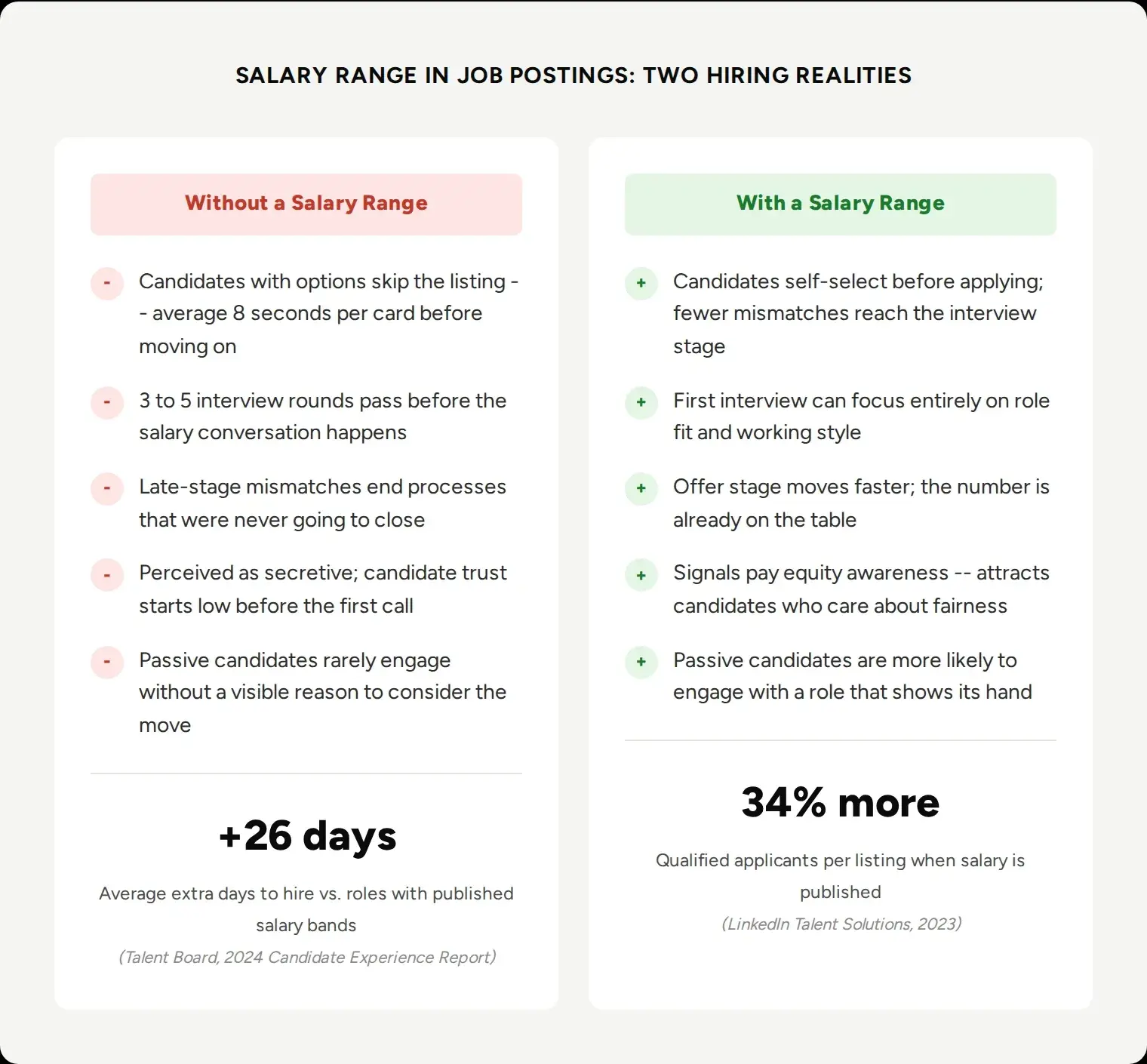
What candidates do when they see a range
The fear that every candidate will anchor to the top of the band and negotiate from there is the most cited reason companies avoid publishing. It sounds reasonable. It is not particularly well-supported by what actually happens in hiring.
Research from Salary.com found that most candidates who see a posted range place themselves somewhere in the middle of it (source needed). The logic holds up: a candidate who genuinely expects the ceiling of your band is almost certainly already earning close to it. They were going to negotiate hard whether or not you published anything. The range did not make them ambitious. It just surfaced that ambition earlier, where it is actually useful.
Here is the scenario most recruiters have lived through at least a dozen times:
- A candidate is earning 22 LPA. The hiring team's budget for the role tops out at 16 LPA, and there is no number in the listing.
- The candidate applies because the company brand is good and the role sounds like a step up.
- They clear the phone screen. Round one goes well, and the hiring manager is genuinely interested.
- By round three, someone finally asks what their expectations are. The candidate says 23 LPA.
- Everyone is polite and awkward. Three weeks of process ends in a decline that a published band would have prevented on day one.
The filtering effect runs the other way too. Some candidates have been earning below market: people switching functions, returning after a break, or working at companies that underpaid them. They sometimes undersell themselves out of uncertainty. A published band tells them the role is within reach. They apply. Your pipeline gets both more relevant and more diverse, without any extra sourcing effort.
Tallect AI insight
Companies that include salary ranges in job postings report a meaningful reduction in time-to-offer (source needed). The saving mostly accrues at the offer stage, not during sourcing. The volume of applicants stays roughly the same, but the proportion who accept drops far less often because both sides already know the number. Tallect's data across Indian SMEs shows a similar pattern: roles with published bands closed faster than equivalent roles where salary was not disclosed (source needed). That is recovered recruiter capacity on every hire.
What it does for the business
When companies move to pay transparency in job postings, a few things happen that are worth understanding before you decide this is more trouble than it is worth.
Screening gets cheaper. A recruiter who is not managing late-stage compensation objections from candidates who were always out of range has capacity for the ones who do fit. In a team doing 20 to 30 hires a year, that is not a rounding error. It adds up to weeks of recovered time across a hiring cycle.
First-round conversations become more useful. When the pay question is already settled, the first interview can go straight to how the candidate thinks, what they want to build, and whether the working style matches. That is a better conversation, and candidates remember the difference. A lot of employer brand is built or destroyed in those first 45 minutes.
Offer acceptance rates improve. When a candidate has seen the band since day one, the formal offer is a confirmation rather than a negotiation. Companies that move to pay transparency consistently report fewer offer declines. They are not paying more; there are simply fewer surprises at the finish line.
It signals that you take pay equity seriously. Over time, a published salary range shows that you have thought seriously about pay equity. The candidates who filter for that tend to be methodical, self-aware, and unlikely to leave for a 10% bump six months in. Not all of them. But enough to be worth thinking about.
What still puts companies off
The concerns are genuine. Worth addressing them directly rather than pretending they do not exist.
The biggest one is internal equity. If your existing employee in the same role is being paid below the floor of the band you are about to advertise publicly, they will find out. That conversation is uncomfortable. It often leads somewhere expensive.
But here is the thing: that problem exists whether you post the band or not. The difference is timing. A company that delays the internal equity conversation is not avoiding it. It is just ensuring that it happens at the worst possible moment, when the employee is already holding an outside offer and calculating whether loyalty is worth the gap. The posted band did not create that situation. It just made the gap visible, earlier, when there is still time to do something about it.
The second concern is competitive exposure. Finance and legal teams worry that showing the market what you pay will help competitors undercut your offers or poach your people. In practice, this information is already out. Recruiters share it informally. Former employees post on Glassdoor. Your offers get screenshotted. The fiction of secrecy mostly just means candidates go into the process less informed than they should be, which creates friction without protecting anything.

Tallect insights
Tallect's compensation module lets you configure structured pay bands by role, level, and location. When a hiring manager raises a requisition, the approved band populates automatically from your benchmarking setup, before anyone starts drafting a job description. The real question before you publish a salary range externally is not "what number do we put?" It is "do we have a band we actually believe in, and can we defend it internally?" Tallect makes that groundwork visible before a single listing goes live.
Setting a range you can stand behind
The first thing to do before any listing goes live is answer three internal questions honestly.
What does the market pay for this role, at this level, in this city, right now? Not what you last hired someone at in 2022. Not what your CFO thinks feels right. Use current data from a credible source, such as Mercer, Aon, Korn Ferry or LinkedIn Salary Insights. Salary benchmarks from three years ago have almost no predictive value in 2026. Markets shifted sharply in both directions during and after the pandemic, and they have kept moving. If your band is based on memory, it is based on a market that does not exist anymore.
Do you have an approved internal band for this role? If the answer is no, create one before the listing goes up. A job posting is not the place to work out your pay philosophy in real time.
Are your current employees in this role within that band? If a meaningful number of them are below the floor you are about to publish, you have a retention problem that the listing is about to make very visible. Decide whether to adjust the salaries, rethink the band, or both, but decide before you post.
Once those questions are answered, the range itself comes down to a few practical rules.
Keep the spread to roughly 15 to 20 percent of the midpoint. A band of 18 to 22 LPA is credible and useful. A band of 10 to 28 LPA tells candidates you have not made a decision. It also makes recruiter conversations harder, because nobody knows where the role actually sits. The wider the range, the less useful it is as a filter.
Publish base salary, not total cash, unless the variable component is contractually guaranteed and consistently paid at target. Say a listing reads "up to 28 LPA", but 8 LPA of that is a sales incentive that hits at 100% roughly 40% of the time. That headline is misleading, and candidates will figure it out. Publish what shows up in the first month's payslip, and describe the variable structure separately in the job description.
One thing that trips up more Indian companies than it should: specify whether the number is annual CTC or take-home. A CTC of 20 LPA and a take-home of 20 LPA are not the same thing by a wide margin. Candidates know this and will ask. Get ahead of it.
Mistakes that undermine the exercise
Publishing a salary range is a commitment. Breaking it is worse than not making it.
Offering below the advertised band
This is the most damaging version. It happens for a handful of reasons: budget approval stalls mid-search, the hiring manager decides they liked a more junior profile, or finance cuts headcount spend between the listing and the offer. Whatever the reason, a candidate who applied at the midpoint of your published range and receives an offer 20% below it has grounds to feel misled. Many of them will say so, to their network if not publicly. The ones who stay silent will decline and remember.
A range so wide it means nothing
"Package: 6 to 18 LPA depending on experience" is not transparency. It is an admission that you have not made a decision and are hoping the candidate makes it for you. The band provides no signal, filters no one, and raises more questions than it answers.
Untrained recruiters
This is a surprisingly common failure mode. If your sourcing team cannot explain why the band is set where it is, or cannot hold a steady conversation when a candidate pushes on it, candidates probe until they find an inconsistency. Say a recruiter tells a candidate "the range is flexible" when the hiring manager said "we are firm". That inconsistency becomes a reason to distrust the whole process.
Skipping the internal audit
Companies publish an external band without checking whether it sits above what existing employees are earning. The attrition that follows is the cost of that shortcut, and it is concentrated among high performers who know market rates best. It happens within six to twelve months of the listing going up, and by then the connection to the original posting is not obvious. But it is there.
Tallect AI insight
Before you publish your first external salary range, run an internal audit of current compensation across every affected role. Identify how many employees fall below the floor you are about to advertise. This is not a communications problem; it is a pay equity problem. Companies that skip this step tend to see higher voluntary attrition in the six months after the listing (source needed). It is concentrated among mid-tenure employees, who have the experience to compare and the options to act on what they find. The band did not cause that attrition. The gap it revealed did.
Key takeaways
- Salary ranges reduce time-to-hire by filtering mismatched candidates before the interview process starts, not during it. The time saving shows up at the offer stage.
- Most candidates do not anchor to the top of a published band. They use the range to decide whether to apply at all, which is exactly what it is supposed to do.
- The internal equity concern is legitimate, but it is an argument for fixing pay structures before posting externally, not an argument against posting.
- A credible band has a spread of 15 to 20 percent of the midpoint. Wider than that and it stops functioning as a filter.
- Publish base salary, not total cash, unless the variable component is guaranteed and consistently paid at target.
- Run an internal compensation audit before any external range goes live. The gap between what you advertise and what you pay existing employees will not stay invisible.
- Train your recruiters to explain the band. A range that cannot be defended in a conversation does more damage than no range at all.
Frequently asked questions
Is there a legal requirement to include salary ranges in India?
Not currently. There is no central legislation requiring it. Several state governments have discussed disclosure requirements (source needed), and multinationals operating across jurisdictions sometimes apply their most stringent policy globally. The business case for transparency is strong regardless of legal obligation. That is increasingly the position most HR leaders take when they look at the data on pipeline quality and offer acceptance rates.
What if our salary band is below market right now?
Do not publish it until you have corrected it. A below-market band posted publicly will attract fewer strong applicants than posting nothing at all, and it signals that you have not benchmarked recently. Fix the band, revise the budget if needed, then post. Posting a range is only useful if you are actually prepared to offer it, and if candidates have a reason to find it competitive.
How wide should a salary band be?
Roughly 15 to 20 percent of the midpoint is a useful working rule. If the midpoint for a role is 20 LPA, a band of 18 to 22 LPA is specific enough to be credible. A band of 10 to 30 LPA tells the candidate you have not made a decision, which raises the question of whether you know what you want.
Should bonus and equity be included in the posted range?
Base salary only, as a general rule. If your variable pay is contractually guaranteed and consistently paid at or above target, you can describe it, but separately from the base and with specifics. Folding in a sales incentive that pays at 100% roughly half the time inflates the headline number and creates an expectation the offer will not meet. Candidates figure this out, and the goodwill you were building with the transparency disappears the moment they do.
Will existing employees be upset if they are below the band?
Some will. That is a real concern, and it is why the internal audit matters before you post anything publicly. Employees who discover they are below a publicly advertised floor have good reason to feel underpaid, because they probably are. Have that conversation on your terms, and early. It is far more manageable than losing a high performer to a competitor who was offering what you should have been paying all along.
What if a strong candidate applies who is clearly above our posted range?
Have the conversation early. A candidate who applies despite seeing a band below their expectations is in one of three positions. They may be genuinely open to the role at that pay level, they may believe the band is negotiable, or they may have misread the listing. Find out which in the first recruiter call. If they are above range and not flexible, a fast and respectful conversation saves both parties weeks. Do not go through multiple rounds hoping the number works itself out. It rarely does, and the candidate's goodwill is not improved by finding out in round three that the gap was always there.
Can we update the salary range mid-search?
Yes, and sometimes it is exactly the right move. If you have been searching for eight weeks and every strong candidate is 25 to 30% above your posted band, the market is telling you something. Revisit the band, get budget approval, and update the listing. What you should not do is keep the old listing live while quietly telling recruiters the band has changed. Candidates who applied at the original terms deserve to know. Update the listing, and where possible, tell people already in your pipeline that the role has been re-scoped.
Where in the listing should the salary range appear?
The listing card or posting summary is where it matters most. Many candidates filter by compensation before they open the job description, so a range buried in a PDF attachment or at the bottom of a long description does very little filtering work. On LinkedIn, Naukri, and similar platforms, fill in the dedicated compensation field rather than putting the range only in the body text. Candidates who use platform-level salary filters will never see a range that is only in the description. If the platform has a field, use it.
How do we handle a candidate who negotiates above our published ceiling?
If they are the right person and you want to go above the band, do it through a formal approval process with a documented rationale. Do not settle it informally between the recruiter and the hiring manager. Undocumented exceptions above the band are where pay equity gaps get quietly created. One candidate gets approved above band because the hiring manager pushed hard for them. Another does not, because their hiring manager did not push the same way. Over time, that pattern produces exactly the kind of pay disparity that shows up in equity audits. The exception itself is sometimes justified. The informal handling of it rarely is.
Should contract or freelance roles also include a rate or range?
Yes, where possible. The same filtering logic applies: candidates who can see the rate early self-select more accurately, and you spend less time in conversations that were never going to close. For day-rate or project-based roles, a rate range or total project budget is more useful than an annualised equivalent that contractors will calculate differently anyway. Some roles are technically contract but effectively full-time; be explicit about that structure in the listing. A contract-to-perm role where the contract rate differs materially from the permanent offer deserves an upfront explanation, not a surprise at conversion.
Disclaimer: Compensation ranges and market data referenced in this article are indicative figures for illustration purposes. Actual salary benchmarks vary by industry, company size, location, and individual role scope. Tallect recommends working with certified compensation professionals and referencing current-year market survey data before setting or publishing pay bands externally.