Sales commission errors: causes, costs and how to fix them
Why sales commission errors happen, what they really cost, and how to fix them, including errors that have already reached payroll. Category:
What counts as a commission error
A commission error is any payout that differs from what the plan, the data, and the approvals say it should be. It can be too much, too little, or paid in the wrong period. Some errors are obvious, like a missing payment. Others hide inside a payout that looks reasonable, which is why they often surface only when a rep checks their own numbers.
Sales commission errors also tend to repeat. The same data feed, the same spreadsheet, and the same manual steps are used every cycle, so a gap that caused one error usually causes the next one too. Fixing the payout corrects one cycle. Fixing the cause stops the next.
All figures in this article are illustrative. They show how errors arise and are not benchmarks, typical error rates, or industry averages.
Four causes of sales commission errors
Most sales commission errors fall into four groups. Knowing which group an error belongs to tells you where the fix needs to happen.
Data errors
The calculation can be perfectly correct and still produce the wrong payout if the inputs are wrong. Common examples are deals booked in the wrong period, missing or duplicated deals, wrong deal owners, and mismatches between what the CRM shows and what finance has invoiced or collected.
Illustrative example. A ₹12,00,000 deal appears twice after two CRM exports are pasted into the same sheet. On a 5% plan, the rep is paid ₹60,000 of commission on a deal that was never closed twice.
Fix: agree one source of truth for deal data, and reconcile deal counts and totals against finance records before each payout run.
Plan-logic errors
These are commission calculation mistakes, where the data is right but the rules are applied incorrectly. Typical causes are tiers applied marginally when the plan says retroactive, or the reverse. Others are accelerators that start at the wrong threshold, split credits entered incorrectly, and quota changes that are not reflected in the calculation.
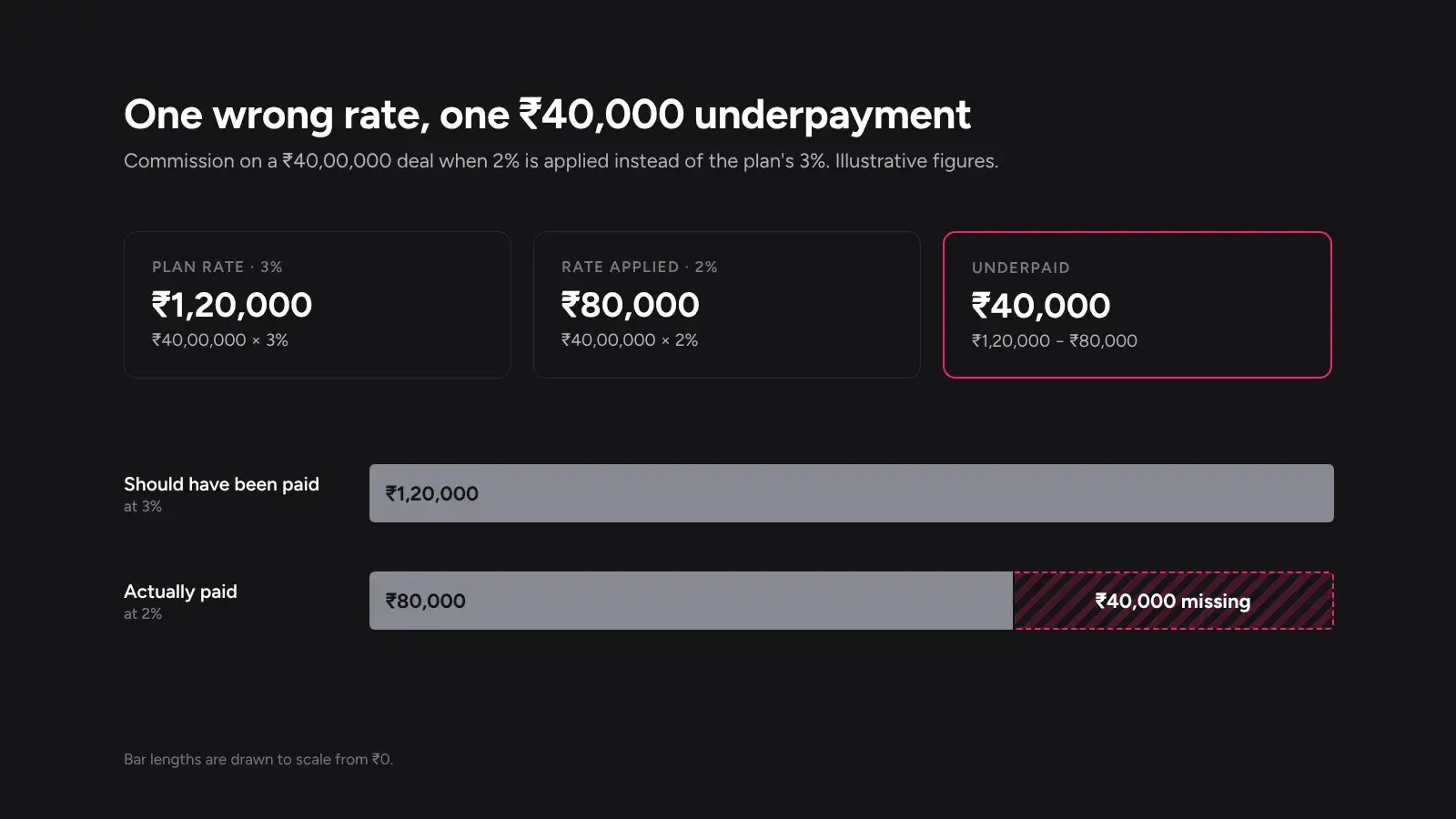
Illustrative example. A 2% rate is applied instead of 3% on a ₹40,00,000 deal. The rep is paid ₹80,000 instead of ₹1,20,000, an underpayment of ₹40,000.
One wrong number in one cell is enough to leave a third of this rep's commission unpaid.
Illustrative example. A ₹10,00,000 deal is split 60/40 between an account executive and an overlay, but the overlay is credited with the full deal. On a 4% plan, the overlay is paid ₹40,000 instead of ₹16,000, an overpayment of ₹24,000.
Fix: write the plan logic down with a worked example for every rule, and test the calculation against those examples whenever a plan or quota changes.
Process errors
Process errors come from how the work is done rather than what the rules say. Commission spreadsheet errors are the most familiar: a formula overwritten with a hard-coded number, a reference that shifts when a row is added, or two people editing different versions of the same file. Missing approvals belong here too, such as a quota change applied without sign-off, or a payout file sent to payroll before anyone has reviewed it.
Illustrative example. An analyst types ₹45,000 over a formula to fix one rep's urgent payout. The override stays in the sheet, and the same rep is paid ₹45,000 again the following month, regardless of their actual sales.
Fix: lock formulas and rules, keep one controlled version of the calculation, log every manual change with a reason, and require approval before payouts go to payroll.
Communication errors
Some errors are not calculation errors at all. When reps cannot follow their statements, they cannot spot real mistakes, and they dispute correct payouts because the logic is unclear. Both outcomes cost time and trust.
Illustrative example. A rep's payout drops by ₹25,000 because of a clawback on a cancelled deal. The statement shows only the net amount, so the rep raises a dispute, and sales ops spends a day explaining a payout that was correct.
Fix: show reps how each payout was built, including deals credited, rates applied, adjustments, and the reason for each adjustment.
What commission errors really cost
The cost of an error is rarely just the amount that was paid wrongly. It shows up in three places.
Direct financial cost
Overpayments cost money directly, and recovering them is often awkward. Underpayments look cheaper at first, because the company has paid less, but they have to be corrected. They also do more damage when the rep finds them first.
Using the earlier illustrative examples, one cycle could include a ₹40,000 underpayment and a ₹24,000 overpayment at the same time. The net difference is small, but two reps have been paid wrongly, and both need to be corrected.
Time cost
Every error creates work: finding it, tracing its cause, recalculating, agreeing the correction, and updating payroll. If the cause is not fixed, that work returns every cycle. Over time, sales ops and finance can spend more effort reconciling past payouts than preparing the next one.
Trust cost
Reps judge the whole plan by whether they trust their pay. Repeated errors lead to disputes, shadow spreadsheets, and time away from selling. A plan that feels unreliable also loses its pull on behaviour, and good performers who feel underpaid may start looking elsewhere. The size of this attrition risk varies by company and is hard to measure, but it is real.

Error types at a glance
Error type | Example | Root cause | Fix |
|---|---|---|---|
Duplicate deal | Same deal credited twice | Repeated manual CRM exports | One source of truth, deal-count reconciliation |
Wrong period | Deal paid in the wrong month | Close date entered late or edited | Cut-off rules and period lock |
CRM and finance mismatch | Commission paid on a deal not invoiced | Systems not reconciled | Match CRM totals to finance before payout |
Wrong rate | 2% applied instead of 3% | Rate typed into the sheet, not referenced | Rates stored once and referenced |
Tier method | Marginal applied instead of retroactive | Plan logic not written down | Documented rules with worked examples |
Split credit | Overlay credited with 100% | Split entered manually | Split rules set before the deal closes |
Quota change | Old quota used after a mid-quarter change | Change not logged or approved | Change control with approval |
Manual override | Hard-coded payout repeats next month | Formula overwritten | Locked formulas and a change log |
Unclear statement | Correct clawback disputed | Statement shows only the net amount | Itemised statements with reasons |
Caption: Common sales commission errors, mapped to their root cause and fix.
When an error has already reached payroll
Once a wrong payout has been paid, the goal is to correct it quickly, fairly, and in a way that does not happen again.
Correcting an underpayment
Pay the difference in the next payroll run, or sooner if the amount is significant. Tell the rep what went wrong and show the corrected calculation. A quick, transparent correction usually limits the damage to trust.
Approaching commission overpayment recovery fairly
Commission overpayment recovery needs more care, because it takes money back from someone who did nothing wrong.
- Confirm the error first. Recheck the data, the rules, and the approvals before contacting the rep.
- Tell the rep early and directly. Explain what happened, show the original and corrected calculations, and acknowledge that the mistake was the company's.
- Agree a reasonable recovery schedule. For example, an illustrative ₹60,000 overpayment could be recovered as ₹20,000 over three payout cycles rather than in one deduction.
- Put the agreement in writing. Record the amount, the schedule, and the rep's acknowledgement.
- Fix the cause. Note which of the four groups the error came from, and change the process so it does not recur.
Whether, how, and over what period an overpayment can be recovered depends on the employment contract, the commission plan terms, and applicable law, which varies by country. Check with HR and legal before deducting any amount from pay.
How to stop errors recurring
Prevention means closing the gaps that produce errors, not just checking harder at the end. These controls address each of the four causes:
- One source of truth for deal data. Agree which system owns deals, owners, close dates, and payment status, and calculate only from that source.
- Written plan logic. Document every rule, threshold, and exception, with a worked example for each.
- Change control. Log every change to quota, territory, plan, or split, with the date, the reason, and who approved it.
- Reconciliation before payout. Check deal counts, totals, and outliers against finance records, and compare each rep's payout with the previous period.
- Approval steps. Require review and sign-off before a payout file goes to payroll.
- Clear statements. Give reps itemised statements, so they can spot real errors and stop disputing correct ones.

Stop errors before payroll
Most sales commission errors start in the same two places: manual data handling and manual rules. Every export, paste, override, and hand-applied tier is a chance for something to slip through. Automating the calculation, adding validation checks before payouts are approved, and keeping an audit trail of every change can reduce those errors and make the ones that remain easier to find. Tallect's Sales Incentive module is built to help teams move commission calculations out of manual processes, so fewer errors reach payroll in the first place.