ROI of Listening: Why Employee Feedback is Your Most Undervalued Business Asset
Most companies collect employee feedback. Very few actually listen. Here's what separates one from the other and what it costs when you get it wrong.
Quick answer:
The ROI of employee listening is real and measurable but only if the feedback loop actually closes. That means building continuous listening channels beyond annual surveys, giving managers the tools to act on what they hear, and connecting what employees say to what the company can show them in return. Organisations that do all three see lower attrition, higher engagement, and stronger employer brands. The ones that collect feedback and do nothing with it end up in a worse position than if they'd never asked.
Part 1: The gap between collecting and listening
Here's a pattern that plays out in almost every organisation. HR runs an annual engagement survey. Employees fill it out. Results land in a 40-slide deck. Leadership reviews it in a quarterly meeting. A few action items get noted. And then nothing visible changes.
Six months later, the same employees who flagged concerns about growth, recognition, or workload are updating their resumes. They didn't leave because the company didn't ask. They left because the company asked and then did nothing with the answers.
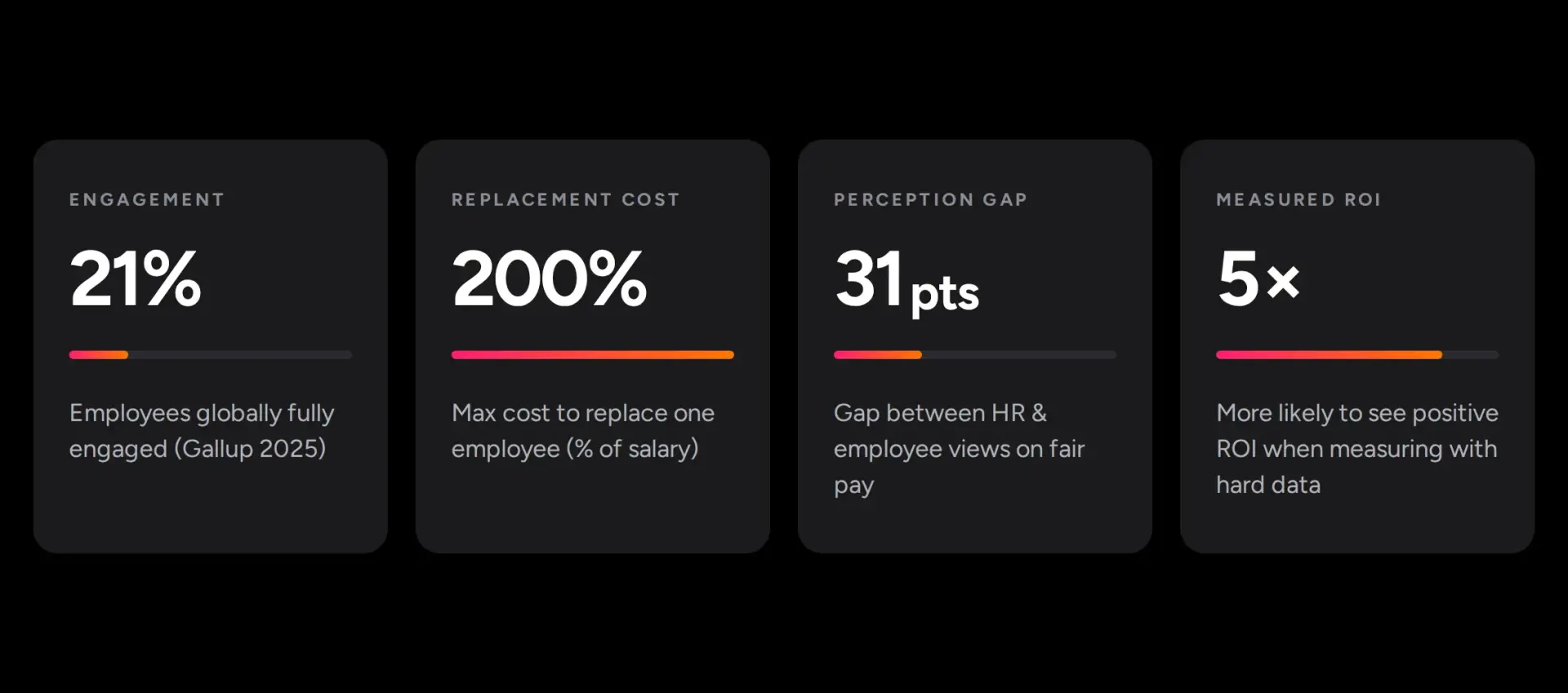
This is the gap between collecting feedback and actually listening. And the business cost of that gap is enormous. According to Gallup's 2025 data, only 21% of employees globally are fully engaged at work, with Europe ranking last in the global engagement table. SHRM's research puts the cost of replacing one employee at between 50% and 200% of their annual salary.
A 5% reduction in attrition from a functioning listening programme can offset its entire annual cost (source needed). That's not a soft HR outcome. That's a direct financial return and it's why the ROI of listening deserves to be treated as a business metric, not a people-team KPI.
The distinction that matters isn't the sophistication of the survey tool. It's whether the organisation has built a system that closes the loop from what employees say, to what leaders see, to what actually changes on the ground.
Part 2: Why annual surveys aren't enough
Annual engagement surveys were a reasonable starting point. They gave HR a baseline, a benchmark to compare against, and a structured moment to take the organisation's temperature. For a long time, that was enough. But they were designed for a world where the pace of organisational change was slower.
In 2026, companies are restructuring teams quarterly, adjusting strategies mid-year, navigating hybrid work transitions, and competing in talent markets that move in weeks, not months. An annual survey captures a snapshot. By the time results are analysed, action plans are drafted, and changes are implemented, the moment has passed.
The employee who flagged a concern about their team dynamic in March doesn't want to hear about it in September. The manager whose team raised workload issues before a product launch has already either addressed them informally or lost people. The annual cadence is too slow for the decisions it's supposed to inform.
There's also a participation problem. When employees fill out the same 60-question survey every year and see no visible change, response rates drop. And low response rates don't just make the data less reliable — they signal to employees that the process is performative. That signal is harder to undo than most organisations realise.
The shift happening globally is from periodic measurement to continuous listening. Not bombarding employees with questionnaires, but building multiple lightweight channels that capture sentiment in real time and feed it into decisions as they're being made.
Part 3: A modern listening strategy
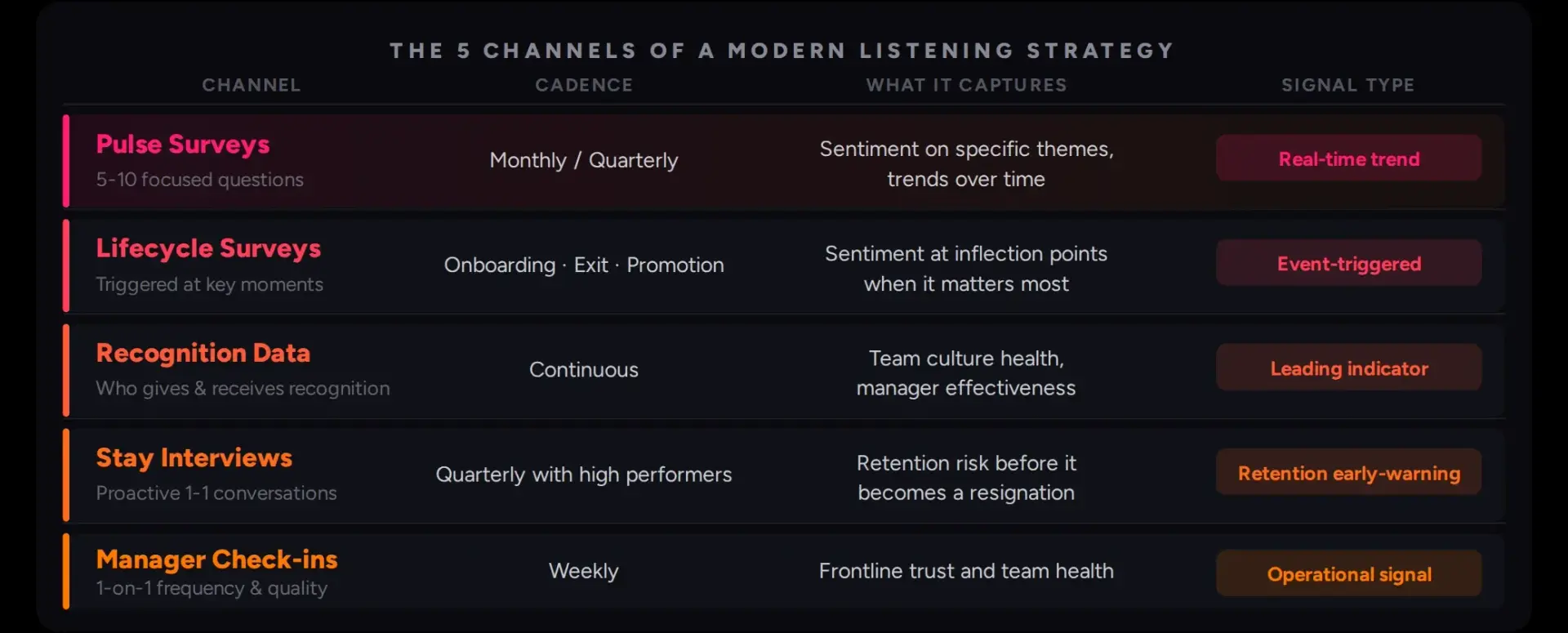
A functioning listening strategy in 2026 isn't one tool. It's a set of layered channels, each capturing different kinds of signal at different frequencies. The 2026 State of Employee Listening study found that 64% of mature organisations listen at least quarterly, with 47% running monthly or always-on programmes. Here's what that actually means in practice.
Pulse surveys
Short five to ten questions and frequent monthly or quarterly focused on specific themes rather than trying to capture everything at once. Participation rates are higher because they're quick. The data is more useful because it's current. The key discipline is rotating the theme: a month on workload, a month on growth, a month on manager relationship. This stops employees from treating it as the same form they filled out last time.
Lifecycle surveys
Triggered at key moments onboarding at 30, 60, and 90 days; role changes; promotions; returns from extended leave; and, critically, exit. These capture sentiment when it matters most, not on an arbitrary annual calendar. An onboarding pulse at day 30 catches integration problems before they become disengagement. An exit survey done properly with genuine anonymity and a clear commitment to using the data recovers signal that most companies never get.
Recognition data
Who's being recognised, who isn't, which teams celebrate each other and which go months without a single acknowledgment recognition patterns are one of the most reliable leading indicators of engagement. Most companies never look at this data analytically. The teams with low recognition rates are almost always the teams with the highest attrition six months later.
Stay interviews
Proactive conversations with high performers about what's keeping them at the company and what might push them to leave. Simple, human, and dramatically more useful than exit interviews, which happen after the decision is already made. A stay interview answered honestly by a key employee is worth ten surveys. The information is specific, actionable, and arrives while there's still time to act on it.
Manager check-in data
The frequency and quality of one-on-one conversations between managers and their direct reports. Teams where structured check-ins happen consistently and regularly show measurably higher engagement and lower attrition. The data point here isn't the conversation itself — it's the pattern. Managers who skip 1-1s during busy periods are the same managers whose teams report feeling disconnected when the annual survey rolls around.
AI in engagement: from survey results to predictive signals. Traditional listening programmes surface what employees are saying. AI-powered engagement platforms go a step further: they look for patterns across multiple data sources — survey sentiment, recognition frequency, manager check-in cadence, internal mobility data and flag where attrition risk is building before anyone submits a resignation. The shift is from reactive analysis to predictive intervention. Instead of reviewing last quarter's engagement scores, you're seeing which teams are quietly disengaging right now — while there's still time to do something about it. Tallect's platform integrates these signals into a single dashboard, giving HR leaders and managers a combined view rather than separate tools pointing in different directions.
Part 4: The data-to-action gap
Here's the uncomfortable truth. Most organisations don't have a listening problem. They have an action problem.
The 2026 State of Employee Listening report surveyed 273 HR leaders across EMEA and found that the biggest barriers shift as programmes mature. Early-stage programmes struggle with leadership buy-in — 36% of Level 1 programmes cite this as their primary obstacle. But mature programmes face an entirely different set of challenges: the data-to-action gap (26%), culture-strategy misalignment (26%), change fatigue (24%), and unclear ROI (24%).
In other words, even companies with sophisticated listening systems struggle to convert what they hear into visible changes. The problem isn't the survey. It's the infrastructure around it who owns the output, how quickly they're expected to act, and whether there's any accountability for following through.
Employees notice this acutely. When you ask for feedback and nothing happens, it's worse than not asking at all. It signals that the organisation doesn't care enough to act, even though it claims to care enough to ask. The erosion in trust that follows a cycle of unaddressed feedback is real and cumulative and it shows up directly in the next round's participation rates.
The companies that break this cycle share one characteristic: they treat survey output as an operational input, not a reporting exercise. Results don't go into a deck. They go into a 30-day action plan with named owners and visible follow-up.
Asking for feedback and doing nothing with it is worse than never asking at all. The erosion in trust is real — and it shows up in your next participation rate.

Part 5: Closing the gap
Make action visible
When you make a change based on employee feedback, say so explicitly. "You told us X. We did Y." This is the single most powerful thing you can do to increase future participation rates and build genuine trust in the listening process. It doesn't require grand gestures a team-level message from a manager saying "you flagged workload concerns, so we're pausing two projects this quarter" does more than a company-wide all-hands about engagement scores. The smaller and more specific the action, the more real it feels.
Empower managers, not just HR
HR can identify trends and analyse data. But managers are the ones interacting with employees daily and they're the ones with the most leverage to act on what they hear. Yet most organisations give managers engagement data in aggregated form, stripped of the specificity that would make it useful. The stat worth sitting with: 69% of organisations train managers on performance evaluations, but only 52% train them on compensation conversations (source needed). The gap is even wider for feedback conversations and how to handle what comes out of them.
Empowering managers means giving them access to their team's sentiment data in real time not filtered through an HR report six weeks later and training them on what to do with it. A manager who sees that their team's pulse scores on growth have dropped three months in a row should be having a conversation, not waiting for HR to flag it.
Set a time-bound action cycle
Survey results should lead to two or three specific, visible actions within 30 days not a comprehensive action plan that requires three approvals and sits in a shared drive for six months. Smaller and faster beats ambitious and slow. The goal isn't to solve everything. It's to demonstrate that the listening loop actually closes. Once employees believe that, participation rises, data quality improves, and the whole system becomes more useful.
Connect listening to business metrics
Track the relationship between engagement scores, attrition rates, productivity metrics, and revenue figures and make that relationship visible to senior leadership. Organisations that measure the ROI of employee listening using hard data are 5x more likely to report a positive return on their employee experience investments (source needed). The conversation shifts from "engagement is important" to "a 4-point engagement improvement in our operations team correlated with a 12% reduction in quarterly turnover." That's a budget conversation, not a people conversation.
AI in engagement: automating the feedback-to-action loop. One reason the data-to-action gap persists is that translating survey results into prioritised actions is genuinely difficult at scale especially when you're managing hundreds of teams across multiple geographies. AI tools are starting to compress this process meaningfully. Rather than a People Analytics team manually reviewing hundreds of open-text responses to find patterns, AI can surface the five themes that appeared most frequently, flag the teams where sentiment dropped most sharply, and suggest the action categories that have historically driven the most improvement in similar contexts. The human judgment is still essential — but it's applied to a much smaller, better-curated set of decisions.
Part 6: Listening and total rewards
This is the connection most companies miss. Employee listening and total rewards are not separate HR functions. They're deeply intertwined and the gap between them is costing companies in ways that don't show up neatly in an attrition report.
When employees say they feel underpaid, the problem is often not the actual compensation. It's the visibility. Salary.com's 2026 State of Pay report found that 74.8% of HR professionals believe employees are paid fairly but only 44% think employees share that view. That's a 31-point confidence gap. And the primary driver? Only 46% of organisations provide employees with a total rewards statement showing the full picture of what the company invests in each person.
Employees who can't see their total rewards salary plus bonus plus equity plus benefits plus insurance — evaluate their pay based on base salary alone. They underestimate what the company spends on them by 15 to 30% (source needed). That perception gap drives a sense of unfairness, which drives disengagement, which drives attrition.
The fix isn't just listening better. It's connecting what you hear to what you can show. When an employee says "I don't feel valued," the right response isn't just a conversation. It's a total rewards statement showing exactly what the company invests in that person, combined with a clear explanation of how their pay was determined and what it takes to earn more.
This matters especially for recognition. Being told you're valued and being shown it in numbers are two very different experiences. Companies that close the loop between employee sentiment what people say they feel — and compensation transparency — what the company can demonstrate see faster recovery in engagement scores after difficult periods than companies that handle feedback and rewards as separate tracks.
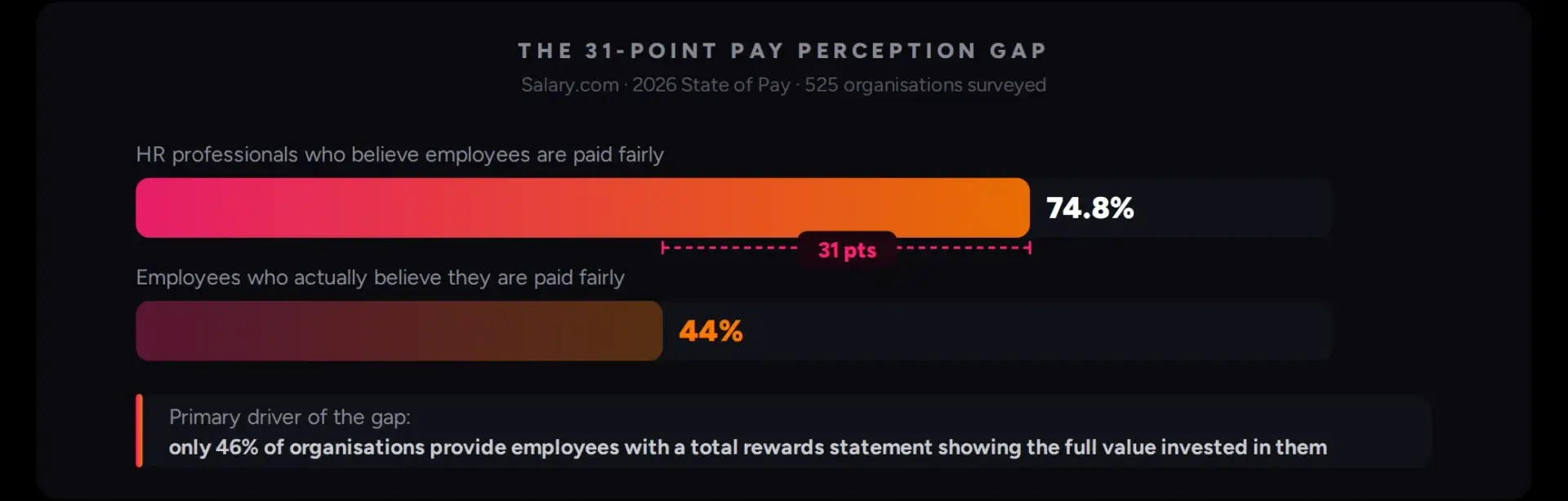
AI in engagement: making total rewards visible at the moment it matters. The 31-point perception gap between what HR believes and what employees feel isn't a communication failure. It's a data availability failure. When a manager has a stay interview with a high performer who's considering an external offer, they need to be able to show in that conversation, not three days later after chasing the HR team exactly what the company invests in that person. Tallect's platform puts that picture on screen in real time: base salary, bonus, equity vesting schedule, benefits, insurance, and any other components of total compensation. When an employee says "I had a conversation with my manager and they showed me exactly what I'm earning," the retention impact is measurably higher than when the same conversation happens without the data.
Part 7: The bottom line
Listening to employees isn't a soft HR initiative. It's a business strategy with measurable, trackable returns. Companies that listen continuously, act on what they hear in visible ways, and connect the feedback loop to their total rewards infrastructure see lower attrition, higher productivity, stronger employer brands, and candidates who stay through the offer process rather than accepting counter-offers at the last minute.
The companies that treat surveys as a compliance checkbox or worse, ask for feedback and then bury the results in a quarterly review that leads to no visible change are paying for it in ways they often can't fully attribute. Turnover in high-performing teams. Disengagement that shows up in project delays. Talent they never knew they were losing to competitors who simply listened better.
The ROI of listening is real. The tools to measure it exist. The frameworks to act on it are well understood. What separates companies that capture that return from those that don't is usually not ambition it's infrastructure. The question to answer honestly is whether your organisation has built a system that closes the loop, or whether it's running the same annual survey it ran ten years ago and hoping the pattern breaks itself.
Key takeaways
- The gap between collecting feedback and acting on it is where most engagement programmes fail — employees who see no change after filling out a survey stop participating and start looking for the door
- Annual surveys were designed for a slower world. Continuous listening pulse surveys, lifecycle surveys, stay interviews, recognition data, manager check-ins captures sentiment when it can still be acted on
- The data-to-action gap is the primary challenge for mature listening programmes. Two to three visible actions within 30 days of a survey cycle does more to build trust than a comprehensive plan that takes months to implement
- 74.8% of HR professionals believe employees are paid fairly. Only 44% of employees agree. That 31-point gap exists because only 46% of organisations show employees a complete total rewards picture
- Make action visible: "You told us X. We did Y." This single habit does more to increase survey participation and build leadership trust than any tool or survey design ever will
- Organisations that measure the ROI of listening using hard data attrition, productivity, revenue correlation are 5x more likely to see a positive return on their employee experience investment (source needed)
Frequently asked questions
Why is employee listening considered a business strategy, not just an HR initiative?
Because the returns are measurable. Companies that listen continuously and act on what they hear see lower attrition, higher productivity, and stronger employer brands. SHRM estimates that replacing one employee costs between 50% and 200% of their annual salary. A 5% reduction in attrition from a functioning listening programme can offset the entire cost of running it (source needed). That's a direct financial return not a soft outcome. When listening data is connected to business metrics like revenue per employee and team-level productivity, the ROI becomes trackable quarter to quarter, not just in theory.
What's the difference between collecting employee feedback and actually listening?
Collecting feedback means running surveys. Actually listening means acting on what comes back and making that action visible. Most organisations do the first part reasonably well and fail at the second. When employees see their feedback disappear into a presentation with no visible follow-through, they stop participating in future surveys. The gap between collecting and listening is where most engagement programmes fail and where the reputational damage to the listening process itself gets done. The repair takes longer than the original breach.
Why are annual engagement surveys no longer enough?
Annual surveys were designed for a world where organisational change happened more slowly. In 2026, companies restructure quarterly, markets shift monthly, and the employee who flagged a concern in March doesn't want to hear about it in September. By the time annual results are analysed, actioned, and communicated, the operational moment that produced the feedback has passed. Modern listening strategies combine pulse surveys, lifecycle surveys, stay interviews, and real-time recognition data to capture sentiment when it matters not on an arbitrary 12-month schedule.
How does employee listening connect to total rewards and compensation?
More directly than most companies realise. When employees say they feel underpaid, the issue is often not the pay itself it's the visibility of what they're actually receiving. Salary.com's 2026 research found that 74.8% of HR leaders believe employees are paid fairly, but only 44% of employees agree. That 31-point gap exists largely because only 46% of organisations show employees a complete total rewards picture. If you respond to "I feel undervalued" with only a conversation rather than a total rewards statement and a clear explanation of how pay decisions are made you're addressing the symptom rather than the cause.
What is the single most effective thing a company can do to improve its listening programme?
Make action visible. When you change something based on employee feedback, say so explicitly "You told us X. We did Y." This one habit does more to increase future survey participation, build trust in leadership, and create a genuine culture of listening than any survey tool, question design, or technology investment. Employees don't expect perfection. They don't need every concern addressed immediately. What they need is evidence that the conversation is real that when they speak, someone in a position to act actually hears them and responds.