Salary Range Design: A Practical Range Builder Guide for Mid-Market Companies
Pay transparency laws have made salary ranges a public document. Most companies still build them the way they did a decade ago.
Quick answer
A defensible salary range rests on three numbers - minimum, midpoint, and maximum where the midpoint is anchored to market data, the spread width is chosen deliberately for the role type, and the whole structure is stress-tested against your current workforce before anything gets published externally. Pay transparency laws have added compliance weight to every design decision that used to be purely internal.
Part 1: The three numbers every range needs
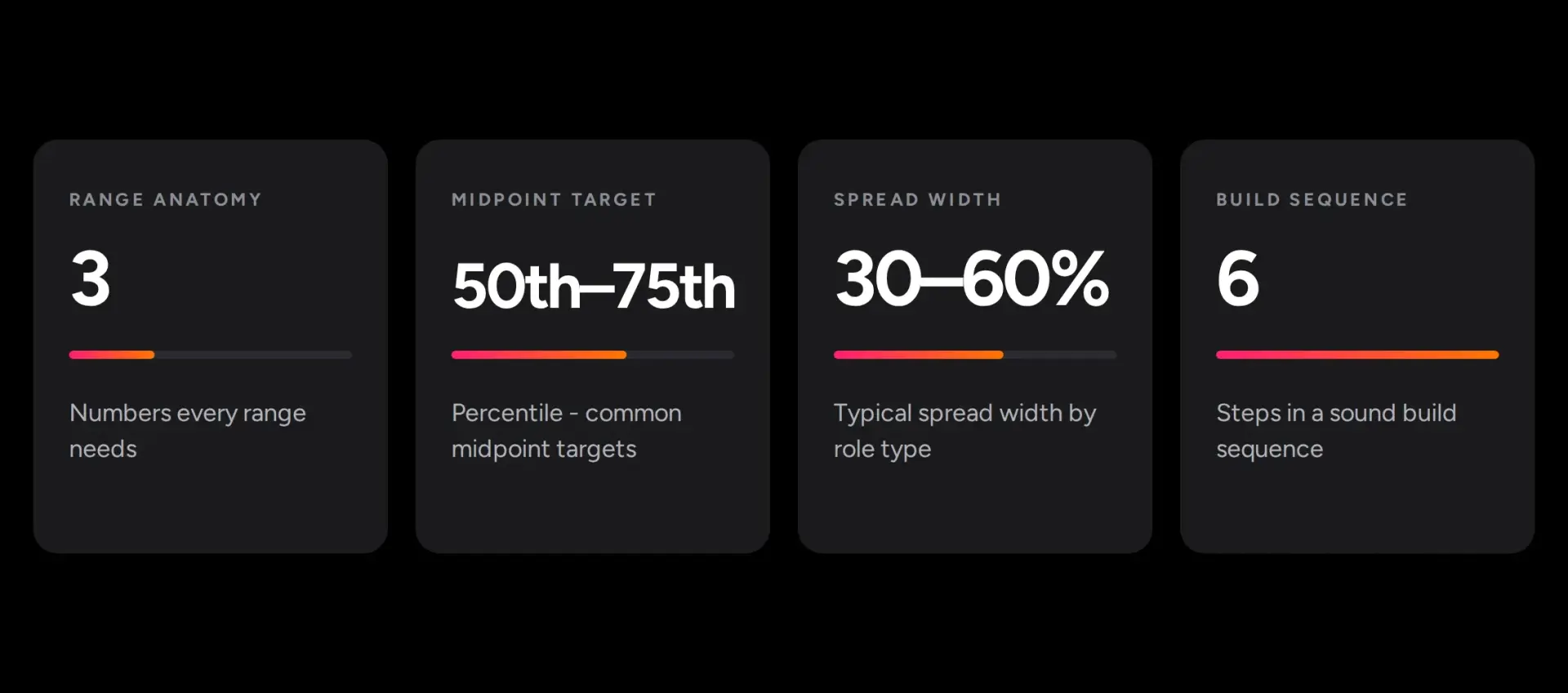
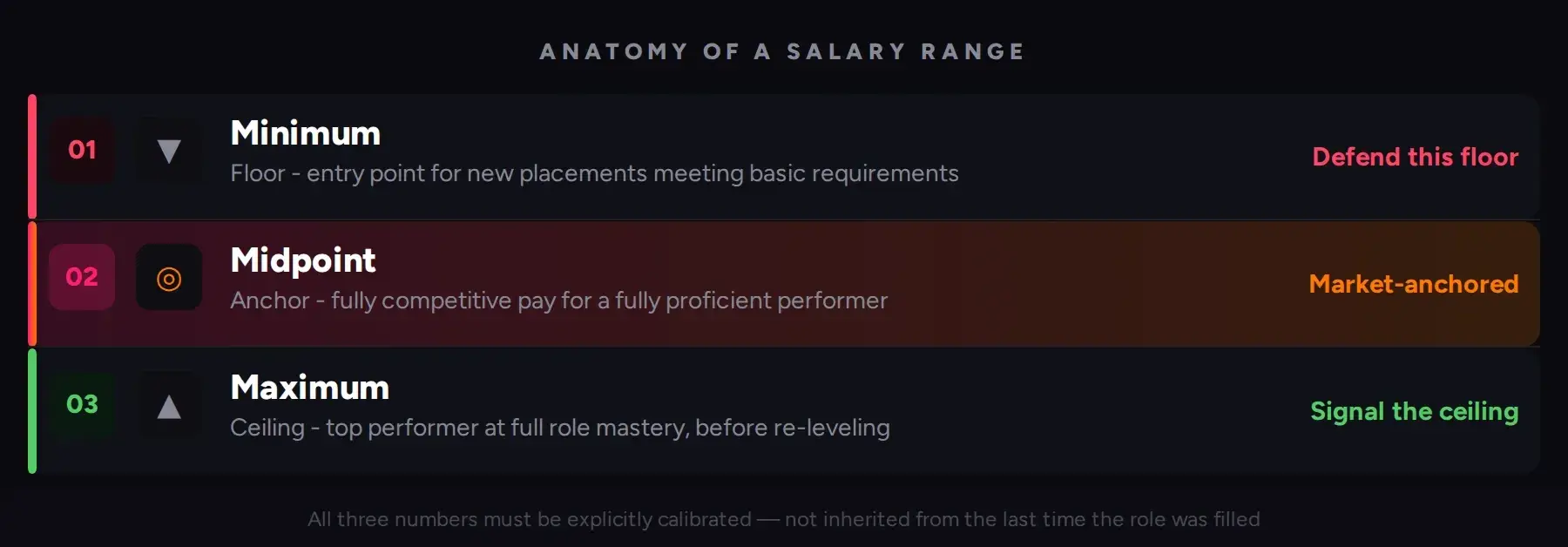
A salary range is built from three reference points, and getting the relationship between them right is the entire exercise. Miss one, and the others lose their meaning.
The minimum is the floor - typically the lowest defensible pay for someone newly placed into the role, meeting the basic requirements but without full proficiency. It's not an arbitrary starting point; it should reflect what you'd actually offer a qualified candidate on day one.
The midpoint is the anchor. This is the number set against market data and represents fully competitive pay for a fully proficient performer. Everything else in the range flows outward from here.
The maximum is the ceiling - typically set for a top performer who has been in the role long enough to be operating at the highest expected level, before the role itself should be re-leveled or promoted. A maximum that no current employee can ever realistically reach signals that the band hasn't been designed - it's just been guessed at.
Everything else in range design - spread width, number of bands, overlap between adjacent bands - is a function of how these three numbers are calibrated relative to each other and to the market data feeding the midpoint.
Part 2: Setting the midpoint from market data
The midpoint is only as reliable as the market data behind it. Using stale data, or data that doesn't accurately match the role's scope and geography, means the entire range drifts from where it should be - and every decision built on top of it gets a little less accurate.
HR-reported compensation survey sources like WorldatWork's Salary Data Center are specifically designed to give organizations a defensible, consistently sourced number for market pricing. The methodology matters as much as the data itself - organizations need to match on job scope and responsibility, not just job title, since two "Senior Engineers" at different companies can represent meaningfully different scopes.
The core design decision at this stage is the market percentile target. Does the organization intend to pay at the market median (50th percentile), lead the market (75th or higher), or deliberately lag it for roles where the company competes on other dimensions? That decision should be made once, explicitly, as policy - not implicitly re-decided role by role depending on who happens to be negotiating the offer.
An undocumented, ad hoc midpoint selection process is how you end up with two people in the same role on very different pay, with no principled reason for the gap.
AI in compensation: from annual snapshots to continuous market intelligence. Traditional market pricing means purchasing a survey once a year and hoping the data holds. AI-powered compensation tools now do something different: they monitor multiple data streams continuously, flagging when a job's midpoint has drifted more than a threshold percentage below current market rates - before that drift shows up in an offer rejection or a resignation. Platforms like Tallect integrate this kind of live benchmarking, meaning your midpoints can be recalibrated against fresh data without waiting for the annual compensation cycle to open.
Part 3: Sizing the spread
Spread width - the distance between minimum and maximum, usually expressed as a percentage of the minimum - is where mid-market companies most often default to inherited convention rather than deliberate design. The most common version of this is a single company-wide spread (usually 50%) applied identically across every role, every level, and every function (source needed).
The problem is that a 50% spread for an entry-level operations coordinator and a 50% spread for a senior technical architect represent two completely different things. The right spread for a role depends on how much variation in experience and performance genuinely exists at a single level in that role.
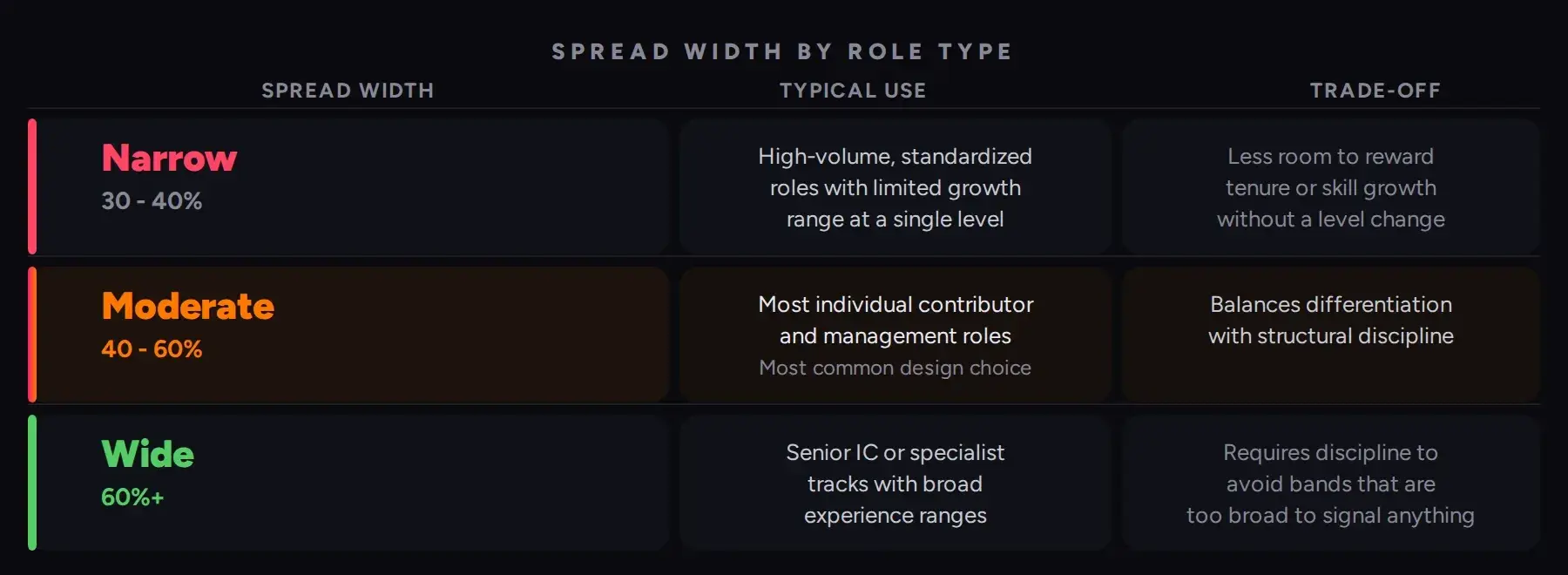
The trade-off to hold in mind at every width: a spread wide enough to accommodate genuine variation in experience and performance, but not so wide that the range stops functioning as a meaningful signal. A range spanning $50,000 to $150,000 for the same job title and level isn't a range - it's an admission that the level itself hasn't been defined precisely enough.
Several state pay transparency laws now scrutinize exactly this kind of breadth when assessing whether a posted range reflects a genuine good-faith estimate (source needed). A wide band that exists mainly to preserve negotiating room has become a compliance liability, not just a design weakness.
A range spanning $50K to $150K for the same title isn't a range. It's an admission that the level hasn't been defined.

Part 4: How many bands to build
The number of distinct salary bands a company needs is a function of how many genuinely distinct levels of scope and impact exist in the organization - not an arbitrary round number chosen for administrative convenience.
Too few bands and the structure can't differentiate a two-year employee from a ten-year one without an artificial title change. Too many and the bands become so narrow that ordinary merit increases push people out of their assigned band within a year or two, defeating the purpose of having bands at all.
The practical test is simple: can a manager explain, without hesitation, why a given role sits in the band it sits in rather than the one above or below it? If the answer requires more than one or two sentences about scope, complexity, and impact, the level structure underneath the bands likely needs more work before the bands themselves can be built correctly.
This "one sentence test" is underrated. It's not just a calibration check - it's the moment that separates compensation structures that live in spreadsheets from ones that managers can actually use in conversations with their teams.
AI in compensation: AI-assisted band architecture and level mapping. Determining the right number of bands requires mapping real job relationships across an organization - a process that traditionally involves weeks of job architecture work with an external consultant. AI tools are starting to compress this timeline significantly. By analyzing job description data, reporting structures, and actual pay distributions, AI platforms can surface where genuine level breaks exist and where the current structure may have artificial distinctions or missing differentiation. The output isn't a final answer, but it's a far better starting point than inheriting whatever the last compensation consultant suggested five years ago.
Part 5: What pay transparency has changed about range design
The construction mechanics above haven't changed. What's changed is the audience. A range built purely for internal HR use can tolerate some looseness - a wide spread "just in case," a midpoint nobody has stress-tested against real offers. A range that will be published in a job posting, read by candidates comparing multiple offers, and potentially reviewed by a state labor department cannot.
This has practical implications for how ranges get finalized, not just designed:
The range needs to reflect what the company would actually pay, not a defensive, artificially wide band meant to preserve negotiating flexibility. Several states now specifically evaluate range breadth when assessing employer good faith (source needed).
The range needs a documented methodology behind it, not just a number someone remembers from the last time the role was filled. If a regulator or an employee asks why the range is what it is, "market data at the 60th percentile, adjusted for internal equity" is a defensible answer. "That's what we've always posted" is not.
Internal pay needs to be checked against the range before it's published, not after. A range posted externally that doesn't match what current employees in the same role actually earn creates an internal equity problem the moment a current employee sees the job ad. This scenario - someone already in the role noticing that the posted range starts above their current pay - is now one of the most common triggers for compensation conversations that HR wasn't prepared for (source needed).
AI in compensation: pre-publication pay equity audits at scale. The internal equity check - comparing current employee pay to posted ranges before anything goes live - is straightforward in theory and genuinely difficult in practice when you're managing hundreds of roles across multiple geographies. Tallect's AI-powered platform automates this audit, flagging current employees whose pay falls outside the proposed range for a role before a job posting goes live. The output is a prioritized action list: which gaps need to be corrected before publication, which require a documented exception, and which reflect a structural band design issue that should be addressed at the source rather than managed role by role.
Part 6: A build sequence for mid-market companies
The sequence below isn't a methodology - it's a checklist for making sure each step happens in the right order, which matters more than the individual steps themselves.
- Set the market percentile policy first, as an explicit, documented decision - not implicitly through ad hoc offer negotiations. This is the single decision that most mid-market companies skip, and it's the one that causes the most internal inconsistency downstream.
- Pull current, role-matched market data for the midpoint, using scope and responsibility rather than job title alone to find the right comparison. A "VP of Marketing" at a 50-person startup and a "VP of Marketing" at a 5,000-person company are different jobs.
- Choose spread width deliberately by role type, using the widths from Part 3 as a starting reference rather than a single company-wide default. Different functions within the same company often warrant different spread widths.
- Stress-test the number of bands against real levels of scope - can every band be explained in one sentence? If not, refine the level structure before finalizing the bands.
- Audit current employee pay against the proposed ranges before publishing anything externally, to catch internal equity gaps before a job posting exposes them. This step alone saves more uncomfortable conversations than any other.
- Document the full methodology, including the market data source, percentile target, and any adjustments. This is now compliance infrastructure, not just an internal reference document. Revisit spread and band structure on a regular cycle, tracking shifts in labor pricing, inflation, and evolving pay transparency requirements.
Key takeaways
- A salary range is anchored at the midpoint - every other design decision flows from how that number is set against reliable, role-matched market data
- Spread width should be chosen deliberately by role type, not applied as a single company-wide default across all levels and functions
- The one-sentence test for each band - can a manager explain in one sentence why a role belongs where it does - is the most practical check on whether your level structure is actually working
- Pay transparency law has turned internal equity auditing into a pre-publication requirement, not an afterthought - current employee pay must be checked against proposed ranges before any posting goes live
- Document the full methodology behind every range: data source, percentile target, adjustments. This is compliance infrastructure now, not just a reference document
- AI-powered compensation tools are compressing what used to be annual, manual processes - market pricing, band architecture, equity audits - into continuous, automated workflows
Frequently asked questions
How often should salary ranges be updated?
Most compensation practitioners recommend a full range review at least annually, aligned with the compensation cycle. However, in volatile labor markets - or when pay transparency laws require posting ranges in jurisdictions with fast-moving salary benchmarks - quarterly midpoint checks are becoming more common. The specific trigger should be documented in your compensation philosophy: a stated policy of "we review ranges when midpoints drift more than 5% from the latest market data" is more defensible than an ad hoc update schedule.
What's the difference between a salary range and a salary band?
In most usage, "salary range" and "salary band" refer to the same thing: a minimum, midpoint, and maximum for a given role or job level. Some organizations use "range" for a specific job's pay (e.g., the range for a Software Engineer II) and "band" for a broader level that encompasses multiple related jobs (e.g., Level 4 across engineering). The distinction matters internally for governance but rarely affects the underlying design principles covered in this guide.
How do pay transparency laws affect how wide a range can be?
Several state laws - including Colorado, California, and New York - now require that posted salary ranges reflect a "good faith" estimate of what an employer actually intends to pay (source needed). A range that spans $80,000 to $200,000 for a single role is increasingly scrutinized as potentially not meeting this standard. While there's no universal statutory cap on spread width, regulators and enforcement agencies in these states have signaled that ranges spanning more than 100% of the minimum may indicate the range isn't functioning as designed (source needed). The practical guideline: if the range you'd post doesn't match what you'd actually offer, it needs to be tightened before publication.
What should we do when an employee's pay falls outside their range?
Pay that falls below the range minimum (called "green circled") typically requires a remediation plan - bringing the employee to the minimum within one or two pay cycles. Pay that exceeds the maximum (called "red circled") is handled differently: most organizations freeze merit increases for red-circled employees until the range catches up through its next update, rather than cutting pay, which is both demotivating and legally complex in some jurisdictions (source needed). Both situations should be documented with an explicit exception or remediation note in the employee's compensation record.
Can the same salary range apply to both remote and in-office employees in the same role?
It depends on the organization's geographic pay philosophy. Companies with location-based pay structures maintain different ranges by geography (e.g., a San Francisco range versus an Austin range for the same role). Companies with location-agnostic pay apply a single national range regardless of where the employee works. Both approaches are defensible - the critical requirement is that the policy is explicit and consistently applied. The worst outcome is an undocumented hybrid: employees in different locations on the same role at different pay rates with no principled explanation for the gap.