
Saudi Arabia: The New Compensation Challenges Facing Rewards Teams
Localisation, talent competition, cost pressure and pay equity are converging on Saudi Rewards teams in 2026.
Quick answer:
What's actually changing for Saudi Rewards teams in 2026? Four things, at once: localisation quotas that now reach directly into pay design, intense competition for experienced Saudi talent, tighter employment-cost conditions, and a labour law that makes pay differences something Rewards has to be able to explain. None of these sit in isolation any more. A decision on one shows up in the others.
Saudi Arabia's Compensation and Benefits function is moving fast. In 2026, Rewards teams are dealing with localisation requirements, intense competition for experienced Saudi talent, tighter employment-cost controls, and new expectations around pay equity, benefits and executive reward, all at the same time.
These pressures are increasingly connected. A localisation decision changes grade architecture. A grade decision changes cost. A cost decision changes what's left for recognition and benefits. Compensation decisions in the Kingdom now need to be looked at together, not in isolation.
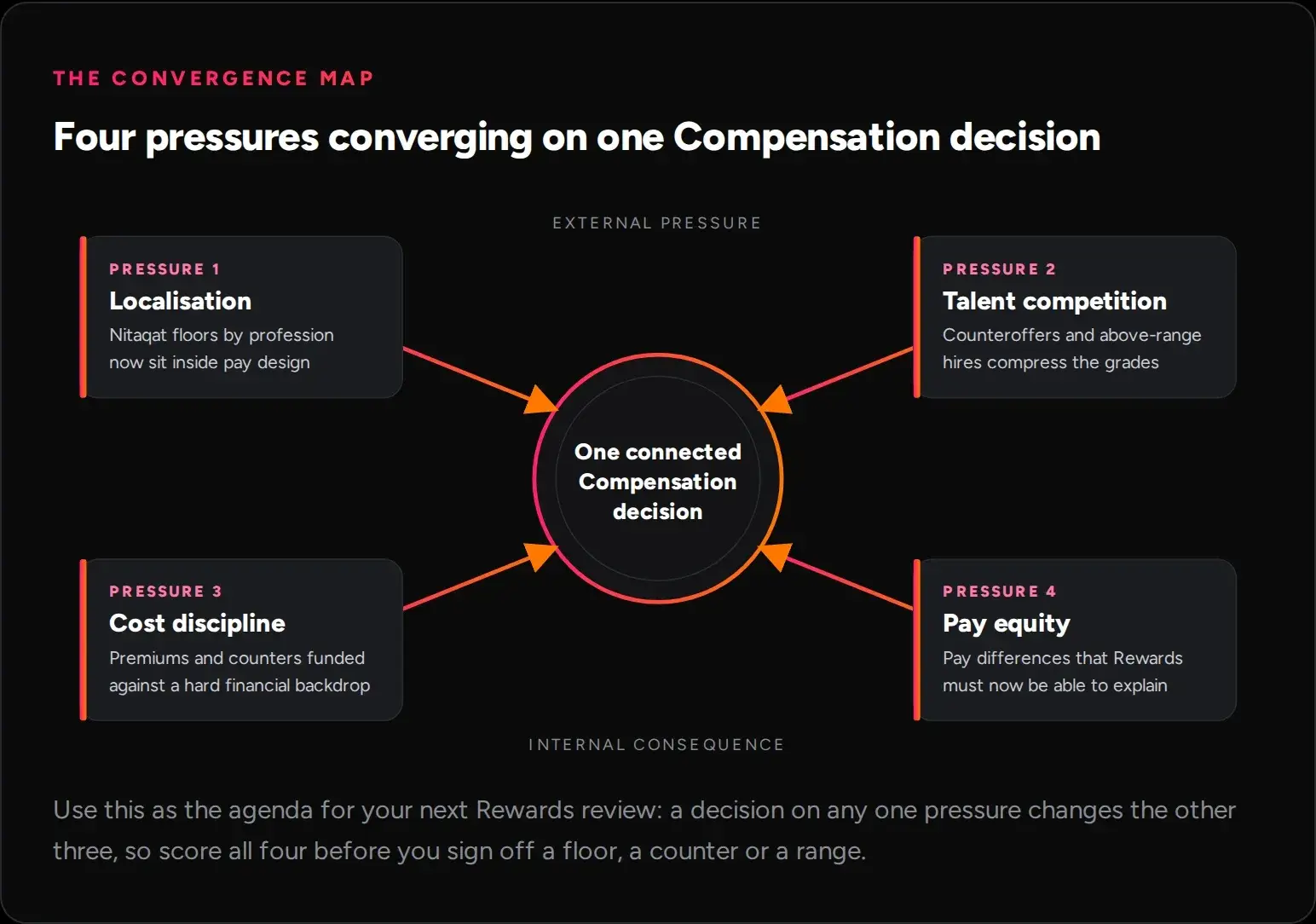
Use this as the agenda for your next Rewards review: a decision on any one pressure changes the other three, so score all four before you sign off a floor, a counter or a range.
Highlights
- Nitaqat's localisation quotas now span 269 professions, with the minimum Saudi salary to count toward quota raised from SAR 3,000 to SAR 4,000, plus higher floors for specific professions (source needed).
- 69% of Saudi professionals received a raise in 2025, yet 56% say their pay doesn't match their responsibilities, pressure that shows up first in grade architecture.
- SABIC and Petro Rabigh posted a combined SAR 29.7 billion net loss for 2025, while Rewards teams are still expected to fund localisation premiums and retention counters (source needed).
- 22% of employees in Culture Amp's July 2026 Saudi data don't think their total pay is fair versus similar roles, under a labour law that now bans discrimination on nationality, gender, age, marital status and disability.
Saudization is becoming a pay-design problem
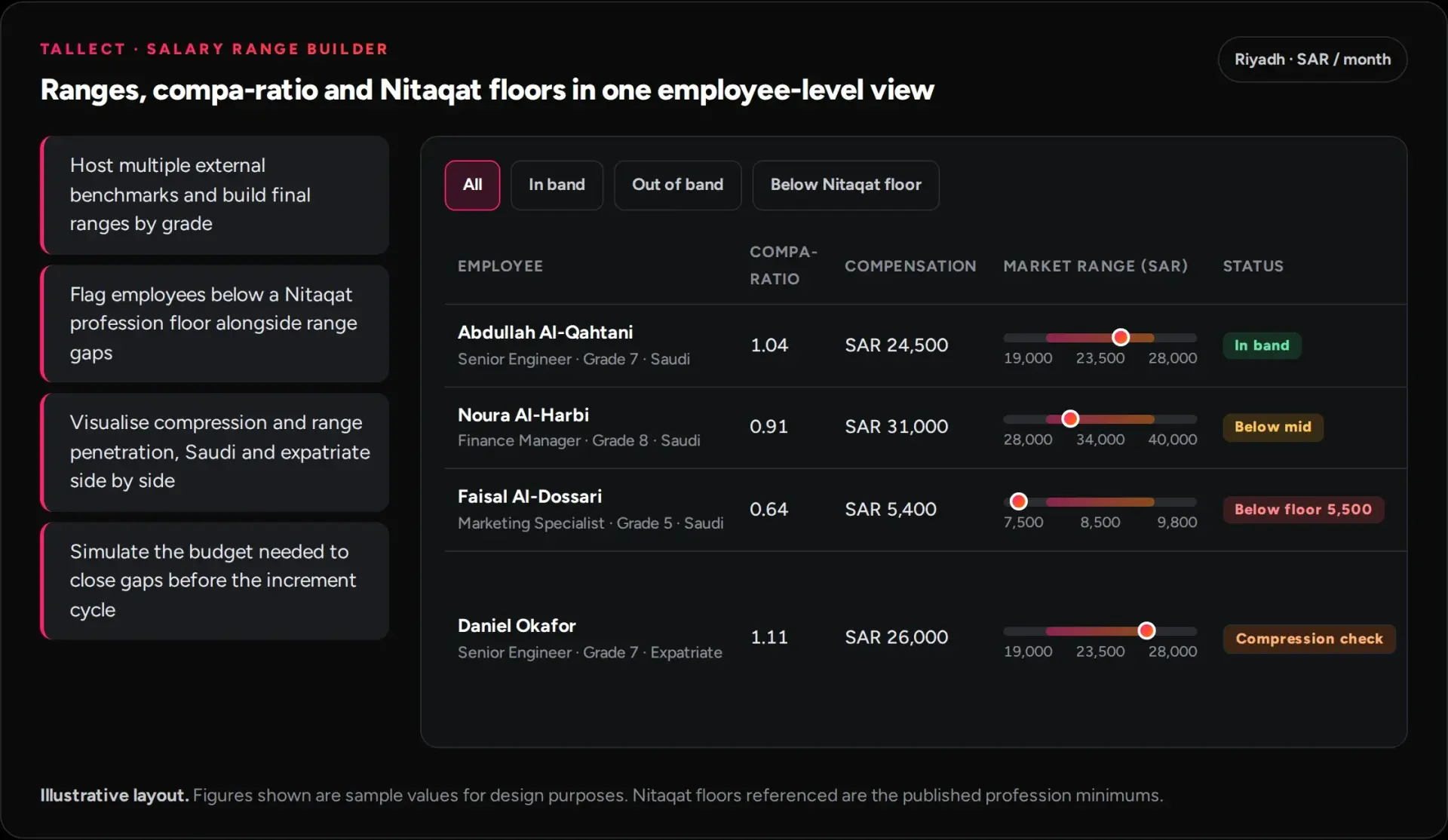
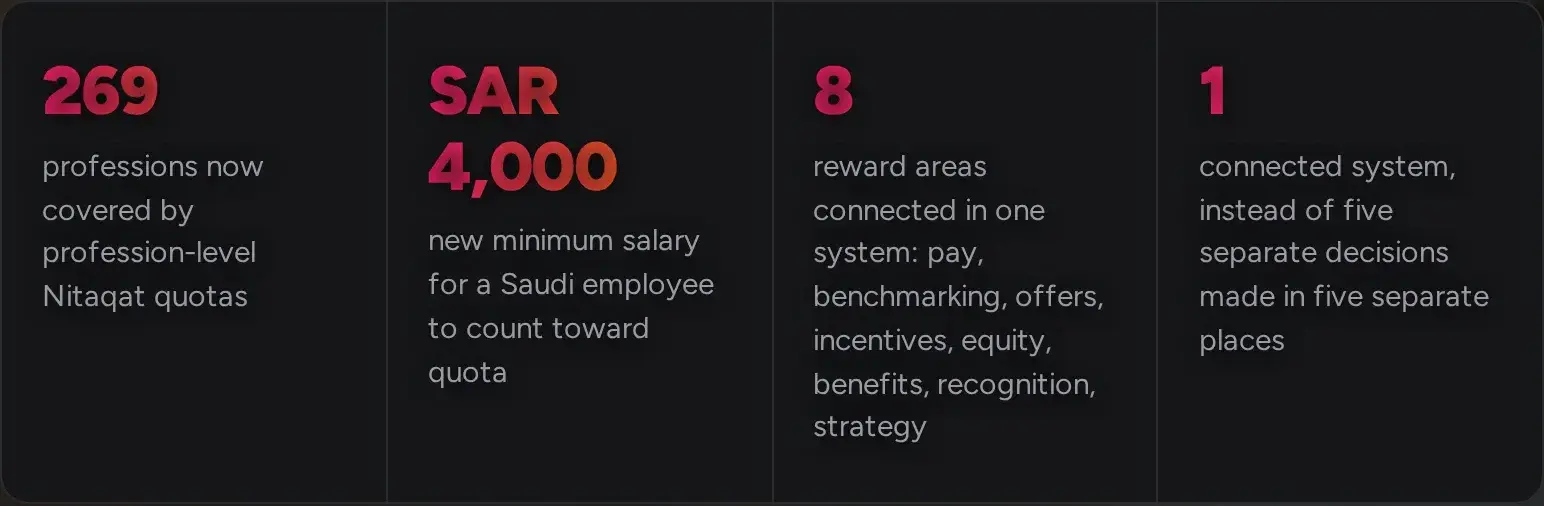
The latest Nitaqat changes move localisation directly into Compensation. Profession-level quotas now cover 269 roles. The minimum salary for a Saudi employee to count toward quota has risen from SAR 3,000 to SAR 4,000, with higher floors for specific professions: SAR 8,000 for engineering, SAR 9,000 for dentistry, SAR 5,500 for marketing (source needed). Since 15 April 2026, an electronically documented contract through Qiwa is also required for a Saudi employee to count (source needed).
For Rewards teams, that means managing salary floors alongside existing ranges, avoiding compression between Saudi and expatriate employees on the same grade, and knowing the cost of localisation profession by profession, not just headcount by headcount.

Experienced Saudi talent is putting salary structures under pressure
Competition for experienced Saudi engineers, finance leaders and functional heads is producing counteroffers, retention premiums and new hires who land above the existing range. Left unmanaged, that pressure compresses the grade architecture underneath them.
Hays' 2026 Saudi Salary Guide found that 69% of professionals received a salary increase in 2025, while 56% said their pay didn't align with their responsibilities. 85% were more likely to apply for a role when the salary range was clearly stated, and 55% cited benefits that didn't meet expectations as a reason for leaving. Long-term incentives remain underdeveloped: only around 21% of surveyed GCC organisations reported having an LTI scheme at all.
Reward costs are under pressure
These talent and localisation pressures are landing while the financial backdrop is difficult. SABIC reported a SAR 25.8 billion net loss for 2025; Petro Rabigh reported a SAR 3.9 billion loss (source needed). Rewards teams are still expected to fund localisation premiums, retention counters and restructuring costs against that backdrop.
The 2024 GOSI pension reform adds a further wrinkle: newer Saudi employees can carry different retirement terms from longer-tenured colleagues (source needed). The February 2025 labour law amendments changed the requirements around housing and transport, or their cash equivalents, and how those components are structured now feeds directly into end-of-service, GOSI and overtime calculations (source needed).

Pay equity and market data are becoming harder to manage
The amended labour framework prohibits discrimination on nationality, gender, age, marital status and disability (source needed). That makes it increasingly important for Compensation teams to be able to explain, not just justify after the fact, why pay differs between two people doing similar work.
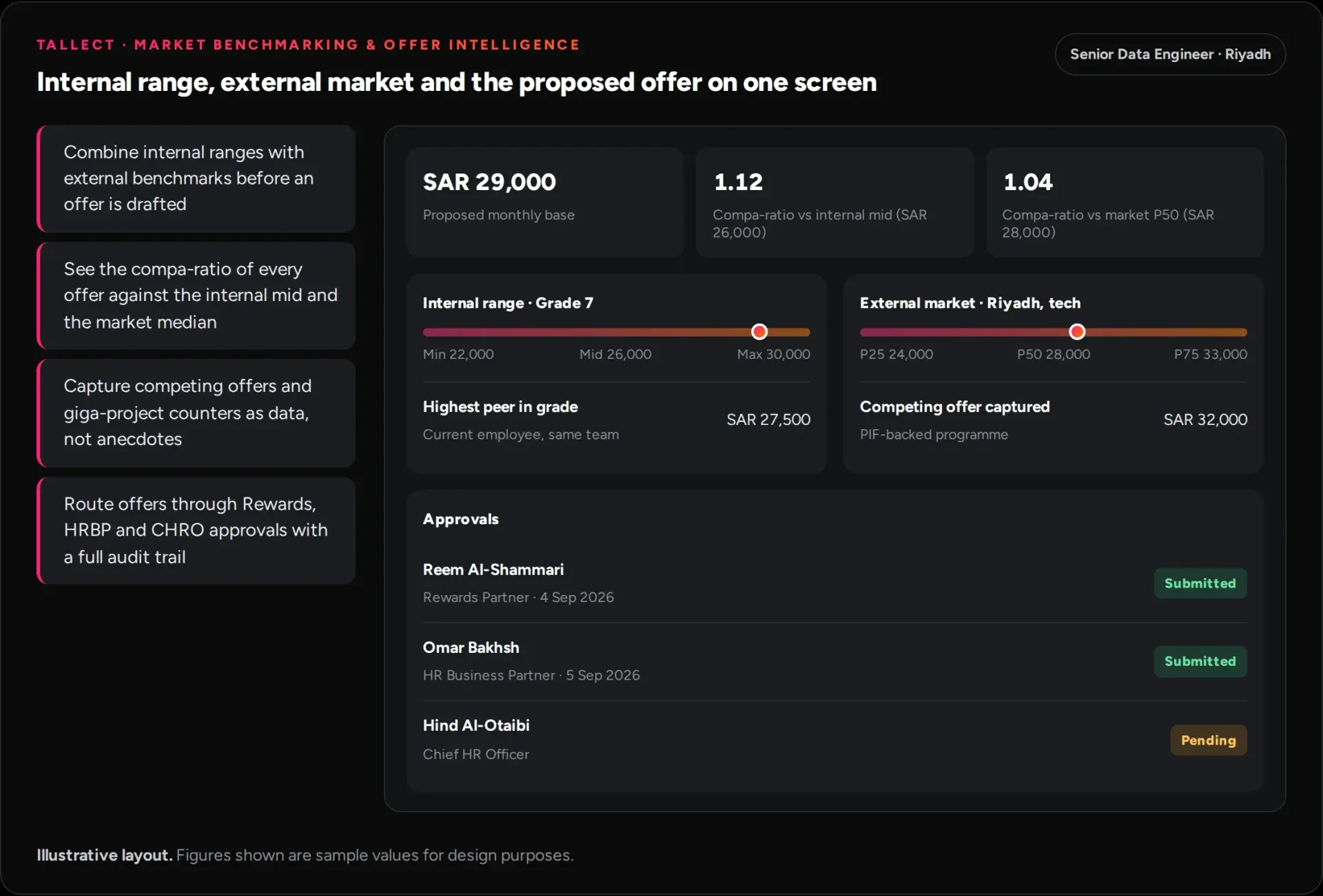
The issue already shows up in how people feel about their pay: 22% of employees in Culture Amp's July 2026 Saudi data disagreed that their total compensation was fair compared with similar roles. Market data has its own limits here too. PIF giga-projects can pay outside conventional survey ranges, so survey medians can lag what's actually being offered for the roles that matter most. Rewards teams need to combine market data with their own internal pay and offer history, not rely on either alone.
A survey median tells you what the market paid last year. Your own offer history tells you what it took to close a hire last month.
Built to connect the pieces
Tallect is a modular Total Rewards platform built by Total Rewards practitioners for Total Rewards teams. Compensation Planning and Market Benchmarking sit inside the same system as Hiring Intelligence, Variable Pay, ESOPs/LTIs, Global Benefits and Recognition, so a Saudization-driven change to a salary floor is visible everywhere it touches, not just in the module where it was made.
For Saudi organisations specifically, that means tracking salary floors by profession alongside compression risk, combining internal offer history with external benchmarks where survey medians lag giga-project pay, and keeping recognition, benefits and incentives inside the same reporting layer as base pay, so the full total rewards picture is auditable in one place.

Variable pay and executive reward are becoming more sophisticated
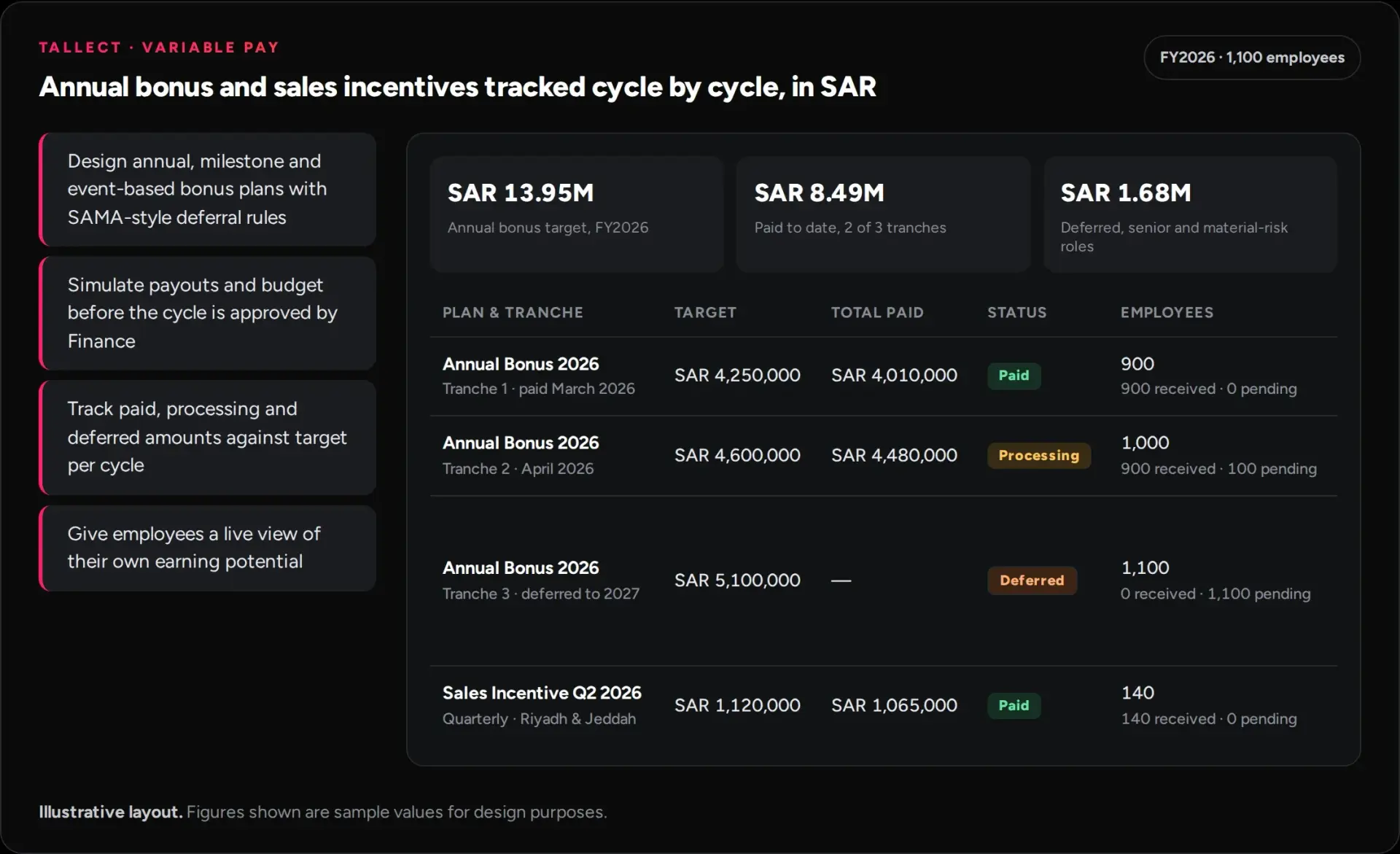
For Saudi banks, variable pay is increasingly a governance exercise. SAMA requires variable remuneration to weigh individual, business-unit and bank-wide performance alongside risk, with deferral, share-linked remuneration and clawback requirements for relevant roles (source needed).
The wider market shows real variation in outcomes. Cooper Fitch's 2026 KSA Bonus Report found that 32% of organisations reported 3 to 5 months' salary as the most common bonus outcome, while 21% reported no bonus payout at all. Executive reward is developing in parallel, with greater CMA disclosure expectations and more attention on equity, vesting, malus and clawback (source needed).
Recognition is part of the total reward proposition
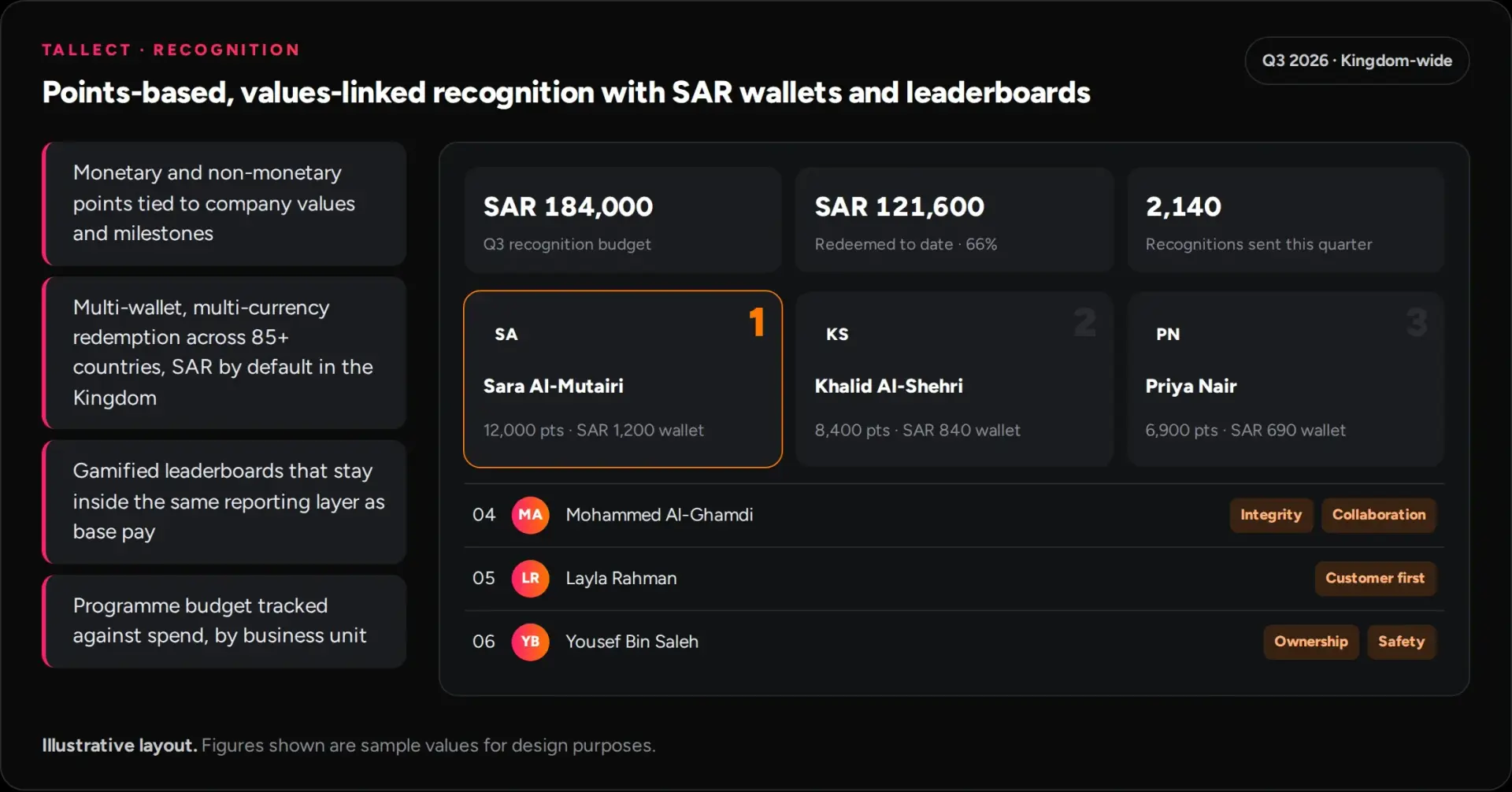
Reward expectations are extending beyond salary and bonus. PwC found that 85% of Saudi respondents value performance-based recognition, 81% prioritise transferable skills, and 88% consider job security very or extremely important. Recognition, development and benefits are becoming as relevant to the total reward conversation as the financial components.
Bringing the pieces together
For large Saudi organisations, M&A activity adds duplicate grades, incompatible incentive plans and legacy benefits. Fragmented HRIS and payroll systems make it hard to answer a basic question: what is reward spend by grade, nationality or business unit, right now? Rewards teams are being asked to manage all of that while also handling localisation, pay equity, benefits, incentives and employment cost, at the same time.
The need, underneath all of it, is a clearer connection between market data, salary structures, offers, incentives, benefits and recognition, so a decision made in one place doesn't create a blind spot in another.
Frequently asked questions
What changed in Nitaqat that affects Compensation directly?
Profession-level quotas now cover 269 roles. The minimum salary for a Saudi employee to count toward quota rose from SAR 3,000 to SAR 4,000, with higher floors for specific professions such as engineering, dentistry and marketing (source needed). Since 15 April 2026, an electronically documented Qiwa contract is also required for a Saudi employee to count (source needed).
How much has Saudi pay actually moved in 2025?
69% of professionals received a salary increase in 2025, according to Hays' 2026 Saudi Salary Guide, yet 56% said their pay didn't align with their responsibilities. That combination is what's putting existing grade architecture under pressure.
What does the amended labour law mean for pay equity?
It prohibits discrimination based on nationality, gender, age, marital status and disability (source needed). That raises the bar for Compensation teams to be able to explain, rather than simply justify after the fact, why pay differs between two people doing similar work.
How sophisticated is variable pay in Saudi banks right now?
SAMA requires variable remuneration to weigh individual, business-unit and bank-wide performance alongside risk, with deferral, share-linked remuneration and clawback requirements for relevant roles (source needed). Cooper Fitch's 2026 KSA Bonus Report found 3 to 5 months' salary was the most common bonus outcome, reported by 32% of organisations.
Why does market benchmarking fall short for some Saudi roles?
PIF giga-projects can pay outside conventional survey ranges, so survey medians can lag what's actually being offered for the roles that matter most. Combining external market data with internal pay and offer history closes that gap.
The bottom line
Saudi Arabia's Compensation function is being asked to hold four things at once: localisation, talent competition, cost discipline and pay equity, connected rather than separate. The Rewards teams managing this well are the ones treating salary structures, market data, incentives, benefits and recognition as one connected system, not five separate decisions made in five separate places.