ESOP Grant Benchmarks in India (2026): Grant Size by Level and Stage
Typical ESOP grant sizes in India by level and funding stage, with pool sizes, rupee examples and a simple way to set your own bands.
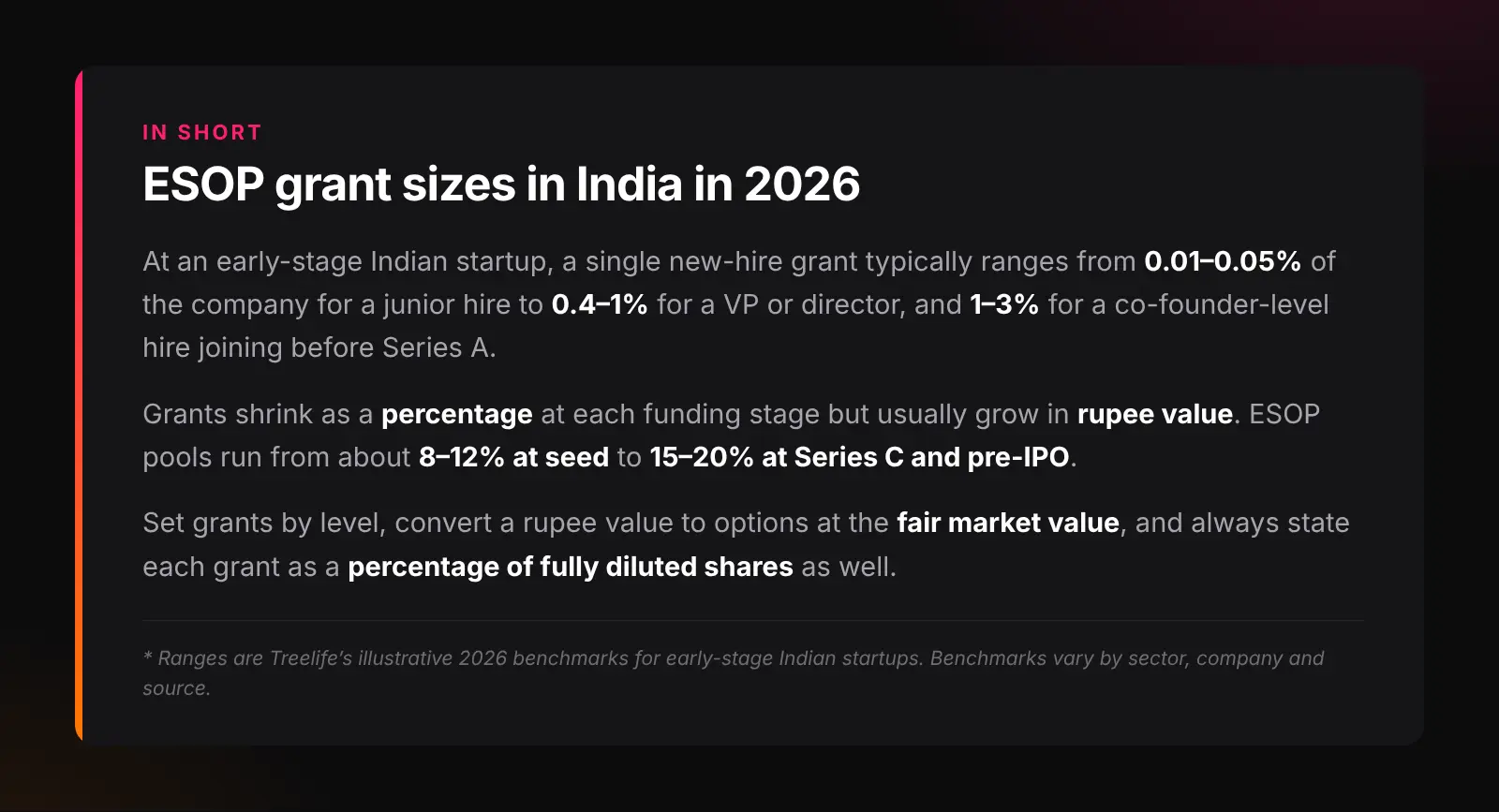
At an early-stage Indian startup, a single new-hire ESOP grant usually ranges from about 0.01% of the company for a junior hire to 0.4–1% for a VP or director. A co-founder-level hire joining before Series A may get 1–3%. These are advisory benchmarks from Indian firm Treelife, and they shrink as the company raises money and its valuation grows. At later stages, grants are smaller as a percentage but often larger in rupees, so many growth-stage companies set grants by value instead. Whatever method you use, state each grant as a percentage of fully diluted shares as well, so it can be compared.
How ESOP grants are sized in India
Indian companies size ESOP grants in one of three ways, and many use more than one.
- Percentage of the company. The grant is a share of fully diluted equity, such as 0.25%. Fully diluted means every issued share plus every option, warrant and convertible that could become a share. This is the most common way to compare grants across companies and stages.
- Rupee value. The company decides what the grant should be worth, then divides that value by the share’s fair market value to get the number of options. Growth-stage companies often work this way.
- Multiple of salary. The grant is set as a multiple of cash pay, usually for senior leaders.
The number of options on its own tells an employee very little. Five thousand options can be a large grant in one company and a small one in another, depending on how many shares exist.
ESOP grant size by level
These are typical single new-hire grants at an early-stage Indian company, as a percentage of fully diluted shares. The last column shows what each range would be worth on paper at a ₹100 crore valuation, before tax, dilution and the exercise price.
Level | Typical single grant (% of fully diluted shares) | Paper value at ₹100 crore |
|---|---|---|
Co-founder-level hire, joining before Series A | 1.0–3.0% | ₹1–3 crore |
VP or director | 0.4–1.0% | ₹40 lakh–₹1 crore |
Senior manager or team lead | 0.15–0.4% | ₹15–40 lakh |
Mid-level individual contributor | 0.05–0.15% | ₹5–15 lakh |
Junior or early career | 0.01–0.05% | ₹1–5 lakh |
The ranges come from Treelife’s September 2026 guidance, which describes them as illustrative and drawn from its advisory work. Treelife advises checking them against your own recent grants first.
What Indian studies show
Other Indian studies point the same way: equity grows sharply with seniority.
- Siason Capital, State of ESOPs in India 2021. In a survey of 268 startups, senior employees received about 0.5% of the company and junior employees less than 0.01%. ESOPs made up about a fifth to two-fifths of senior leaders’ pay, and less than a fifth of CTC for junior staff, as Inc42 reported.
- Elevation Startup PayPulse 2023. At seed to Series B startups, ESOPs for entry and mid-level roles were worth 10–50% of the cash component. CXOs and senior leaders received 0.2–1.5% of the company, as HRKatha reported.
- xto10x, 2025. A study of more than 500 startups, reported in March 2025, found that at startups valued at $1 billion or more, the median CXO received equity worth 1.2 times their salary over their tenure. At a $5 billion valuation the multiple rose to 4 times.
- Blume Ventures. Blume suggests thinking about the most critical early hires in terms of the pool: each might get about 2–3% of it.
ESOP grant size by funding stage
The same role gets a smaller percentage at each new stage, because the company is worth more and each share carries more value. The ESOP pool, the total set aside for grants, usually grows in rupee value even when it stays similar as a percentage.
Stage | What happens to grants | Typical ESOP pool |
|---|---|---|
Pre-seed and seed | The largest percentages, for the first critical hires | 8–12% |
Series A | Grants fall as a percentage; pools are often topped up at the round | 12–15% |
Series B | Smaller percentages, larger rupee values; refresh grants matter more | 15–18% |
Series C and pre-IPO | Grants usually set by value, often tied to retention | 15–20% |
The pool figures are Treelife’s 2026 ranges. Other advisers put pools lower: CFOmatrix says Indian startup pools typically range from 5% to 15%, with many around 10%. Some large Indian companies run much smaller pools that are still worth a great deal in rupees. Zomato’s 2024 pool, below, was about 2%.
US data shows the link between valuation and grant size. In Equitybee’s 2026 report, based on more than 4,000 new-hire grants at US startups, a company valued 10 times higher gave grants about 2.5 times larger in value. The value rises, but much more slowly than the valuation, so the percentage falls.
Grants set by value: Indian examples
Several Indian companies have announced grants by rupee or dollar value rather than by percentage:
- Razorpay gave ESOPs worth ₹1 lakh each to more than 3,000 employees in December 2024, its tenth anniversary.
- PhonePe gave ESOPs to all its 2,200-plus full-time employees in January 2021, with a minimum grant of about $5,000 at every level.
- Meesho let any full-time employee swap up to a quarter of annual CTC for ESOPs in November 2021, with a minimum of ₹50,000.
- Zomato, now Eternal, asked shareholders in May 2024 to approve a pool of about 2% on a fully diluted basis, worth roughly ₹3,500 crore, to be granted over five years.
US grant benchmarks, for comparison
If your company has a US parent and an Indian team, or you hire in both countries, US benchmarks are useful context. Equitybee’s 2026 report gives the median value of new-hire grants at US startups from January 2022 to June 2026.
Seniority | Median grant value | Stage | Median grant value |
|---|---|---|---|
Individual contributor | $24,000 | Seed or Series A | $33,442 |
Senior individual contributor | $51,000 | Series B | $51,000 |
Senior manager | $86,000 | Series C | $57,000 |
VP or C-suite | $346,580 | Series D and later | $75,000 |
Equitybee measures grant size as the number of options times the fair market value per share at grant. Its sample comes from employees who used its platform, mainly in US tech hubs, so it is not a random sample of the market.
How to set your own grant bands

- Define your levels. Use the same levels as your salary bands, so equity and cash move together.
- Choose a method for each level. Percentages suit early stages and senior hires. Rupee values suit later stages and wide grants.
- Set a range for each level, using the benchmarks above as a check, not as the answer.
- Convert to options. For a percentage, multiply by the fully diluted share count. For a value, divide by the fair market value per share.
- Check the pool. Add up the grants for the hires you plan over the next 18 to 24 months, plus refresh grants for your current team. If the total does not fit, change the bands or plan a top-up.
- Write the bands down, with who approves exceptions. Consistent grants are easier to defend to employees and investors.
Worked example: from a value to a percentage
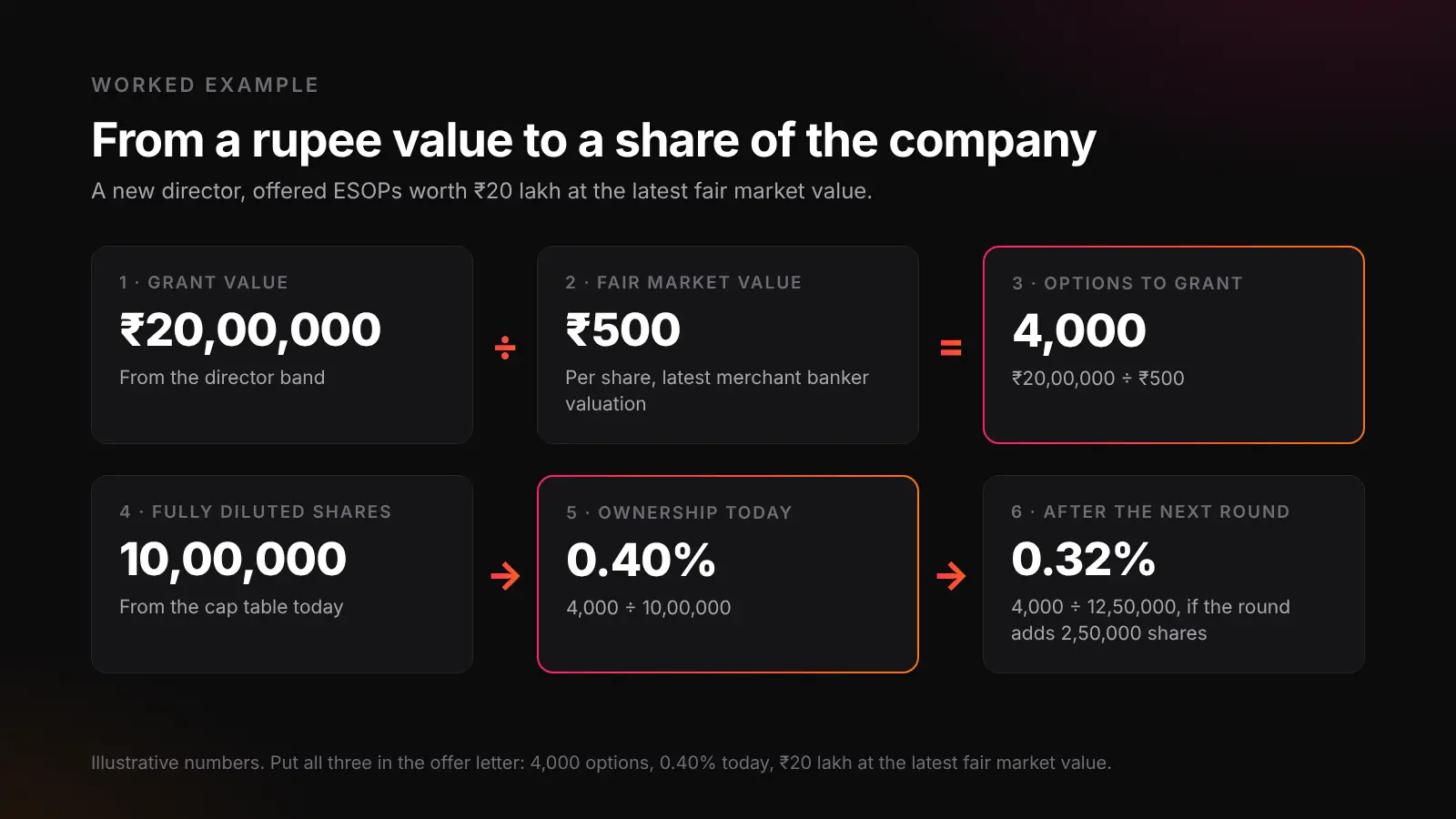
Say you want to offer a new director ESOPs worth ₹20 lakh. The latest fair market value is ₹500 a share, and the company has 10,00,000 fully diluted shares. The numbers are made up to show the method. Like Equitybee, the example values the grant at fair market value, before the exercise price.
Step | How to work it out | Result |
|---|---|---|
1. Grant value | From the director band | ₹20,00,000 |
2. Fair market value per share | Latest merchant banker valuation | ₹500 |
3. Options to grant | ₹20,00,000 ÷ ₹500 | 4,000 options |
4. Fully diluted shares | From the cap table | 10,00,000 |
5. Ownership today | 4,000 ÷ 10,00,000 | 0.40% |
6. Ownership after the next round | 4,000 ÷ 12,50,000, if the round adds 2,50,000 shares | 0.32% |
A grant of 0.40% sits at the bottom of the VP or director range above. Put three numbers in the offer letter: 4,000 options, 0.40% of the company today, and ₹20 lakh at the latest fair market value. Then explain step 6: the percentage falls each time the company raises money, even if the value of each share rises.
Rules that limit ESOP grant size
For an unlisted Indian company, Rule 12 of the Companies (Share Capital and Debentures) Rules, 2014 sets the frame for every grant:
- The scheme sets a maximum per employee, and shareholders approve it.
- Large grants need their own approval. Granting one employee options equal to 1% or more of the issued capital in a single year needs a separate shareholder resolution.
- Some people cannot get ESOPs. Promoters, the promoter group, directors holding more than 10% of the equity and independent directors are excluded. DPIIT-recognised startups are exempt from the promoter and 10% limits for up to 10 years from incorporation.
- Vesting takes at least a year. There must be at least one year between the grant and the first vesting.
- The exercise price cannot be below face value, because Section 53 of the Companies Act bars issuing shares at a discount.
Listed companies follow SEBI’s share-based employee benefits regulations instead. Since September 2025, founders named as promoters in draft IPO papers can keep ESOPs granted at least a year before those papers are filed, but cannot receive new grants once named.
Common grant-sizing mistakes
- Quoting a grant at the last funding round price. Investors usually buy preference shares with extra rights, so their price is often well above the fair market value used for ESOPs.
- Giving a number of options with no share count. Without the fully diluted total, an employee cannot tell whether a grant is large or small.
- Ignoring dilution. Each funding round reduces every holder’s percentage, so explain that a grant’s percentage will shrink.
- Using one size for everyone. Equal grants across levels can overpay junior hires and underpay the senior people who shape the outcome.
- Leaving no room for refresh grants. First grants usually vest over about four years, and keeping those people needs new grants.
This article is general information, not legal, tax or investment advice. Benchmarks vary by sector, company and source, so treat them as a starting point. Speak to a company secretary or adviser before you set or change your grant bands.
Frequently asked questions
What is a typical ESOP grant size in India?
At an early-stage Indian startup, a single new-hire grant typically ranges from about 0.01–0.05% of fully diluted shares for a junior hire to 0.4–1% for a VP or director. A co-founder-level hire joining before Series A may get 1–3%. These are Treelife’s illustrative 2026 benchmarks, so check them against your own recent grants.
How much ESOP should a VP or director get?
At an early-stage company, Treelife’s benchmark for a VP or director is 0.4–1% of fully diluted shares. At a ₹100 crore valuation, that is worth ₹40 lakh to ₹1 crore on paper, before tax, dilution and the exercise price. At later stages, the percentage is usually lower, but the rupee value is often higher.
Why do ESOP grants get smaller at each funding round?
As the company raises money, its valuation rises and each share is worth more. The same role therefore needs a smaller percentage to deliver a meaningful value. US data from Equitybee shows a company valued 10 times higher gave grants about 2.5 times larger in value, so the value rises but the percentage falls.
How big should an ESOP pool be?
Treelife’s 2026 ranges run from about 8–12% at seed to 15–20% at Series C and pre-IPO. Other advisers put pools lower: CFOmatrix says Indian startup pools typically range from 5% to 15%, with many around 10%. Size yours to the hires you plan over the next 18 to 24 months, plus refresh grants for your current team.
Should ESOP grants be set as a percentage or a rupee value?
Percentages suit early stages and senior hires. Rupee values suit later stages and wide grants across many employees. Whichever method you use, also state each grant as a percentage of fully diluted shares, so employees can compare it with other offers.
How do I convert a rupee ESOP value into a number of options?
Divide the grant value by the fair market value per share. For example, ₹20 lakh at a fair market value of ₹500 a share gives 4,000 options. Divide the options by the fully diluted share count to find the percentage: 4,000 out of 10,00,000 shares is 0.40%.
What does “fully diluted” mean?
Fully diluted means every issued share plus every option, warrant and convertible that could become a share. It is the fairest base for stating a grant as a percentage. Without it, an employee cannot tell whether a number of options is large or small.
Is there a legal limit on how much ESOP one employee can get?
Rule 12 requires the scheme to set a maximum per employee, which shareholders approve. Granting one employee options equal to 1% or more of the issued capital in a single year also needs a separate shareholder resolution. Promoters, the promoter group, directors holding more than 10% and independent directors cannot receive ESOPs, though DPIIT-recognised startups are exempt from the promoter and 10% limits for up to 10 years.
Should I value an ESOP grant at the last funding round price?
No. Investors usually buy preference shares with extra rights, so their price is often well above the fair market value used for ESOPs. Value grants at the latest merchant banker valuation, and say clearly which value you used.
What should an ESOP offer letter include?
Put three numbers in the letter: the number of options, the percentage of the company today, and the value at the latest fair market value. Also explain that the percentage will fall each time the company raises money, even if each share becomes worth more.