Workday Advanced Compensation: What It Covers and What Sits Outside It
See what Workday Advanced Compensation covers, what sits outside it, and how to add Total Rewards depth without replacing Workda
Workday is a strong HR and finance suite. At many companies it is the system of record for people, jobs and finance. Tallect is designed to run alongside Workday, not to replace it. Workday stays your system of record. Tallect adds the Total Rewards depth that Workday Compensation and Advanced Compensation were not designed to cover on their own.
Tallect publishes this article, so it is written from Tallect’s point of view. The Workday details come from public Workday sources as of October 2026, including datasheets, release notes, press releases and product pages. Products and release status change, so confirm current details with Workday or your implementation partner.
Workday Compensation handles pay plans, grades and packages. Advanced Compensation is a paid add-on that runs merit, bonus and stock review cycles. Beyond that, companies typically license more Workday products or bring in partners. Tallect is built only for Total Rewards and covers 14 rewards areas on one platform.
We compare the two on Total Rewards only. We don’t cover core HR, payroll, finance, recruiting or learning, where Workday is strong. For each rewards area, we ask three questions:
- Does Workday Compensation or Advanced Compensation cover it today?
- If not, which extra Workday product or partner does it need?
- What does Tallect offer in the same area, and how far does it go?
We rate Workday in each area as one of the following: Available, limited use; Partial; Separate product or partner; or Not available.
What each platform was built for
Workday was built to be the system of record for HR and finance. Tallect was built to run rewards.
Workday was founded in 2005 to replace on-premise HR and finance software with one cloud system. Its strength is a single data model for workers, jobs, organisations and money. Compensation is one module in that suite, and review cycles come from Advanced Compensation, which is sold as an add-on.
Tallect started from rewards. Its founders are Total Rewards leaders with about 20 years of experience running rewards in 52+ countries. They saw HR suites treat rewards as one module, which left rewards teams in spreadsheets, survey files and third-party tools. They built Tallect to put every reward, every market data point and every policy in one place.
Area | Workday | Tallect |
|---|---|---|
Built for | HR and finance system of record | Total Rewards |
Main focus | The worker record and business processes | The reward decision: pay, benefits, equity, incentives, awards |
Main buyer | CHRO, CFO and HRIS | CHRO and Head of Total Rewards |
Place of rewards | Compensation module plus paid add-ons | The whole product |
Rhythm | Review cycles run through business processes | All year: every offer, promotion, payout and query |
Market data | Survey imports, or Compa for joint customers | Surveys, range building and gap costing inside |
Who runs it | HRIS team and certified partners | The rewards team itself |
Who designed it | Enterprise software teams | People who have run Total Rewards |
AI | Total Rewards Agent, with the Compensation Agent “coming soon” as of October 2026 | inTallect agents for every rewards area |
Workday tells you who a worker is, where they sit and what they cost the business. Tallect tells you what to pay, offer and reward, and why. You need both answers, which is why the two work well together.
What Workday Advanced Compensation covers
Advanced Compensation is the Workday add-on for running review cycles. It sits on top of core Workday Compensation and is not sold on its own. Based on Workday’s own documentation, here is what it covers.
Area | What Workday offers |
|---|---|
Plan types | Salary, allowance, merit, bonus, stock, commission, long-term cash and one-time payments |
Review cycles | Merit, bonus and stock reviews routed through Workday business processes |
Manager worksheets | A configurable grid with worker data, budget warnings and pay equity insight |
Budgets and pools | Pools per strategy, holdbacks, calculated award pools and pool authorisation |
Guardrails | Merit and bonus matrices, eligibility rules and AI flags for pay anomalies |
Statements | Total rewards statements for employees |
Market data | Survey data imports, and embedded Compa benchmarks for joint Workday and Compa customers |
Stock | Stock plans and grants in the review cycle, with vesting date rules |
That is a solid base for a yearly pay review. Several rewards areas, though, sit outside it:
- Benefits need Workday Benefits, a separate product. Newer features in Workday Total Benefits are offered mainly to US customers.
- Deep analytics usually need Workday Prism Analytics, a separately licensed add-on.
- Engagement surveys need Workday Peakon Employee Voice, which has its own licence and contract.
- Recognition comes through Workday Recognition (provided by Achievers).
- EU pay transparency is handled by the Pay Transparency Analyzer (built with Kainos).
- Sales commissions usually run in partner tools. Examples customers use include Xactly, CaptivateIQ, Varicent and a PwC app on Workday Marketplace.
- Equity administration needs a specialist provider. Workday’s own training material says: “Workday is not a stock administration tool.” (source needed)
- AI agents are paid for with Workday Flex Credits. Workday publishes the credits used per action but not the price of a credit.
Where rewards teams hit limits
Workday does many things well, but rewards teams that run on it tend to raise the same problems. These are the 12 we hear most often from rewards leaders.
Problem | What it means for the rewards team | How Tallect addresses it |
|---|---|---|
Rewards is spread across many SKUs | Compensation, Advanced Compensation, Benefits, Prism, Peakon and Flex Credits are licensed separately. | One modular subscription covers every rewards area. |
Key rewards areas depend on partners | Recognition, pay transparency, market data and sales commissions all lean on partners. | All 14 areas are built in, on one data model. |
Equity covers grants only | Workday tracks grants and vesting dates. Exercises, buybacks and statements need an equity provider. | Full ESOP and LTI administration, multi-plan and multi-currency. |
No native sales incentive engine | Complex commission plans usually run in partner tools such as Xactly, CaptivateIQ or Varicent. | Sales incentives on the same platform as bonus and equity. |
Changes usually need a certified partner | Eligibility rules, grade profiles and bonus logic often need partner help. | The rewards team changes plans through simple builders. |
Slow test and change cycles | Partners report each bonus or merit launch takes 10 to 12 minutes or more (source needed), and process changes need a relaunch. | Edit and republish, even during a live cycle. |
Market data is not built in | Survey data is imported. Live benchmarks need a separate Compa subscription. | Host surveys, build ranges and cost the gaps inside Tallect. |
Deep analytics cost extra | Rich analysis usually needs Prism Analytics or exports to Excel and BI tools. | Ready rewards dashboards from day one, with no extra licence. |
Global flexible benefits are thin | Workday Benefits is strongest for US plans. New Total Benefits features focus on US customers. | Global flex benefits with local rules set per country. |
Long, partner-led implementations | Industry advisers report 9 to 15 months for Workday HCM, with partner fees of 1.5 to 2.5 times the first-year subscription (source needed). | Rewards modules implemented by Tallect’s own in-house team. |
Two major releases a year to absorb | Each R1 and R2 release needs regression testing of rewards setups. | Updates tested by our team against your setup. |
Rewards AI is still early | As of October 2026, the Compensation Agent is listed as “coming soon”, and agents are billed through Flex Credits. | inTallect agents across every rewards area, included in the platform. |
The common thread is dependence. Around Workday, the rewards team often needs more licences, more partners and more projects for everyday work. Tallect gives it one platform it can run on its own.
Capability by capability
Of the 14 Total Rewards capabilities below:
- Workday covers 3 with limited flexibility.
- Workday covers 5 only in part.
- 5 need a separate Workday product or a partner.
- 1 is not available.
Tallect covers all 14 on one platform.
The ratings mean the following:
- Available, limited use: the feature exists but is rigid or hard to change.
- Partial: only basic features are covered.
- Separate product or partner: it needs another Workday licence or a partner tool.
- Not available: there is no Workday answer for it today.
Pay, market data and policy
Capability | Workday today | Status | Tallect |
|---|---|---|---|
Total rewards statements. No rewards philosophy module or future earnings simulation. | Available, limited use | Full rewards philosophy, every element in one statement, and future earnings simulation. | |
Reviews with pools and matrices. Setup and changes are usually partner-led. | Available, limited use | Multi-currency budget simulation linked to live market ranges. Configured by your team in weeks. | |
Market Benchmarking | Survey imports. Live benchmarks through embedded Compa for Compa customers. | Partial | Hosts multiple surveys, builds ranges, shows compression and range penetration, and costs the gaps. |
Offers in Workday Recruiting, with Compa benchmarks for joint customers. | Partial | Multi-option offers checked against market data and internal parity, with competitor pay captured. | |
Pay Transparency & Equity | Pay equity dashboard. EU directive reporting through the Pay Transparency Analyzer (built with Kainos). | Separate product or partner | Job architecture, pay bands, gap audits and remediation budgets in one module. |
Pay Analytics & Reward Intelligence | Standard dashboards and reports. Deeper analysis usually needs Workday Prism Analytics, a separate licence. | Partial | Ready dashboards for compa-ratio, pay mix, cost of reward, pay gaps and ROI. |
Global Policies | No rewards policy module. Policies usually sit in knowledge articles or the intranet. | Not available | Publish across countries in minutes, capture acknowledgements, audit live and answer queries with AI. |
Benefits, incentives, equity and engagement
Capability | Workday today | Status | Tallect |
|---|---|---|---|
Workday Benefits, a separate product strongest for US plans. | Separate product or partner | Flexible and standard benefits in any country, with life events and utilisation. | |
Annual Bonus / Variable Pay | Bonus plans in Advanced Compensation. Complex designs are slow to build and test. | Available, limited use | Milestone, event-based and cyclic plans with real-time payout simulation. |
Sales Incentives | Commission can be held as a pay plan, but complex plans usually run in partner tools. | Separate product or partner | Complex plan logic and rep earning views on the same data as bonus and equity. |
Stock plans and grants in the review cycle, with vesting dates. Administration needs a specialist provider. | Partial | Multiple LTI plans and currencies, with grants, vesting, exercises, buybacks and compliance reporting. | |
Workday Recognition (provided by Achievers), launched April 2026. | Separate product or partner | Values-linked points, leaderboards and multi-wallet redemption in 85+ countries. | |
Employee Engagement & Culture | Workday Peakon Employee Voice, licensed separately with its own contract. | Separate product or partner | Surveys, polls, events and a social wall, with insights tied to rewards. |
AI agents for Total Rewards | Benefits Agent in early access, Compensation Agent “coming soon”, as of October 2026. Billed through Flex Credits. | Partial | inTallect agents across every module today. |
The pattern is clear. Workday is most at home in the review cycle itself. Around that core, most rewards areas need a separate product or partner, or are covered only in part.
One platform instead of many licences and partners
Around Workday, each rewards gap is usually filled by another SKU or a partner, each with its own contract, data and setup. In Tallect, these areas share one data model, one employee experience and one budget view.
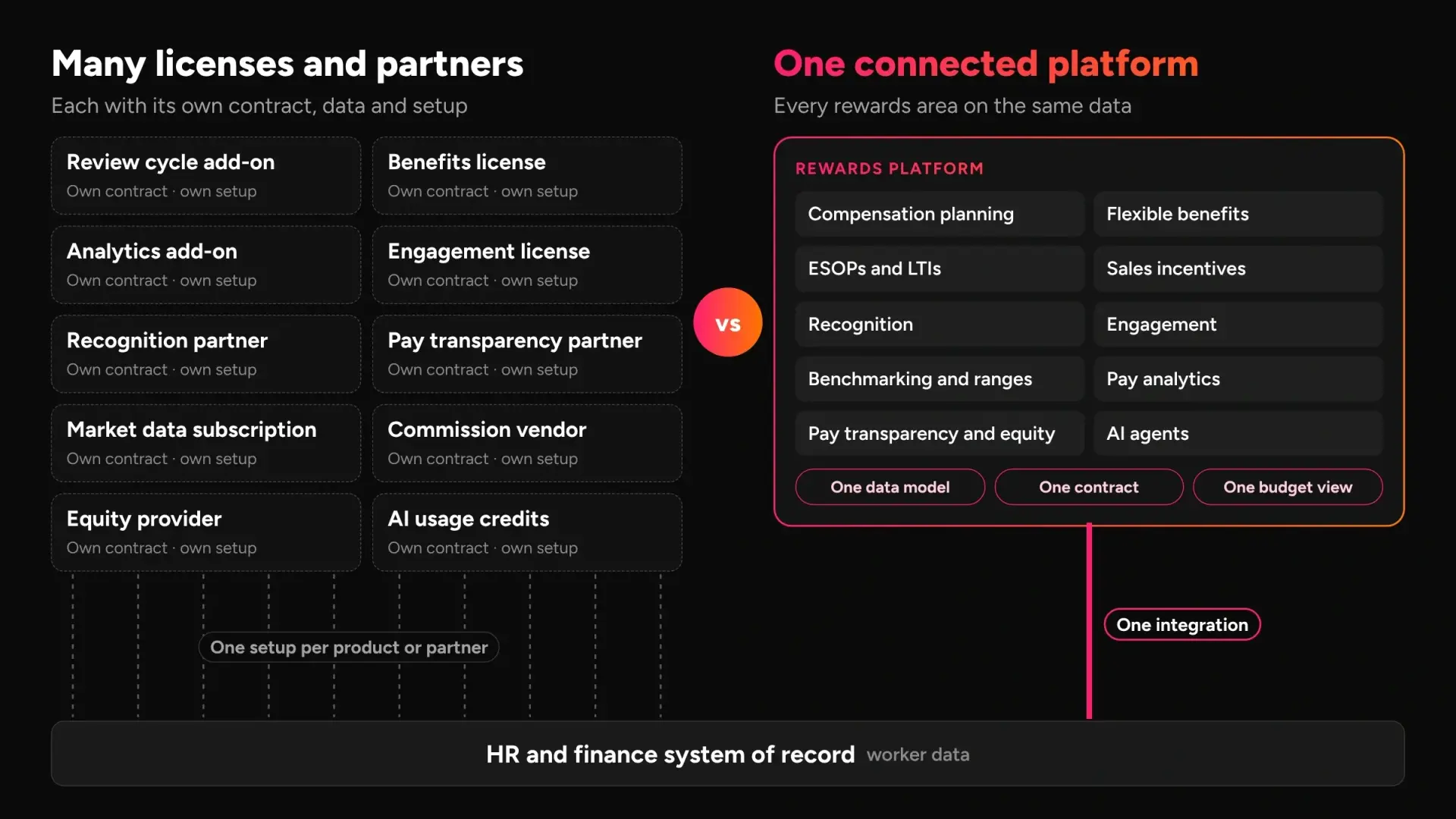
Rewards need | Typical setup around Workday | With Tallect |
|---|---|---|
Review cycles | Advanced Compensation add-on, configured by a partner | Native Compensation Planning module |
Flexible benefits | Workday Benefits licence, plus local providers outside the US | Native Flex Benefits, linked to the rewards statement |
ESOPs and LTIs | A specialist equity administration provider | Native multi-plan, multi-currency module |
Sales incentives | A commission vendor such as Xactly, CaptivateIQ or Varicent | Same data as bonus and equity |
Recognition | Workday Recognition (provided by Achievers) | Redemption in 85+ countries |
Engagement and culture | Workday Peakon Employee Voice, separately licensed | Engagement tied to rewards insight |
Survey imports, plus a Compa subscription for live data | Native benchmarking and range builder | |
Pay analytics | Prism Analytics licence, or exports into Excel and BI | Rewards dashboards, ready on day one |
Pay transparency | Pay Transparency Analyzer (built with Kainos) | Native pay transparency and equity module |
Rewards AI | Flex Credits for agents, priced per action | inTallect agents included across modules |
Why one platform matters
- One source of truth. The salary in the offer, the range in benchmarking, the grant in the LTI plan and the award in recognition all come from the same record.
- One rewards view for employees. Salary, bonus, incentives, benefits, equity and recognition sit in one statement.
- One budget for finance. The full cost of reward, including incentives and equity, sits in one place.
- Fewer contracts to manage. You sign, secure, audit and renew one contract instead of several SKUs and partner agreements.
- Connected decisions. A promotion checks range, pay gap, equity refresh and budget impact in one step.
Global and flexible by design
Tallect was built for companies that pay people in many countries and currencies. One system runs every country, with local rules set through settings, not custom code. Tallect serves clients in close to 18 countries today.
Many countries, one system
- Plan, budget and approve in local currency, and see the group total in real time.
- Keep a fixed planning rate and a live reporting rate side by side.
- See how currency changes affect budgets, payouts and equity value.
- Show employees their numbers in their own currency, and leaders the same numbers in group currency.
- Set grades, ranges, pay mix, benefit plans, eligibility, statutory pay elements and approvals per country or entity.
- Offer screens, statements and letters in multiple languages.
- Prepare for pay transparency laws, including the EU Pay Transparency Directive.
- Offer recognition redemption in 85+ countries, with local catalogues.
Changes as settings, not projects
Rewards design changes every year. In Tallect, the rewards team can make new plans, countries and schemes live in days.
- Fully modular. Start with one module, such as benchmarking or ESOPs, and add more later. Nothing needs to be rebuilt.
- Flexible plan rules. Bonus, incentive and LTI plans support milestones, events, cycles, tiers, accelerators and clawbacks.
- Many plans at once. Run different plans for different countries, functions, levels or acquired companies.
- Your philosophy, built in. Merit matrices, guidelines and range targets follow your philosophy, not a fixed template.
- Changes during a live cycle. Adjust budgets, guidelines, eligibility or exchange rates without starting over.
- Ready for M&A. Keep an acquired company on its own plans first, then bring it in line at your own pace.
Workday is a global system and handles many currencies and languages for worker data. Its rewards extras are less global:
- Workday Benefits is strongest for US plans, and Workday Total Benefits partner features are offered to US customers.
- Country-specific rewards logic is usually built by partners.
- Workday’s business process framework is powerful but built for HRIS experts.
- Partners report that Advanced Compensation calculations are harder to design than expected, because no two companies run bonus and merit the same way.
Analytics and self-service
A rewards team moves only as fast as it can get answers and make changes. Tallect is built for both.
Rewards analytics from day one
Tallect comes with rewards analytics built in, with no reports to build or add-on to buy. Every chart uses the live data that drives offers, increments, payouts and grants.
- Market position: compa-ratio, range penetration and positioning by grade, function, location and talent segment.
- Pay structure health: compression, inversion, red and green circle cases, range spread and overlap.
- Pay equity: adjusted and unadjusted gaps, outlier lists and the cost to remediate.
- Cost of reward: total cost by element, entity and currency.
- Pay mix: fixed, variable and long-term mix by level, against your philosophy targets.
- Budget and cycle: budget consumption, guideline adherence and manager exceptions, live during the cycle.
- Incentive and bonus: attainment, payout curves, earnings potential and cost forecasts.
- Equity: grants, vesting, unvested value, wealth created, dilution and buyback exposure.
- Benefits and recognition: utilisation, enrolment, recognition spread and redemption by country.
- Reward ROI: reward spend against performance, retention risk and talent classification.
You can slice any view by country, grade, gender or talent segment, drill down to one employee, test what-if cases, and ask inTallect questions in plain language.
Workday offers real-time dashboards for budgets and spend, and a pay equity dashboard. Rewards analysis that blends survey data, equity, incentives and benefits usually needs custom reports or Workday Prism Analytics, which is a separate licence. Data from partner tools for commissions, equity or recognition also has to be brought back in.
Your rewards team stays in control
Tallect is built so the rewards team can run it alone. Everyday changes need no IT ticket, partner change request or developer.
Everyday task | Typical path around Workday | With Tallect |
|---|---|---|
Launch a new bonus or incentive plan | Partner-led configuration, testing and relaunch | Configure it in the plan builder |
Load a new salary survey and refresh ranges | Prepare in Excel, then import into Workday | Upload, match jobs once, and inTallect maps the rest |
Change merit guidelines mid-cycle | Configuration change, retesting and relaunch | Edit the guideline and republish |
Add a new country or entity | Configuration project, often with a partner | Clone a setup and adjust local rules |
Publish a policy to five countries | Knowledge articles, intranet updates and email follow-ups | Publish once, track acknowledgements live |
Build a pay equity or cost report | Custom report, Prism Analytics or data export | Ready dashboard, filtered in seconds |
Answer an employee question on equity or benefits | Ticket to HR, the equity provider or the benefits vendor | inTallect answers from the employee’s data and your policy |
Several things make this possible:
- No-code builders.
- Ready templates based on real rewards practice.
- Checked self-serve uploads.
- Role-based access for country leads.
- inTallect agents.
HRIS teams can then focus on the system of record.
Pay transparency and pay equity
Pay transparency is now a legal requirement in many markets. EU countries were due to bring the EU Pay Transparency Directive into national law by June 2026. The first pay gap reports are due from June 2027 for employers with 150 or more staff. Pay range laws are also spreading across US states and other markets. Rules vary by country, so check your local requirements and take legal advice.
Tallect gives rewards teams one module to get ready and stay ready:
- Job architecture. Job families and levels that make “work of equal value” measurable.
- Pay bands. Ranges built from market data, by country, ready for job postings.
- Gap audits. Adjusted and unadjusted analysis, with drill-down to the cases behind the gap.
- Fix-it budgets. Cost the gap, spread the fix across cycles and feed it into pay planning.
- Employee requests. Answer pay information requests with consistent, auditable data.
- Reports. Country-ready reports with a full audit trail.
- Checks in every decision. Offers, promotions and increments are checked against range and parity before approval, so new gaps are stopped early.
Workday has a pay equity dashboard and “pay vs. peers” insight for managers. For the EU directive, Workday announced the Pay Transparency Analyzer in October 2025. It is built with partner Kainos and appears in Workday’s 2026R1 release as “EU Pay Transparency (Powered by Kainos)”. For a rewards team, that means another product to buy, set up and support beside Advanced Compensation. Tallect covers all of the above in one module and links it to every pay decision in the year.
AI for rewards: inTallect
inTallect is Tallect’s team of AI agents. Each agent works like a member of your rewards team and uses your own data and rewards philosophy. The agents come in three kinds:
- Information agents answer questions with data, tables and charts.
- Action agents do tasks, such as building a budget or matching jobs.
- Advice agents give practical guidance on policy, design and market practice.
The agents cover these areas:
- Market Benchmark: job evaluation, benchmark matching, duplicate job reduction and range diagnostics.
- Compensation Planning: budget creation, manager coaching, analytics on prompt and at-risk case flagging.
- Total Rewards: reward scenarios, what-if analysis, budget simulation and nudges.
- Benefits: personalised choices, cost optimisation, compliance checks and policy answers.
- ESOPs and LTIs: plain-language answers and views of wealth created and future wealth.
- Sales Incentives: one-click budget simulation, rep earnings, policy Q&A and dispute handling.
- Recognition: eligibility answers and programme guidance.
- Pay Equity and Transparency: fair pay audits and gap explanations.
Workday is investing heavily in AI. Its Total Rewards Agent is designed to guide benefits choices, model merit and market changes, and monitor pay equity. As of October 2026, Workday lists the Benefits Agent in early access and the Compensation Agent as “coming soon”. Agents are paid for through Flex Credits, and Workday publishes the credits used per action but not the price of a credit. AI can also only go as far as the product under it. inTallect covers the whole rewards lifecycle today because Tallect does.
Implementation, support and cost
Who implements and supports
At Tallect, our own Total Rewards experts set up, support and improve your platform. Nothing is outsourced, so you work with one team that knows both the software and the rewards problem.
Workday works through a large partner network. A certified partner, often a Big 4 or other large consulting firm, usually runs the implementation. After that, support is split:
- Many companies keep a post-production support partner.
- Product issues go to Workday support.
- Partner tools such as Achievers, Compa or a commission vendor each bring their own support team.
For rewards, that can mean many hand-offs.
At Tallect, a dedicated seven-member account pod takes over after go-live. It includes a rewards lead who knows compensation, benefits, equity and incentives, plus setup and data specialists who know your configuration. The pod helps in every cycle, from pay review to bonus payout, grants and benefits enrolment. It also advises on policy, market practice and regulation.

How an implementation runs
Tallect goes live in 1 to 3 months, depending on the number of modules and countries. You can start with the module you need most and add more later without a new project.
- Discover. We learn your rewards philosophy, plans, countries, data and approval flows.
- Design and set up. We configure grades, ranges, plans, policies, workflows, letters and statements.
- Connect. In parallel, we connect Workday for worker data, set up single sign-on and agree on the payroll output.
- Test. Your team tests with real data and cases until you sign off.
- Train and go live. We train the rewards team, HR business partners and managers, then go live for your first cycle.
- Hypercare and handover. We stay close through the first live cycle, then the account pod takes over.
For context, industry advisers report 9 to 15 months for a Workday HCM implementation (source needed). That project covers far more than rewards, so it is not a like-for-like comparison with a Tallect rewards implementation.
Stage | Typical Workday model | Tallect model |
|---|---|---|
Who implements | Certified implementation partner | In-house team led by Total Rewards experts |
Rewards design advice | A separate consultant, if hired | Included, from people who have run rewards in 52+ countries |
Testing | Partners report 10 to 12 minutes or more per launch (source needed), and changes need a relaunch | Test with real data, change and retest the same day |
Plan and cycle changes | Change requests, scoped and priced | Done with your team, often in the same week |
Adding a module later | A new SKU and a new project | Switch it on and configure |
Releases | Two major releases a year to review and regression test | Updates tested by our team against your setup |
Partner tools | Separate support for each partner product | One team for every module |
Support after go-live | Workday support plus a post-production partner | A dedicated seven-member account pod |
Product feedback | Through large customer communities | Direct line to the founders and product team |
From you, we need:
- One project owner from the rewards team.
- Access to set up the Workday connection and single sign-on.
- Your current plan documents, policies and data.
- Timely sign-offs after design and testing.
What drives the real cost
The true cost of rewards technology is more than the licence. The table compares cost drivers, not prices.
Cost driver | Rewards stack around Workday | Tallect alongside Workday |
|---|---|---|
Licences | Compensation and Advanced Compensation, plus Benefits, Prism Analytics and Peakon as separate SKUs | One modular subscription for the modules you switch on |
Partner tools | Separate contracts for equity, commissions, market data and recognition | Included in the platform |
Implementation | Partner-led. Industry advisers estimate 1.5 to 2.5 times the first-year subscription for Workday HCM (source needed). | In-house implementation by Tallect’s team |
Change requests | Scoped and priced partner work | Configured by your team, with pod support |
Releases | Regression testing twice a year | Handled by our team |
Rewards team effort | Reconciling spreadsheets, partner reports and exports | Live dashboards and inTallect agents |
Questions for your business case
- How many Workday SKUs and partner tools touch rewards today, and what does each cost per year?
- How long does a new bonus plan or a mid-cycle change take, and who pays for it?
- How many hours does the rewards team spend in spreadsheets each cycle?
- How many Flex Credits will rewards agents use, and at what price?
- How fast can you answer a pay equity question from the board or a regulator?
Where Workday stays strong
Workday remains the right home for what it was built for, and Tallect is built to work with it:
- One system of record for workers, jobs, organisations and finance.
- A strong business process framework for approvals and audit.
- Workday Payroll and Financial Management, where licensed.
- Recruiting, learning, talent and planning across the enterprise.
- Strong US benefits administration, including US Affordable Care Act (ACA) rules.
None of these needs to move. The best setup for most companies is both: Workday for people, processes and finance, and Tallect for rewards.
Better together: how the integration works
Tallect does not replace Workday. Worker, job and organisation data flows in from Workday, and approved rewards outcomes flow back for payroll. Workday stays your system of record. Tallect becomes your system of rewards.
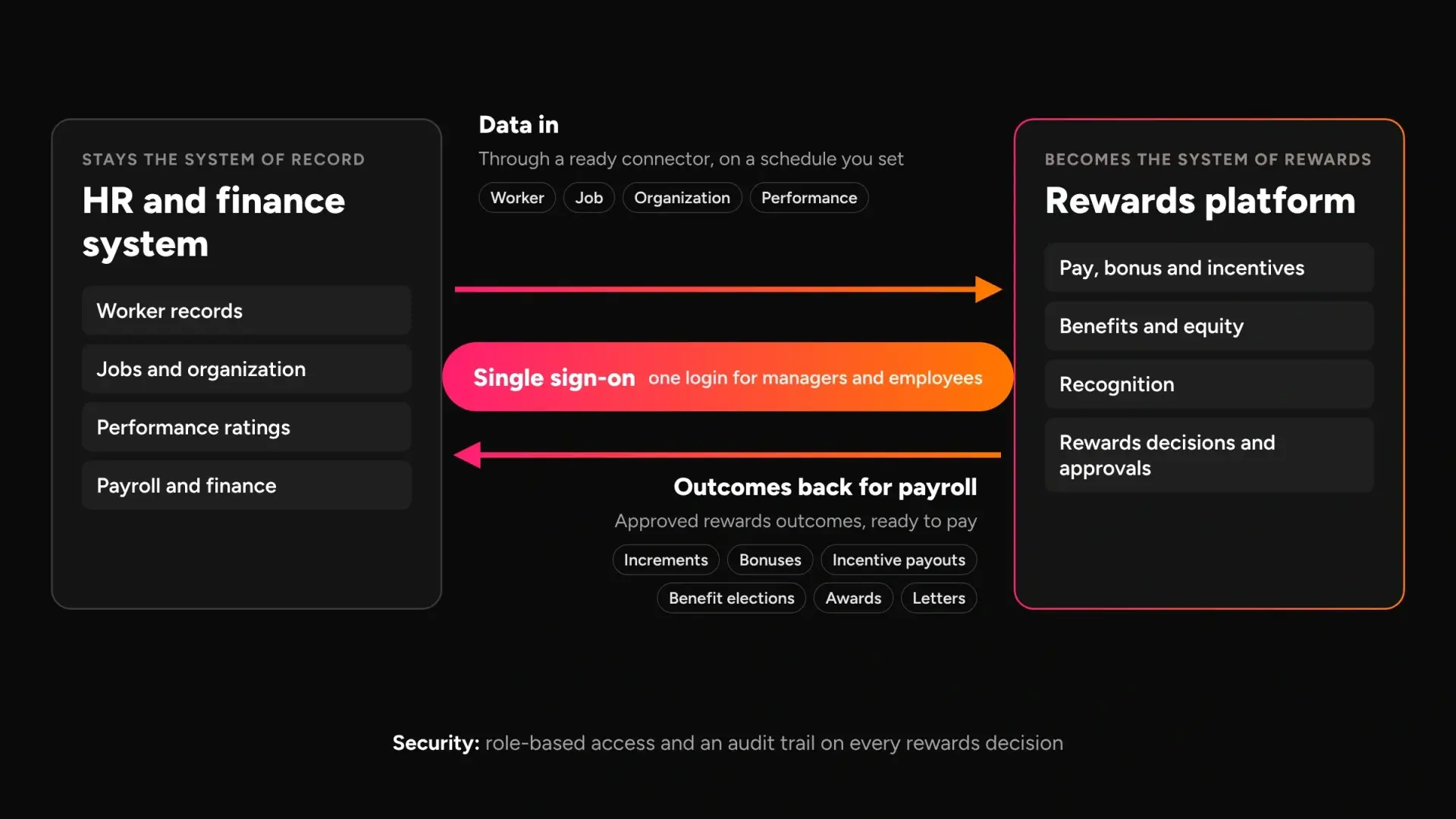
- Data in: worker, job, organisation and performance data comes from Workday through a ready connector, on a schedule you set.
- Outcomes back: approved increments, bonuses, incentive payouts, benefit elections, awards and letters go back ready for Workday Payroll or your payroll provider.
- One experience: single sign-on lets managers and employees move between the two without a second login.
- Security: role-based access and an audit trail on every rewards decision.
- Beyond Workday: the same approach works with SuccessFactors, Oracle and other HRMS platforms, as well as payroll and finance systems.
When Tallect is a good fit
Tallect fits when rewards matters too much to be spread across add-ons and partners, and when you want to:
- Bring all 14 rewards areas onto one platform, in place of several SKUs and partner tools.
- Let your rewards team make everyday changes without partner change requests or long relaunch cycles.
- Work with an in-house expert team and go live in 1 to 3 months, starting small.
- Use AI agents across all of rewards today, included in the platform.
- Keep your Workday investment and add rewards depth alongside it.
Keep Workday and bring Total Rewards into one place
Tallect connects to Workday through a ready connector and single sign-on, and goes live in 1 to 3 months, starting with the module you need most.
Frequently asked questions
What is Workday Advanced Compensation?
Advanced Compensation is the Workday add-on for running review cycles. It sits on top of core Workday Compensation and is not sold on its own. It routes merit, bonus and stock reviews through Workday business processes. It also adds manager worksheets, budget pools, matrices and total rewards statements.
What is the difference between Workday Compensation and Advanced Compensation?
Workday Compensation handles pay plans, grades and packages. Advanced Compensation is a paid add-on that runs merit, bonus and stock review cycles on top of it.
Which rewards areas sit outside Workday Advanced Compensation?
Several areas need another Workday product or a partner:
- Benefits need Workday Benefits.
- Deep analytics need Prism Analytics.
- Engagement surveys need Peakon Employee Voice.
- Recognition comes through Workday Recognition (provided by Achievers).
- EU pay transparency reporting uses the Pay Transparency Analyzer (built with Kainos).
- Sales commissions usually run in partner tools.
- Equity administration needs a specialist provider.
Does Workday handle ESOP and LTI administration?
Only in part. Workday tracks stock plans, grants and vesting dates in the review cycle. Exercises, buybacks and statements need a specialist equity provider.
Can Workday run complex sales commission plans?
Commission can be held as a pay plan in Workday. Complex commission plans usually run in partner tools such as Xactly, CaptivateIQ or Varicent.
How does Workday support the EU Pay Transparency Directive?
Workday announced the Pay Transparency Analyzer in October 2025. It is built with partner Kainos and appears in the 2026R1 release as “EU Pay Transparency (Powered by Kainos)”. It is a separate product alongside Advanced Compensation.
How are Workday’s AI agents for rewards priced?
Workday’s AI agents are paid for through Flex Credits. Workday publishes the credits used per action but not the price of a credit. As of October 2026, the Benefits Agent is in early access and the Compensation Agent is listed as “coming soon”.
Does Tallect replace Workday?
No. Workday stays your system of record for people, jobs and finance. Tallect brings in worker, job and organisation data from Workday through a ready connector and sends approved rewards outcomes back for payroll. Single sign-on links the two.
How long does a Tallect implementation take alongside Workday?
Tallect goes live in 1 to 3 months, depending on the number of modules and countries. You can start with the module you need most and add more later without a new project. Tallect’s own in-house team runs the implementation.