
How to Explain ESOPs to Employees with a Total Rewards Statement
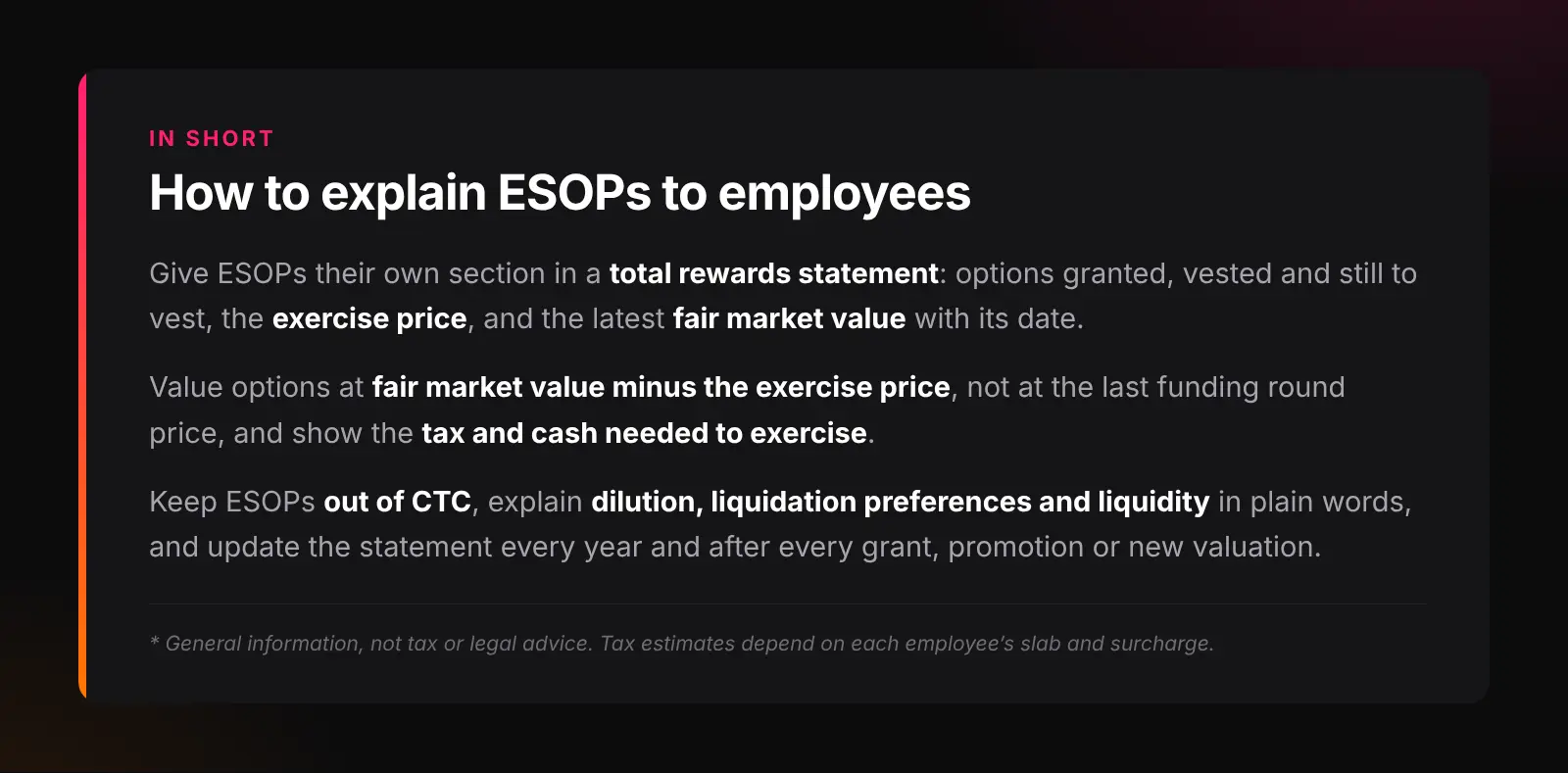
Show employees what their ESOPs are worth, what exercising costs and when options could become cash, in one clear statement.
Most employees who hold ESOPs cannot say what they are worth. They know a number of options, perhaps a vesting date, and little else. A total rewards statement fixes that. It sets out everything an employee receives from the company in one personal document, and gives ESOPs their own section. That section shows how many options have vested, what they could be worth today, what it would cost to exercise them, the tax, and when they could turn into cash. Done well, it turns a line in an offer letter into something people value, and it stops them over- or under-estimating what they hold.
Why ESOPs need explaining
Employees often do not know what equity they have, or what it means.
- Many do not know it exists. A 2024 Morgan Stanley at Work survey asked 1,000 US employees and 600 HR leaders about equity. Only 38% of employees knew their company offered equity benefits. Yet 95% of HR leaders said equity was the most effective way to keep employees motivated and engaged, and 80% of employees agreed.
- Education rarely lands. In the same survey, 45% of HR leaders rated their own equity education for employees as very effective.
- Indian startups see the same gap. In Siason Capital’s survey of 268 Indian startups, lack of knowledge about ESOPs was the biggest barrier to using them, as Inc42 reported.
- Even payslips confuse people. In a 2022 Zellis survey of 2,010 UK and Irish employees, 71% named at least one thing that made their payslip hard to understand, and 28% blamed jargon. ESOP terms such as vesting, exercise price and fair market value are harder still.
An employee who does not understand their options either ignores them or overvalues them. Neither helps with retention, and the second leads to disappointment when the real numbers arrive.
Where a total rewards statement helps
A total rewards statement is a personal summary of everything an employee receives for their work, given a value wherever possible. HR research and training firm AIHR groups the contents into four categories:
- financial rewards, such as salary, bonuses, incentives and equity
- monetary benefits, such as insurance, retirement contributions and allowances
- non-financial benefits, such as leave, flexible working and learning budgets
- intangible rewards, such as recognition and career growth
ESOPs belong in the first category, but they need more space than a single line. Payslips and CTC letters show cash. A total rewards statement shows the whole package, so it is the natural place to give ESOPs their own section, with the numbers each employee needs to understand what they hold.
What to include in the ESOP section
Give each employee one table for their options. Use their own figures, and date every value.
Item | What to show | Why it matters |
|---|---|---|
Grant | Grant date, the scheme it falls under, and options granted | The starting point for everything else |
Vested | Options vested to date, and options already exercised | What the employee could act on now |
Unvested | Options still to vest, and the next vesting date | What staying another year is worth |
Exercise price | The price per share to buy each option | The cost of turning options into shares |
Fair market value | The latest value per share and its date | The basis for the value and the tax |
Indicative value | Vested and unvested value at the latest fair market value | A realistic, dated number, not a promise |
Ownership | Options as a percentage of fully diluted shares | Lets employees compare across companies and rounds |
Exercise window | How long they have to exercise, including after leaving | Prevents options lapsing by surprise |
Tax | An estimate of the tax due if they exercise today | The cash an exercise really needs |
Liquidity | How and when shares could be sold | Explains that value is not cash yet |
Link each item to the source document, such as the grant letter or the scheme, so employees can check it.
How to value ESOPs on the statement
The value you show is the part employees remember, so choose it carefully.
- Use intrinsic value. For each option, take the latest fair market value per share and subtract the exercise price. Multiply by the number of options. This is the value on paper today, before tax.
- Use the fair market value, not the last funding round price. Investors usually buy preference shares with extra rights, so their price per share is often well above the value of an ordinary share. A statement built on the round price overstates what employees hold.
- Label scenarios as scenarios. If you show what options might be worth at a higher valuation, say plainly that it is an illustration, not a forecast.
- Explain dilution. Each new funding round reduces every holder’s percentage, even when the value per share rises.
- Mention liquidation preferences. In a sale, investors with a liquidation preference are usually paid first. If a company sells for less than it raised, ordinary shareholders, including ESOP holders, may receive little or nothing.
That last point is easy to leave out and painful to learn late. In December 2025, as merger talks valued the company well below its peak, Unacademy co-founder Gaurav Munjal told employees this, as Outlook Business reported:
“When liquidation preference is properly enforced, ESOPs effectively become zero. But we didn’t want that to happen.”
Worked example: one employee’s statement
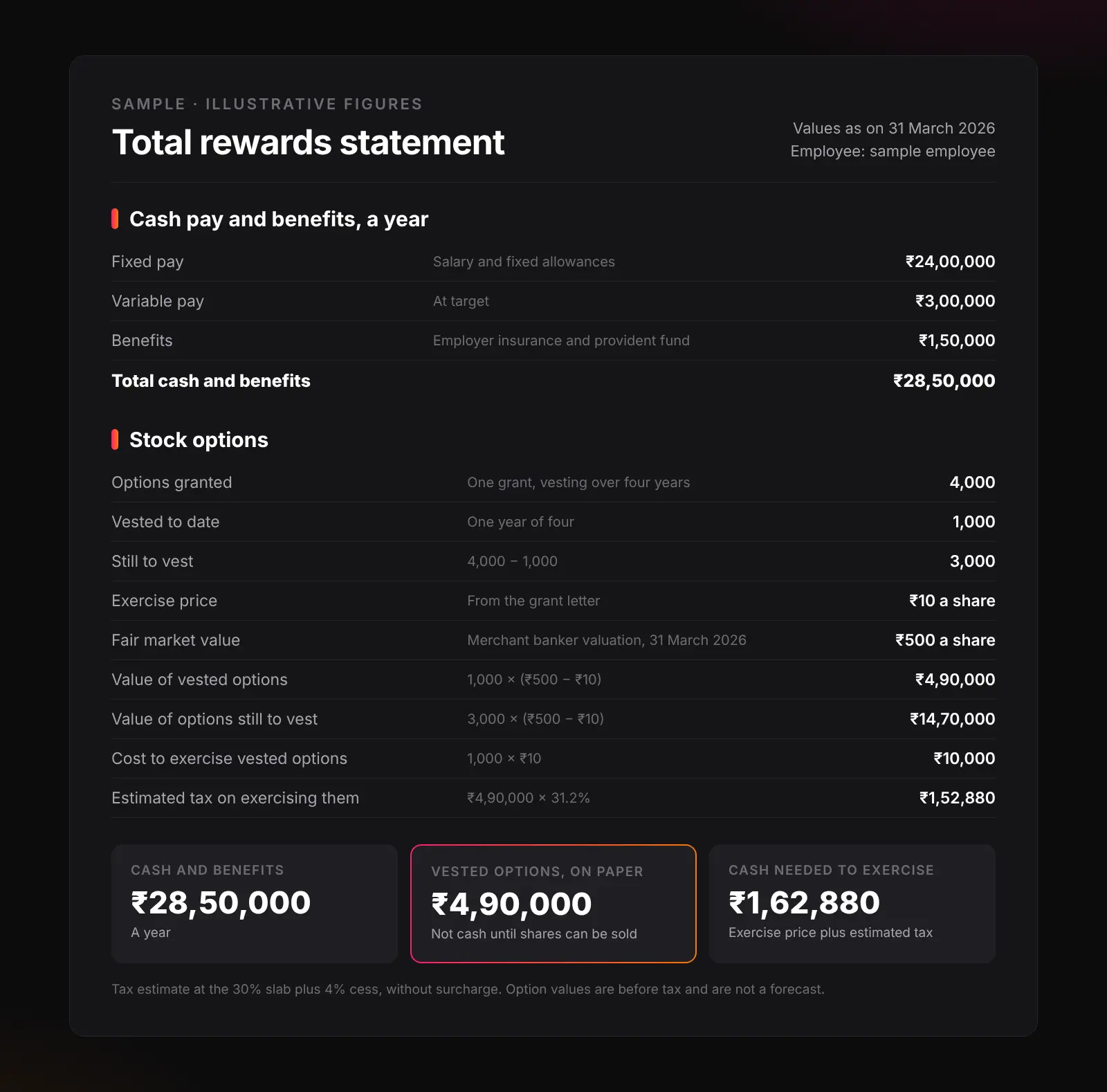
Here is how the numbers come together for one employee. They are made up to show the method. The values are as on 31 March 2026, the date of the latest fair market value.
Cash pay and benefits
Component | Amount a year | Notes |
|---|---|---|
Fixed pay | ₹24,00,000 | Salary and fixed allowances |
Variable pay | ₹3,00,000 | At target |
Benefits | ₹1,50,000 | Employer contributions to insurance and provident fund |
Total cash and benefits | ₹28,50,000 |
Stock options
The ESOP section sits under the cash table, not inside it. Show the working, so the employee can check every number.
Item | How it is worked out | Amount |
|---|---|---|
Options granted | One grant, vesting over four years | 4,000 |
Vested to date | One year of four | 1,000 |
Still to vest | 4,000 − 1,000 | 3,000 |
Exercise price | From the grant letter | ₹10 a share |
Fair market value | Merchant banker valuation, 31 March 2026 | ₹500 a share |
Value of vested options | 1,000 × (₹500 − ₹10) | ₹4,90,000 |
Value of options still to vest | 3,000 × (₹500 − ₹10) | ₹14,70,000 |
Cost to exercise vested options | 1,000 × ₹10 | ₹10,000 |
Estimated tax on exercising them | ₹4,90,000 × 31.2% (30% slab plus 4% cess) | ₹1,52,880 |
Cash needed to exercise today | ₹10,000 + ₹1,52,880 | ₹1,62,880 |
Three numbers matter most to this employee:
- ₹28,50,000 a year in cash and benefits
- ₹4,90,000 in vested options on paper
- ₹1,62,880 in cash needed to turn those options into shares
None of the option value is cash until the shares can be sold.
Show ESOPs separately from CTC
In India, CTC usually means the cash and benefits the company pays in a year. ESOPs do not fit that frame. They vest over years, their value moves, and they become cash only when shares can be sold.
So keep ESOPs out of the CTC total, and show them in their own section of the statement. Adding an unvested, illiquid paper value to salary inflates the package. It also makes the next appraisal look like a pay cut if the value falls. If you want a single headline figure, show cash and benefits as one number, and options as a second number with its date.
Explain tax and liquidity plainly
Tax is where most surprises happen, so give employees an estimate before they decide to exercise.
- Tax at exercise. When an employee exercises, the difference between the fair market value and the exercise price is taxed as salary, even though no cash has been received. For an employee in the 30% slab, the rate is about 31% with cess, and up to about 39% with surcharge at the highest incomes.
- Who sets the value. For an unlisted company, the fair market value for this tax comes from a SEBI-registered Category I merchant banker.
- Deferral at some startups. For employees of eligible startups, the Income Tax Department explains that tax at exercise is deducted within 14 days of the earliest of three dates: 48 months from the end of the assessment year of allotment, leaving the company, or selling the shares. An eligible startup needs an Inter-Ministerial Board certificate, not only DPIIT recognition, so check before you mention the deferral.
- Tax at sale. When the shares are sold, the gain over the fair market value at exercise is taxed again, as capital gains.
- Liquidity. Say how shares could become cash: a buyback, a secondary sale, an acquisition or an IPO. If none is planned, say so.
When to send the statement
- Once a year, usually with the annual pay review, so equity is discussed alongside salary.
- After a new grant or a refresh grant, so the employee sees the full picture straight away.
- After a promotion, when cash and equity often change together.
- After a new valuation or funding round, when the fair market value changes.
- Before someone leaves, with their vested options and the exercise window spelled out.
Walking an employee through it
A statement explains the numbers. A conversation makes them stick. When managers or HR go through the ESOP section, cover these points:
- Start with what they own today: vested options, and their value at the latest fair market value.
- Show what staying adds: unvested options and the next vesting date.
- Explain the cost of exercising: the exercise price and an estimate of the tax.
- Be clear about cash: options are not money until shares can be sold.
- Name the risks: dilution, liquidation preferences and changes in valuation.
- Point to the documents: the grant letter, the scheme and where they can see their grants.
- Ask what is unclear, and answer in writing if the question is about their own options.
Train managers first. Most employees ask their manager before they ask HR.
Mistakes to avoid
- Valuing options at the last funding round price. It overstates what employees hold.
- Adding ESOPs to CTC. It inflates pay and blurs cash with paper value.
- Leaving out the exercise price and tax. An exercise needs cash, and employees should know how much.
- Showing values without a date. A fair market value from two years ago can mislead.
- Using jargon without a definition. Define vesting, exercise price, fair market value and fully diluted the first time they appear.
- Sending it once and forgetting it. A statement that is a year out of date after a funding round is worse than none.
This article is general information, not legal, tax or investment advice. Tax rules and rates change, and each employee’s position differs. Speak to a chartered accountant or adviser before you publish ESOP values or tax estimates to employees.
Frequently asked questions
What is a total rewards statement?
A total rewards statement is a personal summary of everything an employee receives for their work, given a value wherever possible. It covers financial rewards such as salary, bonuses and equity, monetary benefits such as insurance and retirement contributions, non-financial benefits such as leave and learning budgets, and intangible rewards such as recognition and career growth.
Why should ESOPs be in a total rewards statement?
Payslips and CTC letters show only cash, so most employees never see their ESOPs valued alongside the rest of their pay. A total rewards statement shows the whole package. It is the natural place to explain what options are worth, what exercising costs and when they could become cash.
What should the ESOP section of the statement include?
Include the grant details, options vested and unvested, the next vesting date, and the exercise price. Add the latest fair market value with its date, the indicative value, and ownership as a percentage of fully diluted shares. Finish with the exercise window, an estimate of the tax at exercise, and how shares could be sold.
How should ESOPs be valued on the statement?
Use intrinsic value. Take the latest fair market value per share, subtract the exercise price, and multiply by the number of options. For example, 1,000 vested options with a fair market value of ₹500 and an exercise price of ₹10 are worth ₹4,90,000 on paper, before tax.
Why not value ESOPs at the last funding round price?
Investors usually buy preference shares with extra rights, so their price per share is often well above the value of an ordinary share. A statement built on the round price overstates what employees hold, and leads to disappointment when the real numbers arrive.
Should ESOPs be included in CTC?
No. CTC usually means the cash and benefits paid in a year, while ESOPs vest over years, change in value and become cash only when shares can be sold. Show cash and benefits as one number, and options as a second number with its date.
How much tax does an employee pay when exercising ESOPs?
The gain at exercise, meaning the fair market value minus the exercise price, is taxed as salary, even though no cash has been received. In the 30% slab, the rate is about 31% with cess, and up to about 39% with surcharge at the highest incomes. Employees of eligible startups with an Inter-Ministerial Board certificate may be able to defer it.
What is the cash needed to exercise ESOPs?
It is the exercise price plus the tax on the gain. In the article’s example, exercising 1,000 vested options costs ₹10,000 at a ₹10 exercise price, plus about ₹1,52,880 in tax, so the employee needs about ₹1,62,880 in cash.
How often should ESOP statements be sent?
Send one at least once a year, usually with the pay review. Also send an updated statement after a new or refresh grant, after a promotion, after a new valuation or funding round, and before someone leaves, with the exercise window spelled out.
What risks should employees understand about their ESOPs?
Explain three risks. Each funding round dilutes their percentage, even if the value per share rises. Liquidation preferences mean investors are usually paid first in a sale, so ESOP holders may receive little if the company sells for less than it raised. And the value can change with each new valuation.