Pulley Is Shutting Down: Where to Move Your Cap Table and ESOPs (India and US)
Pulley closes on 8 December 2026. Here are the key dates, what to export and how to choose your next cap table platform in India and the US.
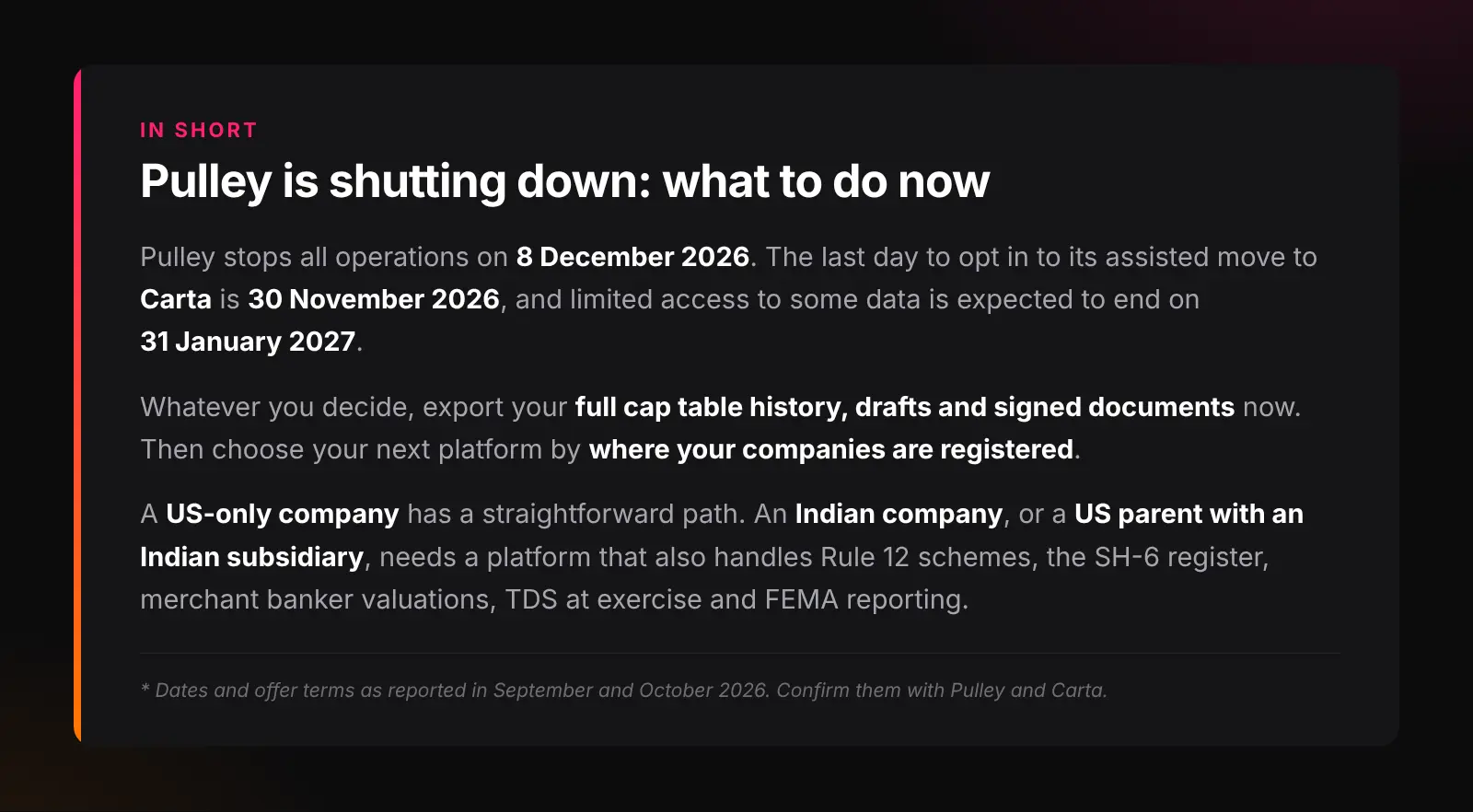
Pulley, the US cap table platform, announced on 15 September 2026 that it is winding down. Its last day of service is 8 December 2026. Pulley has arranged an assisted move to Carta for customers who opt in by 30 November, and limited access to some data is expected to end on 31 January 2027. Whatever you decide, export your full equity records now. Then choose your next platform by where your companies are registered. A US-only company has a straightforward path. An Indian company, or a US parent with an Indian subsidiary, needs a platform that handles Indian company law as well.
Pulley shutdown: the key dates
Date | What happens |
|---|---|
15 September 2026 | Pulley announces it is winding down |
30 November 2026 | Last day to opt in to Pulley’s arranged Carta migration and its pricing terms |
8 December 2026 | Pulley stops all operations; the app becomes inaccessible and support ends |
31 January 2027 | Limited access to some Pulley data is expected to end |
Pulley announced the shutdown to customers in September, as TechCrunch reported. Pulley was founded by Yin Wu and raised more than $50 million from investors including General Catalyst, Stripe and Founders Fund. It has not given a reason for closing.
What Pulley’s Carta offer includes
Pulley has partnered with Carta for an assisted transition. Here is what accounting firm BPM and other reports say the offer includes:
- Pricing: customers who move keep their Pulley pricing for the first year, and any unused part of a Pulley subscription is credited to the new Carta account.
- Contract: you sign a new 12-month Carta agreement.
- Billing: Carta does not offer monthly billing under this arrangement, so customers on monthly plans move to quarterly or annual billing.
- Other providers: Pulley has said it will not help with migrations to any provider other than Carta.
Opting in before 30 November does not commit you to moving. If Carta might be your choice, opting in keeps the option open while you compare.
Export everything before 8 December
Do this first, whatever platform you choose. A clean export is the only record you control once Pulley closes. Save a copy where your finance and legal teams can both reach it.
- The full cap table history, not only today’s ownership. Take one export for all time, and a second with drafts included. Drafts are left out by default and disappear on 8 December.
- The stakeholder list with contact details.
- Every option grant, with its vesting schedule, exercise price, exercises, cancellations and expiries.
- Share issues and transfers, with certificate numbers where you use certificates.
- SAFEs, convertible notes and their terms.
- Signed documents: grant agreements, share purchase agreements, board consents and shareholder approvals.
- Every 409A valuation report.
- Anything pending, such as a grant awaiting board approval or an exercise in progress.
Documents are stored separately from the cap table data, so export them separately. Pulley’s data room has a download-all option for the files stored there.

Where to move: start with your companies
The right next platform depends less on features than on where your companies are registered and where your option holders live.
Your structure | What your next platform must handle |
|---|---|
A US company with US employees | US cap table, 409A, ISO and NSO grants, Form 3921, ASC 718 expense |
A US parent with an Indian subsidiary | Everything above, plus Indian employees holding US options: Indian tax, FEMA reporting and their own statements |
An Indian company | Rule 12 ESOP schemes, the SH-6 register, PAS-3 filings, merchant banker valuations, Indian tax at exercise, demat shares |
An Indian company with staff or investors abroad | Everything for an Indian company, plus FEMA forms for non-residents |
Moving a US company
For a US-only company, Carta’s assisted path is the simplest move, and other US cap table platforms will import a Pulley export too. Before you switch, check four things the new platform must carry over:
- 409A continuity. Your current 409A valuation and its date, so new grants are priced against a valid report.
- Form 3921. If employees exercised incentive stock options in 2026, Form 3921 must go to them by the end of January 2027. The IRS filing is due by the end of February on paper or the end of March electronically. Pulley’s limited data access is expected to end on 31 January 2027, so make sure the exercise data is in your new platform well before then.
- Delaware franchise tax. The annual report and franchise tax are due by 1 March. The assumed par value capital method needs your issued shares and gross assets, so you need an accurate share count early in the year.
- ASC 718 expense. Stock-based compensation reports for your auditors, with the grant-date fair values carried over.
Moving an Indian company
Carta is built around US companies. Its own community guidance says it is not a transfer agent for international companies, so certificates it creates for them “won’t have legal value”. An Indian private company needs a platform that handles Indian law, including:
- grants under a Rule 12 scheme, with the one-year minimum between grant and vesting
- the register of employee stock options in Form SH-6
- Form PAS-3 within 30 days of each allotment when employees exercise
- fair market value from a SEBI-registered Category I merchant banker for the tax at exercise, with TDS through payroll
- the board’s report disclosures, and the ESOP expense under Ind AS 102 or the ICAI Guidance Note
- demat shares, for private companies that are not small companies under Rule 9B
- Form ESOP and FC-GPR for employees who live outside India
If you have a US parent and an Indian subsidiary
Many Indian-founded startups have a US parent company, with the team employed by an Indian subsidiary. The cap table is American, but the option holders are mostly in India, and that brings Indian rules into play:
- FEMA reporting. Indian employees can hold options in a foreign parent under the Overseas Investment Rules, 2022. The Indian entity reports them in Form OPI through its bank, within 60 days of the end of each half-year, according to Treelife. The half-year to 30 September 2026 is due by 29 November 2026, in the middle of a migration.
- Indian tax at exercise. The gain at exercise is taxed in India as salary, and the Indian employer deducts TDS.
- Foreign asset disclosure. Employees must disclose the foreign shares in Schedule FA of their Indian tax return every year.
Your next platform should keep the US cap table and also produce what the Indian subsidiary needs for these filings. If it cannot, plan who will maintain that data and how.
Cap table and ESOP platform checklist
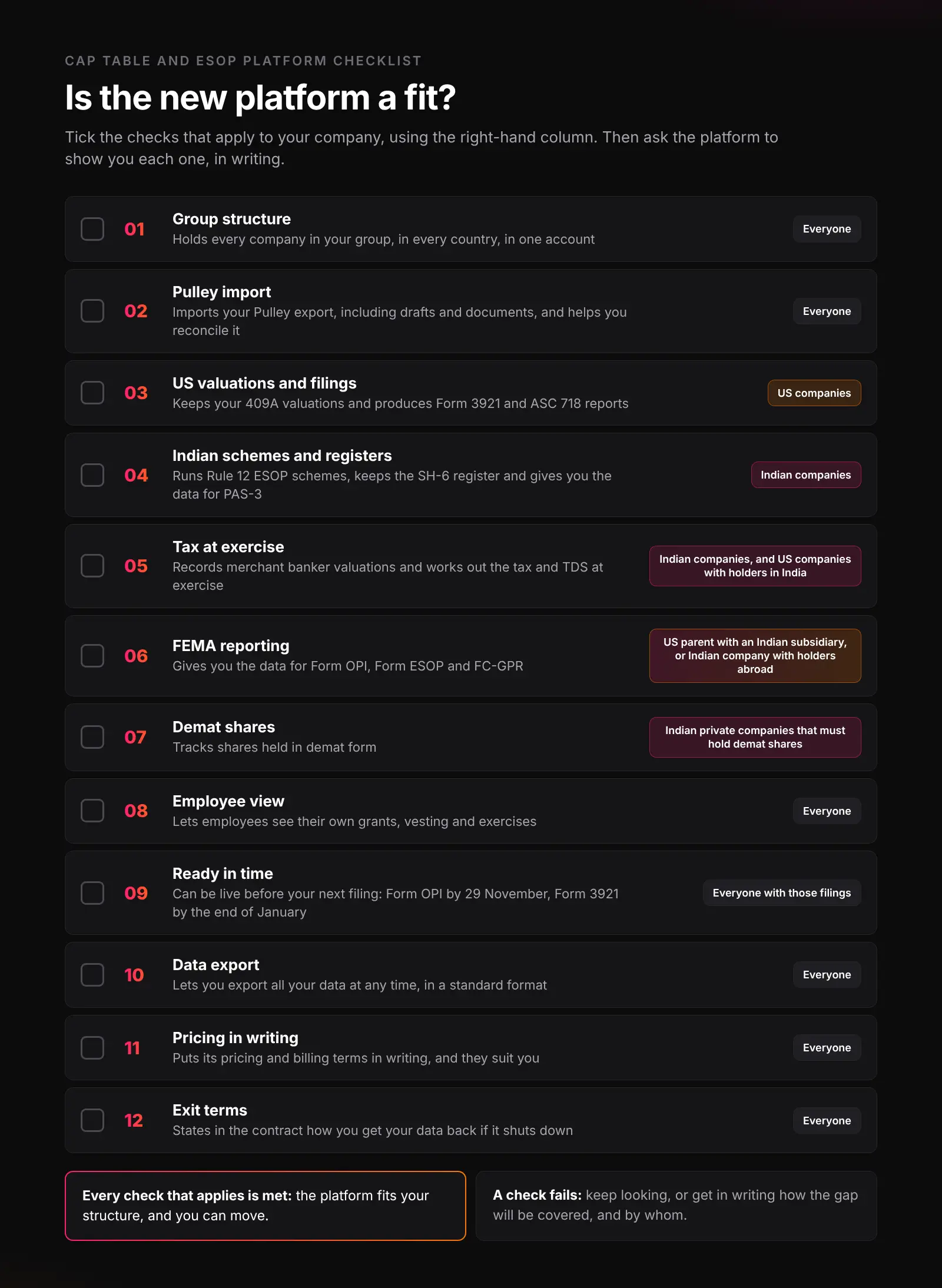
Run every platform you are considering through the same checklist. First mark which checks apply to your company. If a platform meets every check that applies to you, it fits, and you can move to it. If it fails even one, ask how that gap would be covered, and by whom, before you sign.
No. | What the platform must do | Applies to |
|---|---|---|
1 | Holds every company in your group, in every country, in one account | Everyone |
2 | Imports your Pulley export, including drafts and documents, and helps you reconcile it | Everyone |
3 | Keeps your 409A valuations and produces Form 3921 and ASC 718 reports | US companies |
4 | Runs Rule 12 ESOP schemes, keeps the SH-6 register and gives you the data for PAS-3 | Indian companies |
5 | Records merchant banker valuations and works out the tax and TDS at exercise | Indian companies, and US companies with option holders in India |
6 | Gives you the data for FEMA filings: Form OPI, Form ESOP and FC-GPR | US parents with an Indian subsidiary, and Indian companies with holders abroad |
7 | Tracks shares held in demat form | Indian private companies that must hold shares in demat |
8 | Lets employees see their own grants, vesting and exercises | Everyone |
9 | Can be live before your next filing: Form OPI by 29 November, Form 3921 by the end of January | Everyone with those filings |
10 | Lets you export all your data at any time, in a standard format | Everyone |
11 | Puts its pricing and billing terms in writing, and they suit you | Everyone |
12 | States in the contract how you get your data back if it shuts down | Everyone |
Get the answer to each check in writing, ideally in the order form. The last check is the lesson of this shutdown: choose a platform that will give you your data back in a usable form, whatever happens to it.
A six-week migration plan
- This week: take a full export of the cap table, the drafts and every document. Store it in a shared location.
- Before 30 November: decide whether to opt in to the Carta offer. It costs nothing and keeps the option open.
- Before 30 November: shortlist other platforms, and send each one your export to test.
- Before 8 December: take a second, final export, including anything added since the first one.
- After the import: reconcile the new platform against your exports and your source documents, as on the same date.
- Before you go live: tell employees where they will see their options from now on.
- In January: issue Form 3921 for 2026 ISO exercises from the new platform, before the end of the month.
Reconcile before you switch off
A successful import is not the same as a correct one. Before you rely on the new platform, compare it with your Pulley export as on the same date:
- the number of shares in each class, and in total
- the number of options granted, vested, exercised, cancelled and outstanding
- each grant’s exercise price, grant date and vesting start date
- each SAFE and note, with its amount, cap and discount
- the fully diluted share count
Then check the totals against your source documents: board consents, grant agreements and 409A reports. For an Indian company, also check the register of members and the PAS-3 filings. Fix any difference before the old records disappear.
This article is general information, not legal, tax or financial advice. Dates and offer terms are as reported in September and October 2026; confirm them with Pulley and Carta. Speak to your lawyer, company secretary or accountant before you move your equity records.
Frequently asked questions
When is Pulley shutting down?
Pulley announced on 15 September 2026 that it is winding down. Its last day of service is 8 December 2026, when the app becomes inaccessible and support ends. Limited access to some data is expected to end on 31 January 2027.
What is the deadline to opt in to the Carta migration?
The last day to opt in to Pulley’s arranged move to Carta is 30 November 2026. Opting in does not commit you to moving. It keeps the option and its pricing terms open while you compare other platforms.
What does Pulley’s Carta offer include?
According to reports of the offer, customers who move keep their Pulley pricing for the first year. Any unused part of their Pulley subscription is credited to the new Carta account. You sign a new 12-month Carta agreement, and monthly billing is not offered, so monthly customers move to quarterly or annual billing.
Will Pulley help me move to a provider other than Carta?
No. Pulley has said it will not help with migrations to any provider other than Carta. If you choose another platform, you will need to export your own data and work with the new provider to import and reconcile it.
What should I export from Pulley?
Export the full cap table history, not just today’s ownership, and take a second export with drafts included, because drafts are left out by default. Also export:
- the stakeholder list
- every option grant, with vesting, exercises, cancellations and expiries
- share issues and transfers
- SAFEs and convertible notes
- signed documents
- every 409A report
- anything pending
Documents are stored separately from the cap table data, so export them separately.
Is Carta a good option for an Indian company?
Carta is built around US companies. Its own community guidance says it is not a transfer agent for international companies, so certificates it creates for them “won’t have legal value”. An Indian private company needs a platform that handles Rule 12 ESOP schemes, the SH-6 register, PAS-3 filings, merchant banker valuations, Indian tax at exercise and demat shares.
What if we have a US parent company and an Indian subsidiary?
Your cap table is American, but your option holders are mostly in India, so Indian rules apply too. The Indian entity must report employees’ options in a foreign parent in Form OPI within 60 days of the end of each half-year. Gains at exercise are taxed in India as salary, with TDS deducted by the Indian employer. Your next platform should hold the US cap table and also produce the data the Indian subsidiary needs for these filings.
Which filings could fall in the middle of the migration?
Two deadlines stand out. Form OPI for the half-year to 30 September 2026 is due by 29 November 2026. If employees exercised incentive stock options in 2026, Form 3921 must go to them by the end of January 2027. Make sure the data for both is in your new platform before then.
How do I check that the new platform imported my data correctly?
Compare the new platform with your Pulley export as on the same date. Check shares by class and in total, options granted, vested, exercised, cancelled and outstanding, each grant’s price and dates, each SAFE and note, and the fully diluted share count. Then check the totals against board consents, grant agreements and 409A reports, and for an Indian company the register of members and PAS-3 filings.
How do I avoid this happening again with my next platform?
Ask every platform to state in the contract how you get your data back if it shuts down. Also confirm that you can export all your data at any time in a standard format. Get both answers in writing, ideally in the order form, before you sign.