
9 sales commission structures explained, with worked examples
Nine common sales commission structures, how each one pays, worked INR examples, and how to choose the right mix for your team.
What a commission structure is
A sales commission structure is the set of rules that turns sales results into pay. It answers four questions:
- What is measured: revenue, margin, units, or recurring revenue?
- What rate applies?
- When is the commission paid?
- Do any limits apply, such as thresholds, caps, or recovery terms?
A structure is not the same as a commission plan. The structure is the mechanism, such as a tiered rate or a draw. The plan applies that mechanism to a specific role, quota, and period. One company can run several plans built on the same structure, and many plans combine two or more structures. A common example is a base salary with tiered commission and an accelerator above quota.
Getting the structure right matters because reps respond to what the plan rewards. A structure that pays on revenue will drive revenue, even if it erodes margin. A structure nobody can explain will create disputes, even if the maths is correct.
What to weigh when choosing
Five factors shape which sales commission structures will work for a team.
Sales cycle length. Long cycles mean long gaps between effort and reward. A rep working a nine-month enterprise deal needs some predictable income in the meantime, which points towards a base salary or a draw. Short, transactional cycles can support a higher share of variable pay.
Deal size. Large, infrequent deals can make monthly payouts swing sharply. Tiers, caps, and quarterly measurement periods help smooth that out. Small, frequent deals usually work well with simpler flat rates.
Margin sensitivity. If discounting can wipe out profit, paying on revenue alone rewards the wrong behaviour. Margin-based structures, or discount controls inside the plan, keep reps focused on profitable deals.
Rep experience. New reps often need more fixed pay while they build a pipeline. Experienced reps with established accounts may prefer more upside and less base.
How easy the payout is to explain and calculate. Every added rule makes the plan harder to understand and harder to run. A rep should be able to estimate their own payout. Finance should be able to recalculate it and get the same answer. If neither is true, the structure is too complex for the team running it.
Types of sales commission at a glance
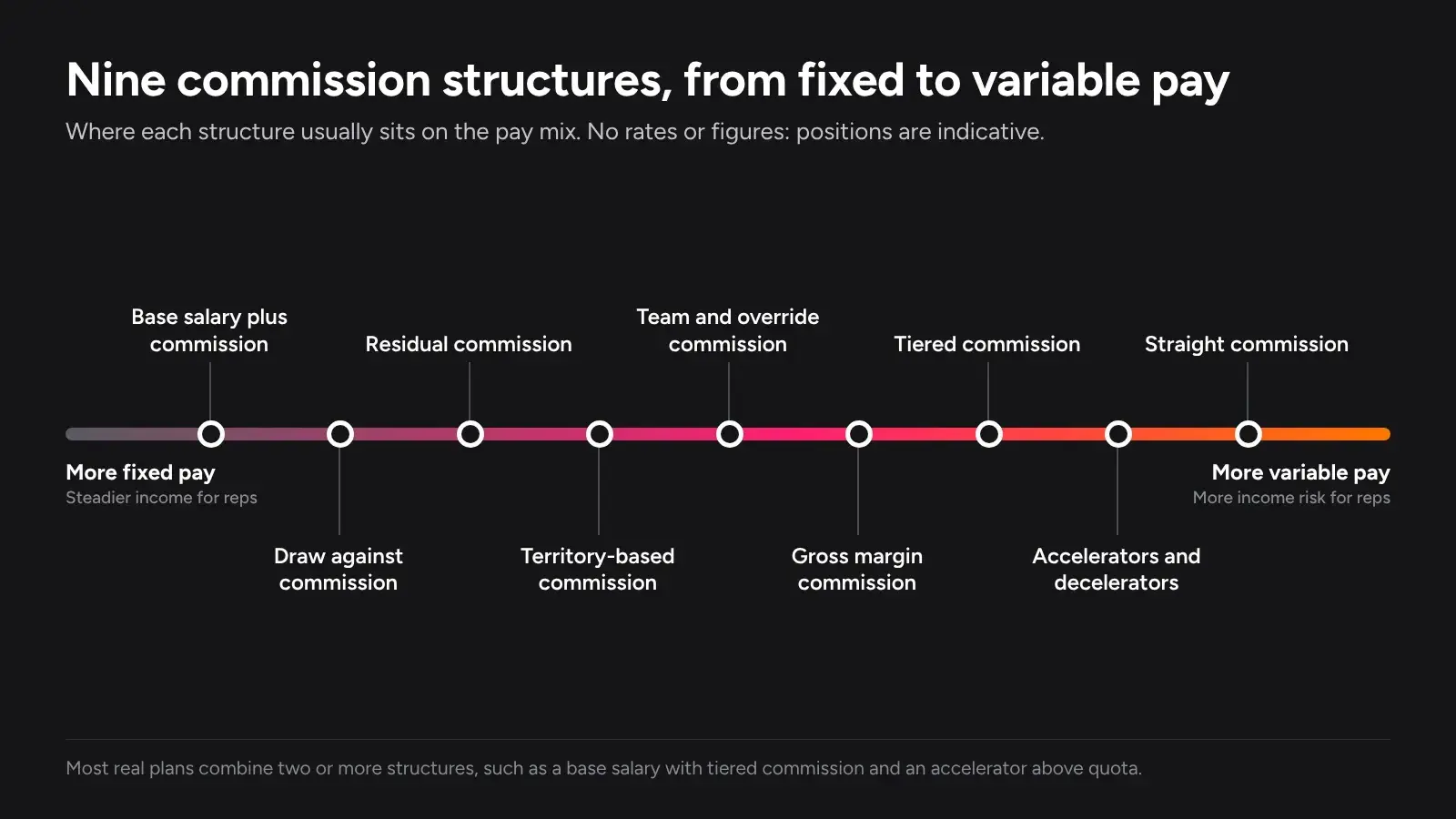
The table below compares the nine types of sales commission covered in this guide. The next section explains each one in detail, with a worked example.
Structure | How it pays | Best for | Main risk |
|---|---|---|---|
Straight commission | A percentage of every sale, no base | Short cycles, high-volume selling | Unstable income for reps |
Base salary plus commission | Fixed salary plus a percentage of sales | Most B2B sales teams | Too little upside if the variable share is small |
Tiered commission | Higher rates as sales cross set levels | Rewarding stretch performance | Tier cliffs and deal timing games |
Accelerators and decelerators | Higher rate above quota, lower rate below a threshold | Motivating top performers, protecting cost | Complexity and windfall payouts |
Gross margin commission | A percentage of margin, not revenue | Businesses where discounting hurts profit | Margin data that reps cannot see |
Residual commission | A share of recurring revenue for as long as the customer stays | Subscription and renewal-based sales | Pay for past work rather than new deals |
Draw against commission | An advance paid against future commission | New hires and long sales cycles | Debt build-up on recoverable draws |
Territory-based commission | Commission on all revenue from a defined territory | Regional teams and account ownership | Unequal territories |
Team and override commission | Shared team pools, or a manager's share of team sales | Collaborative selling and sales managers | Free riders and diluted accountability |
Caption: Nine common sales commission structures. Most real plans combine two or more of them.
9 sales commission structures explained
Each structure below follows the same pattern: what it is, how the payout works, a worked example, when it suits a team, and its main drawback. All figures are illustrative. They show how the maths works and are not benchmarks, typical rates, or industry averages.
Straight commission
What it is. Reps earn only commission, with no base salary. Every rupee of pay comes from sales.
How the payout works. The rep earns a fixed percentage of each sale, usually calculated on revenue and paid monthly or when the customer pays. Paying on booking gets money to the rep sooner. Paying only when the customer pays protects the company against cancelled or unpaid deals, but delays the rep's income.
Worked example. Illustrative figures. A rep on an 8% straight commission plan closes ₹15,00,000 of sales in a strong month and earns ₹15,00,000 × 8% = ₹1,20,000. In a weaker month, they close ₹3,00,000 and earn ₹24,000. The same rep, on the same plan, takes home five times more in one month than the other.
When it suits a team. Straight commission fits short sales cycles, high transaction volumes, and roles where effort quickly turns into closed deals. Because pay depends entirely on results, it attracts self-directed sellers who are comfortable with risk. It is also used for independent agents and channel partners, where the company pays only for results. And it suits companies that want sales cost to rise and fall directly with revenue.
Main drawback. Income is unpredictable, which makes it hard to attract and keep reps who need a stable salary. With no fixed pay to fall back on, it can also push reps towards quick wins, heavy discounting, or overselling. Reps also have little reason to spend time on work that does not close a deal this month, such as onboarding customers or sharing knowledge with colleagues. Rules on minimum wages and employment status vary by country, so check local requirements before using it for employees.
Base salary plus commission
What it is. A widely used way to structure B2B sales pay. Reps receive a fixed salary plus commission on what they sell. The split between the two is called the pay mix.
How the payout works. The base is paid on the normal payroll cycle. Commission is calculated on sales, usually as a percentage, and paid monthly or quarterly. A target incentive defines what a rep earns at 100% of quota. A 70/30 pay mix, for example, means 70% of target earnings is base and 30% is variable at 100% of quota. Illustrative figures: target earnings of ₹12,00,000 a year at a 70/30 mix give a base of ₹8,40,000 and a target incentive of ₹3,60,000.
Worked example. Illustrative figures. A rep earns a base salary of ₹60,000 a month plus 4% commission on sales.
- In a month with ₹12,00,000 of sales, commission is ₹12,00,000 × 4% = ₹48,000, and total pay is ₹60,000 + ₹48,000 = ₹1,08,000.
- In a month with ₹4,00,000 of sales, commission is ₹16,000 and total pay is ₹76,000.
The base protects the rep in slow months, and the commission still rewards strong ones.
When it suits a team. Base salary plus commission suits most B2B teams. It fits especially well where cycles are longer, deals involve several stakeholders, or reps also carry account management work. A higher base share suits complex or consultative selling. A higher variable share suits more transactional roles. This structure is also easier to recruit with, because candidates can compare the base with other offers.
Main drawback. If the variable share is too small, commission stops driving behaviour and the plan becomes a salary with a bonus attached. If the base is too low, the structure carries most of the risks of straight commission. The pay mix needs to match the role, and it should be reviewed as the role changes.
Tiered commission structure
What it is. A tiered commission structure pays different rates on different bands of sales. Rates usually rise as performance increases, so reps earn more per rupee as they sell more.
How the payout works. Most tiered plans are marginal: each band earns its own rate, like income tax slabs. Some are retroactive: once a rep crosses a threshold, the higher rate applies to all sales in the period. The plan document must say which method applies.
Worked example. Illustrative figures. A quarterly plan pays 4% on sales up to ₹10,00,000, 6% from ₹10,00,000 to ₹20,00,000, and 8% above ₹20,00,000. A rep closes ₹25,00,000.
Band | Sales in band | Rate | Commission |
|---|---|---|---|
₹0 to ₹10,00,000 | ₹10,00,000 | 4% | ₹40,000 |
₹10,00,000 to ₹20,00,000 | ₹10,00,000 | 6% | ₹60,000 |
Above ₹20,00,000 | ₹5,00,000 | 8% | ₹40,000 |
Total | ₹25,00,000 | ₹1,40,000 |
Caption: Illustrative marginal tier calculation for a rep at ₹25,00,000 of sales.
The effective rate is 5.6%. Under a retroactive version of the same plan, all ₹25,00,000 would earn 8%, or ₹2,00,000.
When it suits a team. Tiers suit teams that want to reward stretch performance without paying high rates on every sale. They work well when quotas are realistic and reps can see where they stand against each threshold. Keep the number of tiers small. Set the first threshold at a level most reps can reach, so the plan feels attainable rather than out of reach.
Main drawback. Retroactive tiers create sharp jumps at each threshold, which encourage reps to pull deals into a period or hold them back. Too many tiers also make payouts hard to predict and hard to check. Tier levels also need resetting when quotas change, or they quickly become too easy or too hard.
Accelerators and decelerators
What it is. An accelerator is a higher rate that applies above quota. A decelerator is a lower rate. It usually applies below a minimum performance threshold, and sometimes far above quota to limit windfall payouts.
How the payout works. The plan sets a base rate for performance between the threshold and quota, a lower rate below the threshold, and a higher rate above quota. Each rate usually applies only to the sales within its band. Accelerators are sometimes written as multipliers, such as 1.75 times the base rate, which gives the same 7% in the example below. Some plans also cap total payout at a set multiple of the target incentive.
Worked example. Illustrative figures. A rep has a quarterly quota of ₹50,00,000. The plan pays 2% on sales up to 50% of quota, 4% from 50% to 100%, and 7% above quota.
- A rep at 120% of quota, or ₹60,00,000, earns (₹25,00,000 × 2%) + (₹25,00,000 × 4%) + (₹10,00,000 × 7%) = ₹50,000 + ₹1,00,000 + ₹70,000 = ₹2,20,000.
- A rep at 40% of quota, or ₹20,00,000, earns ₹20,00,000 × 2% = ₹40,000.
When it suits a team. Accelerators suit teams where over-performance is valuable and achievable, and where the company wants to keep top performers. They send a clear signal that the company wants reps to keep selling after they hit quota, rather than slowing down or saving deals for the next period. Decelerators suit plans where paying the full rate for weak performance would be expensive or would reward under-delivery.
Main drawback. Uncapped accelerators can produce very large payouts on windfall deals the rep did little to win. Decelerators can feel punitive if quotas are set too high. Both add rules that reps and finance must understand, so test them against realistic scenarios before launch. Make sure every rep knows exactly where each rate changes before the period starts.
Gross margin commission
What it is. Commission is calculated on gross margin, meaning revenue minus the direct cost of the sale, rather than on revenue.
How the payout works. The rep earns a percentage of the margin on each deal. Because discounts reduce margin directly, the rep shares the cost of every discount they give. Margin can be measured deal by deal, or across all of a rep's deals in the period, so a low-margin deal can be offset by a high-margin one.
Worked example. Illustrative figures. A plan pays 15% of gross margin. A deal sold at ₹20,00,000 with ₹12,00,000 of direct costs has ₹8,00,000 of margin, so the rep earns ₹1,20,000. If the rep gives a ₹3,00,000 discount, revenue falls to ₹17,00,000 and margin falls to ₹5,00,000. Commission drops to ₹75,000. The discount cost the company ₹3,00,000 and cost the rep ₹45,000.
When it suits a team. Gross margin commission suits businesses where pricing varies by deal, discounting is common, or product costs differ widely. It gives reps a direct reason to defend price instead of reaching for a discount to close. Examples include distribution, manufacturing, and services with variable delivery costs. It also helps when the same product can be sold with different bundles, services, or delivery terms that change its cost.
Main drawback. Reps need reliable, timely margin data to trust their pay, and some companies do not share cost information with sales. Margin can also change after the sale, through returns or cost overruns, which complicates the calculation and the timing of payouts. One practical approach is to give reps a margin band or a discount matrix. They can then see how a discount affects their commission without seeing full cost data.
Residual (recurring) commission
What it is. Reps earn a share of recurring revenue for as long as the customer keeps paying, or for a set period. It is common in subscription, insurance, and other renewal-based businesses.
How the payout works. The rep earns a percentage of each recurring payment the customer makes. Some plans pay an upfront commission at signing plus a smaller residual afterwards. Residuals usually stop when the customer cancels or stops paying, so the rep's income tracks the health of the account. The residual rate is normally lower than the upfront rate, because the rep is paid repeatedly for the same customer.
Worked example. Illustrative figures. A plan pays 5% of monthly recurring revenue for 24 months. A customer signs a subscription worth ₹2,00,000 a month, so the rep earns ₹10,000 a month while the customer stays, up to ₹2,40,000 over two years. A rep who has signed 20 similar customers earns ₹2,00,000 a month in residuals, before any new business.
When it suits a team. Residual commission suits roles where the same rep both sells and keeps the account healthy, and where retention drives lifetime value. It rewards reps for selling customers who stay. It also fits businesses that want reps to stay involved after the sale, helping customers adopt the product and renew.
Main drawback. Over time, residuals can make up most of a rep's pay, which reduces the incentive to win new business. They also create a long-running liability, so the plan must say what happens when a rep leaves, changes territory, or hands over accounts. Some companies limit residuals to a fixed term, as in the example, or reduce the rate after the first year to keep attention on new revenue.
Draw against commission
What it is. A draw is an advance paid to the rep against future commission. It gives reps predictable income while their commission builds up. There are two types: recoverable and non-recoverable.
How the payout works. Under a recoverable draw, any shortfall between the draw and commission earned is carried forward and deducted from future commission. Under a non-recoverable draw, the company absorbs the shortfall, so the draw works as a guaranteed minimum.
Worked example. Illustrative figures. A rep has a draw of ₹40,000 a month.
- Month 1: commission earned is ₹15,000. The rep is paid ₹40,000. Under a recoverable draw, ₹25,000 is carried forward.
- Month 2: commission earned is ₹55,000. After deducting the ₹25,000 balance, ₹30,000 remains, which is below the draw. The rep is paid ₹40,000 and ₹10,000 is carried forward.
- Month 3: commission earned is ₹80,000. After deducting ₹10,000, the rep is paid ₹70,000 and the balance is cleared.
Under a non-recoverable draw, the rep would be paid ₹40,000, ₹55,000, and ₹80,000, and the month 1 shortfall would never be recovered. The difference between the two types is who carries the risk of a slow start: the rep or the company.
When it suits a team. Draws suit new hires building a pipeline, long sales cycles, and seasonal businesses with uneven months. They are often time-limited, for example to a new hire's first few months, and removed once the rep's pipeline is established.
Main drawback. A recoverable draw can leave a struggling rep owing a growing balance, which hurts morale and can lead to attrition. Whether and how a balance can be recovered depends on the employment contract and local law, so check with HR and legal before using one. A non-recoverable draw costs the company money whenever commission falls short. It also needs an end date, or it can turn into a permanent salary top-up that weakens the link between pay and performance.
Territory-based commission
What it is. Reps earn commission on all revenue from a defined territory, such as a region, a set of named accounts, or an industry segment, regardless of who sourced the deal.
How the payout works. Revenue is credited to the territory owner, often including inbound and repeat business. Rates or quotas may differ between territories to reflect their potential. Some plans pay a blended rate: a higher rate on new customers in the territory and a lower rate on repeat business.
Worked example. Illustrative figures.
- A rep owns the western region, with a quarterly quota of ₹1,20,00,000 and a 2% commission rate. The region brings in ₹1,50,00,000 in the quarter, including ₹30,00,000 of repeat orders from existing customers. The rep earns ₹1,50,00,000 × 2% = ₹3,00,000.
- A colleague with a smaller, newer territory has a quota of ₹60,00,000 and a 3% rate. They bring in ₹70,00,000 and earn ₹2,10,000.
The higher rate partly offsets the smaller territory, which is one way to keep earning potential fair across regions.
When it suits a team. Territory-based commission suits regional sales teams, field sales, and account-management roles where one person owns the customer relationship. It reduces disputes over who sourced a deal, because ownership is defined in advance. It also helps where marketing or channel partners generate much of the demand, since the territory owner still has a reason to support every deal.
Main drawback. Territories are rarely equal. A rep in a mature, high-demand region can earn well without much new effort, while a rep in a new territory works harder for less. Territory design, quotas, and rates need regular review. Changes during the year need clear rules for crediting deals already in progress. Overlapping coverage, such as a named account that also sits inside a region, needs a clear rule for who gets the credit.
Team and override commission
What it is. Team commission rewards a group for shared results, usually through a pool split among its members. Override commission pays a manager a share of their team's sales, on top of or instead of individual commission.
How the payout works. A team pool is funded by a percentage of team revenue, often only above a team quota, and divided equally or by a set formula. An override pays the manager a small percentage of the team's total sales. Pool splits can be equal, weighted by role, or weighted by each member's individual attainment.
Worked example. Illustrative figures. A team of five reps has a quarterly team quota of ₹2,00,00,000 and achieves ₹2,30,00,000. The plan funds a pool with 5% of revenue above quota: ₹30,00,000 × 5% = ₹1,50,000, split equally at ₹30,000 per rep, on top of their individual commission. The team's manager earns a 1% override on total team sales: ₹2,30,00,000 × 1% = ₹2,30,000.

When it suits a team. Team commission suits collaborative selling, such as pods where account executives, solution specialists, and customer success work the same deals. Overrides suit sales managers whose job is to grow the whole team's results. Team pools also help with new products, where no single rep can yet be expected to own the whole sales motion.
Main drawback. Shared pools can reward low contributors along with high ones, which frustrates top performers. Members may also disagree about who did the work on a deal, especially when the split is equal. Overrides can push managers to focus on their strongest reps, or to sell themselves rather than coach. Keep a meaningful individual component, and define clearly how team credit is shared. Overrides also need limits on layering, so the same deal is not paid out several times through a chain of managers.
How to choose a commission structure
Most teams do not choose one structure. They combine two or three, such as a base salary with tiered commission and an accelerator above quota, or territory commission with a team pool. These steps help you find the right combination.
- Start from the behaviour you want. Write down what the plan should drive: new logos, expansion, retention, margin, or collaboration. Choose the structures that reward that behaviour, and avoid ones that reward something else.
- Match the structure to the sale. Long cycles and complex deals point towards more base pay or a draw. Margin-sensitive businesses point towards margin commission or discount controls. Recurring revenue points towards residuals or renewal credit.
- Keep the number of rules small. Each added tier, threshold, or exception makes the plan harder to explain and to calculate. If a rule does not clearly change behaviour, leave it out.
- Model it on last year's deals. Run the proposed structure against real historical data before launch. Check total cost, the payout range across reps, and whether any single deal produces an outsized payout. Compare how top, middle, and bottom performers would be paid under each option.
- Test whether reps can explain their own pay. Give a few reps a sample month and ask them to work out their payout. If they cannot, simplify the plan or improve how it is communicated.
- Plan for change during the year. Decide in advance how quota changes, territory moves, new joiners, and leavers will be handled, so changes do not trigger disputes.
The more structures you combine, the harder they are to run consistently in spreadsheets across roles, regions, and periods. Teams with several plans often move the calculation into a dedicated system, such as Tallect's Sales Incentive module, so the structure they designed is the structure that gets paid.

Frequently asked questions
What is a sales commission structure?
A sales commission structure is the set of rules that turns sales results into pay. It defines what is measured, such as revenue, margin, units or recurring revenue. It also sets what rate applies, when commission is paid, and whether any limits apply, such as thresholds, caps or recovery terms.
What is the difference between a commission structure and a commission plan?
The structure is the mechanism, such as a tiered rate, a draw or an accelerator. The plan applies that mechanism to a specific role, quota and period. One company can run several plans built on the same structure, and most plans combine two or more structures.
Which commission structure is most common for B2B sales teams?
Base salary plus commission is the most widely used structure for B2B teams. It gives reps predictable income through the base, while commission still rewards strong months. It suits longer sales cycles, deals with several stakeholders, and roles that include account management work.
What is a good pay mix for sales reps?
There is no single right pay mix. It depends on the role. Complex or consultative selling usually suits a higher base share, while transactional roles can support a higher variable share. A 70/30 mix means 70% of target earnings is base and 30% is variable at 100% of quota. Review the mix whenever the role changes.
What is the difference between marginal and retroactive tiers?
With marginal tiers, each band of sales earns its own rate, like income tax slabs. With retroactive tiers, once a rep crosses a threshold, the higher rate applies to all sales in the period. The same sales can produce very different payouts under each method, so the plan document must say which one applies.
Should accelerators be capped?
Many companies cap them, or add a decelerator far above quota. Uncapped accelerators can produce very large payouts on windfall deals the rep did little to win. Whatever you decide, test the plan against realistic scenarios, including your largest expected deals, before the period starts.
When should a company pay commission on gross margin instead of revenue?
Margin-based commission makes sense when pricing varies by deal, discounting is common, or product costs differ widely. Because discounts reduce margin directly, reps share the cost of every discount they give. The trade-off is that reps need reliable margin data. A margin band or discount matrix can show them the effect of a discount without exposing full cost data.
What is the difference between a recoverable and a non-recoverable draw?
Both are advances paid against future commission. Under a recoverable draw, any shortfall is carried forward and deducted from later commission. Under a non-recoverable draw, the company absorbs the shortfall, so the draw works as a guaranteed minimum. Whether a balance can be recovered depends on the employment contract and local law, so check with HR and legal first.
Can a commission plan combine more than one structure?
Yes, and most do. A common combination is a base salary with tiered commission and an accelerator above quota. Another is territory commission with a team pool. Each added structure makes the plan harder to explain and calculate, so keep only the rules that clearly change behaviour.
How do you test a commission structure before launching it?
Run the proposed structure against last year's real deals. Check the total cost, the payout range across reps, and whether any single deal produces an outsized payout. Then give a few reps a sample month and ask them to work out their own payout. If they cannot, simplify the plan or explain it better before launch.