
Accelerated Vesting of ESOPs: What to Do When a Key Employee Asks for It
Single or double trigger, who must approve, what it costs and India’s one-year rule: how to handle a request to accelerate ESOP vesting.
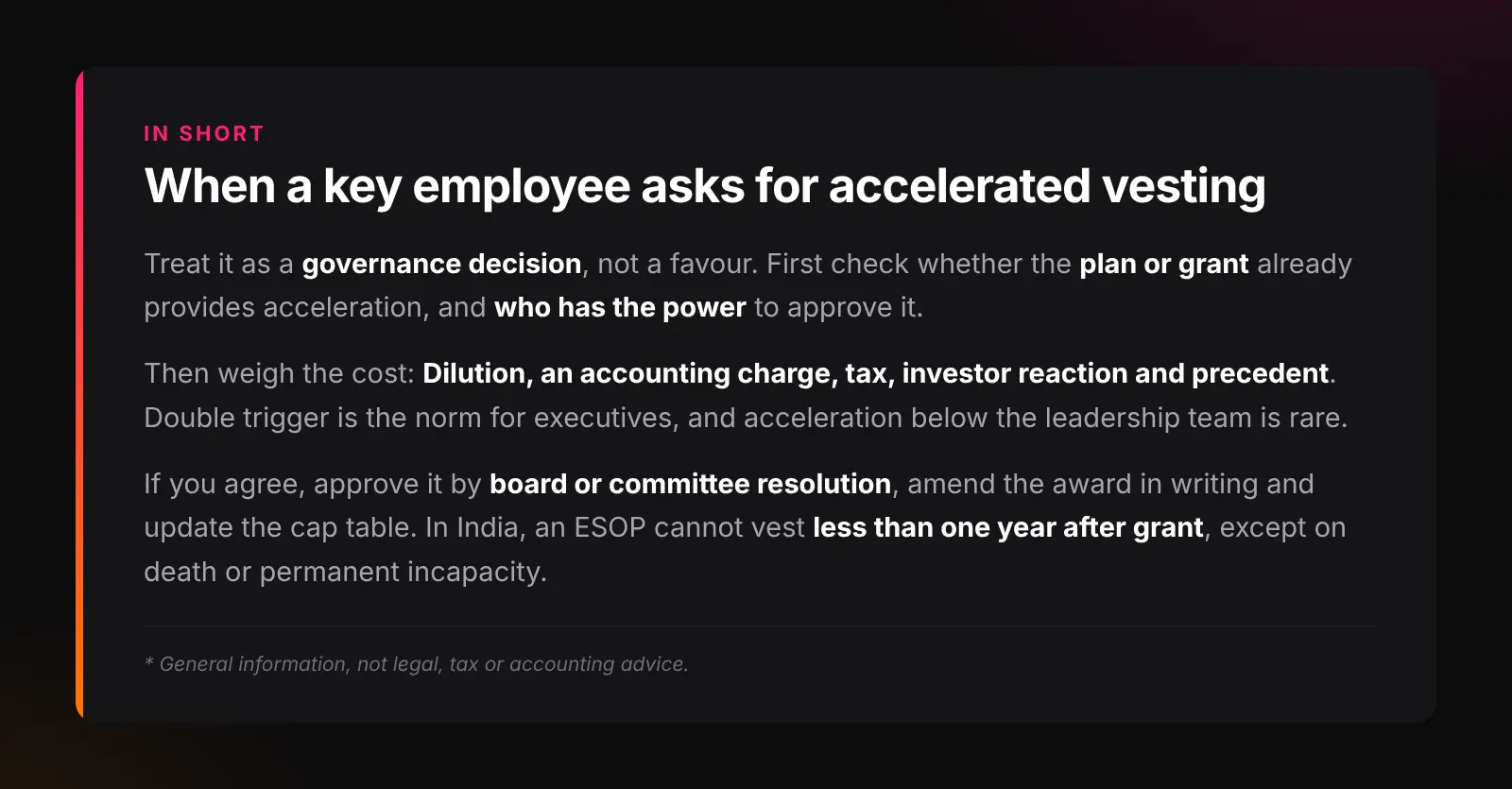
Treat it as a governance decision, not a favour:
- Check the documents. See whether the plan or the grant agreement already provides acceleration, and who has the power to grant it.
- Weigh the cost. Consider dilution, an accounting charge, tax, how investors will react and the precedent it sets.
- Decide formally. If you agree, approve it by board or committee resolution, amend the award in writing and update the cap table.
What is accelerated vesting?
Accelerated vesting lets some or all of an employee’s unvested ESOPs, or other equity awards such as RSUs, vest earlier than their schedule. It is usually written into an executive’s grant as a protection if the company is sold.
Type | When it vests early | Typical use |
|---|---|---|
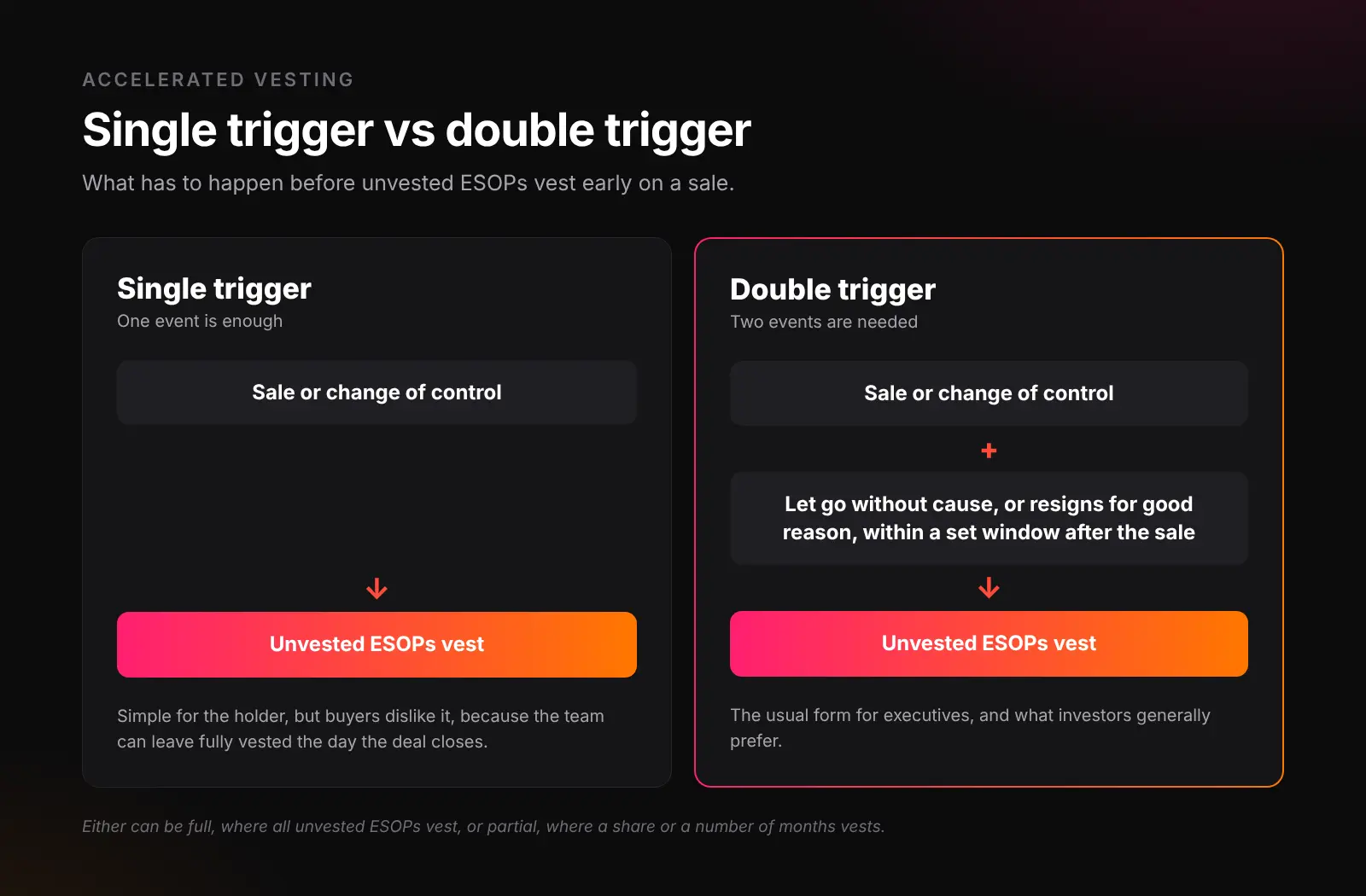
Single trigger | On one event, usually a sale or change of control | Some founders and senior leaders |
Double trigger | On a sale plus the employee being let go without cause, or resigning for good reason, within a set period after it | The usual form for executives |
Full | All unvested ESOPs vest | Founders and top executives |
Partial | A fixed share or a number of months vests | A common compromise |
On termination without cause | Some months of extra vesting if let go, with no sale | CEOs and senior leaders |
On death or permanent incapacity | All granted ESOPs vest | Required by law in India |
Performance-based | Specific milestones |
Caption: Types of accelerated vesting, when each applies and who usually gets it.
The two main forms differ in how many events must happen:
- Single-trigger acceleration vests ESOPs on one event, usually a change of control.
- Double-trigger acceleration needs two: the change of control, and the employee’s termination without cause or resignation for good reason within a set window after the deal.
Investors and buyers generally prefer double trigger.
How common is acceleration, and for whom?
It is mostly an executive benefit. Radford (Aon) data presented by Cooley in 2019 shows how often companies gave acceleration on a change of control:
Role and sector | Single trigger | Double trigger |
|---|---|---|
Vice presidents, technology | 18% | 24% |
Individual contributors, technology | 8% | 6% |
Vice presidents, life sciences | 22% | 50% |
Caption: Share of companies giving acceleration on a change of control. Radford (Aon) data presented by Cooley, 2019.
Outside a sale, 40% of tech companies and 48% of life sciences companies gave their CEO some acceleration. The sample size was not published, so treat these figures as indicative.
Index Ventures, which surveys startup equity practice, adds two points:
- In the US: “Acceleration without a double trigger, and acceleration for non-executive staff, are both rare in the US.”
- In Europe: “One third of European startups offer full accelerated vesting to all employees, which would be unheard of in the US.”
So if a key employee below the leadership team asks for acceleration, they are asking for something few companies give at that level.
Does the plan or grant already allow it?
This is the first question, because the answer changes everything that follows.
- Contractual acceleration is already written into the plan or the grant agreement. The company simply applies it when the trigger happens. Under US GAAP, acceleration that follows the original terms is not treated as a change to the award (PwC Viewpoint).
- Discretionary acceleration is anything the documents do not already give. A key employee asking for it is asking you to change the deal. You need the power to do so, a formal decision and a record.
Read three things before you answer:
- the plan’s discretion and amendment clauses
- the employee’s grant agreement
- any employment or severance agreement
Who has to approve accelerated ESOP vesting?
Usually the board or the committee that administers the plan, such as a compensation committee or a nomination and remuneration committee. Some plans also need shareholder approval for changes, and listed companies may have to disclose the decision.
- Approve it by written resolution, not by email.
- Record the business reason, such as retention through a sale, a smooth handover or a settlement.
- Have directors with a personal interest step out of the decision.
- Check that the decision is consistent with how earlier, similar requests were handled.
Boards are judged on their process. In the lululemon case (Shabbouei v. Potdevin), a lawsuit over a departing CEO’s USD 5 million separation was dismissed. Commentators pointed to the board’s careful process (Reed Smith):
- several meetings over about three months
- outside counsel
- checking the facts
Can ESOP vesting be accelerated in India?
Only within a one-year floor. In India, an ESOP cannot vest less than one year after it is granted:
- Unlisted companies: under Rule 12(6)(a) of the Companies (Share Capital and Debentures) Rules, 2014.
- Listed companies: under Regulation 18 of the SEBI (Share Based Employee Benefits and Sweat Equity) Regulations, 2021.
The only exceptions are death and permanent incapacity, when all granted options vest immediately.
Three more Indian rules shape the decision:
- Leavers lose unvested options by default. Under Rule 12(8)(f), options not vested on resignation or termination expire that day. A departing employee’s request is therefore a request to override the scheme. The board must first confirm the scheme gives it that power.
- Changing the scheme needs a special resolution. Rule 12(5)(a) allows the terms of unexercised options to be varied by special resolution, provided the change is not prejudicial to option holders.
- Listed companies need shareholder approval for changes that depart from the approved scheme, according to SEBI’s FAQs, as summarised by ESOP Direct.
The tax point is simpler. In India, ESOPs are taxed when exercised, not when they vest. Acceleration brings forward when the employee can exercise and pay that tax, but does not create a tax charge by itself.
What does accelerating ESOP vesting cost the company?
Dilution
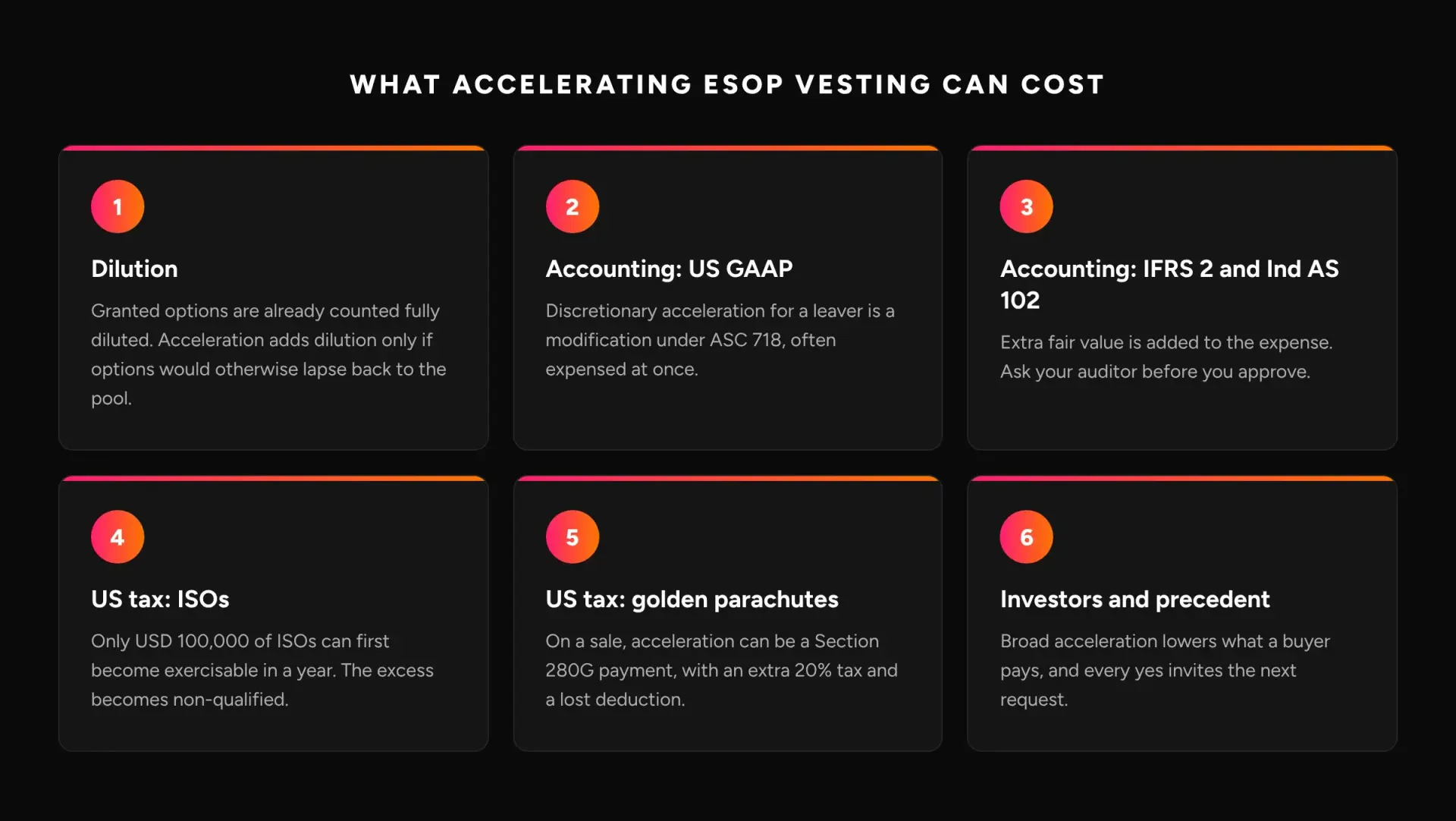
Granted options are already in the fully diluted share count, so acceleration changes when shares can be issued more than how many. It does add dilution if the options would otherwise have lapsed and gone back to the pool for someone else. See how acceleration changes the fully diluted count.
Accounting charge
- US GAAP (ASC 718): Discretionary acceleration for a departing employee whose awards would otherwise lapse is a modification. The company records the fair value of the modified awards on the date of the change, immediately if no further service is required (PwC Viewpoint).
- IFRS 2: A change that benefits the employee adds its extra fair value to the expense. Cancelling an award during vesting is treated as accelerating it, so the remaining expense is booked at once (Grant Thornton).
- India: Ind AS 102 follows IFRS 2 on modifications. Ask your auditor how the change will be booked before you approve it.
PwC also gives a useful compromise. Make acceleration conditional on a short transition period, such as three months, so the cost is spread over that service instead of booked on day one.
US tax traps
- Incentive stock options: Only USD 100,000 of ISOs, by exercise-price value, can first become exercisable in a calendar year. Acceleration can push more into one year, and the excess becomes ordinary non-qualified options (Cooley GO). Extending the exercise window works differently from accelerating vesting, and it can turn an ISO into a non-qualified option.
- Golden parachutes: On a sale, accelerated vesting can count as a parachute payment under Section 280G. This applies if an executive’s parachute payments reach three times their base amount (Treasury regulations). Two things then follow:
- The excess over one times the base amount is taxed at an extra 20% under Section 4999.
- The company loses the deduction.
Investor and buyer reaction
Investors dislike broad acceleration because it reduces what a buyer will pay for the team. Index Ventures warns that it can “reduce the sale proceeds for each common stock shareholder”. It adds that a broader policy “could seriously impede your chances of a successful exit”. Its advice:
“We recommend at most, double-trigger partial acceleration limited to the executive team only.”
Precedent
The hardest cost to measure is fairness. Once one person gets acceleration, others will ask. Keep a log of every request, the decision and the reason.
What are the alternatives to accelerating ESOP vesting?
Often the real goal is to keep someone, or to part on good terms. Other tools may do that better.
Alternative | When it fits | Watch out for |
|---|---|---|
The employee is staying and you want to keep them longer | In India, each new grant restarts the one-year minimum | |
Partial acceleration | A fair middle ground for a departing leader | Still a modification with an accounting charge |
Acceleration tied to a handover | You need the person for a transition | Define the service and the date clearly |
Continued vesting after leaving | A retiring or advisory leader | Must be allowed by the plan; SEBI’s FAQs allow it on retirement if company policy permits |
Longer exercise window | The worry is the cost of exercising, not vesting | US ISOs can turn into non-qualified options |
You want certainty without dilution | A cash cost, taxed as salary |
Caption: Alternatives to accelerating ESOP vesting, and when each fits.
How do you document the decision and update the cap table?
- Read the plan’s discretion and amendment clauses and the grant agreement.
- Confirm who must approve, and whether shareholders must too.
- Model the dilution, the accounting charge and any tax cost.
- Decide any conditions, such as a handover period, a release of claims or a non-solicit.
- Approve it by resolution and minute the business reason.
- Amend the award in writing and have the employee sign it.
- Update the cap table, the vesting schedule and, in India, the SH-6 register of options.
- Tell payroll, the auditors and, where required, shareholders or the stock exchange.
- Add the decision to your precedent log.
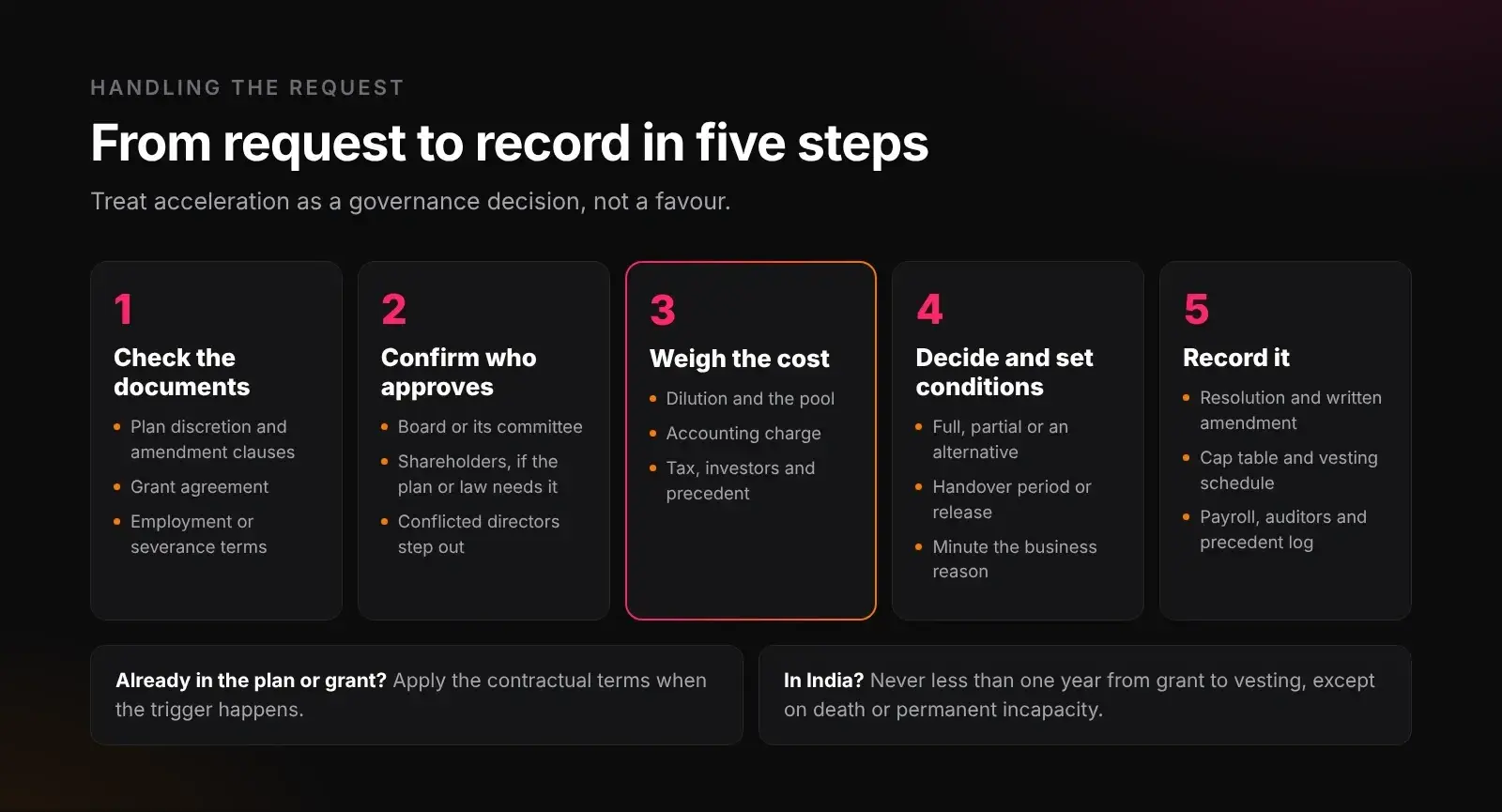
A good ESOP platform makes steps 3, 7 and 8 routine. The approval and the reasoning still belong to the board. For who should own this work, see who administers and documents ESOP decisions.
Frequently asked questions
1. Can the board accelerate ESOP vesting for one employee?
Usually yes, if the plan gives the board or its committee that power. If it does not, the plan or the award may need to be amended, and in some cases shareholders must approve.
2. Is accelerated ESOP vesting taxable?
Not by itself in most cases. Options are generally taxed when exercised, not when they vest. In the US, there are two exceptions:
- acceleration on a sale can create golden parachute tax
- acceleration of ISOs can turn some of them into non-qualified options
3. Does accelerated ESOP vesting need shareholder approval?
It depends on the plan and the country. In India:
- varying an unlisted scheme needs a special resolution
- listed companies need shareholder approval for changes that depart from the approved scheme
4. What happens to unvested ESOPs when an employee leaves?
They usually lapse on the leaving date. In India, Rule 12 makes this the default for unlisted companies, except on death or permanent incapacity, when all granted options vest.
5. What is an example of accelerated vesting?
An executive’s ESOPs vest over four years, with a double trigger. Two years in, the company is sold and the buyer lets the executive go within 12 months. The remaining unvested ESOPs vest immediately.
6. How common is accelerated vesting?
Common for founders and executives, rare for other employees, especially in the US. Double trigger is far more common than single trigger.
7. Should I negotiate acceleration in my offer?
Senior hires often negotiate double-trigger acceleration. For other roles, a larger grant or a longer exercise window may be easier to get.
8. Can ESOP vesting be accelerated in India?
Yes, within two limits:
- vesting can never be less than one year after the grant, except on death or permanent incapacity
- the scheme must allow it or be validly changed
This article is general information, not legal, tax or accounting advice. Acceleration terms depend on your plan, your agreements and local law. Speak to your lawyer, company secretary and auditor before you approve any change.
Model and record vesting changes
Tallect lets you see the dilution before you decide, then update the vesting schedule, the grant and the cap table in one place.