
Fully Diluted vs Outstanding Shares: Why Your 1% Is Not What It Seems
Outstanding shares are held today. Fully diluted adds everything that could become a share, and that changes every percentage.
Outstanding shares are the shares a company has issued and shareholders hold today. Fully diluted shares add every share that could be issued later:
- granted options and RSUs
- warrants
- usually the unallocated option pool
- convertible notes, SAFEs and convertible preference shares (CCPS in India), counted as if converted
The fully diluted count is always equal to or higher than outstanding.
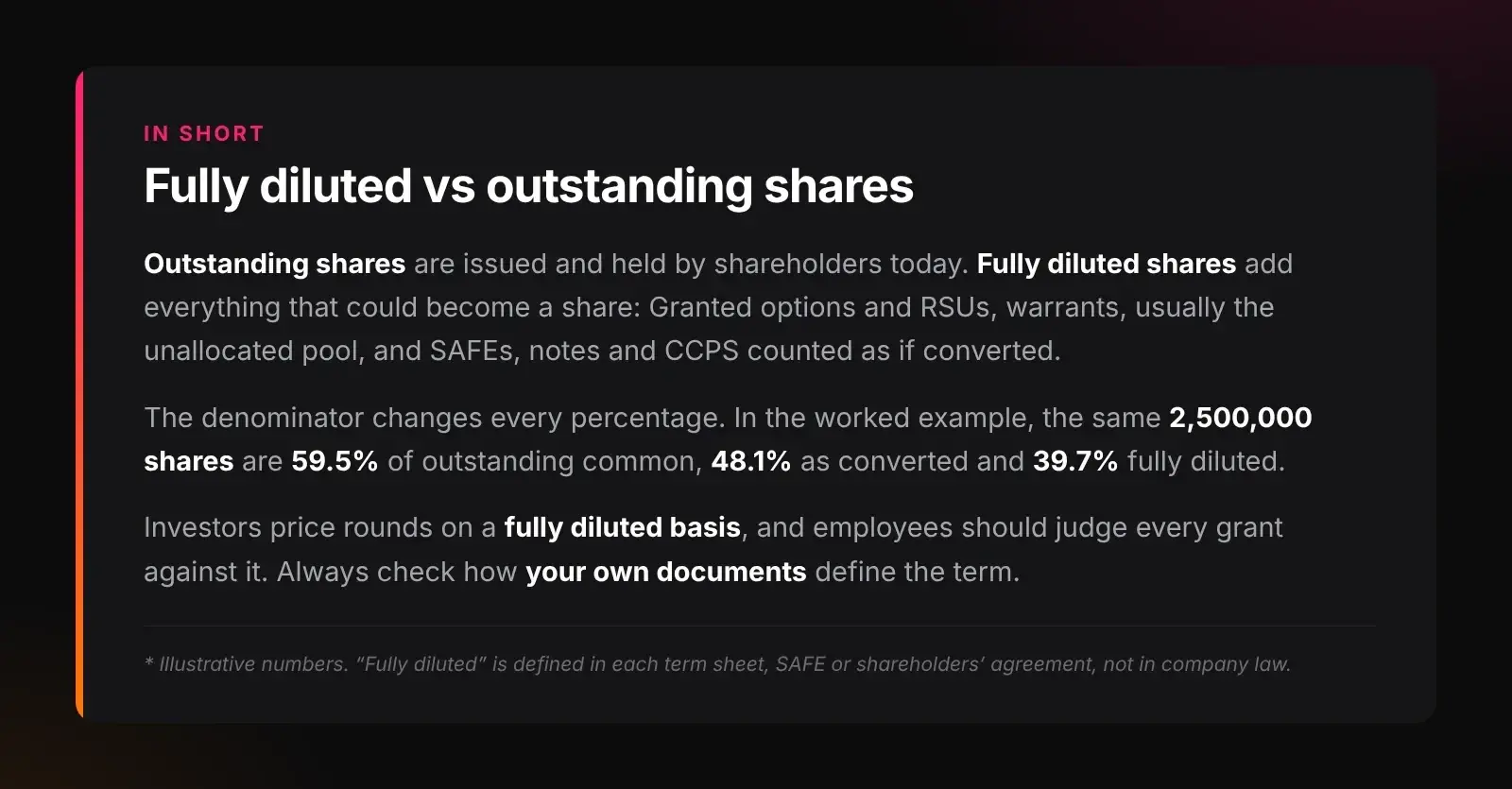
Why it matters: The same holding can be a very different percentage depending on which count you divide by. Investors price rounds on the fully diluted count, and an employee’s grant only makes sense against it.
What are authorised, issued, outstanding and treasury shares?
Share counts form a ladder, from the most a company may issue down to what shareholders hold today.
- Authorised shares are the maximum a company is legally allowed to issue under its charter. In India, Section 2(8) of the Companies Act, 2013 defines authorised capital as the maximum amount of share capital set out in the memorandum (Companies Act, Section 2(8)).
- Issued shares are those the company has actually issued.
- Outstanding shares are issued shares held by shareholders today (Carta).
- Treasury shares are shares a US company has bought back and holds. They are issued but not outstanding. Indian companies generally cancel bought-back shares rather than holding them.
- Fully diluted shares are outstanding shares plus everything that could become a share.
In plain terms, authorised is at least issued, and issued is at least outstanding. The fully diluted count can be higher than issued, but once everything converts it must still fit within authorised. That is why companies often raise their authorised capital before a round or an option pool top-up.
Term | US usage | India usage (Companies Act, 2013) |
|---|---|---|
Ceiling | Authorized shares, in the certificate of incorporation | Authorised capital, in the memorandum |
Issued | Issued shares | Issued capital |
Taken up and paid | Outstanding shares | Subscribed and paid-up capital |
Bought back | Treasury stock, or retired | Bought-back shares, cancelled |
Caption: How US and Indian company law name each rung of the share ladder.
What is included in a fully diluted share count?
“Fully diluted” is not defined in company law. It is defined in each term sheet, SAFE or shareholders’ agreement, so always read the definition in your own documents. The common components are these.
Component | In outstanding? | In fully diluted? |
|---|---|---|
Common or equity shares | Yes | Yes |
Preferred stock or CCPS | Yes, as its own class | Yes, as if converted to common |
Granted options, vested and unvested | No | Yes |
Unallocated option pool | No | Usually yes, in a financing |
RSUs and restricted stock not yet issued | No | Yes |
Warrants | No | Yes |
SAFEs and convertible notes | No | Yes, as if converted |
Cash-settled phantom stock and SARs | No | No, they issue no shares |
Caption: What usually counts in outstanding and fully diluted shares. Your own agreements may define it differently.
The Y Combinator post-money SAFE is a good model. It defines “Company Capitalization” on an as-converted basis and “without double-counting”. The definition includes:
- all issued shares
- other SAFEs and convertible notes
- all granted and promised options
- the unissued option pool
How do you calculate fully diluted shares? A worked example
Take a company with 10,000,000 authorised shares. Its cap table looks like this.
Holder or instrument | Shares | In outstanding? | In fully diluted? |
|---|---|---|---|
Founder A | 2,500,000 | Yes | Yes |
Founder B | 1,500,000 | Yes | Yes |
Employees, options already exercised | 200,000 | Yes | Yes |
Series A preferred or CCPS (converts 1:1) | 1,000,000 | Yes, as its own class | Yes |
Granted options, vested and unvested | 600,000 | No | Yes |
Unallocated option pool | 400,000 | No | Yes |
Warrants held by a lender | 100,000 | No | Yes |
Total | 6,300,000 | 5,200,000 | 6,300,000 |
Caption: An illustrative cap table with 10,000,000 authorised shares.
So the company has three share counts:
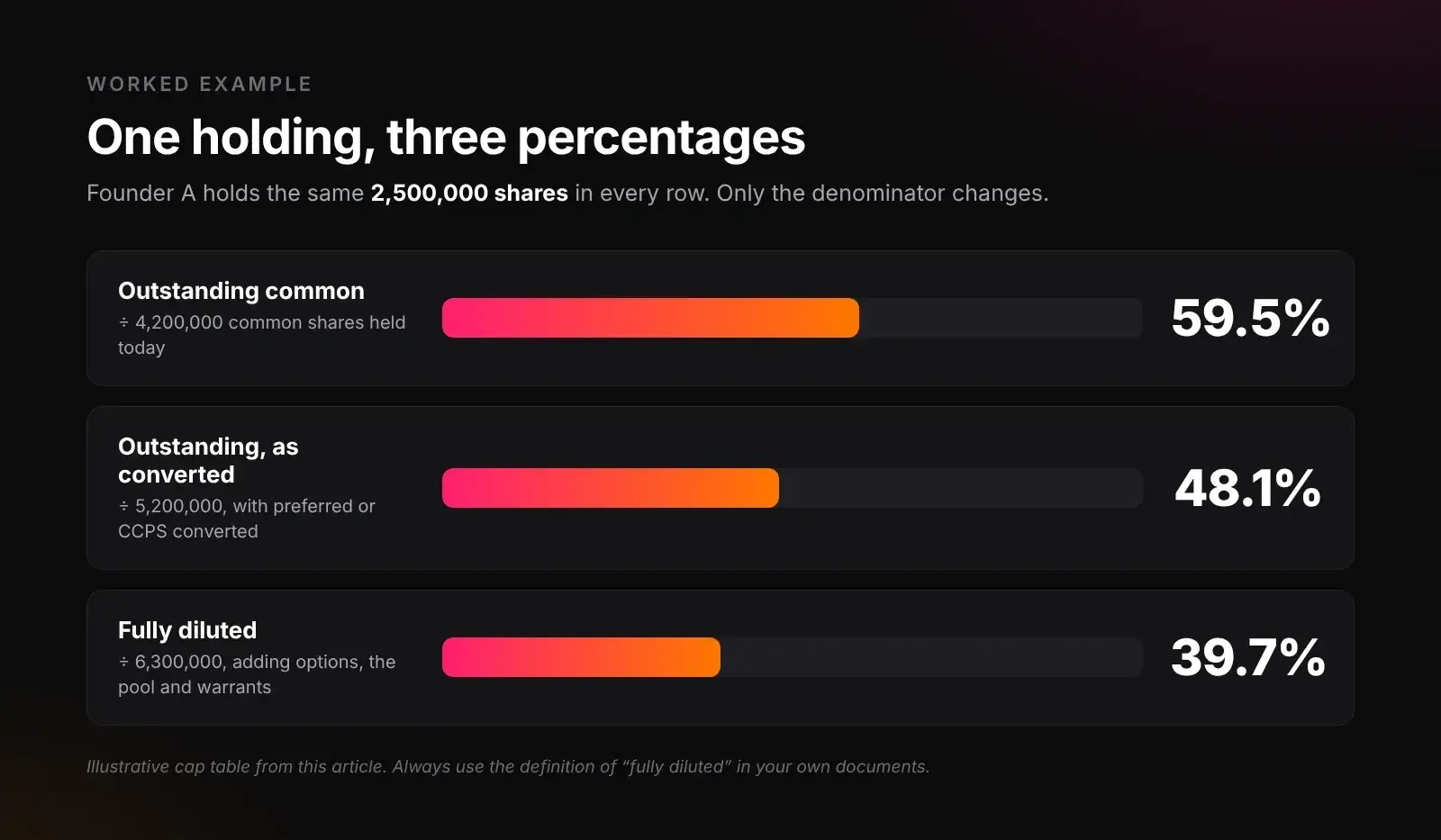
- 4,200,000 outstanding common shares
- 5,200,000 outstanding shares, counting the preferred as converted
- 6,300,000 fully diluted shares
Why your 1% is not what it seems
Now look at three people on that cap table.
Holder | % of outstanding common | % of outstanding, as converted | % fully diluted |
|---|---|---|---|
Founder A | 59.5% | 48.1% | 39.7% |
Series A investor | Not applicable | 19.2% | 15.9% |
Employee with 63,000 options | 0% until exercised | 0% until exercised | 1.0% |
Caption: The same holdings as a percentage of three different share counts.
Founder A owns the same 2,500,000 shares in every column, yet the percentage ranges from 39.7% to 59.5%. The employee’s options do not count as outstanding at all until they are exercised. Only the fully diluted column gives everyone a fair, comparable number.
Fully diluted percentages are also more stable:
- If you own 1% fully diluted, that does not change when other employees exercise options or receive grants from the existing pool (Carta).
- It does change when new shares are sold. If the next round sells 20% of the company, the employee’s 1.0% becomes 0.8%.
- Their stake can still be worth more if the price per share rises.
Why should employees and investors use the fully diluted percentage?
Employees should judge any grant as a percentage of fully diluted shares. A grant of 10,000 options means nothing without the total. Ask for three numbers and work out the percentage yourself:
- the fully diluted share count
- the strike price
- the latest fair market value
To explain this well to a team, see explaining ownership percentages to employees.
Investors price rounds on a fully diluted basis, so that options the company has already promised do not dilute their ownership. This is also why voting and dividend percentages, which normally follow outstanding shares, can differ from the economic stake people talk about.
What does “fully diluted basis” mean in a term sheet or SAFE?
It means the price per share is worked out by dividing the pre-money valuation by the fully diluted count, as that agreement defines it. The detail that matters most is the option pool.
The option pool shuffle
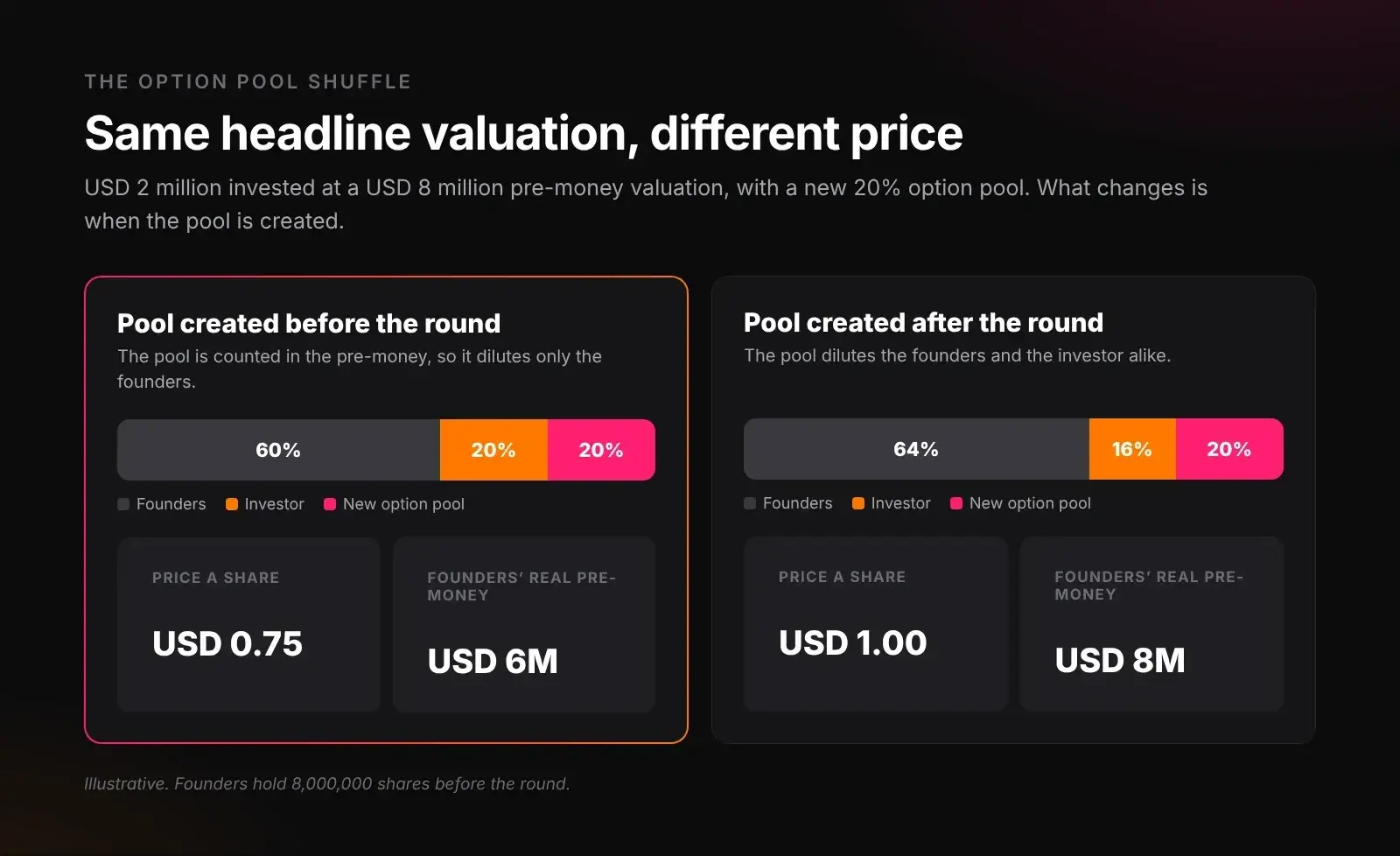
Founders hold 8,000,000 shares. An investor puts in USD 2 million at a USD 8 million pre-money valuation. The investor asks for a new option pool equal to 20% of the company after the round, created before the money comes in.
- Post-money valuation is USD 10 million. The investor owns 20% and the new pool 20%, so the founders keep 60%.
- 8,000,000 founder shares are 60%, so the company has 13,333,333 shares after the round.
- The investor gets 2,666,667 shares for USD 2 million, a price of USD 0.75 a share, not USD 1.00.
- The founders’ effective pre-money valuation is USD 6 million, not USD 8 million.
Suppose instead the same pool were created after the round, so it diluted both founders and the investor. Then the founders would keep 64%. That is why the pool size and its timing are among the most negotiated lines in a term sheet.
SAFEs and convertible notes
- Post-money SAFE: It fixes the holder’s percentage. A USD 1 million SAFE with a USD 10 million post-money cap converts into 10% of the company’s capitalisation, as the Y Combinator post-money SAFE defines it. Every additional SAFE therefore dilutes the founders, not the earlier SAFE holders.
- Pre-money SAFE: The original version worked differently, and each new SAFE diluted the others (McLane Middleton).
- For planning: Model capped SAFEs and convertible notes at their cap price. That shows the most dilution they can cause.
CCPS and CCDs in India
- How they are used: Most foreign venture investment into Indian startups is structured as compulsorily convertible preference shares. Both CCPS and compulsorily convertible debentures count as equity under the FEMA (Non-Debt Instruments) Rules, 2019 (Treelife).
- How they are counted: On a fully diluted basis, CCPS are counted at their current conversion ratio.
- What to watch: Anti-dilution clauses can change that ratio after a down round, so a cap table that assumes 1:1 forever may be wrong.
Is fully diluted the same as diluted EPS?
No. Diluted earnings per share is an accounting measure for financial statements, and it counts far fewer shares than a cap table’s fully diluted count.
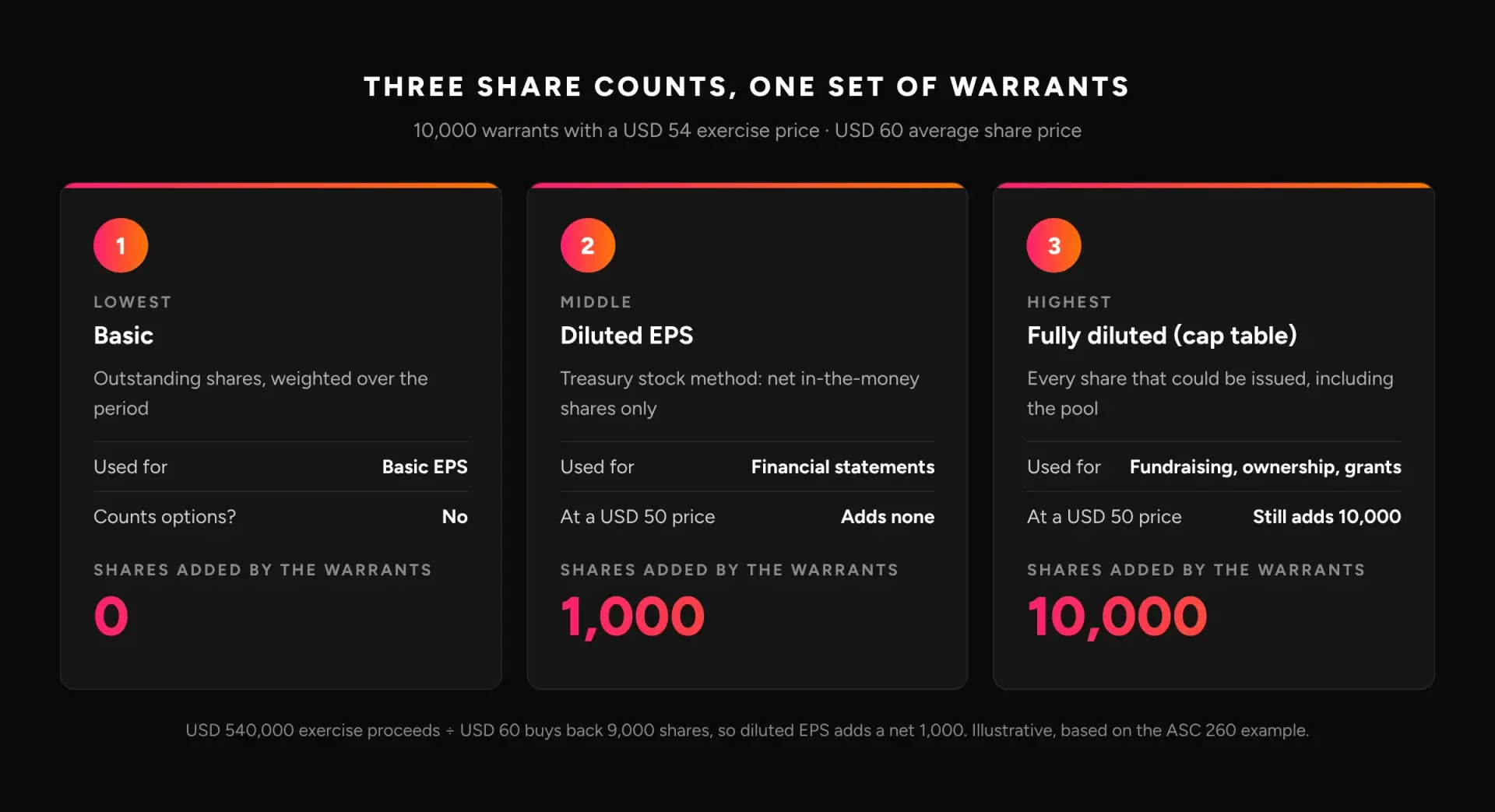
- US GAAP (ASC 260): The treasury stock method assumes options and warrants are exercised, and that the cash received buys back shares at the average market price. Only the net extra shares are added, and only if the options are in the money.
- An example: In the codification’s own example, 10,000 warrants with a USD 54 exercise price and a USD 60 average share price add just 1,000 shares (Deloitte DART). At a USD 50 average price they would add none. A cap table counts all 10,000 either way.
- IFRS and India: IAS 33 and Ind AS 33 use the same approach, counting only instruments that reduce earnings per share.
- The option pool: An unallocated pool appears in neither basic nor diluted EPS.
Count | What it includes | Used for |
|---|---|---|
Basic | Outstanding shares, weighted over the period | Basic EPS |
Diluted (EPS) | Basic plus net in-the-money options by the treasury stock method, plus convertibles if converting reduces EPS | Diluted EPS in financial statements |
Fully diluted (cap table) | Every share that could be issued, including the full option pool | Fundraising, ownership and grants |
Caption: Basic, diluted EPS and fully diluted share counts compared.
The three counts always rank in the same order. Basic is lowest, diluted EPS sits in the middle and the cap table’s fully diluted count is highest.
What are the most common fully diluted mistakes?
- Leaving out the unallocated pool when an investor’s definition includes it.
- Mixing denominators, such as quoting a founder’s stake on outstanding shares and an investor’s on fully diluted.
- Double counting exercised options, once as shares and again as options.
- Assuming CCPS or preferred convert 1:1 after an anti-dilution adjustment.
- Dropping out-of-the-money options from the cap table. They stay in the fully diluted count, even though they are left out of diluted EPS.
- Forgetting convertibles, especially uncapped notes and SAFEs issued between rounds.
- Counting cash-settled awards such as phantom stock as shares. Show them separately.
A live cap table that updates on every grant, exercise and conversion avoids most of these. So does deciding who owns the cap table. See in-house vs outsourced equity administration.
Frequently asked questions
1. Does fully diluted include the unallocated option pool?
Usually yes in a financing, because investors want the pool counted before they price their shares. Some definitions leave it out in an exit. The YC post-money SAFE, for example, includes the unissued pool in a financing but excludes it in a sale.
2. Are SAFEs included in fully diluted shares?
Yes. SAFEs and convertible notes are counted as if converted, normally at the valuation cap.
3. Do unvested options count in fully diluted shares?
Yes. All granted options count, whether vested or not, because the company has already promised those shares.
4. Is fully diluted ownership used for voting?
Generally no. Voting rights usually attach only to outstanding shares, depending on the company’s charter (Carta).
5. What is the treasury stock method?
It is the accounting method for diluted EPS. It assumes in-the-money options are exercised and the cash received buys back shares at the average market price, so only the net extra shares are counted.
6. What does “fully diluted pre-money” mean?
It means the pre-money valuation is divided by the fully diluted share count before the new money, usually including any new option pool. That makes the price per share lower and dilutes the existing holders, not the new investor.
7. How are CCPS counted on a fully diluted basis?
CCPS are counted as the number of equity shares they would convert into at the current conversion ratio, which can change under anti-dilution terms.
8. Are phantom stock and cash-settled SARs part of fully diluted shares?
No. They are paid in cash and issue no shares, so they do not dilute anyone’s percentage. Show them separately, because they are still a cost.
This article is general information, not legal, tax or investment advice. The definition of “fully diluted” in your own agreements always prevails. Speak to your lawyer or accountant before you rely on any figure.
See your fully diluted cap table, live
Tallect keeps every share class, option, warrant and convertible in one cap table for every entity, so each percentage uses the right denominator.