
How to Communicate a New Incentive Plan: 8 Best Practices
Eight best practices for rolling out a new sales incentive plan so reps understand it, trust it and know how to act on it.
A new incentive plan can be carefully designed, fully modelled and approved by every leader, and still fail in its first quarter. The problem is not that the plan is wrong. It fails because the people it is meant to motivate:
- do not understand it
- do not trust it
- do not know what to do differently
Reps cannot chase a target they cannot explain, and they will not believe a payout they cannot check.
This article sets out eight best practices for communicating a new incentive plan. They apply to a commission plan, a bonus plan or a hybrid of both. Each one can be applied on its own. Together they turn a launch announcement into a plan people can actually use.
The short answer
Good plan communication does more than announce the plan. It does five things before launch:
- makes sure the plan is final before anyone hears about it
- tells leaders and managers before reps
- gives every rep a one-page summary in plain language
- shows the maths with a worked example
- prepares managers to answer questions and gives reps one clear place to ask
After launch, it lets reps see their own quota, attainment and earnings, and it checks whether the message actually landed.
Why rollouts fail even when the plan is sound
Most failed rollouts share a few causes, and none of them is about the plan’s design.
- Unclear terms. Words like “attainment”, “credited bookings” or “threshold” mean something precise to the people who wrote the plan and something vague to everyone else. If reps have to guess, they guess differently.
- Surprises. Picture a rep who first learns from a slide in an all-hands meeting that their territory changed, or that a product no longer pays commission. They will spend the rest of the meeting thinking about that, not about the plan.
- Managers who cannot explain it. Reps take their first questions to their manager. If the manager hesitates, guesses or says “I’ll find out”, confidence drops quickly.
- Nowhere to check earnings. If reps cannot see how their earnings are calculated during the period, they track them in their own spreadsheets. Every difference between their number and the official number becomes a dispute.
The eight best practices below are designed to prevent each of these.
1. Finish and test the plan first
The most common communication mistake happens before any communication starts: announcing a plan that is not finished. If rules change after launch, every change has to be explained again, and each one costs trust.
Plan design is its own piece of work and should be settled before this point. What matters here is that the final plan is complete, tested and agreed.
Close the open questions
Before you announce, make sure the plan answers the questions reps will ask in the first week:
- How are split deals credited?
- What happens to a deal that closes the day after someone leaves?
- What if a territory changes mid-year?
- When is a result final?
If the answer to any of these is “we’ll decide case by case”, write a rule now.
Test that payouts can be calculated and explained
Run real or realistic deals through the plan and calculate the payouts. Then ask someone who did not design the plan to explain each result in plain words. If they cannot, reps will not be able to either. Fix the wording, or simplify the rule, before launch.
Get sign-off in writing
Agree the final version with Sales, Finance and HR, and record who approved it and when. This avoids a late change from one function after the plan has already been shared with reps.
Common mistake: announcing the headline numbers early “to build excitement” and filling in the rules later. Reps remember the headline and then feel misled by the detail.
2. Tell leaders and managers before reps
Who hears about the plan, and in what order, matters as much as what you say. Reps should never hear about their plan before their manager can answer questions about it.
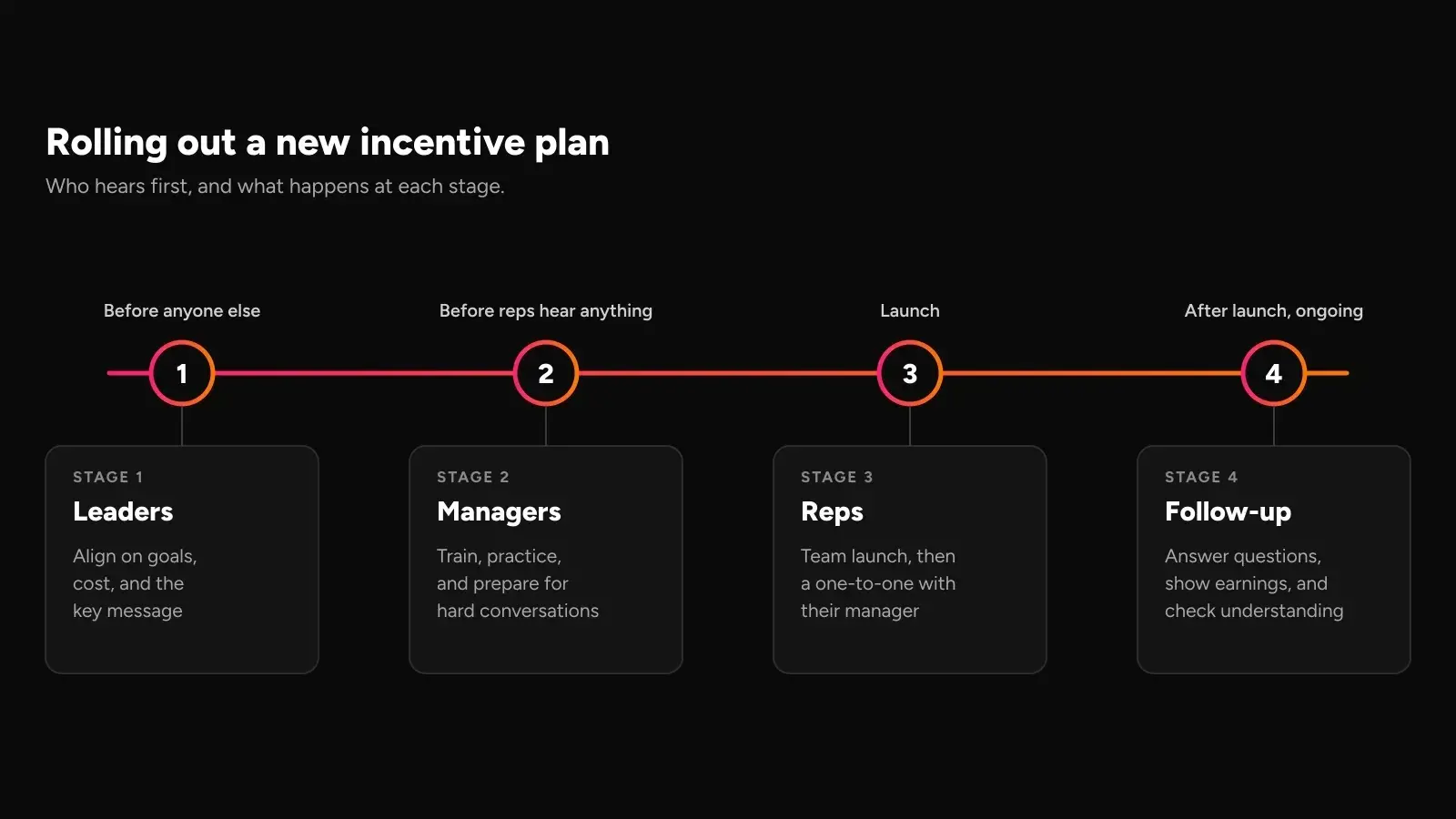
A simple sequence works for most companies:
- Leaders align first.
- Then the people who will run and pay the plan.
- Then managers.
- Finally, reps.
New hires need their own path, because they join after the main launch.
Audience | What they need | Suggested timing and format |
|---|---|---|
Executives and sales leaders | The plan’s goals, cost and key changes, and the message they will repeat | First, in a leadership review, before any wider sharing |
Sales operations and Finance | Final rules, edge cases, data sources and payout calendar | Before managers, in a working session with the full plan document |
Sales managers | Talking points, worked examples and answers to likely questions | Before reps, in a live training session plus written materials |
Reps | A one-page summary, their own targets, a worked example and where to ask questions | A team launch session, followed by a one-to-one with their manager |
New hires | The same summary, their own targets and any ramp or pro-rating rules | During onboarding, with a one-to-one before their first payout period |
Caption: Who needs what, and when, in a new incentive plan rollout.
Timing should leave room to fix what you learn. Managers may find an unclear rule in their training session. If so, you need enough time to correct the summary before reps see it. A gap of several days between the manager session and the rep launch is usually more useful than a gap of a few hours.
Keep the gap between the team launch and each rep’s one-to-one short, too. Questions that sit unanswered for weeks turn into assumptions.
Common mistake: sending the plan to everyone at once by email. Managers then learn the plan at the same moment as their teams and have to answer questions they have not had time to think about.
3. Give every rep a one-page summary
The full plan document is the reference, but most reps will not read it end to end. A one-page summary is what they will actually keep, check and return to. Write it in plain language and avoid internal jargon. Make sure it matches the full plan document exactly.
A good summary covers:
- Purpose. What the plan is designed to reward this year, in one or two sentences.
- Eligibility. Which roles are covered, and from when.
- Targets or quotas. What the rep is measured on and how their target was set.
- Rates and thresholds. How earnings are calculated, and any level that must be reached before payouts start.
- Accelerators and caps. What happens above target, and whether earnings are limited.
- Bonuses. For hybrid plans, what each bonus pays for and how it is earned.
- Payout timing. When results are final and when payments are made.
- Questions and disputes. How to raise a question, who decides and by when.
- What changed from last year. The main differences, stated plainly.
- Where to find the full plan. A link or location for the complete plan document.
The section on changes deserves special care. Reps compare the new plan with the old one immediately, so say clearly what is different and why. If a change will reduce earnings for some reps, say so in the summary and in their one-to-one conversation. Do not leave them to work it out.
Many companies also keep a written plan document and ask reps to sign an acknowledgement that they have received it. Whether either is required, and what they must contain, depends on the country and the employment contract. Check with HR and legal.
Common mistake: a summary that paraphrases the plan loosely. If the summary and the plan document say different things, reps will rely on the version that pays them more.
4. Show the maths with a worked example
Rates and thresholds on their own are abstract. A worked example shows reps exactly how a result turns into earnings, and it often answers questions before anyone asks them.
Use a hypothetical rep in a common situation, and walk through the calculation one step at a time. The example below uses a hybrid plan, with commission and a milestone bonus. All figures are illustrative US dollar amounts. They are not a recommendation, a benchmark or a typical plan.
In this example, the plan works like this:
- The rep has a quarterly quota of $300,000 in bookings.
- Commission is $4,000 for every $100,000 booked up to quota.
- Commission is $6,000 for every $100,000 booked above quota.
- A $3,000 bonus is paid if the rep signs at least three new customers in the quarter.
The rep books $360,000 and signs four new customers.
Step | Calculation | Illustrative amount |
|---|---|---|
Quarterly quota | Set in the rep’s plan | $300,000 |
Bookings in the quarter | Credited bookings at quarter end | $360,000 |
Attainment | $360,000 ÷ $300,000 | 120% |
Commission up to quota | $300,000 at $4,000 per $100,000 | $12,000 |
Commission above quota | $60,000 at $6,000 per $100,000 | $3,600 |
Milestone bonus | Four new customers, so the three-customer milestone is met | $3,000 |
Total quarterly incentive earnings | $12,000 + $3,600 + $3,000 | $18,600 |
Caption: Illustrative worked example for a hypothetical rep on a hybrid plan. All figures are illustrative US dollar amounts, not a recommendation or a typical plan.
Then show a second case, so reps see how the plan behaves when things go less well. Suppose the same rep books $270,000:
- attainment is 90%
- commission is $10,800
- nothing is paid at the higher rate
- the bonus depends only on whether the new-customer milestone is met
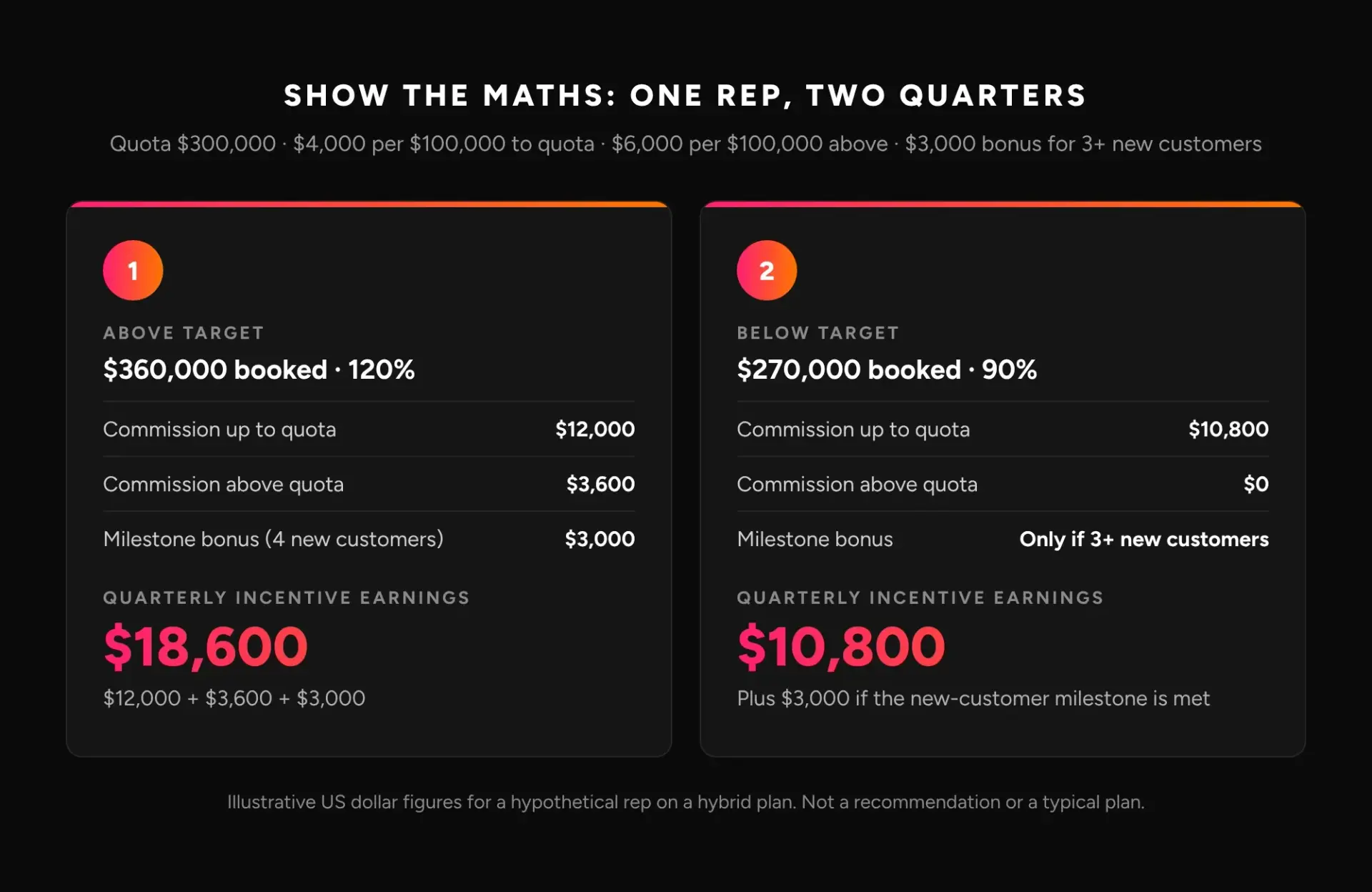
Two or three examples are enough: one at target, one above and one below. Use the same layout every time, so reps learn to read it, and make sure Finance has checked every figure.
Common mistake: showing only the best case. Reps notice when every example ends at 150% of quota, and they stop trusting the examples.
5. Train managers to explain the plan
Managers are the most important channel for any plan. Reps ask them first, believe them most, and judge the plan by how confidently they explain it. Train managers before reps hear anything, and give them what they need to answer well.

Give them talking points and practice
Prepare short talking points on what the plan rewards, what changed and why. Add the worked examples and a list of the questions reps are most likely to ask, with agreed answers.
Then let managers practise. Run a short session where managers explain the plan to each other and answer tough questions. It shows quickly where the materials are unclear.
Prepare them for difficult conversations
Some reps will earn less under a new plan, or will lose a product, account or territory they valued. Managers should know in advance which of their reps are affected and how.
In those conversations, honesty works better than spin:
- state what changed
- explain the reason
- show the rep how they can earn under the new plan
- listen
Set clear limits
Managers should not promise exceptions, interpret rules on the spot or guess at answers they do not know. Give them a simple rule: if you are not sure, log the question and come back with the agreed answer.
Common mistake: assuming managers will learn the plan from the same email as their reps. A manager who is learning the plan in front of the team cannot defend it.
6. Give reps one clear route for questions
Questions are a good sign. They mean reps are engaging with the plan. The goal is to make questions easy to ask, quick to answer and answered consistently.
Choose the right formats
Format | When to use it |
|---|---|
Live launch session | The main explanation, because people can ask questions and hear each other’s answers |
Recording or short walkthrough | People who cannot attend, and new hires who join later |
Written plan FAQ | Published alongside the summary |
Office hours with sales operations | The first few weeks after launch |
Caption: Formats for answering questions about a new plan.
Keep one route and one log
Give reps one clear place to send questions, such as a shared inbox, a form or a channel run by sales operations. Log every question and its answer. The log does two jobs:
- it keeps answers consistent across teams and regions
- it shows which parts of the plan cause confusion
When the same question appears several times, add it to the FAQ and tell managers.
Agree response times
Tell reps how quickly they can expect an answer, and keep to it. A question about how a deal will be credited matters most while the deal is still open.
Common mistake: letting each manager answer questions in their own way. Different answers to the same question in different teams quickly become a fairness issue.
7. Make earnings visible after launch
Communication does not end at launch. Reps keep asking one question throughout the year: “Where do I stand?” If they cannot answer it, they will build their own trackers, and every difference between their number and the official one becomes a dispute.

What a good earnings view shows
Reps need three figures, each traceable to the deals and rules behind it:
- their quota
- their attainment to date
- their earnings
They should be able to see which deals were credited, at what rate, and when each payout is expected. Managers need the same view across their team, so they can coach before the period ends rather than explain results afterwards.
You might use a spreadsheet or a dedicated system such as Tallect’s Sales Incentive module. Either way, the aim is the same: a clear view of quota, attainment and earnings, and how each figure was calculated.
Handle disputes in a set way
Even with good visibility, some figures will be questioned. Set out in the plan:
- how a rep raises a dispute
- what information they need to include
- who reviews it
- how quickly they will get a decision
Record the outcome. If a rule needs clarifying, update the FAQ for everyone.
Keep a short check-in cadence
Review earnings and attainment in regular one-to-ones, and recap the main plan terms at the start of each period. A short reminder of how the plan works is often more useful in the third month than in the first week.
Common mistake: sharing results only when payouts arrive. By then, it is too late for reps to act on them, and any surprise feels like an error.
8. Check understanding and adjust
A launch that felt smooth may still have left gaps. Check whether the message actually landed, and adjust while there is still time to act.
Look at the signals you already have
Signal | What it shows |
|---|---|
The questions log | Which rules confuse people |
Disputes | Where the plan or the summary is unclear |
Manager feedback | Which conversations were hard |
Caption: Signals to review after launch.
Look at all three after the first few weeks and again after the first payout.
Ask reps directly
A few short questions, asked in a one-to-one or a brief survey, can test understanding without feeling like an exam:
- Can the rep explain how they earn above target?
- Do they know when payouts arrive?
- Do they know where to raise a question?
If many reps get the same question wrong, the communication needs fixing, not the reps.
Update the materials
Use what you learn to revise three things:
- the summary
- the FAQ
- the manager talking points
Tell reps what changed in the materials. Keep the full plan document unchanged unless the plan itself changes. If it does, communicate that change with the same care as the launch.
Common mistake: treating the launch session as the end of the job. Understanding builds over the first few payout cycles, and the communication should keep pace.
Frequently asked questions
How far in advance should you announce a new incentive plan?
Announce it early enough that reps understand their targets before the period they apply to begins. Leave time before that for leaders, Finance and managers to review the plan and fix unclear points. If reps start a new period without knowing their plan, they make decisions on old assumptions. Where the plan replaces an existing one, check with HR and legal whether any notice period applies.
Who should communicate a new compensation plan, the manager or HR?
Usually both, in different roles:
- Sales leadership sets out the plan’s purpose and main changes.
- Managers explain it to each rep and answer day-to-day questions.
- HR and sales operations provide the plan document, handle formal questions and disputes, and keep the message consistent.
Reps tend to trust their own manager most, so managers need to be trained before reps hear anything.
How do you explain a new plan to reps who earn less under it?
Tell them early, in a one-to-one, rather than leaving them to work it out from the summary. In that conversation:
- explain what changed and why
- show how they can earn under the new plan with a worked example
- listen to their concerns
Avoid spin or promises you cannot keep. If their concern points to a real problem with the plan, pass it on to the plan owners.
Should reps sign a plan acknowledgement?
Many companies ask reps to sign or confirm that they have received and read the plan document. It creates a clear record of what each rep was given and when. Whether an acknowledgement is required, what it should say and what effect it has depend on the country and the employment contract. Check with HR and legal before you introduce one.
How often should you remind reps of the plan terms?
Recap the main terms at the start of each payout period, and whenever a question keeps coming up. Short reminders in regular one-to-ones work better than long refresher sessions. Keep the summary, the FAQ and the full plan document easy to find, and point reps to them whenever they ask. Reps also understand a plan better when they can see their own earnings during the period.
How do you handle questions and disputes after launch?
Give reps one route for questions and a clear dispute process set out in the plan. The process should say:
- what information to include
- who reviews it
- how quickly a decision is made
Log every question and outcome so answers stay consistent across teams. When the same question appears more than once, add the answer to the FAQ and update the manager talking points.
How do you communicate mid-year plan changes?
Treat a mid-year change with the same care as a launch. Brief leaders and managers first. Then explain to reps, with a worked example:
- what is changing
- why
- from when
- how it affects earnings already made
Whether and how a plan can be changed mid-year depends on the plan document, the employment contract and local law, so check with HR and legal first.
Help reps see how every payout adds up
With Tallect, reps and managers see quota, attainment and earnings in one place, along with how each figure was calculated. The plan still makes sense after launch.