
Are Sales Incentives Taxable? From Gross Payout to Net Pay
What happens between a sales incentive being earned and money reaching a rep’s account, with US and India examples and what to check.
A rep checks their earnings statement and sees a commission of $10,000. A few weeks later, the amount that reaches their bank account is noticeably smaller. Nothing has gone wrong. Between payout and payment sit:
- tax withholding
- contributions
- sometimes other deductions
If nobody explains that gap, it turns into disputes and lost trust in the plan.
This article covers three things:
- what usually happens between a sales incentive being earned and money reaching the employee
- why the answer varies
- what plan owners should check
It uses the United States and India as two worked examples of how rules differ.
This article is general information, not tax or legal advice. Rules vary by country and change over time. The country examples are as of November 2026.
The short answer
In both countries covered here, sales commission is treated as part of an employee’s pay for tax purposes:
- United States. The IRS’s employer tax guide lists commissions and bonuses among the wages subject to federal employment taxes.
- India. The Income-tax Act, 2025 includes “any fees or commission” in salary.
The details for both countries follow in the section on the two examples.
That does not mean every incentive is handled the same way everywhere. Three things change the answer:
- The country, and sometimes the region within it. Each has its own rules on tax, contributions, deductions and payment timing.
- Employment status. An employee, a contractor and an agent may be handled very differently, so confirm status before you pay.
- The type of incentive. Each of these raises different questions:
- cash commission
- a bonus
- a short-term SPIFF
- a trip
- an advance against future earnings
The same payment can also be treated differently under different laws in the same country. India is a good example:
- Commission counts as salary under the income-tax law.
- The labour ministry’s handbook on the Code on Wages lists commission among the items excluded from “wages”, subject to a limit.
So for plan owners, “Is it taxable?” is not the only question. They also need to ask: “What will payroll do with it, and how do we explain that to reps?”
How incentive types are treated
Sales incentives come in several forms. Each raises different points to check with payroll and your tax adviser. The table below sets out what to look at for each type. It does not state how any type is taxed in a given country.
Incentive type | What usually matters | What to check |
|---|---|---|
Cash commission | When it is earned, when it is paid, and whether it runs through payroll with regular pay | How payroll classifies it, and which withholding and contributions it applies |
Bonus | Whether it is tied to a target, a period or a one-off event | Whether payroll handles it the same way as commission, and when it is paid |
SPIFF (short-term incentive) | Its size, its timing, and whether it is paid in cash or in kind | That it is captured in payroll, not paid outside it as a one-off |
Non-cash rewards and trips | The value of the reward and who receives it | Whether the reward counts as pay where you operate, and how it is valued and reported |
Draws and advances | Whether the advance is recoverable from later earnings | How the advance is treated when paid, and what the contract and local law allow on recovery |
Caption: What to check for each type of sales incentive. Not a statement of how any type is taxed in a given country.
Cash commission and bonuses
These are the simplest cases, because they are cash paid for work. In the United States, the IRS’s Publication 15 lists both bonuses and commissions as wages. Bonuses are worth checking separately even so, because payroll may process a one-off payment differently from regular pay.
SPIFFs and non-cash rewards
A SPIFF (sales performance incentive fund) is a short, targeted incentive, such as a reward for selling a new product in one quarter. Paid in cash, it is still pay for work. The practical risk is that payroll misses SPIFFs paid quickly or outside the normal cycle.
Non-cash rewards, such as trips, electronics or gift cards, need more care:
- In the United States, Publication 15 includes taxable fringe benefits in wages.
- Whether a particular reward is a taxable fringe benefit, and how it is valued, is a question for your payroll provider and tax adviser.
- Outside the United States, check how non-cash rewards are treated in each country where you pay people.
Draws and advances
A draw is an advance against future commission, often paid to new hires while they build pipeline. Check two things:
- how the advance is treated when it is paid
- what happens if later earnings do not cover it
India offers one data point on timing. Under the Income-tax Act, 2025, salary paid in the tax year is chargeable even if it is not yet due.
Equity and long-term incentives, such as stock options or share awards, follow separate rules and are outside the scope of this article.
Deductions that can apply
Several kinds of deduction can sit between a gross incentive and the net amount an employee receives. Which ones apply, and in what order, depends on the country, the employee and the employment contract.
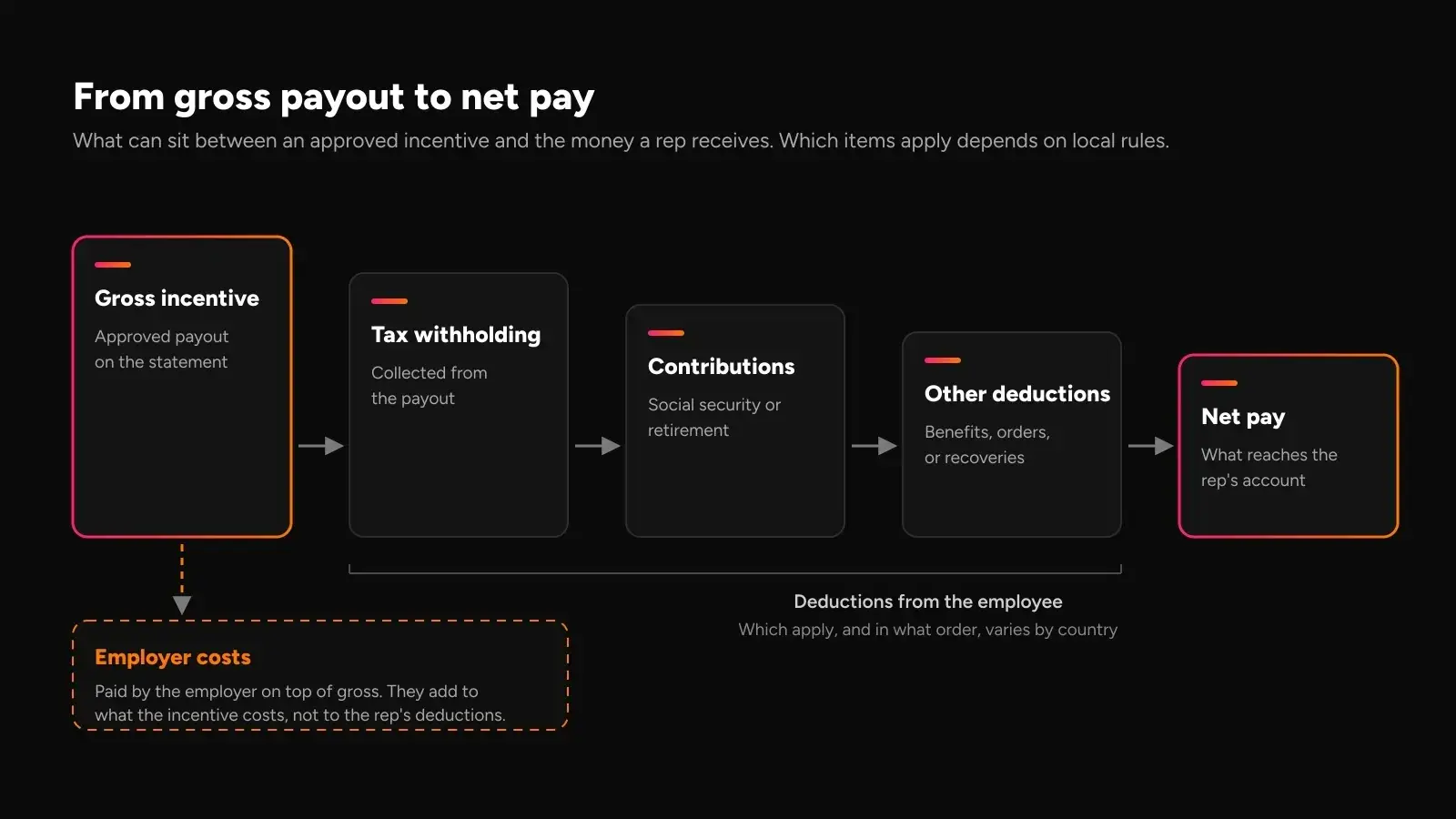
It helps to separate two groups:
- Deductions from the employee reduce what the rep receives, such as income tax withheld or an employee contribution.
- Costs on the employer do not reduce the rep’s pay, but they add to what the incentive costs the company. In the United States, for example, both the employer and the employee pay social security and Medicare taxes.
Finance needs both views: the net amount for the rep, and the full cost for the budget.
Deduction type | Who it affects | What to check |
|---|---|---|
Income tax withholding | Employee; the employer collects it | How payroll calculates withholding on incentive pay |
Social security or payroll contributions | Employee, employer or both | Which contributions apply, at what rates and on what pay |
Retirement or pension contributions | Employee, employer or both | Whether contributions are calculated on incentive pay as well as base pay |
Benefit deductions | Employee | Whether any benefit deduction changes when incentive pay is added |
Deductions ordered by a court or authority | Employee | Whether the order covers incentive pay, and how much can be taken |
Recoveries of draws, clawbacks or overpayments | Employee | What the contract and local law allow, and the correct order and timing |
Employer-side contributions | Employer | The full cost of each payout, for budgeting and ROI |
Caption: Deductions and employer costs that can sit between a gross incentive and net pay.
Income tax withholding
Both countries covered here set out how tax is collected from pay:
- United States. Publication 15 sets a withholding rate for supplemental wages.
- India. Section 392 requires tax to be deducted from salary at the time of payment.
How much is withheld from an incentive payout depends on the method payroll uses. Ask your payroll provider to explain it in terms you can pass on to reps.
Contributions
Contributions to social security, social insurance or retirement schemes can apply to the employee, the employer or both. Check two things in each country:
- whether contributions apply to incentive pay at all
- whether any limit or ceiling changes the result for high earners
Recoveries
Recovering money from a rep is where plans, payroll and employment law meet. This covers repaying a draw, applying a clawback or correcting an overpayment.
Whether an employer may recover any of these from pay, and how much it can take at once, depends on the employment contract and local law. India’s labour ministry handbook, for example, lists recovery of advances or loans as an authorised deduction and caps total deductions. Check with legal and HR before you deduct anything that is not tax or a required contribution.
Employee, contractor or agent
Before you think about deductions, confirm who you are paying. An employee, a contractor and an agent may each be handled differently. Check with your tax adviser how each status is treated where you operate.
The United States shows how detailed this can be. Section 2 of the IRS’s Publication 15 makes three points:
- Employee status depends on tests such as the common-law test. That test looks at whether the business has the right to control what will be done and how.
- Certain salespersons count as “statutory employees”.
- Direct sellers and qualified real estate agents are by law considered nonemployees.
For plan owners, the practical steps are these:
- Confirm status in writing for everyone who receives an incentive, before the first payout.
- Keep separate plan documents or schedules where employees and non-employees are paid under different terms.
- Ask your tax adviser how non-employee payments are handled and reported in each country, rather than assuming they follow the employee process.
- Review status when roles change, for example when a contractor becomes an employee or moves to another country.
Paying a team in several countries
A sales team that spans several countries brings several sets of rules into one plan. These can differ between countries, and sometimes between regions within a country:
- tax
- contributions
- permitted deductions
- payment deadlines
A single plan design can therefore produce different net results for two reps with the same gross payout.

Points to check for an international team:
- Payroll in each country. Confirm which entity or payroll provider pays each rep, and the cut-off date for incentive data in each payroll.
- Where the work is done. Remote employees, people who move during the year and frequent travellers can raise questions about which country’s rules apply. Ask your tax adviser before a move takes effect, not after.
- Currency. Decide whether incentives are calculated in a plan currency and paid in local currency. If so, document which exchange rate is used and on which date. Confirm with payroll how converted amounts should be reported.
- Deadlines. Payment deadlines differ. India’s labour ministry handbook, for example, sets dates for monthly wages and for final dues on exit. Make sure incentive timing in your plan fits each country’s payroll calendar.
- Local plan documents. Check whether each country needs local wording or terms on deductions and recoveries.
Use a shared plan design with a short country annex that records these points. That keeps reps and payroll in each country working from the same reference.
Two examples: United States and India
The United States and India show how differently two countries can handle the same incentive. The table below uses only facts from official sources, as of November 2026. Where this article has no supplied fact for a country, the table says so.
Topic | United States | India |
|---|---|---|
Is commission treated as pay? | Commissions and bonuses are listed among wages subject to federal employment taxes | For income tax, salary includes “any fees or commission”. The Code on Wages handbook lists commission among exclusions from “wages”, subject to a 50% limit |
Tax collected from pay at source | Withholding rate on supplemental wages of 22%, or 37% if supplemental wages paid to an employee in the calendar year exceed $1 million | Tax deducted at the time of payment, based on estimated salary for the tax year, at the average rate |
Payroll contributions | Social security 6.2% each for employer and employee, up to a $184,500 wage base. Medicare 1.45% each, with no wage base limit | Not covered here. Check local rules. |
Limits on deductions from pay | Not covered here. Check local rules. | Only authorised deductions, including recovery of advances or loans. Total deductions capped at 50% of wages in a wage period |
Payment timing | Not covered here. Check local rules. | Monthly wages due before the seventh day of the following month. Final dues on exit within two working days |
Employment status | Tests such as the common-law test. Certain salespersons are statutory employees, and direct sellers and qualified real estate agents are nonemployees | Not covered here. Check local rules. |
Caption: Selected rules as of November 2026, from the official sources named in the text. Not a complete summary of either country’s rules.
United States
The facts above come from the IRS’s Publication 15 (2026), Employer’s Tax Guide:
- Section 5 says that wages subject to federal employment taxes generally include all pay given to an employee for services performed. That includes bonuses, commissions and taxable fringe benefits.
- The “What’s New” section for 2026 is the source of the withholding and contribution figures.
These are federal rules only. This article does not cover:
- state or local taxes
- state rules on wage payments and deductions
- the full methods for withholding on supplemental wages
India
India’s new Income-tax Act, 2025, as amended by the Finance Act, 2026, comes into force on 1 April 2026. Three sections matter here:
- Section 16 includes in salary “any fees or commission” and “profits in lieu of, or in addition to, any salary or wages”.
- Section 15(1) makes salary due in the tax year chargeable whether paid or not. Salary paid in the tax year is chargeable even if not yet due.
- Section 392 requires the payer to deduct tax at the time of payment.
On the labour side, the four Labour Codes, including the Code on Wages, 2019, took effect on 21 November 2025, according to a Press Information Bureau release. The Ministry of Labour and Employment’s compliance handbook on the Labour Codes makes these points:
- It explains the deduction limits and payment deadlines shown in the table.
- It says that “wages” includes basic pay, dearness allowance and retaining allowance.
- It says that if the excluded items together exceed 50% of total pay, the excess is treated as wages. The Central Government can notify another percentage.
- It notes that the Codes prevail over it if there is any discrepancy.
What the contrast shows
The two countries answer different questions in different places:
- The United States facts here focus on federal tax and contributions.
- The India facts cover income tax, and also labour-law limits on deductions and payment timing.
Even the definition of pay can differ between laws in one country.
The lesson for plan owners is not to copy one country’s process to another. Map each country’s rules with local advisers, and record the result in your plan documents.
From gross to net: an example
This example shows how a gross payout becomes net pay, using one hypothetical commission. The rates are illustrative rates that do not match any country’s rules. All amounts are hypothetical US dollars. The figures are not a benchmark and not tax advice.
A rep earns a gross commission of $10,000 in one month. In this illustration, three deductions apply to the employee:
- income tax withholding at an illustrative 20%
- a social contribution at an illustrative 5%
- a retirement contribution at an illustrative 3%
The employer also pays an illustrative employer contribution of 7%.
Line item | Amount | Note |
|---|---|---|
Gross commission | $10,000 | From the approved earnings statement |
Income tax withholding | −$2,000 | Illustrative 20% |
Social contribution (employee) | −$500 | Illustrative 5% |
Retirement contribution (employee) | −$300 | Illustrative 3% |
Total employee deductions | −$2,800 | Sum of the three deductions |
Net pay to the rep | $7,200 | Gross minus total employee deductions |
Employer contribution | $700 | Illustrative 7%, paid on top of gross |
Total cost to the employer | $10,700 | Gross plus employer contribution |
Caption: Illustrative gross-to-net calculation using hypothetical amounts and rates that do not match any country’s rules. Not a benchmark and not tax advice.
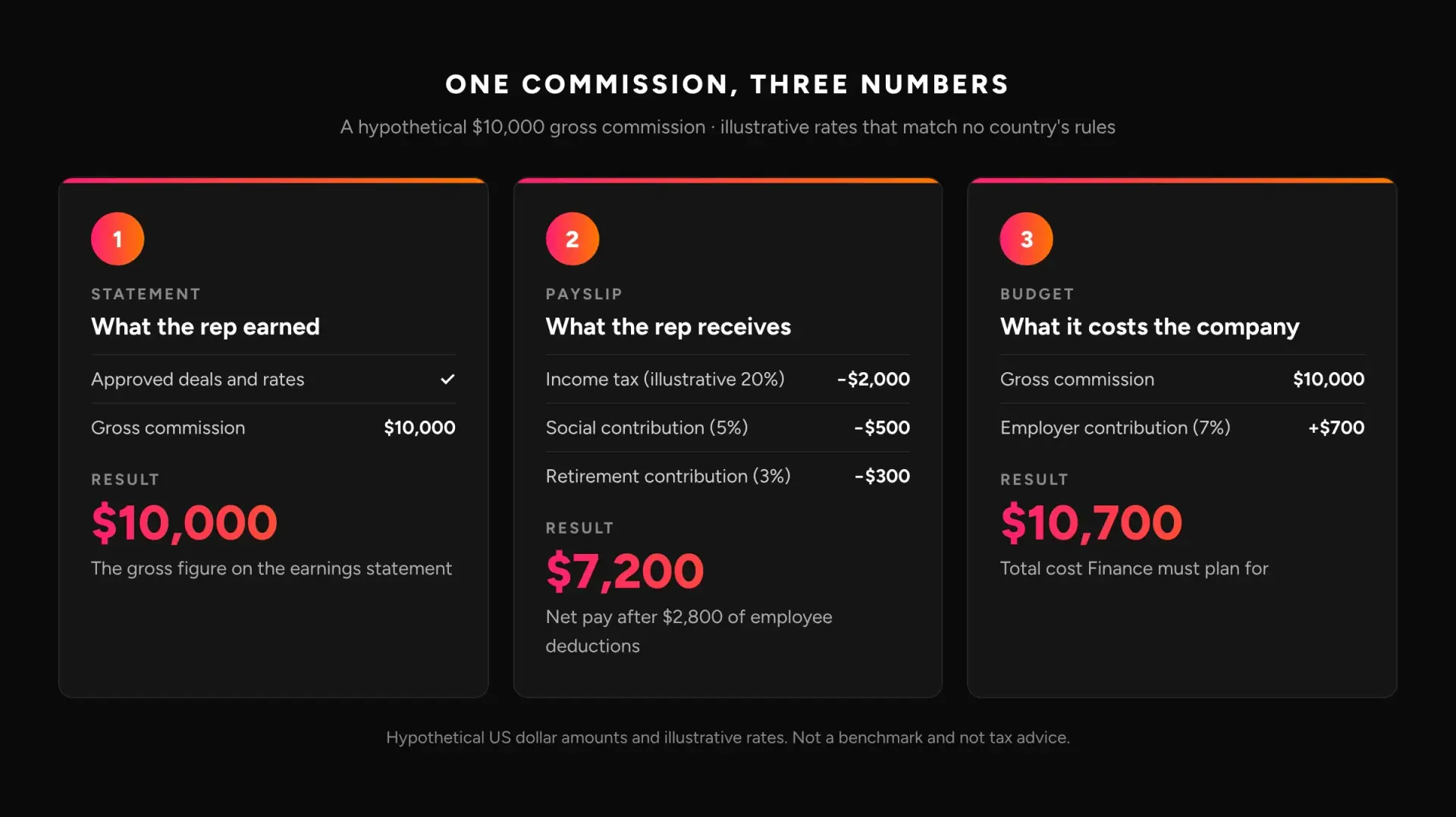
The rep sees $7,200 and needs to understand why. Finance sees $10,700 and needs to budget for it.
Here, every rate is applied to the full gross amount. A real payroll may work differently. Check with your payroll provider:
- which amount each deduction is calculated on
- in what order the deductions apply
- whether any limits apply
Handling tax and deductions in your plan
Most problems here come from three sources:
- plan documents that say nothing about deductions
- statements that show only one number
- payouts that reach payroll late
These steps help.
Say it in the plan document
State clearly that all incentive amounts in the plan are gross, before any tax, contributions or other deductions required or allowed by law. Then say three more things:
- Payouts are processed through payroll.
- Deductions depend on the employee’s country and circumstances.
- If the plan includes draws or clawbacks, describe how they work, and say that any recovery is subject to the employment contract and local law.
Have legal review this wording in each country.
Show reps gross and net
Give reps an earnings statement that shows how each gross amount was calculated, with deals, rates and attainment. Then point them to their payslip for the net amount and the deductions. When reps can trace the gross figure themselves, questions about the net amount become far easier to answer.
You might use spreadsheets or a dedicated system such as Tallect’s Sales Incentive module. Either way, the aim is the same:
- a clear earnings statement for each rep
- a clean handoff of approved payouts to payroll, which remains responsible for tax and deductions

Respect payroll cut-off dates
Agree on a monthly calendar with payroll. It should set three dates:
- when incentive results are final
- when they are approved
- when payroll needs them
Late or corrected payouts create extra work and may need adjustments in a later pay period. Keep a record of every adjustment and the reason for it.
Handle recoveries with care
If a draw, clawback or overpayment needs to be recovered, decide with legal and HR how to recover it. The options are:
- deduct it from pay
- offset it against future commission
- have the rep repay it another way
Also confirm how recovery interacts with tax already withheld on the original payout. Do not assume that because a payout can be clawed back under the plan, it can be deducted from wages.
Know when to involve experts
Involve your payroll provider, legal counsel and a qualified tax adviser when you:
- launch a plan
- enter a new country
- introduce non-cash rewards or draws
- change how people are classified
- plan any recovery from pay
Rules vary by country and change over time, so check the country facts in this article again before you rely on them.
Frequently asked questions
Is commission taxed at a higher rate than salary?
How tax is collected from a payout and how much tax an employee owes overall are separate questions:
- In the United States, Publication 15 sets a withholding rate for supplemental wages.
- In India, section 392 requires tax to be deducted from salary at the average rate, based on estimated salary for the year.
Whether the amount withheld matches what an employee finally owes is a question for their tax adviser.
Are bonuses and commissions treated the same way?
In the United States, Publication 15 lists both bonuses and commissions among the wages subject to federal employment taxes. India’s Income-tax Act, 2025 includes commission in salary, and the India sources used here do not address bonuses separately.
Payroll may still process a one-off bonus differently from regular commission. Check with your payroll provider how each is handled, and check local rules in every other country where you pay people.
Are SPIFFs and non-cash sales incentives taxable?
A cash SPIFF is pay for work, so make sure it runs through payroll and confirm how payroll processes it.
Non-cash rewards need more care. In the United States, Publication 15 includes taxable fringe benefits in wages. But whether a particular trip or gift counts, and how it is valued, needs advice. Elsewhere, check local rules with your payroll provider and a tax adviser.
Do social security or payroll contributions apply to commission?
In the United States, Publication 15 says wages subject to federal employment taxes generally include commissions. For 2026:
- social security tax is 6.2% each for the employer and the employee, up to a $184,500 wage base
- Medicare tax is 1.45% each, with no wage base limit
For other countries, including India, check with your payroll provider which contributions apply to incentive pay and on what basis.
Can an employer deduct overpaid commission from pay?
It depends on the employment contract and local law, so check with legal and HR before deducting anything. As one example, India’s labour ministry handbook on the Code on Wages:
- lists recovery of advances or loans as an authorised deduction
- caps total deductions at 50% of wages in a wage period
It does not settle every type of overpayment, and other countries have their own rules.
Do independent contractors pay tax on commission?
That depends on the country and on whether the person is truly a contractor. In the United States, Publication 15 explains how employee status is decided, including the common-law test. It says that direct sellers and qualified real estate agents are by law considered nonemployees.
How a contractor’s own tax works is outside this article. Companies should ask a tax adviser what they must report, and contractors should take their own advice.
How do you show gross and net commission to your sales team?
Use two documents:
- The earnings statement shows the gross amount, with the deals, rates and attainment behind it, so reps can check the calculation.
- The payslip shows the net amount and each deduction.
State in the plan document that all amounts are gross. When reps ask about the difference, explain the types of deduction in general terms. Refer detailed tax questions to payroll or an adviser.
Show reps what they earned and why
Tallect gives reps and managers a clear view of what was earned and how it was calculated. It then hands approved payouts to payroll with calculations Finance can trace.