
How to Design a Sales Incentive Plan: A 7-Step Guide
A practical seven-step guide to sales incentive plan design, from goals and pay mix to quotas, plan rules, cost modelling and launch.
A sales incentive plan is the set of rules that decides how salespeople earn variable pay on top of their base salary. It states what you pay for, how much, when and under what conditions.
A good plan points the sales team at the results the business needs and pays people fairly for delivering them. A weak one causes three problems:
- it pays for the wrong things
- it confuses reps
- it surprises Finance at quarter end
Most plans use two kinds of variable pay:
- Commission is pay that rises with sales. The more a rep sells, the more they earn, usually as a set amount for every dollar of revenue or margin.
- Bonus is pay tied to a target or milestone. A rep earns a fixed amount on reaching a goal, such as a quarterly quota or a new-product target.
Many plans combine both.
This guide walks through seven steps, in order. Each step depends on decisions made in the one before it, so work through them in sequence rather than jumping straight to commission rates. Each step covers four things:
- what to decide
- why it matters
- how to weigh the options
- one common mistake
To make the steps concrete, we build one plan for a hypothetical account executive (AE) as we go. All figures in that example are illustrative US dollar amounts. They are not a recommendation, a benchmark or a typical plan.
Step 1: Set the plan’s goals
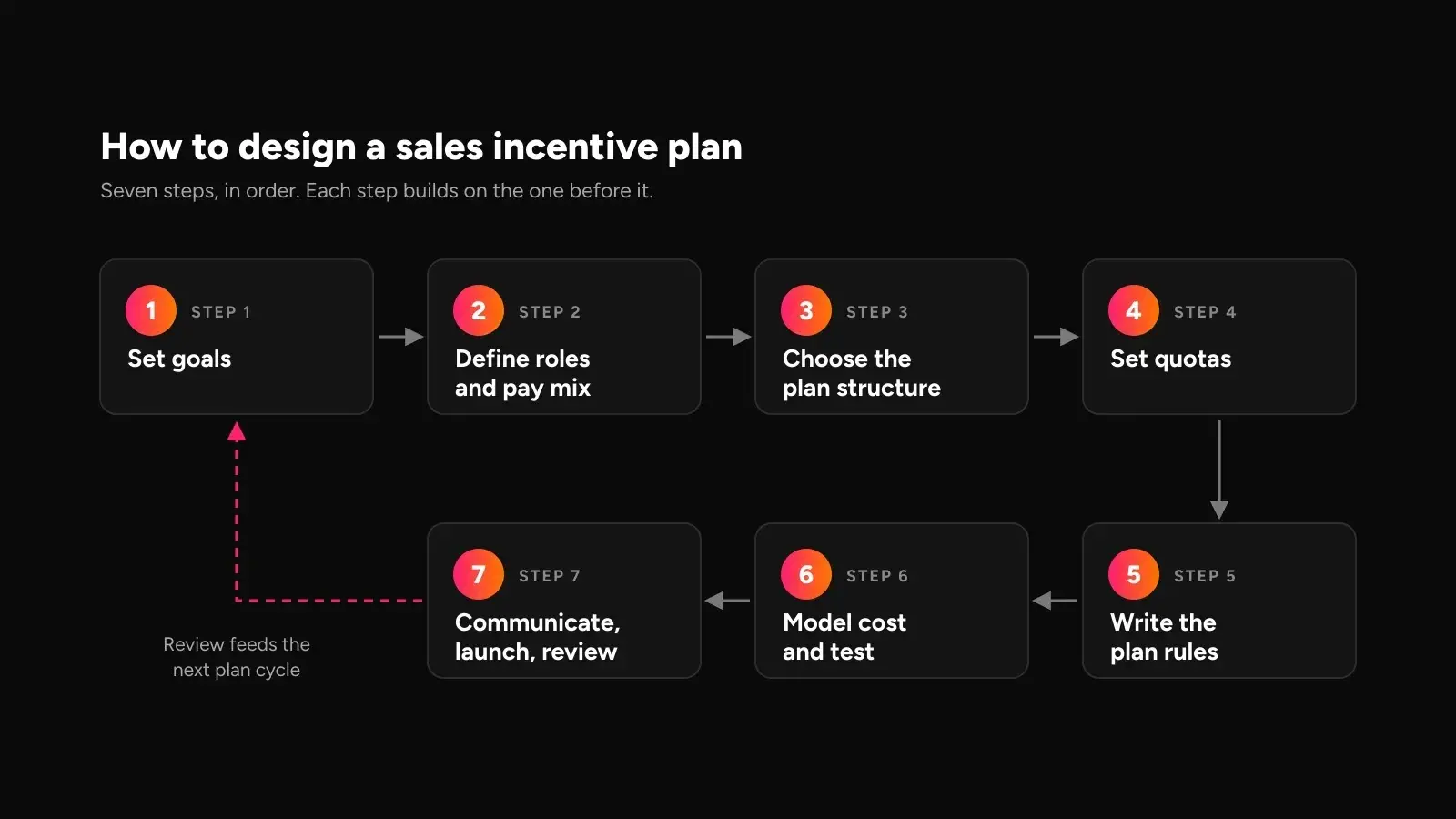
Every incentive plan is a message about what the company values. Before anyone discusses rates or quotas, agree on what the plan must achieve this year. Start with the business plan, not last year’s compensation plan. Ask leadership and Finance three questions:
- Where must revenue come from?
- What kind of revenue matters most?
- What should reps do more of, or less of?
Separate business goals from behaviours
The plan has to deal with two different things:
- Business goals are outcomes. Examples include growing new-customer revenue, expanding within existing accounts, launching a new product, improving margin or moving customers to multi-year contracts.
- Behaviours are what reps do to get there. Examples include prospecting into new segments, selling the full product line, protecting price or keeping forecasts accurate.
The plan should pay for outcomes the rep can influence and, where it helps, steer the behaviours behind them.
Limit the number of measures
Each measure you add dilutes the others. A rep with five measures, each worth a small slice of variable pay, will focus on the one or two that pay most and quietly ignore the rest.
For most roles, one primary measure plus one or two secondary measures is enough to send a clear message. Other priorities belong in management coaching and performance reviews, not in pay.
Choose measures reps can see and affect
A measure works only if reps understand it, can track it and can move it through their own effort. Company profit matters to the business, but most reps cannot see how their work changes it from week to week. Bookings, revenue or gross margin on their own deals are usually clearer.
Also check that the data exists. If you cannot measure something reliably each month, you cannot pay on it fairly.
Common mistake: trying to pay for everything. When a plan carries every leadership priority, it pays for nothing in particular. Reps learn to ignore the parts that do not move their earnings.
Worked example: our illustrative company wants to grow new-customer revenue and move more customers onto multi-year contracts. The AE plan therefore has two measures:
- the primary measure is new-customer annual contract value (ACV) booked
- the secondary measure is the value of multi-year contracts signed
Step 2: Define roles and pay mix
Once the goals are set, decide who the plan covers and how much of each person’s pay should be at risk. Start with roles, because pay mix only makes sense in relation to what a role controls.
Define each role before you pay it
Write a short description of each sales role. It should answer four questions:
- Who do they sell to?
- What do they sell?
- How long does a typical deal take?
- How much of the result depends on them alone?
These roles all influence revenue in different ways:
- a new-business AE
- an account manager focused on renewals
- a sales development rep (SDR) who books meetings
- a sales engineer who supports deals
If two roles overlap or blur, fix the role design first. A compensation plan cannot fix an unclear job.
Choose the pay mix and on-target earnings
Pay mix is the split between base salary and target variable pay. On-target earnings (OTE) is what a person earns in total when they reach 100% of their targets. Two decisions sit here:
- The level of OTE. This should reflect the market for the role and your company’s pay philosophy.
- The split within it. This depends on how much the individual controls the result.
The more a sale depends on one person’s effort in a short cycle, the more of their pay can be variable. The more it depends on long cycles, teamwork or ongoing account care, the more pay should sit in base. Market practice on pay mix varies by role, industry and country, so use a reliable survey source for your markets rather than a rule of thumb (source needed).
Role type | Pay mix direction | Why |
|---|---|---|
New-business AE, short sales cycle | More variable pay | Results are frequent and driven mainly by the individual |
Enterprise AE, long sales cycle | Balanced, with more base than a short-cycle role | Deals take longer and depend on wider teams |
Account manager or renewals | More base pay | The role protects existing revenue and relationships |
Sales development rep | Moderate variable pay | Activity is measurable, but the rep does not close the deal |
Sales engineer or presales | Mostly base pay | The role supports many deals and rarely owns the result |
Front-line sales manager | Balanced | Pay should reflect team results and coaching |
Caption: Pay mix direction by role type. Guidance in words only, not percentages or benchmarks.
Weigh the trade-offs
More variable pay | More base pay | |
|---|---|---|
Strengths | Sharpens focus and lowers fixed cost when sales are weak | Supports teamwork, retention and long-term account health |
Risks | Raises earnings volatility and can push reps to chase short-term deals | Weakens the link between effort and reward |
Caption: Trade-offs between more variable pay and more base pay.
Neither choice is right in general. The role decides.
Common mistake: applying one pay mix to every sales role because it is simpler to administer. An SDR, an enterprise AE and a renewals manager do different jobs and need different signals from their pay.
Worked example: our illustrative AE has an OTE of $200,000. That splits into a base salary of $100,000 and target variable pay of $100,000. These figures are illustrative only and do not reflect a market rate.
Step 3: Choose the plan structure
Structure is the set of mechanics that turns results into payouts. Most plans draw from a small set of building blocks, and the skill lies in choosing only the ones the goals require.
The building blocks
- Commission pays an amount for each unit of result, such as a set dollar amount for every $100,000 of revenue.
- Bonus pays a fixed amount when a target or milestone is met.
- Tiers change the commission rate at set attainment levels.
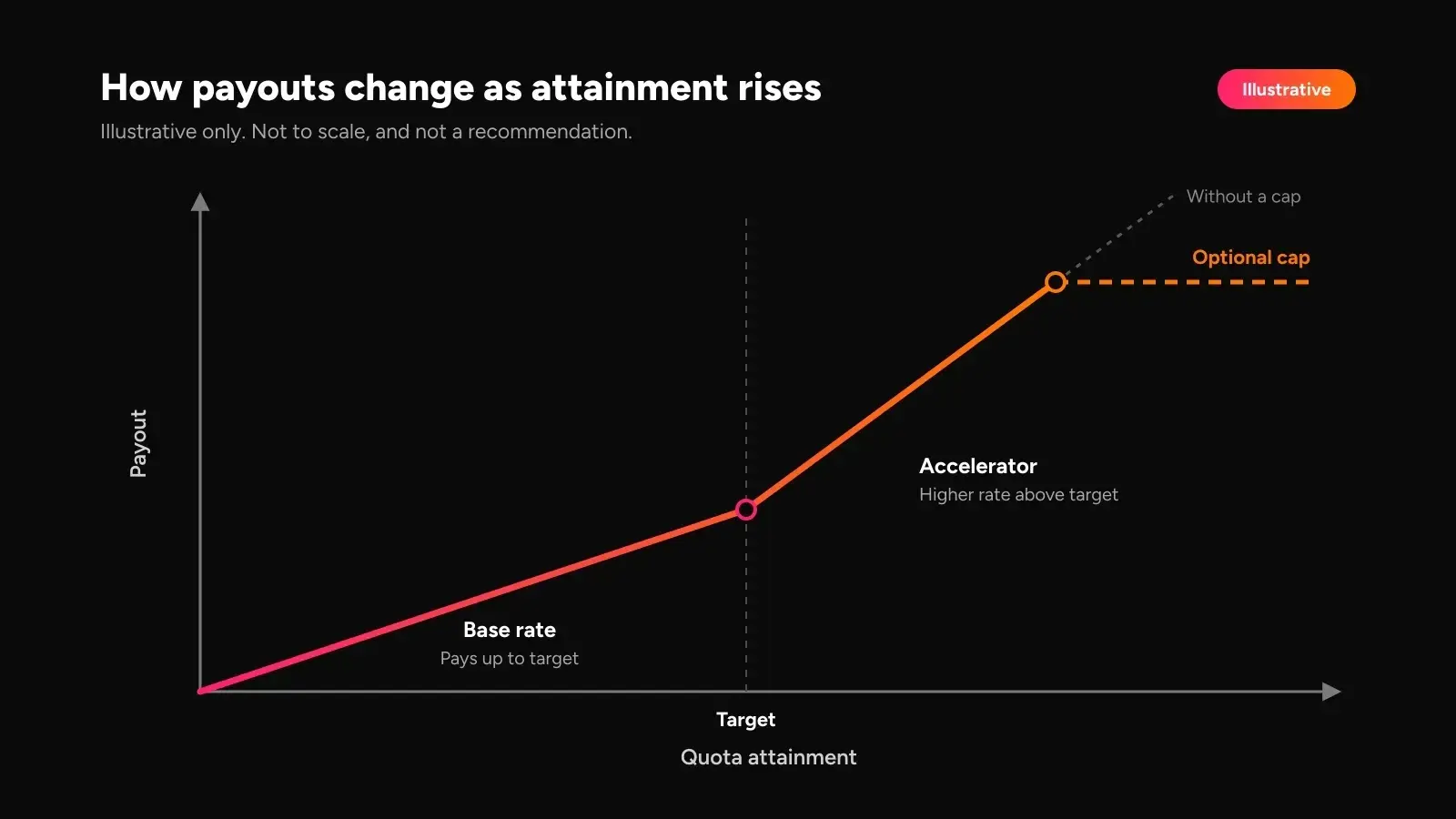
- Accelerators are higher rates above target, so that each extra sale pays more than the last.
- Decelerators are lower rates below a set level.
- SPIFFs (sales performance incentive funds) are short-term, one-off incentives for a specific push, such as a new product or an end-of-quarter goal.
Component | What it pays for | When to use it | Main risk |
|---|---|---|---|
Commission | Each unit of revenue, bookings or margin | Results are frequent, measurable and driven by the individual | Reps chase volume at the expense of price, fit or retention |
Bonus | Reaching a target or milestone | Goals that are not simple volume, such as a strategic product or a team result | All-or-nothing targets can demotivate reps who fall just short |
SPIFF | A short, specific push | A product launch, a new segment or a time-limited priority | Overuse turns SPIFFs into expected pay and distracts from the core plan |
Caption: The main incentive components, when to use each and the main risk.
When to combine them
Component | Use it when |
|---|---|
Commission (as the core) | Results are frequent, measurable and driven by the individual |
Bonus | You want to reward a target that is not simple volume, such as a strategic product, a margin goal or a team result |
Accelerator | You want strong performers to keep selling after quota instead of holding deals back for the next period |
SPIFF | You need a short, clearly defined push. Use them sparingly, so they do not become an expected part of pay |
Caption: When to add each component to a plan.
Thresholds and caps
- Threshold. A threshold, or floor, is the attainment level below which no commission is paid. It stops the company paying for very low results. Set it too high, though, and it can demotivate reps who are having a difficult quarter.
- Cap. A cap limits total payout. Caps protect the budget from windfalls, but they can also tell top performers to stop selling once they reach the limit.
- Review rule. An alternative to a hard cap is a review rule for unusually large deals, which Step 5 covers.
Keep it simple enough to explain
A rep should be able to estimate their earnings on a deal in their head or on the back of an envelope. If explaining the structure takes more than a few minutes, the plan will not steer behaviour. Reps cannot see the link between what they do and what they earn.
Common mistake: stacking components. Each new tier, kicker or SPIFF may make sense on its own. Together, they create a plan that only the compensation team understands and that is hard to calculate correctly.
Worked example: our illustrative AE earns commission on new-customer ACV, with an accelerator above quota and no cap. A separate bonus pays for multi-year contracts. Step 5 sets out the illustrative figures.
Step 4: Set quotas reps believe in
A quota is the target a rep must reach to earn their target variable pay. It links the incentive plan to the sales forecast, and it is where trust is won or lost. If reps believe quotas are unreachable, even a well-designed structure will not motivate them.
Top-down and bottom-up
Top-down | Bottom-up | |
|---|---|---|
Starts from | The company’s revenue target, divided across regions, teams and reps | Each territory’s potential: the number of accounts, their likely spend, the current pipeline and past results |
Strength | Keeps the sum of quotas tied to the business plan | Makes each quota more realistic |
Caption: Top-down and bottom-up quota setting compared.
A practical approach uses both. Sales leadership and Finance then reconcile the gap in a deliberate conversation.
Account for capacity and ramp
A quota should reflect what a fully productive rep can achieve in that territory. New hires need time to learn the product and build pipeline. Give them a ramped quota for their first months, with the length based on your own sales cycle.
Also decide how much over-assignment to build in. Over-assignment means the total of rep quotas sits above the company target, to cover vacancies and underperformance. Be open with leaders about this. With heavy over-assignment, many reps will miss quota even when the company hits its number.
Make quotas transparent and fair
Explain how quotas were set. Reps accept a demanding number more readily when they can see the method and the territory data behind it. Then check fairness in three ways:
- Compare quotas across similar territories.
- Look for patterns where some people or groups consistently receive harder targets.
- Decide in advance what happens to a quota when a territory changes during the year.
Common mistake: setting quotas only from the company number and adding a flat increase each year, without looking at territory potential. Quotas end up too easy in some territories and impossible in others. The plan ends up paying for luck rather than performance.
Worked example: our illustrative AE has an annual quota of $1,000,000 in new-customer ACV. New hires in the role receive a ramped quota for their first quarter. These figures are illustrative only.
Step 5: Write the plan rules
The rules decide what happens in situations the structure does not cover. Unclear rules can turn a sound structure into a steady source of disputes. Write them before launch, not when the first question arrives. Many of these rules touch employment law, which varies by country, so draft them with HR and legal.
Crediting and splits
Crediting decides which sale counts for whom, and when. Define the event that triggers credit. It could be any of these:
- contract signature
- booking in the CRM
- invoice
- cash received
Each choice trades speed of reward against certainty of revenue.
Set split rules for deals worked by more than one person, such as an AE and an overlay specialist. State whether credit is shared or given in full to each person.
Caps, floors and large deals
Confirm three things:
- whether total payouts are capped
- whether commission starts only after a threshold
- how you will treat unusually large deals that nobody could have forecast
A review rule sends deals above a set size to a committee. It lets you handle windfalls case by case without capping every rep.
Payout timing and draws
Set how often you pay: monthly, quarterly or annually. More frequent payouts keep the reward close to the effort, but they add administration and make clawbacks more likely.
A draw is an advance against future commission, often used for new hires while they ramp. There are two kinds:
- Recoverable draw. The rep pays it back from later earnings.
- Non-recoverable draw. The rep does not pay it back.
State which you use and for how long.
Clawbacks
A clawback recovers commission already paid when the underlying revenue does not materialise, for example if a customer cancels or does not pay. Define three things:
- the trigger
- the time window
- how recovery works
Whether clawbacks and deductions from pay are enforceable varies by country and by contract. Check with HR and legal before you include one.
Edge cases
Write down how you will handle each of these:
- reps who join or leave mid-period
- promotions and role changes
- territory changes
- leaves of absence
- changes to the plan itself during the year
For leavers, state whether commission is paid on deals closed before the leaving date. Also state what happens to deals that close afterwards. These rules also depend on local employment law and individual contracts, so agree on them with HR and legal.
Common mistake: leaving edge cases to case-by-case decisions. Ad hoc calls feel flexible, but they create inconsistency and a sense of favouritism. They also lead to disputes that are hard to settle without a written rule.
Worked example: the table below brings the illustrative AE plan together.
Component | How it pays | Illustrative figure |
|---|---|---|
Base salary | Fixed pay through payroll | $100,000 per year |
Target variable pay | Paid at 100% of quota and bonus targets | $100,000 per year |
Quota | New-customer ACV booked in the year | $1,000,000 |
Commission up to quota | Paid on each dollar of new-customer ACV | $9,000 per $100,000 booked |
Accelerator above quota | Higher rate on ACV booked above quota | $13,500 per $100,000 booked |
Multi-year bonus | Fixed bonus when multi-year contract value reaches the target | $10,000 at $300,000 in multi-year contracts |
Cap | No cap; very large deals go to a review committee | Review for deals above $500,000 ACV |
Payout timing | Commission monthly, bonus annually | Commission paid the month after booking |
Ramp draw | Non-recoverable draw for new hires | $4,000 per month for the first 3 months |
Clawback | Recovers commission if a customer cancels early | Within 90 days of signature, subject to local law |
Caption: Illustrative plan summary for a hypothetical account executive. All figures are illustrative US dollar amounts, not a recommendation or a typical plan.
Step 6: Model cost and test the plan
A plan that reads well on paper can still behave badly once real deals flow through it. Before launch, model what it will pay across a range of outcomes. Test it against the deals and reps you actually have.
Run scenario tests
Model payouts at low, target and high attainment for each role. Then run last year’s deals through the new plan to see how they would have paid. Look for outcomes that feel wrong, such as these:
- a rep earning more in a weak year than in a strong one
- a cliff, where one extra dollar of revenue changes the payout sharply
- a split rule that pays three people in full for the same deal
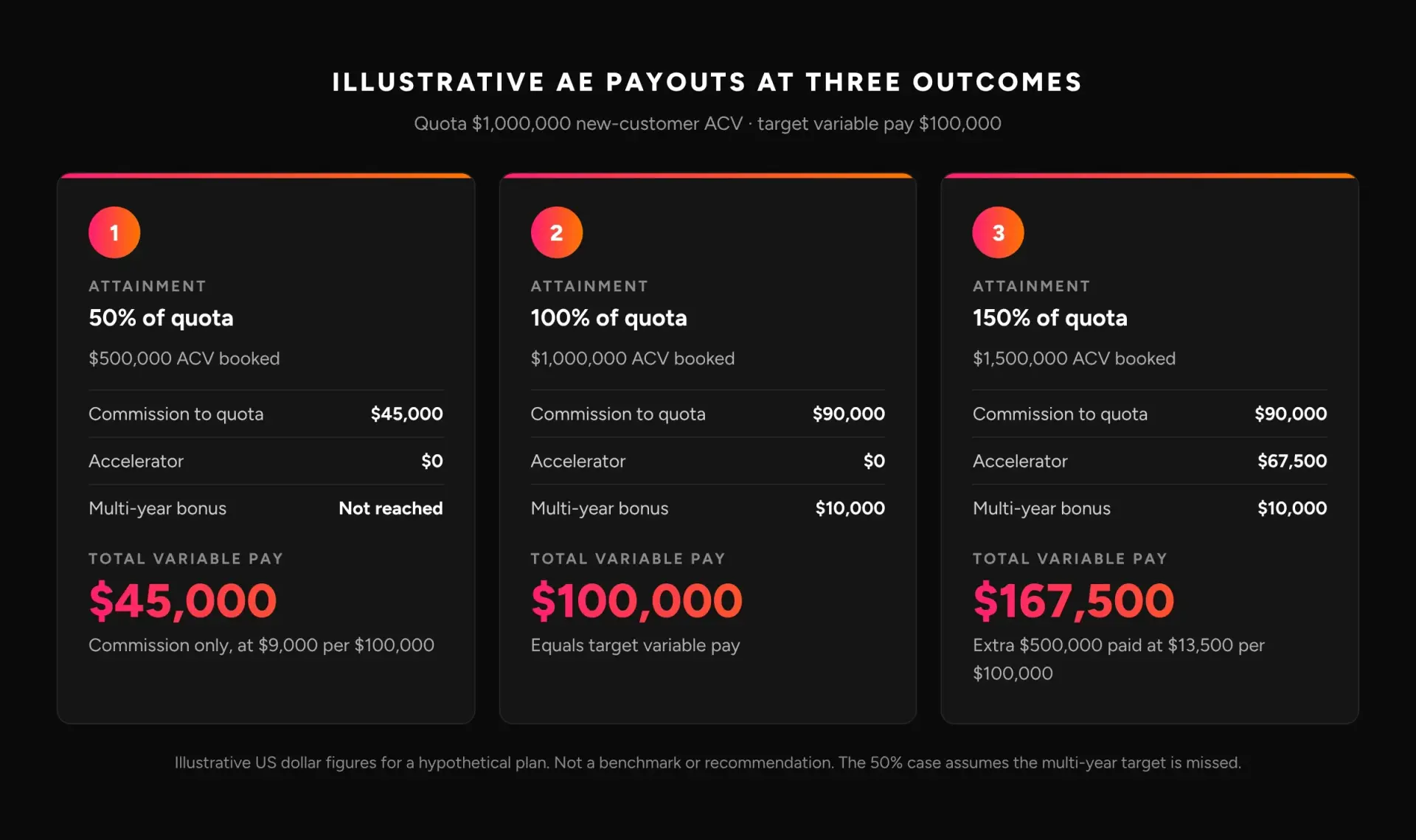
Worked example: this is how the illustrative AE plan pays at three levels of attainment.
Attainment | ACV booked | Commission up to quota | Accelerator | Multi-year bonus |
|---|---|---|---|---|
50% | $500,000 | $45,000 | $0 | $0 if the target is missed |
100% | $1,000,000 | $90,000 | $0 | $10,000 if the target is met |
150% | $1,500,000 | $90,000 | $67,500 on the extra $500,000 | $10,000 if the target is met |
Caption: Illustrative AE payouts at three attainment levels. At 100% the total is $100,000. At 150% commission is $157,500, or $167,500 with the bonus. These figures are illustrative only.
Check the total cost with Finance
Add up expected payouts across the whole team. Use a realistic spread of attainment rather than assuming everyone lands at exactly 100%.
Compare the total cost of sales compensation with the revenue it is expected to produce. Agree with Finance on the range that is acceptable.
Test what happens if results come in well above plan. Even with an accelerator, each extra dollar of revenue should still leave the company better off.
Pressure-test the rules
Walk through edge cases with realistic examples, such as these:
- a rep who leaves mid-quarter
- a deal that is cancelled after payout
- a territory that changes in month six
If the written rules do not give a clear answer, fix the rules now rather than after launch.
Plan how you will calculate it
Decide how payouts will be calculated, approved and audited each period, and who owns each step. Spreadsheets can work for a small team. They become fragile as roles, rules and countries multiply. A dedicated tool such as Tallect’s Sales Incentive module can help keep calculations consistent once the plan is live.
Common mistake: modelling only the target case. Plans rarely break at 100% attainment. They break at the extremes, where windfalls and cliffs show up.
Step 7: Communicate, launch and review
A plan only drives behaviour if reps understand it and trust it. The launch matters as much as the design, and the review cycle keeps the plan aligned as the business changes.
Write the plan document
Every participant should receive a written plan document that sets out exactly how they will be paid. Many teams also ask reps to acknowledge the document in writing. Whether a signature is needed, and what the document must contain, can depend on local law, so check with HR and legal.
Section | What to include |
|---|---|
Purpose and effective dates | What the plan rewards and the period it covers |
Eligibility | Roles covered and when participation starts and ends |
Target pay | Base salary, target variable pay and OTE |
Measures and quotas | Each measure, its weight and how quotas are set |
Payout mechanics | Rates, tiers, accelerators, thresholds, caps and bonuses |
Crediting and splits | The credit event and the rules for shared deals |
Payout timing | Payment frequency and when results become final |
Draws and clawbacks | Terms, triggers and how recovery works |
Edge cases | Joiners, leavers, role changes, territory changes and leave |
Plan changes | Who can change the plan and how changes are communicated |
Questions and disputes | How a rep raises a question and who decides |
Caption: What to include in a sales incentive plan document.
Walk teams through it

Hold a launch session where managers walk each team through the plan using worked examples. Then give every rep a simple way to see their quota, attainment and earnings during the period. Visibility reduces disputes and lets reps act on the plan instead of guessing what it will pay.
Set a review cycle
Review the full plan at least once a year, in step with business planning. Check mid-year for clear problems. At each review, track five things:
- whether the plan drove the intended results
- how payouts spread across the team
- the total cost of sales compensation
- the disputes raised
- what reps say about the plan
Keep mid-year changes rare and well communicated. Changing a plan in flight can damage trust, and it may be restricted by contract or local law.
Common mistake: launching with a slide deck and no written plan. A presentation explains intent, but only a document can settle a dispute.
Worked example: the illustrative AE plan launches with three things:
- a written plan document
- a team session
- a monthly earnings statement
Leadership reviews it after two quarters and again before next year’s planning.
Frequently asked questions
How much of a salesperson’s pay should be variable?
It depends on how much the individual controls the result. Roles with short sales cycles and clear individual results can carry more variable pay. Roles with long cycles, team selling or ongoing account care need more base pay. Market practice varies by role, industry and country, so use reliable survey data for your markets (source needed). Check that the mix supports the behaviours you want.
How do you set fair sales quotas?
Combine a top-down view of the company target with a bottom-up view of each territory’s potential, then reconcile the gap openly. Then:
- base quotas on accounts, pipeline and past results
- give new hires a ramped quota
- check for fairness across similar territories
Explain the method to reps. People accept a demanding number more readily when they can see how it was set.
What is an accelerator in a commission plan?
An accelerator is a higher commission rate that applies once a rep passes a set level of attainment, usually quota. Each sale above that point pays more than sales below it. Accelerators encourage strong performers to keep selling instead of holding deals for the next period. Before you add one, model the cost at high attainment, so each extra dollar of revenue still leaves the company better off.
Should a sales incentive plan have a cap?
Not always. A cap limits total payouts and protects the budget from windfalls. It can also tell top performers to stop selling once they reach it. One alternative is to leave earnings uncapped and send unusually large or unforecast deals to a review committee. Whichever you choose, write the rule into the plan document and model its cost with Finance before launch.
How often should you review a sales incentive plan?
Review the full plan at least once a year, in step with business planning, so it reflects new goals, products and territories. Add a lighter check mid-year to spot clear problems, such as:
- payouts far above or below expectations
- a rule that keeps causing disputes
At each review, track four things so it rests on evidence:
- results against the plan’s goals
- the spread of payouts
- total cost
- rep feedback
Can you change a sales incentive plan in the middle of the year?
Sometimes, but it should be rare and handled with care. Mid-year changes can damage trust. Whether you can make them depends on the plan document, employment contracts and local law. Include a clause that explains who can change the plan and how changes are communicated, and check with HR and legal before acting. When a change is needed, do three things:
- give notice
- explain why
- protect earnings already earned
What is a clawback in a commission plan?
A clawback is a rule that lets the company recover commission already paid when the underlying revenue does not materialise. Examples include a customer who cancels early or never pays. The plan should define the trigger, the time window and how recovery works. Whether clawbacks and deductions from pay are enforceable depends on the employment contract and local law, so check with HR and legal first.
Turn your plan design into automated payouts
Put your new plan to work. Tallect automates commission calculations, shows reps their attainment and earnings, and gives Finance calculations it can trace.