
Incentive Plan Design in 2027
Most sales incentive plans are too complex, misaligned and brittle. Here is what it takes to build one that works.
Incentive plans are strange things to design. The theory is clean: decide what behaviour you want, attach money to it, and people produce that behaviour. The practice is messier:
- Plans pile up exceptions.
- Quotas get set by guesswork dressed up as analysis.
- Reps find the edges faster than comp teams can close them.
Someone hits 200% of target by doing something the plan did not quite intend. Then leadership has a difficult conversation about whether it counts.
None of this is new. What has changed going into 2027 is the environment plans operate in:
- Sales cycles in many industries have lengthened.
- Buying committees have grown.
- The line between individual contribution and team effort has blurred in ways old commission structures handle poorly.
The data available for plan design and administration has also grown considerably, which raises the bar for what good incentive design is expected to do.
This article is a candid look at where incentive plan design tends to go wrong, and what organisations that get it right have in common. It is not a blueprint: every plan depends on its sales motion, company stage and competitive context. But the structural mistakes are consistent enough to be worth naming.
The complexity problem
Ask most sales reps to explain their comp plan, beyond the headline numbers such as OTE, quota and commission rate. Ask them to explain:
- how their payout is actually calculated
- what happens at different attainment levels
- how accelerators interact with any MBO components
- how the quarterly and annual mechanics differ
Most cannot. They know roughly what they will earn at plan. Beyond that, the details are fuzzy.
This matters more than it seems. Incentive plans are meant to direct behaviour, and they can only do that if people understand them well enough to know what choices to make. A plan too complex to understand only pays people. It does not shape their decisions day to day.
Complexity usually enters through one of three doors:
- Well-meant nuance. Someone adds a component to reward a behaviour the base plan misses. Someone else adds one to block a gaming behaviour they spotted. Over time the plan gathers clauses and carve-outs until it needs a spreadsheet to interpret.
- Organisational politics. Different stakeholders want different things weighted. Rather than make a prioritisation call, the plan tries to include everything.
- Legacy. A plan built for an earlier sales motion gets patched instead of redesigned for the current one.
The practical test for any plan component is simple. Can a rep explain, in one sentence, what they need to do to earn more from it? If the answer takes more than one sentence, the component is probably too complex to drive the behaviour it is meant to drive.
Why clarity drives motivation
Behavioural economics research shows that a reward’s motivating effect depends heavily on how clear the path to earning it is (source needed). When the link between action and reward is unclear or delayed, the reward loses much of its pull. That is why simplicity is a design requirement, not just a communication preference.
A plan that takes five minutes to explain generates much less motivation per rupee than one that takes thirty seconds. “Do X, earn Y” only shapes daily decisions when X is clear and Y is predictable.
The quota problem
Quotas sit at the centre of most incentive plans, and they are set badly more often than comp professionals like to admit. The two most common failures run in opposite directions:
- Quotas set too high. Underattainment becomes widespread and the team loses heart. The best performers leave first, because they have the most options.
- Quotas set too low. Overattainment becomes widespread and blows the comp budget. It also creates a credibility problem the next year, when leadership tries to tighten things up.
The root cause is usually data. Some quotas come mainly from top-down revenue targets. Others come from bottom-up capacity modelling: what each territory can really produce, given account potential, competitive position and rep ramp stage. Top-down quotas tend to feel disconnected from reality to the reps who receive them. When reps believe their quota was set by someone who does not understand their territory, they stop treating it as a goal and start treating it as a tax.
Good quota-setting is an analytical process, not an allocation exercise. It starts with the real potential in each territory and account segment, and factors in rep experience and ramp stage. It accounts for seasonal patterns in the pipeline. And it produces quotas that a well-performing rep can actually achieve, not aspirational targets dressed up as expectations.
What the attainment distribution tells you
The spread of attainment in a plan tells a story:
- Most reps cluster just at or below quota. The process may be producing targets that feel like ceilings rather than goals.
- Attainment is bimodal, with one group of high achievers and one that is always behind. The problem is often territory design rather than rep performance.
- Attainment is widely scattered with no pattern. Quota-setting is probably more guesswork than analysis.
What plans reward versus what you need
This is where the most expensive misalignments live. A plan rewards what it measures, and what it measures is often a simplified stand-in for what the organisation actually needs.
Revenue is the most common primary metric, and a reasonable one. But revenue-only plans can produce behaviours that look good on a commission statement while quietly hurting the business:
- discounting to close within the quarter, at the expense of pricing integrity
- pushing customers into products that maximise deal size rather than fit
- ignoring renewal risk because renewals belong to customer success
- favouring new logos over expansion, even when the expansion opportunity is bigger but less visible in the pipeline
None of these behaviours are irrational given the incentive structure. They are exactly what the plan produces. The fix means being honest about what the plan actually rewards versus what leadership says it values, then aligning the two. That is often a harder conversation than the technical design.
Multi-metric plans can help, but they bring the complexity costs above. The tension is real. Simpler plans are easier to understand and act on but may reward an oversimplified version of the right behaviour. More nuanced plans get closer to what the organisation needs but lose clarity.
The usual answer is to keep the primary metric simple and clean. Then add a small number of modifiers or gates to block the worst misaligned behaviours, rather than trying to engineer every desired trait into one formula.
The annual cycle is too slow
Most incentive plans are designed once a year, launched at the start of the fiscal year and then largely left alone until the next cycle. That cadence made sense when markets moved slowly enough that a plan designed in October still fitted in December. In many industries today it does not:
- product portfolios shift
- competitive dynamics change
- new segments open up
Organisations that treat the annual plan as a fixed document rather than a living framework end up with reps optimising for metrics that no longer reflect current priorities. That often goes on for months before anyone adjusts. A lightweight mid-year review catches this drift before it compounds. That means a structured check that plan metrics still match company priorities, not a full redesign.
Individual versus team incentives
Most sales incentive plans are built around individual attribution:
- commission on the deals you close
- accelerators for your attainment against your quota
- recognition for your performance
That made sense when most sales motions were largely individual: a rep covering a territory, running their own pipeline and closing their own deals.
In complex B2B sales, that model fits poorly. A single deal might involve several people:
- an account executive
- a solutions engineer
- a customer success manager whose renewal work created the expansion opportunity
- a manager who brought in an executive sponsor
Crediting the whole deal to the AE’s quota and paying them the full commission is a simplification. It can also breed resentment among everyone else who contributed.
The difficulty with team incentives is that they can dilute individual accountability and the clarity that makes individual incentives work. The hardest-working rep in a team pool is not always confident of being rewarded fairly. Free-riding is real, and it demoralises the people who notice it.
Most organisations land on a hybrid:
- Strong individual incentives as the base. This keeps clarity and accountability.
- A smaller team component on top. It rewards the collaboration that individual metrics miss, usually as a bonus tied to team attainment or a specific team objective.
Getting the balance right means knowing your sales motion well enough to see where individual effort really decides outcomes, and where it does not.

Detecting plan drift and unintended behaviour
Tallect’s AI continuously monitors incentive plan performance data for signs that the plan is producing unintended outcomes. It can:
- Spot quota calibration problems. It flags when attainment shifts in a telling way, such as a previously well-spread group suddenly clustering just below quota in one region or segment.
- Catch pricing used as a commission tool. It flags when discount rates start to track movement between commission tiers.
- Show over-rewarded deal types. It surfaces when certain deal types dominate the pipeline out of proportion to company mix targets, suggesting the plan over-rewards one motion at the expense of others.
These signals often stay invisible in standard reporting until they have already done damage. Continuous monitoring surfaces them while there is still time to adjust.
Transparency and communication
Even well-designed plans fail when they are communicated badly. The two most common failures are:
- Launching without explanation. Reps are left to work out the plan from a document.
- Accurate but impenetrable documentation. The plan is full of defined terms, modifier tables and conditional clauses that need a finance background to follow.
At launch, reps need to understand five things. If these are clear, a rep can connect daily choices to expected pay.
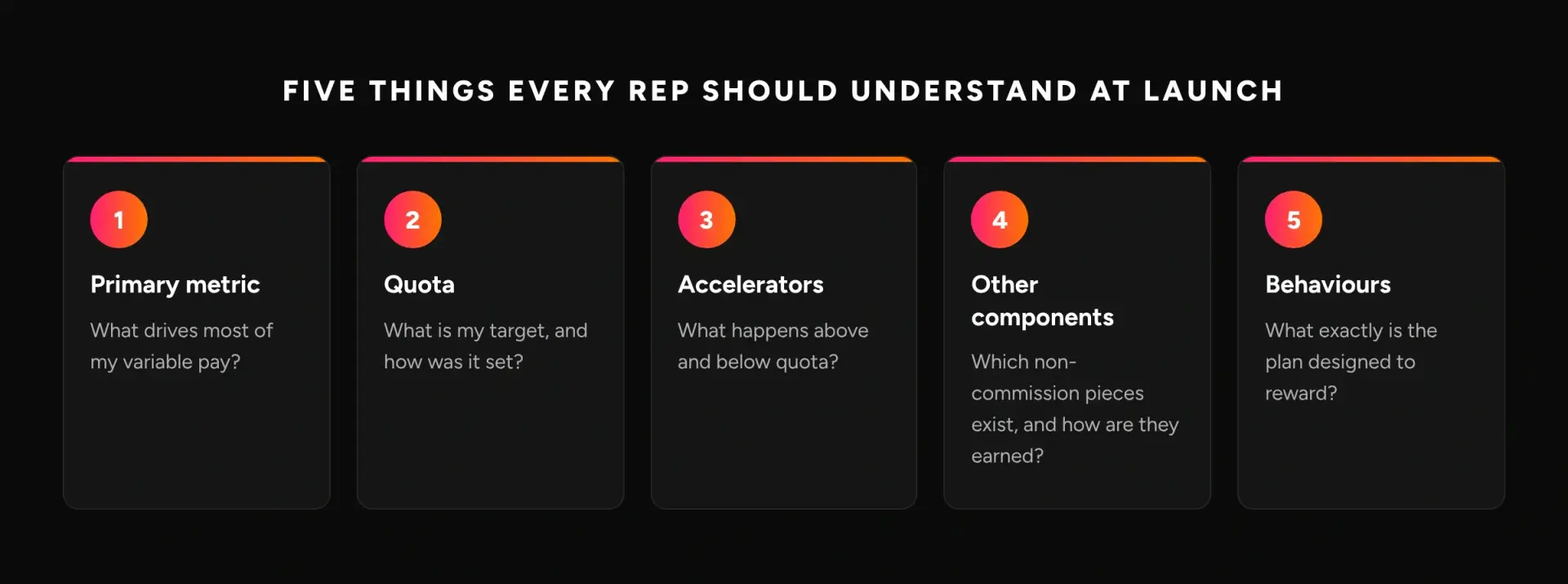
- The primary metric: what drives most of their variable pay.
- Their quota: what it is and how it was set.
- The accelerators: what happens at different attainment levels.
- Other components: any non-commission elements, and how they are earned.
- The behaviours: what specifically the plan is designed to reward.
The administration behind that clarity matters too, but it is not the main communication challenge. That means the full plan documents, exception handling and mid-year adjustment procedures. The main challenge is making sure every rep can answer “what do I need to do to have a good year?” in concrete behaviours, not abstract targets.
How quotas are set has become a more sensitive topic as pay transparency norms spread. Reps who understand the basis for their quota are more likely to see it as credible, even if they would like a lower number. Reps who experience their quota as an arbitrary figure handed down without explanation are more likely to disengage, whether or not it is reasonable. There is a strong case for explaining the method, at least well enough to make the process credible.
What changes in 2027
Several pressures are reshaping incentive plan design going into 2027.
Longer sales cycles. In many markets, enterprise sales cycles keep getting longer and more complex, and deals that once closed in a quarter now take two or three. That strains plans built around quarterly performance. A rep building the right pipeline and running the right process may show poor quarterly attainment for months, until a group of deals closes at once. Purely quarterly evaluation can demoralise reps who are doing the right work. It also creates perverse incentives to pull deals forward in ways that do not serve customers or the business.
AI-assisted selling. AI tools add a new layer to attribution. A rep who uses AI to generate better-qualified outreach, run sharper discovery and shortlist the highest-value accounts may perform far better against quota than a similar rep without those tools. Plans designed before AI-assisted selling may need recalibrating for that productivity lift. Otherwise companies end up overpaying reps for performance their tools largely generated, rather than their own skill.
Customer lifetime value. Lifetime value matters more than initial contract value as a measure of sales quality. A rep who closes deals at steep discounts with customers who churn within a year produces revenue that looks good on a commission statement. It may cost the business more than it earns. Plans with some retention or expansion signal are becoming more common where customer quality varies a lot. Even a simple gate that reduces payouts on deals below a minimum tenure counts.
Key takeaways
- Complexity is deferred decisions, not sophistication. A plan reps cannot explain does not direct behaviour.
- Quota quality matters most. It is the variable that most affects how well a plan works. Quotas set by guesswork or pure top-down allocation reveal themselves in attainment patterns within two quarters.
- Watch the gap between what you reward and what you need. That is where the costliest misalignments live. Revenue is a sound anchor but needs modifiers or gates to block the most damaging behaviours.
- Individual incentives still motivate most. For most sales roles they beat team pools. But hybrid structures increasingly suit complex B2B motions, where deal outcomes are genuinely shared.
- Annual cycles are too slow. Mid-year reviews and continuous monitoring of attainment are becoming a practical necessity.
- AI can catch problems early. AI analysis can spot unintended behaviours as they emerge and surface quota calibration problems that standard reporting misses.
Frequently asked questions
What is a sales incentive plan?
It is the structure that sets how salespeople are paid for performance, beyond base salary. It typically defines:
- a quota
- a commission rate or formula applied to closed deals
- an accelerator structure that raises the rate at higher attainment
It may also include components such as MBO bonuses or team pools. The aim is to align individual earnings with the behaviours the organisation most needs from its sales team.
What makes a sales incentive plan effective?
Effective plans share five traits:
- reps can explain them clearly
- the primary metric is tied to behaviour reps can influence
- quotas come from credible analysis, not top-down allocation
- accelerators meaningfully reward outperformance
- the plan avoids incentives that harm the business
Plans that meet all five are uncommon.
How should sales quotas be set?
Start with bottom-up analysis of the real opportunity in each territory or segment, based on market potential and historical close rates. Then factor in tenure, ramp stage and past attainment. The result should let most reps hit quota with strong execution, with real upside for top performers. If the numbers do not add up to the revenue plan, that is a conversation about capacity and hiring, not a reason to inflate quotas.
What is the difference between a commission and a bonus?
A commission is variable pay tied to a specific transaction or revenue outcome, usually a percentage of deal value, earned deal by deal. A bonus is paid periodically, often quarterly or yearly, for reaching defined goals, as a lump sum. Many plans combine both. The terms are often used loosely.
What are accelerators and why do they matter?
Accelerators raise the commission rate once a rep passes set attainment levels, such as a higher rate on revenue above 120% of quota. They make outperformance disproportionately rewarding. That helps retain top performers and signals that exceptional results are valued. Without meaningful accelerators, top performers earn little more than quota attainers.
How complex should an incentive plan be?
The simplest plan that accurately rewards the behaviours you need. For most sales roles, the practical ceiling is two or three tracked metrics, with one primary driver deciding most variable pay. Beyond that, complexity tends to add admin work without improving behaviour.
Should incentive plans be transparent to employees?
Yes. Every rep should see the full terms of their own plan, including the payout formula. Explaining how quotas are set is also advisable, because reps who understand the method see their quota as more credible. Organisations do not need to share what other reps earn or how each territory was modelled.
How often should incentive plans be updated?
Major restructures usually happen once a year, with the fiscal planning cycle. A mid-year checkpoint catches drift before it becomes a full year of misaligned behaviour. Some organisations also allow mid-year quota changes for material territory or market shifts, under defined criteria.
What is the right base-to-variable split for sales roles?
It depends on how much control the role has over outcomes. Account executives who own the full sales cycle typically carry higher variable ratios, often between 50/50 and 40/60 (source needed). Roles with less direct deal influence, such as SDRs or customer success managers, usually carry less. Experienced reps may accept more variable pay, while newer reps benefit from a more stable base.
How does customer retention fit into plan design?
Often it does not, and that is a problem. Plans that pay at deal close, with no downside for early churn, encourage closing deals regardless of fit. Common fixes include:
- Clawbacks, which are more common in high-value deals
- Renewal-linked commission, where part of the payout depends on the customer renewing
- Retention metrics in annual bonuses, which suit volume businesses better
Can AI improve how incentive plans are administered?
Yes. AI can:
- model territory potential and past performance to speed up quota-setting
- monitor attainment and flag calibration problems early
- spot unintended behaviour in pipeline data, such as discount clustering or gaming around period end
- give each rep an accurate earnings forecast based on their current pipeline
This article is general information, not legal, financial or compensation compliance advice. Incentive plan design has legal, tax and regulatory implications that vary by jurisdiction and employment relationship. Consult qualified advisers when designing or changing sales compensation programmes.
Build incentive plans that work
Tallect gives you the quota insight, attainment analytics and AI monitoring to design incentive plans that drive the behaviour your business needs.