
Formula-Based or Discretionary Bonus: How to Choose
Formula and discretionary bonuses each have real strengths and failure modes. The right choice depends on your roles, managers and culture.
Most bonus decisions start with an intuition rather than a framework. A finance team builds a model, ties it to revenue targets and calls it a formula bonus. An HR team decides performance is too nuanced to capture in numbers, gives managers a budget and a rating, and calls it discretionary. Both approaches work for some companies in some situations. Both cause serious problems in the wrong context.
The debate rarely resolves cleanly because the two approaches optimise for different things:
- Formula bonuses optimise for objectivity, consistency and a clear line of sight between effort and outcome.
- Discretionary bonuses optimise for flexibility, judgement and the ability to reward contributions that do not fit a metric.
Neither is inherently better. The question is which one fits your roles, your managers and what you are trying to achieve when bonus season comes round.
How formula-based bonuses work
A formula bonus is any structure where the payout can be calculated in advance from known inputs. Sales commission is the most familiar example: a fixed percentage of revenue, with accelerators above target and decelerators below. The same principle applies wherever measurable outputs can be tied to a defined payout schedule:
- a production team hitting throughput targets
- an operations role measured against service level agreements
- a finance function rewarded for keeping costs within budget
The defining feature is that employees can, in principle, work out their bonus before the cycle ends. They know the formula, can track their metrics and can see how their effort maps to their payout. That predictability is not incidental. It is the main way formula bonuses are meant to shape behaviour: when the link between action and outcome is clear, people direct effort towards what moves the number.
Formula bonuses are also simpler to administer. They cut the number of year-end conversations HR and finance have to manage. They limit exposure to equal pay claims by grounding differences in documented metrics. And they make any individual payout easier to defend if it is questioned.
Goodhart’s Law and metric gaming
The principle known as Goodhart’s Law holds that once a measure becomes a target, it tends to stop being a good measure. It applies directly to bonus design. When employees know exactly which metrics decide their payout, they optimise for those metrics, sometimes at the expense of the outcomes the metrics were meant to stand for. For example:
- A customer service team measured on call resolution time learns to close tickets quickly rather than thoroughly.
- A product manager measured on features shipped ships small features to hit volume targets.
This gaming is not necessarily dishonest. Employees are doing exactly what the formula asks; the formula has simply stopped asking for the right thing. Recognising this is a prerequisite for designing formula bonuses that hold up over time.
Where formula bonuses break down
Formula bonuses have a well-known failure mode: they measure what they measure, not necessarily what matters. The gap between metric and goal can be small and manageable. It can also be large enough to steer whole teams away from what the organisation actually wants.
The problem grows in roles where the most important contributions are qualitative:
- A senior engineer whose main value is design judgement, mentoring junior colleagues and preventing costly architectural mistakes. None of that maps neatly to a metric.
- A people manager whose team outperforms because she spots and removes friction before it escalates. Her contribution is real and valuable, but it will not show up in any formula.
When formula bonuses reward only what can be counted, the implicit message is that what cannot be counted does not matter. Employees hear that message.
Formula bonuses also struggle where external factors drive the metrics. Take a sales team that missed target because a major account went into administration, not because of anything they did differently. They still face reduced bonuses if the formula cannot accommodate that context. The metric gave the wrong answer, the formula paid it out, and trust in the system suffers.
How discretionary bonuses work
A discretionary bonus is any structure where the payout is set by a manager’s judgement rather than a fixed formula. It can be fully open-ended, as in “managers allocate budgets as they see fit”. It can also be semi-structured, with performance ratings, recommended ranges and calibration sessions that constrain discretion without removing it.
The appeal is that discretion can capture what a formula cannot. A manager may have watched a team member work through a difficult project, make good decisions under pressure and grow significantly over the year. That person may also have contributed to outcomes no metric captured. A discretionary framework lets the manager recognise all of that, where a formula would miss it entirely.
Discretion also allows for context:
- When a team’s metrics were hit by factors outside its control, a manager can take that into account.
- When an individual had an unusual year, the bonus can reflect what actually happened rather than inputs that do not tell the whole story. Examples include returning from leave, taking on a bigger role mid-year or navigating a team restructure.

The calibration problem
The most persistent failure of discretionary programmes is not bias in any one manager’s judgement. It is inconsistency between managers. Without structured calibration, manager A might give a “strong performer” 15% above target while manager B gives the same rating 5% above target, simply because their personal thresholds differ.
At scale, people doing similar work with similar performance ratings end up with meaningfully different bonuses based on who they report to, not how they performed. This variation is hard to spot without systematic data review. It undermines trust and creates unexplained pay differences that become a liability in pay equity conversations.
Tallect’s calibration tools let HR identify these cross-manager inconsistencies before payouts are finalised, so they can be fixed rather than locked into the record.
Where discretionary bonuses break down
The practical problems with discretionary bonuses fall into two groups: bias and inconsistency.
Bias. Even well-meaning managers apply unconscious patterns when judging performance (source needed). Three are common:
- Proximity bias: employees with more face time are remembered more favourably than equally productive but less visible colleagues.
- Affinity bias: managers tend to rate people who remind them of themselves more highly.
- Recency bias: a strong final quarter can outweigh three mediocre ones in a way a metric-driven system would not allow.
Discretionary systems do not create these patterns, but they do not constrain them either.
Inconsistency. Even if every manager were perfectly unbiased, their independent judgements would still differ. Some managers are naturally generous raters; others apply consistently high standards. Without calibration, an employee’s payout depends partly on their performance and partly on which manager they happened to get. That is a fairness problem, and an increasingly visible liability as pay transparency expectations grow.
Discretionary bonuses are also harder to explain. In a formula system, employees can point to their metrics and see why they got what they got. In a discretionary system, the explanation is “your manager rated you X, and X corresponds to a Y% payout”. That often fails to satisfy, especially for employees who feel their manager did not see all their work. When the reasoning behind a bonus cannot be clearly explained, trust erodes.
Comparing the two approaches
The useful question is not which is better, but what each does well and where each needs compensating mechanisms.
Dimension | Formula-based | Discretionary |
|---|---|---|
Employee line of sight | High: employees can track progress | Low: outcome unknown until communicated |
Recognising qualitative contribution | Weak: only captures what metrics measure | Strong: managers can weigh the full picture |
Consistency across managers | High: same inputs give same outputs | Variable: needs calibration to align |
Adapting to context | Low: the formula does not bend | High: managers can adjust for circumstances |
Risk of gaming | High: employees optimise for the metric | Low: harder to game a judgement |
Risk of bias | Low, if the formula is fair | High: bias enters through judgement |
Administrative load | Lower once the formula is set | Higher: calibration, documentation, reviews |
Pay equity defensibility | High: differences are metric-based | Lower without strong calibration records |
Caption: How formula-based and discretionary bonuses compare across eight dimensions.
The case for hybrid structures
Most organisations that have run either approach at scale eventually move to some kind of hybrid. A common design pairs a formula-driven base with a discretionary modifier:
- The formula produces an initial number from measured performance.
- The manager then has a constrained range, such as plus or minus a set percentage, to adjust it for factors the formula missed.
This keeps the line of sight of a formula bonus, because employees roughly know where they stand from their metrics. Contextual judgement then closes the gap between what the formula measured and what the manager actually saw. The key design question is how wide to make the discretionary range. It needs to be wide enough to matter but narrow enough that the formula stays relevant.
Another hybrid runs different mechanisms for different groups in the same organisation:
- Formula bonuses for sales and other roles with clearly measurable outputs.
- Discretionary bonuses within calibrated bands for engineering, HR, finance and roles where judgement matters most.
This accepts that the right answer varies by role, rather than forcing one structure on the whole company.
Which approach fits your organisation
Several factors tend to predict which approach will work better.
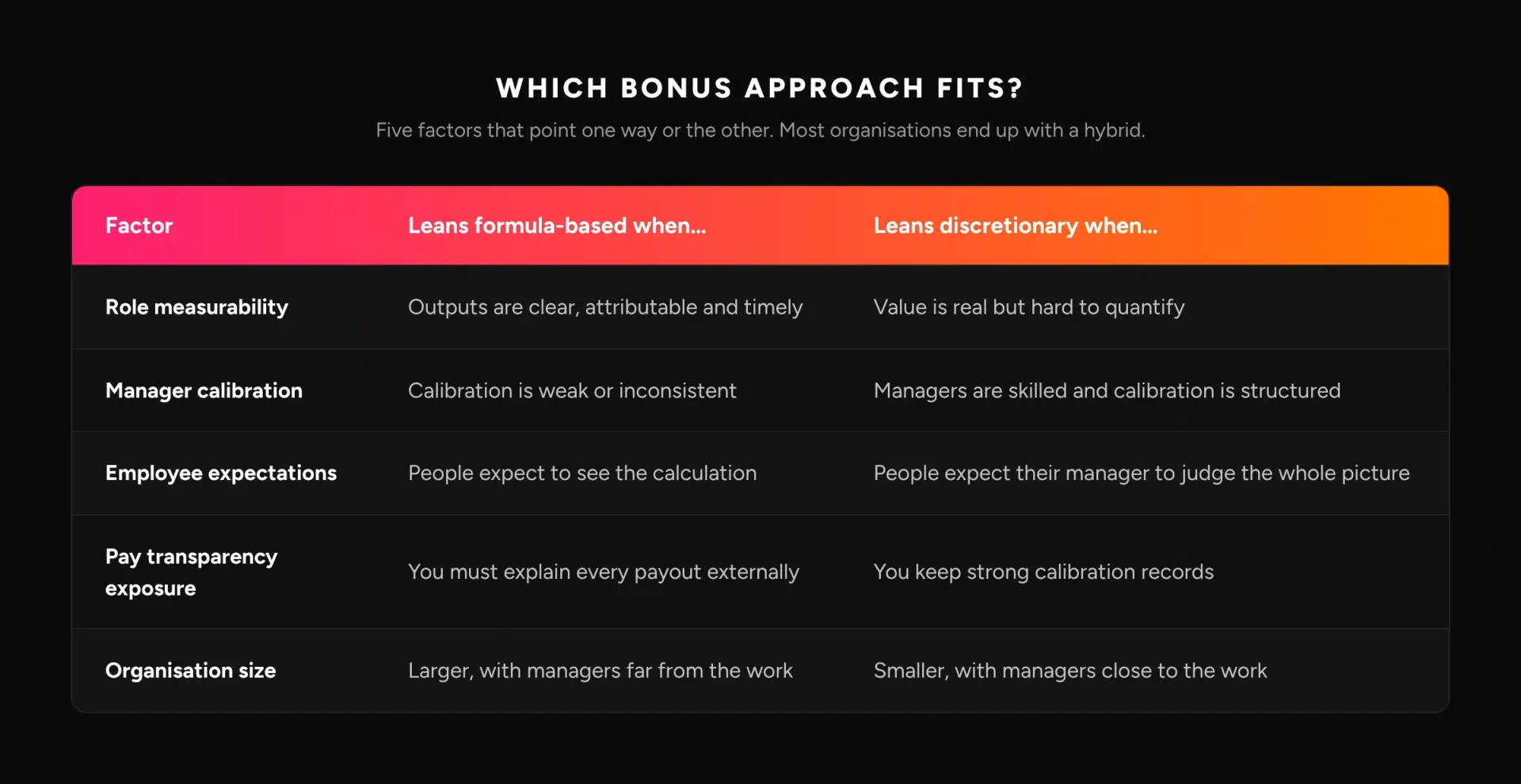
Role measurability. If the work produces clear, attributable, timely outputs such as revenue, units or cases handled, a formula bonus is a natural fit. If the value is real but hard to quantify, as with strategic judgement, relationship management or organisational development, discretion works better, provided it is carefully structured.
Manager quality and calibration. Discretionary bonuses need a level of managerial skill and consistency that not every organisation has. If calibration sessions are perfunctory, performance conversations inconsistent and documentation weak, discretion will produce unfair and indefensible outcomes. Formula bonuses set a floor. They may miss some contributions, but they do not need every manager to be an exceptional evaluator.
Employee expectations and culture. In some cultures and industries, employees expect to understand their bonus formula, and an opaque calculation feels like a breach of trust. In others, employees expect their manager to know their work and reward it, and a formula feels reductive. Getting this wrong in either direction creates dissatisfaction that the size of the payout cannot fix.
Pay transparency exposure. As pay transparency rules expand, being able to explain a pay decision to an employee, an auditor or a regulator is becoming a practical necessity. Formula bonuses are inherently easier to explain. Discretionary programmes need strong calibration records and consistent documentation to stand up to scrutiny.
Detecting calibration drift
Tallect’s AI analyses bonus distributions across managers in the same calibration group and surfaces systematic deviations that signal calibration has drifted, or was never aligned. It:
- Flags unexplained outliers. It identifies managers whose distributions sit consistently above or below the organisation average in ways team composition or performance data cannot explain.
- Separates real performance from inflation. It distinguishes a manager whose team genuinely outperformed from one whose ratings are simply inflated relative to peers.
- Spots inconsistent payouts. It flags cases where the same rating produces materially different payouts depending on the manager.
HR and compensation teams can then step into calibration before payouts are final, instead of finding the inconsistency later in a pay equity review.
What changes as you scale
The right bonus structure at 50 people is often the wrong one at 500.
At smaller scale, managers see most of their people’s work directly. Calibration is informal but often accurate, and the overhead of a formula programme may outweigh its benefits. Discretionary bonuses can work well precisely because the people judging are close to the work.
As organisations grow, that closeness disappears. Managers manage managers. Senior leaders reviewing bonus recommendations are several layers away from the work. The informal calibration that worked at small scale gets replaced by nothing, or by formal processes that are inconsistent and poorly documented. This is usually when the failure modes of pure discretion become acute. Organisations then start adding formula components, distribution curves or structured calibration sessions to limit the variation.
At any size, the design question is the same. Given how much you can actually observe, and how consistent your managers are as evaluators, which approach produces outcomes that are fair, defensible and motivating for the roles you want to reward?
Key takeaways
- They optimise for different things. Formula bonuses favour objectivity and line of sight; discretionary bonuses favour flexibility and judgement. The right choice depends on role type, manager quality and what you want to reward.
- Formula bonuses invite gaming. When employees see exactly which metrics decide their payout, they optimise for those metrics, sometimes at the expense of the real goal.
- Discretionary bonuses risk bias and inconsistency. Without structured calibration, payouts vary by manager rather than performance. That creates unfair differences and pay equity exposure.
- Hybrids keep the best of both. A formula base with a constrained discretionary modifier preserves line of sight while allowing judgement. The key question is how wide to make the range.
- Role measurability is the strongest predictor. Clear, attributable, timely outputs suit formulas. Real but hard-to-quantify value suits structured discretion.
- Scale breaks informal calibration. As headcount grows, pure discretion’s failure modes become acute and push organisations towards more structure.
- Pay transparency raises the bar. You increasingly need to explain any individual pay decision. Formula bonuses are easier to defend; discretionary programmes need strong calibration records.
Frequently asked questions
What is a formula-based bonus?
It is a payout calculated directly from measurable inputs, usually performance metrics, targets and a defined payout schedule. Because the formula is known in advance, employees can in principle work out their bonus before the cycle ends. Sales commission is the most common example.
What is a discretionary bonus?
It is a payout set mainly by a manager’s judgement. The manager assesses overall performance, including things no metric captures, and recommends an amount within a budget or range set by HR and finance. Calibration sessions, recommended bands and rating guidance can shape that judgement without removing it. The outcome cannot be calculated in advance.
Which type of bonus is better for motivation?
It depends on the role:
- Formula bonuses motivate more where employees directly control measurable outputs.
- Discretionary bonuses can motivate more where the most valuable work is qualitative or strategic. There, a formula can make people feel their most important work is invisible. But they only work if employees trust that their manager sees their work and judges it fairly.
What are the main risks of a discretionary bonus system?
Bias and inconsistency. Bias, such as proximity, affinity and recency bias, enters through manager judgement. Inconsistency arises when managers apply different standards. Both can be reduced with structured calibration, documented rating criteria, distribution guidance and a review of cross-manager patterns before payouts are final.
What are the main risks of a formula-based bonus system?
There are three:
- Metric gaming: optimising for the formula’s inputs rather than the outcome they stand for.
- Rigidity: the formula pays the wrong answer when outside factors affect the metrics.
- Invisible contributions: qualitative contributions the formula does not measure go unrewarded.
What is a hybrid bonus structure?
It pairs a formula-driven base with a constrained discretionary modifier. The formula sets an initial number from measured performance, and the manager can adjust it within a defined range for factors the formula missed. Many mature organisations land on this after experiencing the failure modes of either pure approach.
How does company size affect the choice?
Smaller organisations can often run discretionary programmes well, because managers are close to the work. At scale, that closeness and informal calibration break down. Formula bonuses become more attractive as headcount grows, and many organisations add formula elements or structured calibration as they grow.
How should calibration sessions work?
Calibration sessions bring managers in a cohort together to review and align their recommendations before they are final. They compare recommendations against peers to spot outliers, both individuals and managers whose distributions sit persistently high or low. Calibration works best when it is data-led, using aggregate distributions, cross-manager comparisons and documented criteria. Sessions based purely on verbal advocacy tend to favour confident speakers over accurate judgement.
How does pay transparency affect bonus design?
Expanding transparency rules raise the bar for explaining any individual pay decision to an employee, a works council or a regulator. Formula bonuses have a natural advantage, because differences rest on documented metrics. Discretionary programmes are more exposed unless they keep strong calibration records and evidence that similar performance was treated similarly.
Can formula and discretionary bonuses coexist?
Yes, and in many organisations they should. Sales and other roles with measurable outputs suit formulas. Knowledge workers, senior individual contributors and leaders suit structured discretion. This works as long as each group understands which model applies to them and why, and target bonus opportunity is equitable across both.
What role does Tallect play in bonus programmes?
Tallect supports both types of programme:
- Formula bonuses: metric integration, payout modelling, what-if scenarios and audit trails for every calculation.
- Discretionary bonuses: the calibration workflow, with distribution data, cross-manager comparisons and outlier flags before approval.
Its AI surfaces calibration drift and bias patterns, and it handles pay equity reporting across both types.
This article is general information reflecting broad practice in compensation and bonus design. It is not legal, financial or HR consulting advice. Bonus structures, tax treatment and regulations vary by jurisdiction, company type and workforce. Consult qualified advisers before changing your compensation programmes.
Design bonuses that hold up
Tallect helps you model, calibrate and run formula and discretionary bonuses, with the data to catch inconsistencies before payouts are final.