Funding the Bonus Pool When the Budget Falls Short
When year-end numbers will not fund the pool employees expected, what HR and finance decide next decides who stays.
At some point in most companies’ histories, the year closes and the bonus maths does not work. The usual reasons:
- revenue came in short
- a major deal slipped into the next quarter
- the company hit costs it had not planned for
Whatever the reason, the pool HR and finance need to fund is smaller than what employees were led to expect, and someone has to decide what to do about it.
This is one of the hardest situations compensation teams face, and it arrives at the worst time. Everyone is tired from the year, manager conversations about performance are already under way, and employees who worked hard through a difficult twelve months are waiting to hear about their bonus. Getting it wrong causes more than short-term frustration. It drives resignations among exactly the people most likely to have options elsewhere.
This article is a practical guide to four decisions:
- how bonus pools are usually structured
- what options exist when the pool falls short
- how to allocate scarce money without destroying differentiation
- how to communicate a shortfall in a way that keeps trust rather than spending it
How bonus pools are funded
Before tackling the shortfall, it helps to understand the mechanics. Pools are funded in different ways depending on company structure, industry and pay philosophy.
A share of company performance. The most common approach in larger organisations ties the pool to financial results, such as a percentage of profit, revenue above a threshold, or EBIT. This links company performance to total payout: the pool grows when the company does well and shrinks when it does not. The logic is sound. The problem is how many employees experience it. Their own performance affects how the pool is divided, but not whether there is a meaningful pool to divide.
A fixed percentage of payroll. This is adjusted at year end based on overall performance ratings. It is more predictable for budgeting, but it can produce odd results when payroll grows mid-year through hiring. The pool expands even if company performance did not justify it.
A leadership-set discretionary pool. This is more common in smaller organisations and professional services firms. Leadership sets the pool based on how the year went. It is flexible but highly variable. It often creates the biggest expectation gaps, because employees have no formula to estimate their likely bonus.
In all three cases, the shortfall appears when the funded pool is much smaller than the amount needed to pay all employees their target bonus.
Defining the shortfall
Not all shortfalls are the same, and diagnosing the gap precisely matters before deciding how to respond.
Size matters. A modest shortfall, where the pool covers most target payouts across the board, is a different problem from a severe one, where it funds only a fraction. A modest gap may be solved with a small, even reduction and clear communication. A severe one forces harder choices about where to concentrate the money.
The cause matters too. A shortfall caused by company underperformance is different from one caused by a flaw in plan design. Sometimes the pool is underfunded because bonus targets were set too high for the financial model. Sometimes individual performance beat plan in ways the pool was not sized for. These are different problems with different causes. Blurring them when you talk to employees makes the conversation harder than it needs to be.
Loss aversion and how a shortfall lands
Kahneman and Tversky’s work on prospect theory showed that people feel losses more sharply than equal gains. A bonus below expectation is not just a smaller gain; psychologically, it feels closer to a loss. That shapes how shortfalls should be communicated.
“Here is what we were able to fund for you” lands differently from “you received less than your target”. The substance is the same, but the reference point changes the experience. Organisations that understand this anchor the message on what was achieved and why, rather than on the gap between expectation and outcome.
Options when the pool falls short
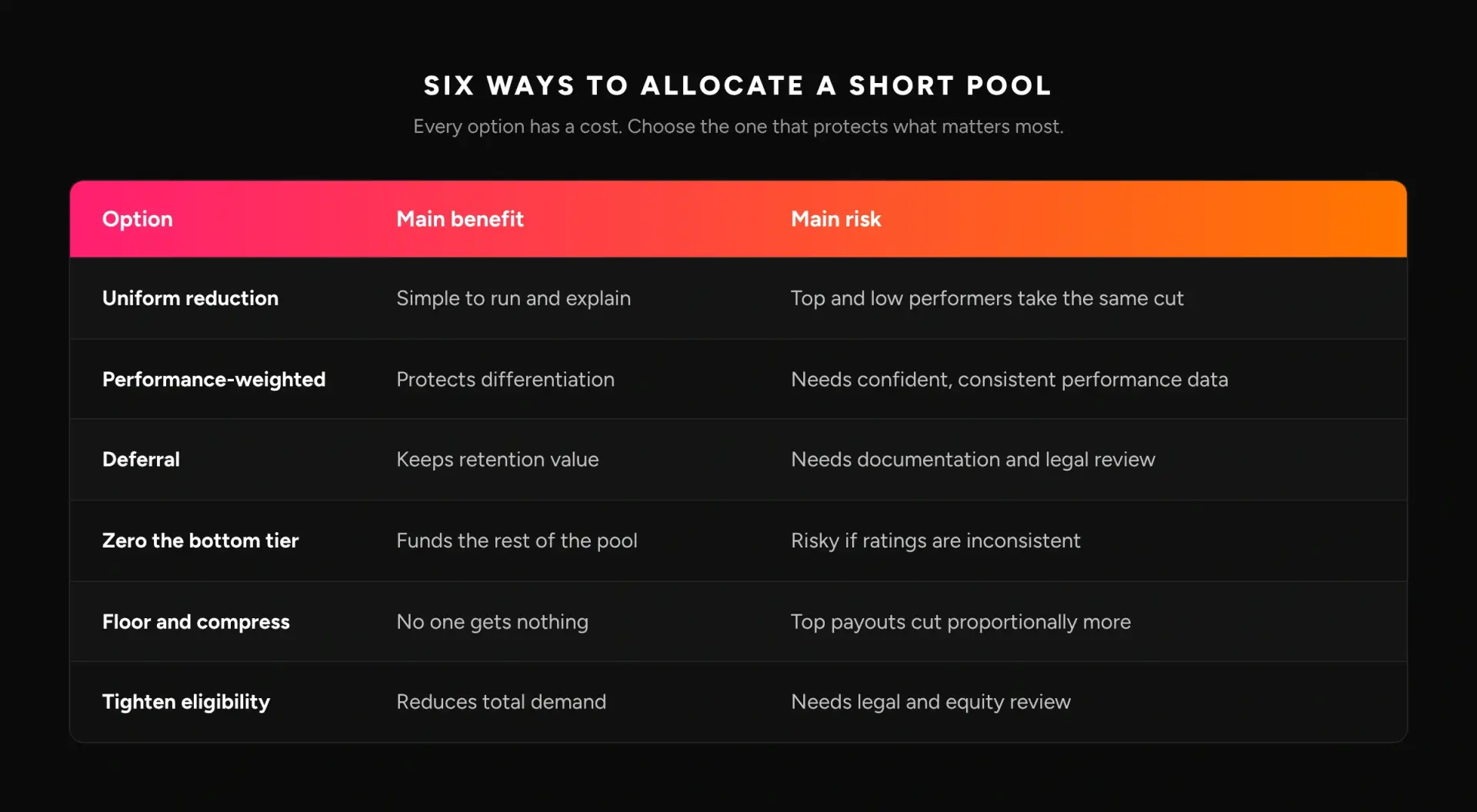
When the pool is underfunded, HR and finance face six main allocation choices, each with trade-offs.
Uniform reduction
Apply the same percentage cut to every payout. It is simple to run and easy to explain. The downside is that it does not differentiate: top performers take the same cut as low performers.
Performance-weighted allocation
Protect high performers’ payouts and absorb more of the shortfall lower down the performance distribution. This keeps differentiation, but you need confident performance data to defend it.
Deferral to a later period
Pay part of the bonus now and the rest in the first or second quarter of next year, subject to continued employment. This keeps retention value but needs clear documentation and, in many jurisdictions, legal review.
Zero out the bottom tier
Pay nothing to the lowest performance category and use that money to protect the rest of the pool. This is defensible where performance differences are clear. It is risky if the bottom-tier ratings are inconsistent or disputed.
Floor and compress
Set a minimum payout for every eligible employee and compress the top of the range to bring the pool within budget. Nobody receives nothing, and the highest payouts shrink proportionally more than the lowest.
Adjust eligibility
Narrow the eligible group, for example by tightening tenure rules or rating thresholds. This reduces total demand on the pool but needs careful legal and equity review first.
None of these options is free. The question is not which one avoids all harm, but which one limits the harm that matters most right now. If your biggest risk is losing top performers, performance-weighted allocation is usually the strongest choice. If your main concern is trust and cohesion, a uniform but honestly explained reduction may do less damage overall.
Protecting differentiation
The temptation in a shortfall is to treat it as an admin problem rather than a talent problem: apply the cut, send the message, move on. That underestimates what a shortfall tells high performers.
Imagine someone who delivered strong results in a hard year. They get the same percentage cut as someone who underperformed. The signal is clear: when things get hard, the organisation does not distinguish strong performance from weak. High performers use exactly that signal when deciding whether to keep their options open.
Protecting differentiation does not mean fully funding top performers’ bonuses. It means keeping the link between performance and payout visible, even as absolute amounts fall. Suppose a high performer gets 80% of target while a low performer gets 40%. Both have felt the shortfall, but the gap between them is intact. That sends a very different message from both receiving 60%.
The carve-out approach
Some organisations handle shortfalls with a two-tier allocation:
- A standard pool for most employees, subject to the uniform or weighted reduction.
- A separate carve-out pool for identified high performers and critical roles, funded at a higher level of protection.
The carve-out is sized by retention risk analysis. It usually covers a set percentage of the workforce judged hardest to replace, and it is calculated separately so it does not absorb the shortfall directly.
This approach has three requirements:
- defensible criteria for who is in the carve-out
- strong documentation to withstand pay equity scrutiny
- disciplined confidentiality in manager communication
Done well, it protects the people most likely to leave while spreading the reduction across a larger group. Tallect’s allocation tools support this model by running both pools against the same employee data at once, so you can see the trade-offs before the approach is final.

The communication challenge
The allocation decision is technical. The communication decision is human, and it carries more risk of lasting damage than the allocation itself.
The most common mistake is treating the shortfall message as a disclosure rather than a moment of trust. HR drafts a message that states the financial facts, the pool size and the adjusted payout percentages. It is complete and legally sound. It also tells employees almost nothing about how the organisation thought the decision through, what it prioritised or what it means for next year. Employees fill that silence with their own interpretations, most of them unfavourable.
Effective shortfall communication has three parts:
- An honest account of what happened. Not vague references to “market conditions”, but a direct explanation of the specific financial gap and why it happened. Employees are not fragile. They can handle the truth about a hard year. What they will not tolerate is being managed.
- How the allocation was decided, and what was prioritised. If you protected differentiation, say so and explain why. If you set a minimum floor, say so. The reasoning matters as much as the outcome, because it tells employees how the organisation thinks about them.
- A credible view of what comes next. What changes next year? Is the pool structure changing? Are target bonuses being revised? Are the causes of this shortfall being fixed? Employees who get a disappointing bonus and see no reason to expect next year to be different start weighing their options that same week.
What not to do
Several common reactions to a shortfall make things much worse.
Raiding next year’s budget. Borrowing from future pools to protect this year’s payouts avoids pain now but compounds the problem next cycle. The same employees who felt fairly treated this year will face a smaller pool next year. By then the company has used up its goodwill and has less credibility to explain a second shortfall.
Announcing the shortfall without a plan. Telling managers the pool is reduced, without giving them allocation guidance, a communication framework or answers to employees’ likely questions, creates chaos. Managers who cannot explain a decision will either make something up or say nothing. Both are worse than a clear organisational message.
Surprising people in the conversation. Some employees have had no signal that the bonus cycle was under pressure. Learning about a large shortfall in the same conversation as their payout is a shock that makes the number feel worse than it is. Organisations that send signals mid-year keep far more trust than those that stay upbeat until the last moment. Even a vague signal helps, such as “it’s been a challenging year and we want to be open about expectations heading into the final quarter”.
Inconsistency across managers. When some managers are candid and others soften the message or avoid explaining it, employees compare notes. They conclude the inconsistency reflects organisational dysfunction, not manager style. A centrally coordinated approach prevents this, with talking points, common framing and clear guidance on what managers can and cannot share.
Modelling pool scenarios before you decide
Before any decision is communicated, Tallect’s AI runs several allocation scenarios side by side against the full employee dataset. HR and finance then see the real distribution impact of each approach instead of judging options in the abstract.
For a given pool size, it models a uniform reduction, a performance-weighted allocation and a floor-and-compress approach. For each, it shows:
- the spread of payouts by performance tier
- the differentiation ratio between high and low performers
- how many employees fall below amounts that may trigger retention risk
- the overlap between affected employees and those flagged as critical
Decision-makers get a concrete picture of the talent consequences of each option before committing. They also get the documentation to explain and defend the final allocation to leadership and employees.
Setting better expectations next time
The best long-term fix for shortfalls is upstream, in how bonus expectations are set in the first place.
Many organisations accidentally promise more certainty than the bonus structure can deliver:
- The manager’s estimate. A manager tells a new hire “the bonus here is usually around 15–20% of base”. The new hire hears a reasonable expectation, not a range that could be zero in a bad year.
- The offer letter. An offer letter lists a “target bonus of 20%”. Employees read “20% unless something extraordinary happens”, not “20% if finances allow”.
The language of “target” and “opportunity” is meant to signal that the bonus is conditional. It rarely does.
Organisations that manage expectations well talk in explicit ranges. In a strong year, the bonus for this role is around X; in a base year, around Y. In a year when targets are missed badly, it could be much lower or zero. That conversation is uncomfortable at offer stage or in a mid-year review. It is far less uncomfortable than the one that follows a shortfall, when an employee feels misled by the word “target”.
Some organisations go further and share the formula that links pool funding to company performance. Employees can then track the pool’s likely state as the year goes on, using internally shared performance updates. That takes the shock out of a shortfall, because people have watched the pool’s trajectory all year rather than waiting for a year-end announcement.
Key takeaways
- Communication matters as much as allocation. How you explain the decision shapes the damage to trust more than the payout itself.
- Every allocation option has trade-offs. Uniform reduction, performance weighting, deferral and floor-and-compress each affect differentiation, retention risk and defensibility differently. The right choice depends on where you are most vulnerable.
- Protect differentiation. High performers who take the same cut as low performers draw a clear conclusion about how the organisation values performance, and act on it.
- Carve-outs can protect key talent. A separate pool for high performers and critical roles helps retention, but it needs defensible criteria and strong documentation.
- Good communication has three parts: an honest account of what happened, how the allocation was decided, and a credible view of next year.
- Signal pressure early. Springing a shortfall on people in the payout conversation is worse than signalling pressure mid-year. Even vague early signals keep much more trust.
- Fix it upstream. Set bonus expectations as explicit ranges rather than targets, and link pool updates to company performance so employees can see the likely outcome before year end.
Frequently asked questions
What does it mean when a bonus pool is underfunded?
The total available for bonuses is less than the sum of target bonuses across eligible employees. This can happen for three reasons:
- company results missed the thresholds for full funding
- the pool’s design assumptions did not hold
- individual performance beat plan in ways the pool was not sized for
The gap is the shortfall, and it has to be absorbed in the allocation, the payout or both.
Can a company legally reduce bonuses it has already communicated?
It depends on the jurisdiction and what was promised:
- Contractually guaranteed bonuses, stated as a fixed amount rather than subject to conditions, may be a breach of contract to reduce.
- Bonuses described as discretionary or subject to company performance usually give more flexibility.
The wording of offer letters, contracts and plan documents all matters. Take employment law advice before finalising allocation decisions.
What is a performance-weighted bonus reduction?
It applies different cuts to different performance levels instead of one uniform percentage. High performers get a smaller cut, or none, while lower performers absorb more. This keeps the link between performance and pay intact. It needs consistent performance data and clear communication about how the allocation was set.
How does a bonus deferral work?
Part of the bonus is paid at year end and the rest in a later quarter, usually the first or second quarter of the following year, subject to continued employment. It cuts the year-end cash outflow while keeping some retention value. Deferrals need clear documentation, local legal review and open communication about timing and conditions. They work best when employees trust the deferred amount will be paid.
How should managers communicate a bonus shortfall?
Honestly, specifically and with a forward view. Managers should:
- explain what happened at company level in plain terms
- describe how the allocation was decided
- acknowledge that the outcome is disappointing
- offer something concrete about the next cycle
They need central talking points and clear guidance on what they can and cannot share before these conversations.
What is a bonus pool carve-out?
A separate fund within the pool, set aside for a specific group, usually high performers or critical roles, and protected from the general reduction. These employees receive payouts closer to target while the cut is spread more widely. Carve-outs need defensible criteria, strong documentation and careful handling to avoid looking like favouritism.
Do bonus shortfalls increase attrition?
Voluntary attrition tends to rise after a shortfall, especially among high performers with options (source needed). The rise is driven less by the payout amount than by what the communication signals. Employees are less likely to leave when they feel three things:
- the situation was explained honestly
- strong performance was recognised within the constraints
- leadership has a credible plan to improve
Should the company warn employees about a likely shortfall before year end?
Usually, yes, once the financial picture is clear enough to give a signal. Cautious early transparency prevents the shock that amplifies damage, and gives managers and employees time to adjust expectations. Staying upbeat through the final quarter and revealing the shortfall at payout combines financial disappointment with a breach of trust.
How should a company handle employees who threaten to leave over a reduced bonus?
It depends on the employee and on how credible the threat is:
- Critical roles with real retention risk. A targeted arrangement separate from the bonus pool may be justified, such as a retention bonus, an accelerated equity grant or a commitment on future pay.
- Frustration rather than a real risk of leaving. An honest conversation about the situation and their value often works better.
A vague promise that “next year will be better” buys a few months at most.
What structural changes prevent recurring shortfalls?
Four changes help:
- link pool funding to company performance through a transparent formula
- describe bonus opportunity as ranges rather than targets
- run mid-year pool forecasts and share directional updates with HR and managers
- check that target pools match what the business can realistically fund across a range of scenarios
What role does Tallect play in a bonus pool shortfall?
Tallect provides tools across the process:
- Scenario modelling compares allocation approaches side by side, with differentiation ratios and retention risk indicators.
- Calibration keeps manager recommendations consistent with the allocation principles.
- Reporting supports pay equity documentation.
- Communication workflows keep manager messaging consistent across the organisation.
This article is general information reflecting broad practice in compensation planning and bonus administration. It is not legal, financial or HR consulting advice. Employment law, bonus obligations and regulations vary widely by jurisdiction. Consult qualified legal and compensation advisers before deciding on bonus pool allocation, deferrals or related communication.
Model every scenario first
Tallect gives compensation teams the allocation modelling, calibration and communication tools to handle a shortfall without losing the people who matter most.