Spot Awards vs Annual Bonuses: What Actually Drives Performance?
Both have a place in a well-designed rewards programme. The question is what each is built to do, and where each quietly breaks down.
Picture two employees at the same company, and both had strong years:
- The first receives a certificate and a cash bonus at the December all-hands, nine months after the project she led hit its goal.
- The second gets a personalised award from her manager the week after a client presentation went particularly well. It comes with a short note describing exactly what she did that made the difference.
Both were recognised. Only one will reliably connect that recognition to the specific behaviour the company wanted to reinforce.
That is the real issue in the spot awards versus annual bonuses debate. It is not a contest between two reward types. It is a question of timing, specificity and what you are trying to achieve within a wider recognition architecture.
What annual bonuses are designed to do
Annual bonuses have long been a fixture of corporate pay. Their purpose is fairly simple. They tie part of an employee’s total pay to overall performance at company, team and individual level, and give employees a financial stake in year-end results.
They suit roles where value builds up over time:
- a finance analyst whose modelling supports three major decisions across the year
- a sales leader managing a pipeline that closes over long cycles
- an HR business partner whose succession and organisation design work will not show results for quarters
For roles like these, judging performance at a single point in time makes less sense than looking at the whole year.
Annual bonuses also help with retention. A bonus paid after the year ends gives people a reason to stay through the measurement period, whether the deferral is formal or just the understood cycle of “bonuses come out in February”. It may not be the most inspiring form of loyalty, but it is real, especially in industries where year-end bonuses are a cultural fixture.
Where annual bonuses break down
The best-known problem with annual bonuses is timing. By December, most employees cannot trace the link between something they did in March and a number on a bonus statement. The behaviour is long past, and the reinforcement arrives too late to reinforce much.
This is not a theoretical concern. Behavioural psychology research has repeatedly found that the gap between a behaviour and its consequence matters a great deal for learning and motivation (source needed). The longer the lag, the weaker the signal. Annual cycles work for financial planning. They work poorly as a way to teach which behaviours the organisation values.
There are structural problems too. Bonus pools are set months in advance, based on projected performance. By the time bonuses are paid, the formula often feels disconnected from what people experienced on the ground.
A strong performer on a team that missed its targets may get a reduced bonus, or none. The message they hear is not “your performance was strong” but “your team underperformed”. Those are different messages, and blurring them erodes trust in the system over time.
The timing problem in recognition
Learning theory has long held that recognition works better the closer it comes to the behaviour it responds to (source needed). The implication for reward design is clear. Recognition that arrives eleven months after the behaviour does very little behavioural work. Annual bonuses can serve retention and financial planning, but they are poorly suited to reinforcing specific behaviours in real time.
What spot awards are built for
A spot award closes the gap between behaviour and consequence. It is also called an on-the-spot bonus, a discretionary award or simply a recognition award. It is given soon after a specific action, with explicit acknowledgement of what happened and why it mattered.
The form varies widely:
- cash
- gift cards
- experiences
- extra leave
- points redeemable in a catalogue
- a formal recognition message shared across the organisation, with nothing tangible attached
What matters more than the form is specificity and timing (source needed). A personal note describing exactly what the employee did, delivered within a week, often beats a generic cash sum that arrives months later.
Spot awards work especially well in two situations. The first is reinforcing behaviour that falls outside a formal job description. These contributions often go unrewarded in a purely metric-driven annual cycle:
- a junior engineer who mentors a new hire without being asked
- a customer service agent who goes well beyond the script to resolve a complicated complaint
- a project manager who flags a risk the wider team missed
The second is when recognition needs to be visible. Spot awards announced to a team or the whole organisation show everyone what good looks like. That signal lands far better alongside a recent, specific event than as a name on a list at the end of the year.

Where spot awards fall short
Spot awards have their own failure modes, and it is worth being honest about them.
Uneven distribution is the most common. When awards are purely at managers’ discretion, they tend to track who has visible relationships with their managers, not who is performing well. Some employees can go months without any formal recognition, not because they are not contributing but because no one is looking:
- people in remote roles
- people in support functions
- people whose managers rarely use the programme
Inflation is the second. When spot awards become routine rather than meaningful, they quickly lose their signal value. That happens when they are given for ordinary parts of the job, or to everyone on a team after any project closes. Employees learn to discount them, and the recognition stops working.
Unpredictability is the third. Spot awards do not serve the planning role that annual bonuses do. An employee promised a certain total pay package needs to know, with reasonable certainty, what they will earn in a year. Spot awards add to a base and bonus structure; they cannot replace the predictability that pay planning needs.
Recognition concentration: a hidden risk
In many organisations with purely discretionary spot award programmes, recognition is concentrated. A few managers issue most of the awards, while much of the workforce receives nothing over a rolling quarter. This is rarely intentional. It reflects differences in manager engagement, team visibility and how much effort the tool takes to use.
The result is a programme most employees never experience, which defeats its purpose however good the individual awards are. Tallect’s recognition data shows these distribution patterns, so programme managers can see the gaps and act on them rather than discovering them in exit surveys.
Comparing them by use case
Rather than a head-to-head contest, it is more useful to map each tool against the jobs it does well or poorly.
Purpose | Spot awards | Annual bonuses |
|---|---|---|
Reinforce a specific behaviour | Strong: close in time to the event | Weak: the lag is too long |
Reward long-cycle contributions | Limited: hard to pin to one moment | Strong: captures the full year |
Retain through predictable pay | Weak: amounts are unpredictable | Strong: employees can plan around it |
Signal values in real time | Strong: visible to teams and peers | Weak: a private payout with no visible signal |
Reward above-and-beyond effort | Strong: can be given outside cycles | Limited: usually tied to measurable targets |
Pay for metric-driven roles | Partial: can supplement, not replace | Strong: linked directly to measurable results |
Support peer recognition | Can support peer-to-peer models | Manager-only |
Caption: Spot awards and annual bonuses suit different recognition jobs.
Building an architecture that uses both
The most effective approach treats annual bonuses and spot awards as layers in one architecture, not alternatives. Each layer does a different recognition job, on a different time horizon, with a different signal.
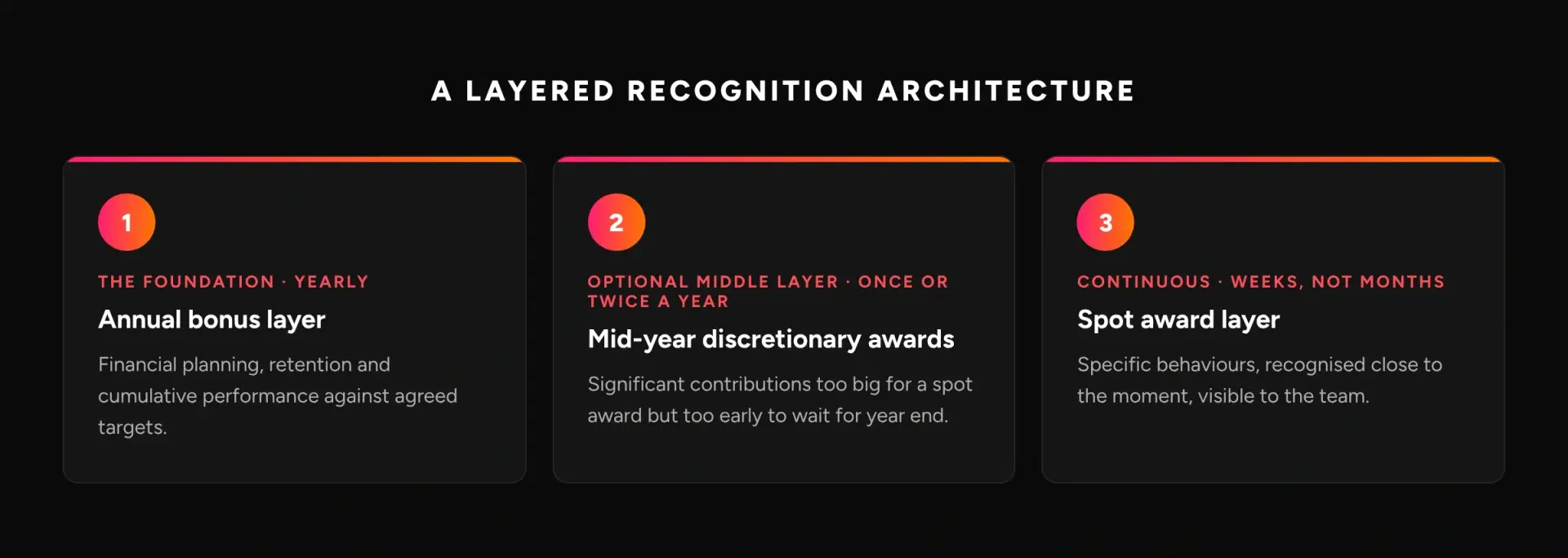
The annual bonus layer handles financial planning, retention and recognition of cumulative performance against agreed targets. It is the foundation. Its job is not to motivate in a behavioural sense but to be fair, predictable and clearly linked to the objectives set at the start of the year.
The spot award layer runs continuously through the year, working in weeks rather than months. It is the tool for:
- reinforcing specific behaviours close to real time
- recognising contributions that would not show up in a metric-driven review
- making the organisation’s values visible through real examples
A mid-year layer sits between the two in some organisations. It is a discretionary award, sometimes a team recognition event and sometimes an individual payment for a project that has closed. It covers contributions too significant for a typical spot award but too early to wait for the year-end cycle.
Whether this architecture works depends on how well each layer is defined and explained. If employees see the spot award programme as an arbitrary extra payout rather than deliberate recognition of specific behaviour, the signal turns into noise. Being clear about what each layer is for, and which contributions it rewards, is what makes a layered programme coherent rather than confusing.
Finding recognition gaps before they become retention risks
Tallect’s AI monitors recognition activity across teams over rolling periods. It surfaces employees who have received no formal recognition, whether a spot award, nomination or peer acknowledgement, within a set timeframe.
It also detects patterns at manager level. It shows where one or two managers give most of the awards while others give almost none. It also shows where recognition keeps going to the same people instead of spreading across the team.
These signals let HR and programme managers step in early:
- nudging managers who rarely use the programme
- highlighting high contributors who have been overlooked
- flagging teams where recognition has effectively stopped
The aim is not to force awards. It is to close the gap between what managers notice and what is actually happening across the workforce.
The 2027 shift in recognition design
Several trends are pushing organisations to rethink how they split recognition budgets between the two tools.
Remote and hybrid work. Remote and hybrid work has reduced the everyday visibility managers once had. In an office, it is easy to notice when someone stays late to help a colleague or handles a hard customer call with unusual care. In distributed teams, those contributions are largely invisible. That is part of why many spot award programmes see recognition fall sharply in remote teams unless someone deliberately compensates for it.
Continuous performance management. Shorter review cycles, real-time feedback tools and frequent check-ins create more natural moments for timely recognition. Organisations that have moved away from annual reviews often find their spot award programmes become more active and effective. Managers are thinking about performance over a shorter horizon, and recognition fits naturally into that rhythm.
Different preferences. Employees in different groups want recognition delivered in different ways (source needed). Younger workers tend to value visibility and peer acknowledgement more. Senior contributors often care more about development opportunities or added responsibility. A single-track programme cannot serve all these preferences. Spot award programmes that offer a range of award types, whether monetary, experiential or developmental, give flexibility a uniform annual payout cannot.
Key takeaways
- They solve different problems. Annual bonuses suit financial planning, retention and long-cycle contributions. Spot awards suit behavioural reinforcement, timely recognition and contributions that do not show up in metrics.
- Timing is the annual bonus’s weak spot. Recognition that arrives nine to twelve months after the behaviour does little behavioural work.
- Spot award programmes usually fail through uneven distribution. The design is rarely the problem. Awards concentrate with a few engaged managers while most employees receive nothing.
- The strongest architectures use both. A predictable annual bonus layer covers financial outcomes, and a continuous spot award layer reinforces behaviour in real time.
- Each layer needs a clear purpose. Without that clarity, employees treat spot awards as arbitrary extras and both tools underperform.
- Remote work makes deliberate systems essential. Remote and hybrid work has reduced everyday visibility, so systems that surface contribution and prompt timely awards matter more.
- Offer a range of award types. Recognition preferences vary by role, seniority and individual. Monetary, experiential and developmental awards serve a diverse workforce better than a single payout.
Frequently asked questions
What is a spot award?
A spot award is a payment or formal acknowledgement given to an employee soon after a specific action or contribution. It is not tied to a fixed review cycle and is usually given within days or weeks. Its defining trait is specificity: it is attached to something the employee did, with an explanation of why it mattered.
How is a spot award different from a performance bonus?
They differ in four ways:
Performance bonus | Spot award | |
|---|---|---|
How it is set | Usually formula-driven | Discretionary |
What it rewards | Results against pre-set objectives | A specific behaviour |
When it is paid | On a set cycle | Outside the review cycle |
What it covers | Measurable targets | Behaviour that targets miss, such as mentoring, problem-solving under pressure or exceptional collaboration |
Do spot awards have to be monetary?
No. They can be gift cards, extra paid leave, experience vouchers, catalogue points or a formal nomination for wider recognition. Timeliness and specificity matter more than the form. That said, cash awards send their own signal about how much the organisation values the contribution.
Can a company have both spot awards and annual bonuses?
Yes, and in most cases that works best. Annual bonuses handle financial planning, retention and cumulative performance. Spot awards handle real-time reinforcement and contributions outside formal metrics. Problems start when organisations treat them as interchangeable. Two common mistakes:
- cutting the bonus pool to fund spot awards
- assuming a big year-end payout replaces timely recognition through the year
How much should a spot award be worth?
There is no universal standard. Values vary by industry, company size and type of contribution. What matters is how the value relates to the contribution: an award that feels token-sized can be worse than none. Clear, communicated tiers for different contribution levels prevent both inflation and confusion.
Who can give a spot award?
Most programmes are manager-driven. Some also allow peer nominations, with managers or HR approving them. Some combine the two, with peers nominating and managers approving and issuing. Peer models tend to surface contributions managers would miss, especially in large or distributed teams.
What makes spot award programmes fail?
There are three main causes:
- Uneven distribution. Some managers use the programme and others do not.
- Inflation. Awards are given for ordinary work.
- An unclear purpose. Employees do not know what the programme is for, so awards feel arbitrary.
Are spot awards taxable?
In most countries, cash and cash-equivalent awards such as gift cards are taxable income, like regular salary. Some non-cash awards may qualify for small-value exemptions, depending on local rules. Work with payroll and tax advisers, explain the tax treatment to employees, and decide whether to gross up awards so employees receive the intended amount.
How should managers be trained on spot awards?
Cover three things:
- what the programme is for and which contributions qualify
- how to write a specific recognition message
- how to make recognition visible to the team where appropriate
Many programmes underperform because managers fall back on vague phrases like “for going above and beyond”. Training on specific messages usually helps more than changing award values or frequency.
How do spot awards affect employee engagement?
Recognition programmes are linked to higher engagement, lower absenteeism and lower voluntary turnover, but the effect depends on quality. A programme where most employees never receive an award will not lift engagement. What matters is whether employees feel their contributions are noticed, and that requires recognition to reach a meaningful share of the workforce.
What role does Tallect play in recognition programmes?
Tallect runs structured spot award programmes alongside annual bonuses and total rewards management. It covers:
- tools for managers to give awards
- peer nomination and approval workflows
- reporting on distribution across teams
- AI signals that surface recognition gaps
It also links recognition data with compensation analytics, so HR can see how recognition relates to retention and engagement.
This article is general information reflecting broad practice in total rewards and recognition design. It is not legal, tax or financial advice. Tax treatment of awards varies by jurisdiction and circumstance, so consult qualified advisers before changing your compensation or recognition programmes.
Build a recognition programme that works
Tallect runs spot awards and annual bonuses as one rewards architecture, with real-time visibility into who is being recognised, and who is not.