Sales Are Down. Should You Change Your Incentive Plan?
Before you change incentives in a slowdown, find out why sales fell. Seven levers, when each helps and what each one costs.
When sales volumes fall, the pressure to act is immediate:
- reps are behind quota
- managers are worried about losing good people
- leadership wants to see a response
Changing the incentive plan feels like the fastest thing you can do. Sometimes it is the right thing. Often it is not, because the plan was never the reason volumes fell.
This article explains how to decide. It starts with a diagnostic. Then it walks through seven levers you can pull, with when each helps, what it costs and what can go wrong.
The short answer
Diagnose before you change anything. A fall in sales volume can come from several causes:
- weaker demand across the market
- a seasonal dip
- a pricing or product problem
- a thin pipeline
- quotas that no longer fit the territory
- low morale and staff turnover
Each cause points to a different response, and some point away from the incentive plan altogether.
Once you know the likely cause, pick the lever that matches it. There are seven:
- Reset or rebalance quotas.
- Change what you measure.
- Use short-term boosters.
- Shift the mix of individual and team pay.
- Use recognition and coaching.
- Protect the floor of earnings and the company’s margins.
- Leave the plan alone.
No lever is always right, and every lever has a cost. Some cost money. Others cost trust, set a precedent or reward the wrong behaviour.
The goal is not to make reps comfortable at any price. It is to keep them focused on the results the business still needs, without paying for results that were not earned.
Diagnose why volumes are down
Before you touch the plan, find out what changed. A decline is not always market-wide. It may affect one region, one product, one segment or one team, and the right response depends on which.
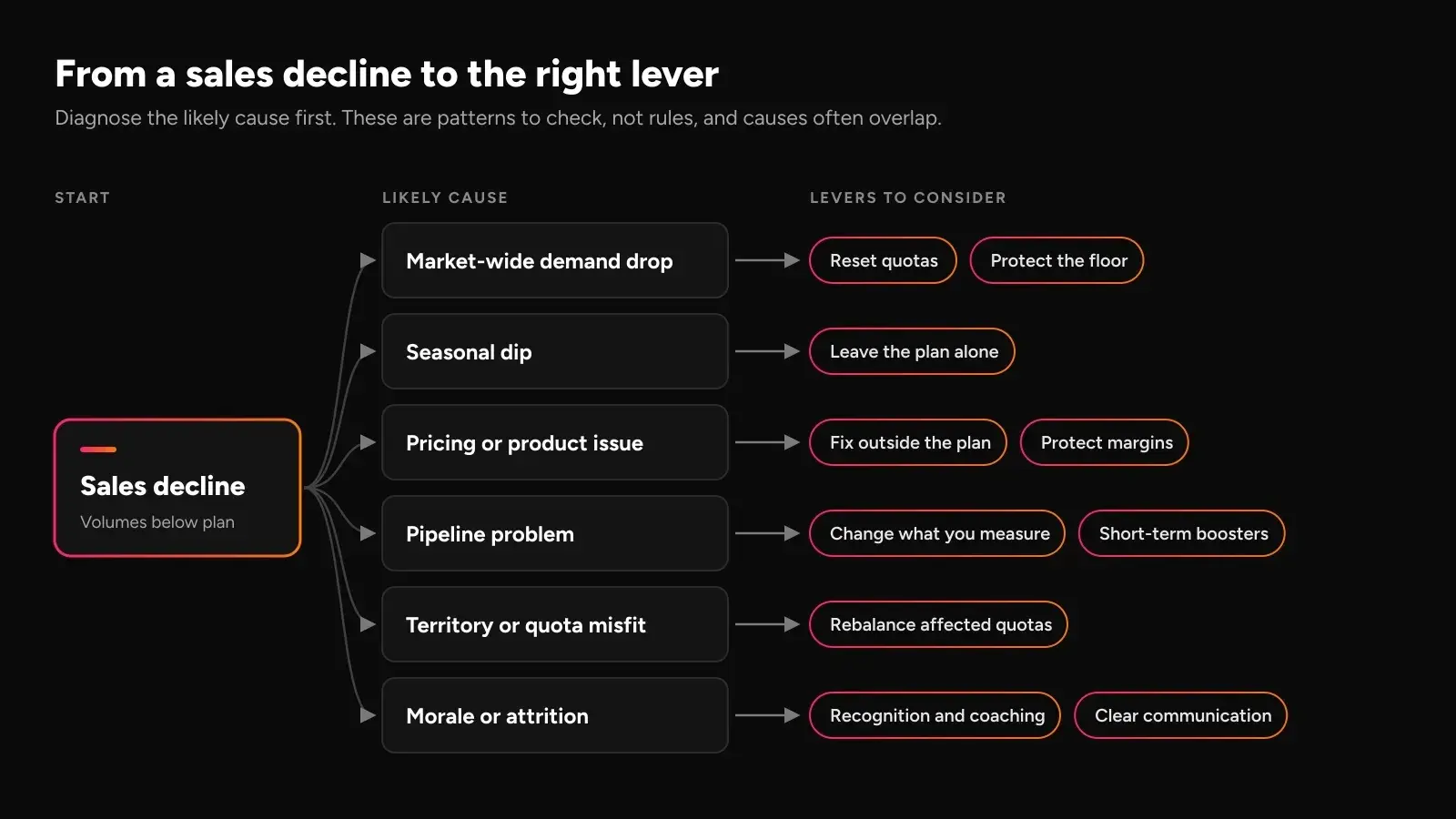
The table below lists common causes and the signs that tend to go with them. Treat these as patterns to check, not conclusions. Several causes often overlap, and the data will rarely point to just one.
Likely cause | What you would see | What that suggests |
|---|---|---|
Market-wide demand drop | Fewer opportunities across most regions and teams, longer buying cycles, more deals stalled at budget approval | Targets may no longer be realistic; plan changes may help retention, but they will not create demand |
Seasonal dip | A decline that matches past years at the same time, with recovery in later periods | Usually no plan change; check that quotas already reflect seasonality |
Pricing or product issue | Win rates falling against competitors, more discount requests, losses citing price or features | Fix pricing or product first; incentive changes may push reps to discount harder |
Pipeline problem | Fewer new opportunities entering the funnel, while win rates on existing deals hold up | Look at lead flow and prospecting; a measure tied to pipeline may help |
Territory or quota misfit | Some territories or reps far behind while similar ones are on track | Rebalance territories or targets for the affected group, not for everyone |
Morale or attrition | Rising resignations, lower activity, top performers disengaging | Recognition, coaching and clear communication; check whether the plan itself is a cause |
Caption: Common causes of a sales decline, the signs that go with them and what each suggests.
To work through the table, compare the current period with the same period last year and with similar teams. Look at the full funnel, not just closed revenue:
- new opportunities
- conversion at each stage
- deal size
- cycle length
- discounting
Talk to managers and a sample of reps. They will often explain in a few minutes what the dashboard takes weeks to show.
Be honest about what you find. The cause may sit outside sales, in pricing, product or marketing. If it does, changing the incentive plan may hide the problem rather than solve it.
Lever 1: Reset or rebalance quotas
Sometimes most reps are clearly out of reach of their targets, and the cause is something they cannot control. When that happens, the plan stops motivating. A rep who knows they will finish far below quota has little reason to push for the next deal. Resetting or rebalancing quotas can restore a target that people believe in.
When it helps
This lever fits a market-wide drop or a territory misfit, where targets were set on assumptions that no longer hold. It is less suitable in two cases:
- a seasonal dip that quotas already allowed for
- a decline caused by pricing or product
How to do it fairly
Decide whether to adjust everyone’s quota or only those of affected teams or territories. Then follow three rules:
- Base any change on the same data you used to diagnose the decline.
- Apply the same method to everyone in a similar situation.
- Be clear about whether the change applies to the rest of the period, to the next period or both.
Whether and how quotas can be changed during a period depends on contracts, plan documents and local law. Check with HR and legal before you change a plan in-period.
What can go wrong
Lowering targets mid-period carries three risks:
- Precedent. Reps may expect the same treatment every time results dip, which weakens future targets.
- Paying for results not earned. You may pay full variable pay for results the business did not get.
- Resentment. Reps who were on track may feel their effort counts for less if others now reach the same payout with lower results.
Common mistake: cutting quotas for everyone when only some territories are affected. That pays the reps who were already on track for results they would have reached anyway.
Lever 2: Change what you measure
When deals take longer to close, closed revenue alone can leave reps with nothing to show for months of work. Adding measures earlier in the sales process can recognise progress and keep effort going while the market is slow.
When it helps
This lever fits a pipeline problem or a longer sales cycle. Measures might include:
- new qualified opportunities
- meetings with decision-makers
- deals moving from one stage to the next
They work best alongside closed revenue, as a smaller part of variable pay, rather than replacing it.
What it costs
Activity and pipeline measures need clean, trusted data. If your CRM records are inconsistent, you will spend time checking entries and settling disputes. The measures also take a share of the budget that would otherwise reward closed business.
What can go wrong
The main risk is rewarding activity over outcomes. If reps earn for meetings booked or opportunities created, they may book meetings that go nowhere or log opportunities that will never close. To limit this:
- define each measure precisely
- check quality as well as volume
- limit how much of variable pay depends on it
Common mistake: keeping an activity measure long after the market recovers. A temporary measure should have an end date, or reps will learn to optimise for it permanently.
Lever 3: Use short-term boosters
Short-term boosters add a time-limited incentive on top of the main plan. They include:
- a SPIFF (a short-term sales incentive) for a specific product or deal type
- a kicker that pays extra above a set level
- a temporary reduction in a threshold
- a temporary floor that guarantees a minimum payout
When it helps
Boosters fit a focused, temporary goal, such as:
- clearing a specific product
- re-engaging dormant accounts
- closing deals stuck at a particular stage
They are less suited to a broad, lasting fall in demand, because a short-term payment cannot fix a long-term problem.
What it costs
The direct cost is the extra payout. The indirect costs are:
- administration
- communication
- the effort of working out whether the booster produced new results or simply paid for results that would have happened anyway
The illustrative example below shows how to think about this.
Line item | Amount | Note |
|---|---|---|
SPIFF payment per qualifying deal | $1,000 | Paid on new deals above $25,000 closed within 30 days |
Qualifying deals closed during the SPIFF | 30 | Team of 20 reps |
Deals expected without the SPIFF | 22 | Estimate based on recent run rate |
Incremental deals | 8 | 30 minus 22 |
Total SPIFF payouts | $30,000 | 30 deals × $1,000 |
Administration and communication | $3,000 | Set-up, tracking and checks |
Total cost | $33,000 | Payouts plus administration |
Cost per incremental deal | $4,125 | $33,000 ÷ 8 |
Caption: Illustrative SPIFF cost for a hypothetical team. All figures are illustrative US dollar amounts, not a recommendation or a typical result.
[Upload image: illustrative-spiff-cost-per-incremental-deal.webp | Alt: Three cards show an illustrative SPIFF paying 30 deals for 8 incremental ones, at $4,125 per incremental deal or $8,250 if half were pulled forward.]
Most of the payout in this example goes to deals that would have closed anyway. Suppose half of the eight extra deals were simply pulled forward from the next month. The cost per genuinely new deal then doubles to $8,250. That does not make the SPIFF wrong, but it changes the decision.
What can go wrong
Boosters can backfire in three ways:
- Reps may hold back deals until the booster starts, or pull forward deals that would have closed next month.
- Repeated boosters teach reps to wait for the next one.
- A temporary floor can reduce the urgency it was meant to protect.
Set clear start and end dates, define qualifying deals precisely, and check results after the booster ends.
Common mistake: running one booster after another. Each may look reasonable on its own, but together they become an unplanned addition to the core plan.
Lever 4: Shift the individual and team mix
In a slow market, deals often involve more people for longer:
- specialists
- presales
- managers
- sometimes several account teams
A plan that pays only on individual results may discourage the collaboration those deals need.
When it helps
This lever fits three situations:
- closing depends on several people
- reps are competing for a shrinking pool of opportunities
- a team needs to support each other through a difficult quarter
A team or hybrid component can reward shared results while keeping individual accountability.
What it costs
Team measures change how earnings are spread. Some strong individual performers may earn less, and the plan becomes more complex to explain and calculate. Crediting rules for shared deals need to be clear before any change.
What can go wrong
The main risk is free-riding, where some people benefit from the team result without contributing to it. To guard against it:
- keep the team share modest
- make individual contribution visible
- keep teams small enough that everyone can see who is doing the work
Common mistake: moving to a team measure to soften individual misses. If the underlying problem is a territory or quota misfit, a team measure only spreads it around.
Lever 5: Use recognition and coaching
Not every lever involves money. Recognition, development, coaching and flexibility can sustain effort when earnings are under pressure. They cost far less than a change to pay.

When it helps
These levers fit three situations:
- a morale or attrition problem
- a team adjusting to a tougher market
- a period where the plan itself does not need to change
Each tool does a different job:
- Public recognition shows reps their effort is noticed. It can mark progress such as good deals won, strong pipeline built or a difficult customer kept.
- Coaching helps reps adapt to longer cycles and tougher buyers.
- Development opportunities and reasonable flexibility can matter more than usual when earnings are lower.
What it costs
The main cost is management time. Coaching only works if managers have the time and skill to do it well. Recognition only works if it is consistent and fair.
What can go wrong
These levers supplement pay. They do not replace it. If reps feel recognition is being offered instead of fair pay, it can damage trust rather than build it. Recognition that rewards only the biggest deals can also discourage everyone else.
Common mistake: treating recognition as a one-off gesture. A single award in a hard quarter means less than regular, specific acknowledgement from a rep’s own manager.
Lever 6: Protect the floor and margins
When earnings fall sharply, some companies look for ways to protect reps’ minimum earnings for a time. At the same time, reps under pressure may chase any deal at any price. This lever covers both sides:
- protecting the floor of earnings
- protecting the company’s margins
Protecting the floor
There are three main options:
- a temporary guarantee of part of variable pay
- a draw, which is an advance against future commission
- a non-recoverable amount paid for a set period
These can help retain good people through a difficult stretch. But they cost money without any link to results, and they can reduce urgency if they last too long.
Whether a draw or guarantee can be recovered later, and on what terms, depends on contracts, plan documents and local law. Check with HR and legal before offering one.
Protecting margins
When volume is hard to find, reps may:
- discount heavily
- accept poor contract terms
- sell to customers who are unlikely to stay
If the plan pays on revenue alone, it may reward these deals. Consider three fixes:
- paying on margin or gross profit where possible
- setting clear discount approval rules
- excluding deals below a set margin from incentive credit
Each of these adds complexity, so explain them clearly.
Common mistake: protecting earnings with a guarantee while still paying full commission on heavily discounted deals. The company pays twice: once for the floor, and again for business that adds little profit.
Lever 7: Leave the plan alone
Sometimes the best change to the incentive plan is no change at all. The decline may be seasonal, temporary or caused by something outside sales, such as pricing, product or marketing. In that case, changing the plan may cost money and trust without fixing anything.
When it helps
This lever fits four situations:
- a seasonal dip that quotas already reflect
- a short disruption that is likely to pass
- a cause that sits in another part of the business
- a plan that has only just launched, where a change after a few weeks can suggest it was never thought through
What it costs
Leaving the plan alone is not the same as doing nothing. Reps will still feel the decline. Explain why the plan is not changing and what the company is doing about the real cause. The cost is that some reps may be disappointed, and a few may leave.
What can go wrong
If the diagnosis is wrong, waiting too long can mean losing good people to an unrealistic plan. Set a date to review the decision. Decide in advance what evidence would lead you to change course.
Common mistake: saying nothing. Silence during a decline tends to be read as indifference, even when the decision to leave the plan alone is sound.
Choosing between the levers
The table below summarises the seven levers. Several can be combined, such as a quota rebalance for affected territories alongside coaching for everyone. But each lever you add makes the plan harder to explain and manage.
Lever | Best when | Main cost | Main risk |
|---|---|---|---|
Reset or rebalance quotas | Targets are out of reach for reasons reps cannot control | Variable pay for lower results | Precedent, and paying for results not earned |
Change what you measure | Cycles are longer or pipeline is thin | Data quality and admin effort | Rewarding activity over outcomes |
Short-term boosters | There is a focused, temporary goal | Extra payouts and admin | Gaming, pulled-forward deals, waiting for the next boost |
Shift the individual and team mix | Deals depend on several people | Complexity and redistributed earnings | Free-riding |
Recognition and coaching | Morale is low or the plan does not need to change | Management time | Seen as a substitute for fair pay |
Protect the floor and margins | Good people are at risk, or discounting is rising | Payouts not linked to results | Reduced urgency; margin loss if discounted deals still pay in full |
Leave the plan alone | The cause is seasonal, short-term or outside sales | Rep disappointment | Waiting too long if the diagnosis is wrong |
Caption: Summary of the seven levers, with the main trade-offs of each. Not a ranking or a recommendation.
Communicate changes and measure the effect
Any change to an incentive plan needs to be explained well. So does a decision not to change it. The same practices that apply to launching a new plan apply here:
- brief managers first
- give reps a clear written summary
- show a worked example
- give people one place to ask questions

Explain why, what, how long and when it ends
Reps need four things:
- Why the change is happening, based on the diagnosis.
- What exactly is changing, and for whom.
- How long it will last.
- When and how it will end or be reviewed.
Temporary changes without an end date tend to become permanent by default.
Whether a change can take effect mid-period, and whether notice or consent is needed, depends on contracts, plan documents and local law. Check with HR and legal first.
Set a review date and track the result
Before the change starts, decide what success looks like and when you will check. Track the measures the change was meant to move, such as:
- deals closed
- pipeline created
- attainment spread
Track them alongside the cost and any side effects, like discounting or pulled-forward deals. Compare against the period before, or against a team that did not receive the change.
Reps also need to see how the change affects them. You might use a spreadsheet or a dedicated system such as Tallect’s Sales Incentive module. Either way, the aim is the same: a clear view of quota, attainment and earnings under the changed plan, and how each figure was calculated. That lets you track the effect and lets reps trust the numbers.
Common mistake: declaring success too early. A short-term spike may simply be pulled-forward deals, so look at the period after the change as well.
Frequently asked questions
Should you lower quotas when sales decline?
Only when the diagnosis shows targets are out of reach for reasons reps cannot control, such as a market-wide drop or a territory that no longer fits. Adjust only the affected teams where possible, and use a consistent method. Lowering quotas has costs, including precedent and paying for results not earned. Whether quotas can change mid-period depends on contracts and local law, so check with HR and legal.
Should you run a SPIFF during a sales slump?
Run one only for a focused and temporary goal, such as moving a specific product or closing stalled deals. A SPIFF is less suited to a broad, lasting fall in demand. If you run one:
- set clear start and end dates
- define qualifying deals precisely
- work out how much of the payout goes to deals that would have closed anyway
Repeated SPIFFs teach reps to wait for the next one.
Should you pay on activity metrics instead of revenue?
Usually alongside revenue, not instead of it. Activity or pipeline measures can recognise progress when deals take longer to close, but they risk rewarding effort that does not lead to results. Define each measure precisely, check quality as well as volume, and keep it to a modest share of variable pay. Set an end date if the measure is meant to be temporary.
How do you keep top performers when targets look out of reach?
Start with an honest conversation about the market and what the company is doing about it. Then:
- recognise their contribution specifically
- offer coaching or development
- make sure the plan still rewards strong performance above target
Avoid changes that pay weaker performers the same as top performers for lower results. If targets are genuinely unrealistic, consider a fair, consistent adjustment rather than individual exceptions.
Can you change a commission plan in the middle of a period?
It depends on the plan document, employment contracts and local law, so check with HR and legal before making any in-period change. If a change is possible, explain four things:
- why it is needed
- what changes
- from when
- how it affects earnings already made
Give reps a worked example, and set a review date so the change does not continue longer than intended.
How long should a temporary incentive change last?
Long enough to address the cause you diagnosed, and no longer. Set the end date before the change starts, and tie it to a review point, such as the end of a quarter or a defined recovery in pipeline. Communicate the end date clearly from the start. Changes without an end date tend to become permanent, and reps begin to treat them as part of normal pay.
How do you avoid paying for results that were not earned?
Estimate what results would have been without the change, and compare actual results against that baseline. Then:
- target changes at the teams or deals that need them, rather than everyone
- define qualifying results precisely
- watch for pulled-forward deals and heavy discounting
- check the period after the change
Where a guarantee or floor is used, keep it time-limited and review it on a set date.
Adjust your plan without losing your reps’ trust
Tallect handles thresholds, floors and kickers for every team. When plans change, it shows reps their quota, attainment and earnings, and how each was calculated.