
Learning Stipends as a Core Benefit
A learning stipend sounds simple. Whether it shapes careers or just buys audiobooks comes down almost entirely to design.
The idea behind a learning stipend is simple. Give employees a budget, let them decide how to spend it on their own development, and trust that people who know their own skills gaps will invest well. No approval process, no internal course catalogue, no L&D bottleneck. Just money and autonomy.
In practice, learning stipends are more complicated than they look. They are also more valuable than most organisations realise when they are designed with intention. Some stipends shape how people develop, and others get treated as a minor perk. The difference lies almost entirely in how the programme is structured, communicated and connected to the wider work of the organisation.
This article looks at what that difference involves, where most programmes fall short, and what the successful ones have in common.
Why stipends became part of pay
For most of corporate history, professional development came in one of two forms:
- something the company decided, such as a training programme you were sent on
- something individuals pursued in their own time and at their own expense
Outside a handful of tech companies, employers rarely handed employees a budget to spend however they chose on their own learning.
That changed over the past decade, as three things converged:
- Skills went out of date faster. In many fields, knowledge that was current three years ago is now partly outdated.
- Candidates started asking. Knowledge-work hiring became more competitive, and candidates began weighing learning and development when assessing an offer.
- Remote work changed L&D. Development moved away from in-person formats, which created both a need and an opportunity to rethink how budgets were allocated.
Learning stipends caught on as a simple answer to a complex problem. Employees’ needs are diverse, the L&D team is small, and knowledge changes faster than a course catalogue can be updated. So you give people money and let them work it out.
The question is whether that is enough, or whether the answer needs a little more nuance.
Why choice helps, and its limits
Research on adult learning suggests that learning by choice, on a topic you picked, leads to better retention and use than externally directed training (source needed). This is one of the strongest arguments for stipends over mandatory corporate training. When employees choose what to learn, they tend to engage more deeply and apply it more readily.
The caveat is that choice without a link to purpose can scatter energy. People may spread themselves across interesting topics that never become visible skill on the job.
What a stipend covers
Scope varies a great deal between organisations.
- Narrow scope. Some companies limit eligible spending to job-related courses, professional certifications and industry conferences.
- Broad scope. Others cover almost any learning the employee sees as development, including language apps, cooking classes and music lessons. The idea is that curiosity and the habit of learning are valuable in themselves.
Most programmes sit somewhere in between. Common eligible categories include:
- online courses and learning platform subscriptions
- professional certifications and exam fees
- books and educational materials
- workshops and seminars
- relevant conferences, sometimes including travel
- coaching or mentoring fees, in some programmes
Scope is a design choice that reflects organisational values. A tight scope signals investment in skills with direct work relevance. A loose scope signals a broader commitment to growth for its own sake. Neither is wrong, but each sends a different message to employees and produces different spending patterns.
What employees spend stipends on
When organisations track where stipend money goes, the patterns are revealing.
In technical roles, online learning platforms, certification programmes and specialist courses tend to dominate. Engineers and data professionals often spend much of their stipend on cloud certifications, programming language courses and tool-specific training.
In non-technical roles, spending is more varied. Common choices include project management certifications, leadership programmes, industry conferences and business books. Communication and presentation training also comes up often, especially among people whose career growth depends more on influence than on extra technical knowledge.
Books and audiobooks are nearly universal, because they are cheap and easy to justify and buy. That matters, because a stipend spent mostly on business books is not necessarily building meaningful skill. Books have value, but professional skills mainly develop through practice, feedback and application, not reading.
The programmes that produce the most visible development tend to combine structure, accountability and application. Examples include certification programmes with assessments, cohort-based courses with peer interaction, and coaching with structured check-ins.

The set-and-forget trap
One of the most common failures is “set and forget”. The organisation announces the stipend, sets up reimbursement and never checks how it is used or what it produces.
Employees who are already self-directed learners use it enthusiastically. Those who need more guidance do not know where to start, do not think to ask and quietly leave it unused. The stipend ends up developing people who were already developing themselves, and leaves everyone else behind.
Three low-cost steps change this pattern considerably:
- periodic prompts
- manager conversations
- light guidance on linking the stipend to career goals
The design decisions that matter
The size of the stipend matters less than most organisations assume. Raising the annual amount from modest to generous does not necessarily improve the quality or depth of learning. What matters more is whether the stipend connects to a conversation about what the employee is trying to develop, and why.
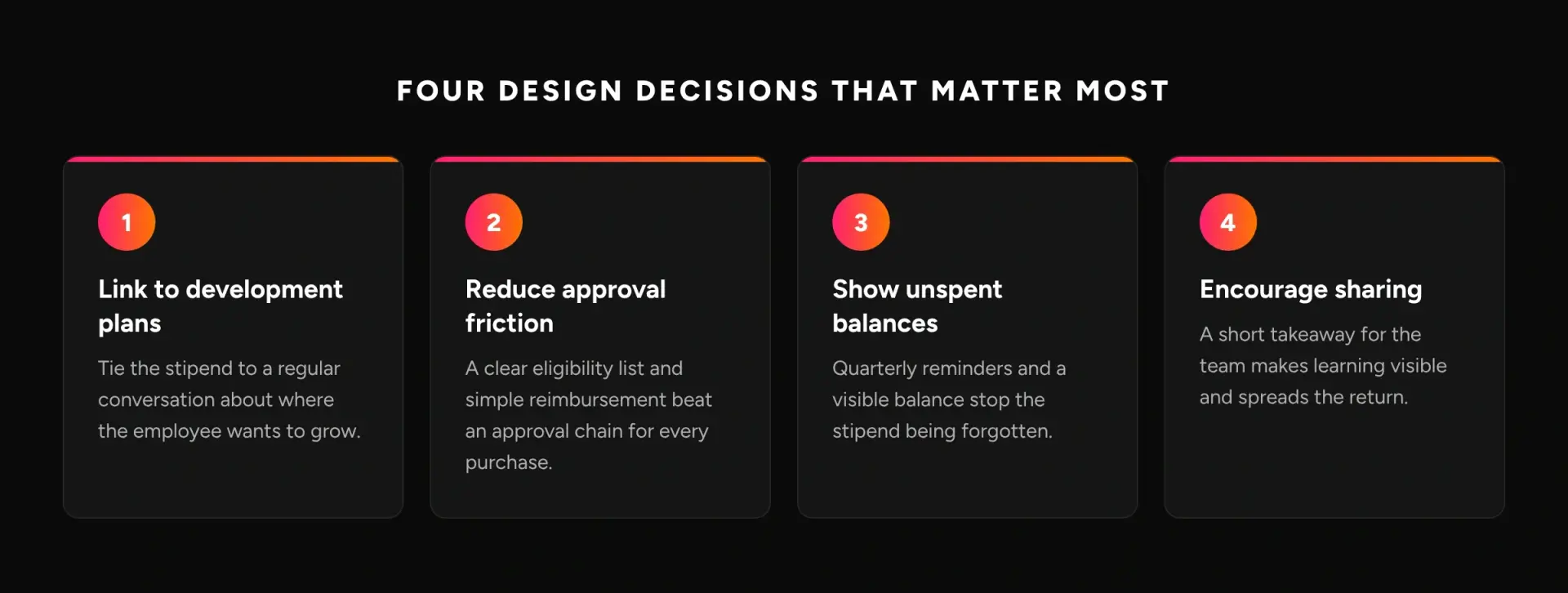
Link it to development conversations
The most effective programmes tie the stipend to a wider development planning conversation. Ideally, the employee and their manager meet once or twice a year to discuss where the employee wants to grow and which skills matter for where they are heading. The stipend then becomes a tool that serves that direction, rather than a free-form budget with no anchor.
Reduce approval friction
Programmes that need manager approval for every purchase often see lower use than simple reimbursement or direct-payment models. Having to ask permission, especially for small amounts, makes people not bother. A sensible eligibility list with a simple submission process works better than an approval chain for each purchase.
Make unspent balances visible
In many organisations, employees do not know their current stipend balance or how much they have used this year. Some programmes surface this regularly, through a quarterly reminder or a visible balance in the benefits portal. They see much better use than programmes where the stipend is technically available but easy to forget.
Encourage sharing what was learned
Some organisations ask employees who use their stipend to share a short takeaway with their team. That could be a brief write-up, a slot in a team meeting or a summary in a shared channel. It signals that learning is valued and visible. It also multiplies the return by spreading knowledge beyond the person who learned it.
How Tallect connects stipends to skill gaps
Tallect’s AI analyses stipend use alongside performance data, role requirements and organisational skill gap signals. It shows where learning investment matches real development needs and where it does not. It can:
- detect roles or teams whose stipend spending is going into areas unrelated to the skills the organisation is trying to build
- flag groups where stipend use is low but skill gap indicators are high
HR and L&D teams can see more than whether the budget is spent. They can also see whether it is spent in ways likely to build the skills the organisation needs over the next one to two years.
Tax and compliance
In many jurisdictions, employer-provided educational assistance has specific tax treatment, and that affects how programmes should be structured. In the United States, for example, qualifying employer educational assistance is tax-free to the employee up to an annual statutory limit (source needed). What counts as “qualifying” matters. Programmes that exceed the limit or cover non-qualifying expenses may create taxable income for the employee. That reduces the net value of the benefit and adds tracking work.
Organisations operating across several countries face more complexity, because the treatment of educational assistance varies widely. In some markets it is fully deductible, and in others it is fully taxable as pay. A stipend programme that spans countries needs to be designed around each country’s tax rules, not just the home country’s.
Learning stipends and retention
A common worry is that investing in learning makes employees more attractive to competitors. The counter-argument, which the evidence tends to support, is that employees who feel invested in are more likely to stay, not less (source needed).
The organisations that lose most of the employees they develop tend to have one thing in common. The investment is not matched by growth opportunities, interesting work, or any sense that the organisation cares about the employee’s future beyond the training budget.
Learning stipends, like most development benefits, work as retention tools when employees feel their growth is genuinely valued. They work less well when the stipend is the only visible sign of that investment and the work itself offers little chance to use new skills or advance because of them.
Key takeaways
- Connect it to development. Learning stipends work best when they are connected to a wider development conversation. An open budget that employees do not know how to use achieves little.
- Visibility beats size. The size of the stipend matters less than clear communication, easy access and regular reminders for employees who may have forgotten it.
- Spending patterns are revealing. Books and audiobooks are everywhere but rarely where the deepest skill development happens. Structured programmes with assessments and accountability tend to produce more lasting learning.
- Friction reduces use. Approval chains lower use. Simple reimbursement or direct payment consistently gets better uptake.
- Check local tax rules. Organisations in several countries need to understand local tax treatment of educational assistance before designing a global programme.
- Match spending to skill gaps. AI can compare stipend spending with skill gap signals, showing where the budget is going and where development needs are highest.
Frequently asked questions
What is a learning stipend?
A learning stipend is a set budget an employer gives employees to spend on their own development. Employees choose what to learn, usually from a list of eligible categories, and are reimbursed or paid directly.
What can a learning stipend be spent on?
Common eligible categories include:
- online courses and learning platform subscriptions
- professional certifications and exam fees
- books
- workshops and seminars
- relevant conferences
Some programmes also cover coaching or mentoring. Broader programmes may include language apps or hobby classes.
How much should a learning stipend be?
The amount matters less than most organisations assume. A larger stipend does not necessarily improve the quality of learning. Connecting the stipend to development conversations, and keeping it visible and easy to use, makes more difference.
Why do employees leave learning stipends unused?
Often they do not know where to start, forget the stipend exists, or are put off by approval steps. Periodic reminders, a visible balance and manager conversations about development goals all lift use.
Should learning stipends need manager approval?
Requiring approval for every purchase tends to lower use, especially for small amounts. A clear eligibility list with a simple reimbursement or direct-payment process usually works better.
Are books a good use of a learning stipend?
Books have value, but professional skills mainly develop through practice, feedback and application. Structured programmes with assessments, cohorts or coaching tend to produce more visible skill development.
Are learning stipends taxable?
It depends on the country. In the US, qualifying employer educational assistance is tax-free up to an annual limit, and spending beyond it may be taxable. Elsewhere, treatment ranges from fully deductible to fully taxable as pay. Check local rules before designing a global programme.
Do learning stipends help retention?
Employees who feel invested in tend to be more likely to stay. Stipends work best as a retention tool when the work also offers chances to use new skills and grow.
How can employers measure the impact of a learning stipend?
Look beyond whether the budget is spent. Track what it is spent on and whether that spending matches the skills the organisation needs. Then check whether employees apply what they learned at work.
How can teams share what they learn from a stipend?
Ask employees to share a short takeaway, such as a write-up, a slot in a team meeting or a summary in a shared channel. This makes learning visible and spreads knowledge beyond the individual.
Connect learning to real skill development
Tallect shows where your learning stipend budget is going, and whether it is building the skills your organisation needs.