
How to Communicate ESOPs to Employees So They Actually Value Them
Most employees can’t say what their ESOPs are worth. Eight practices, a communication calendar and the legal limits to know.
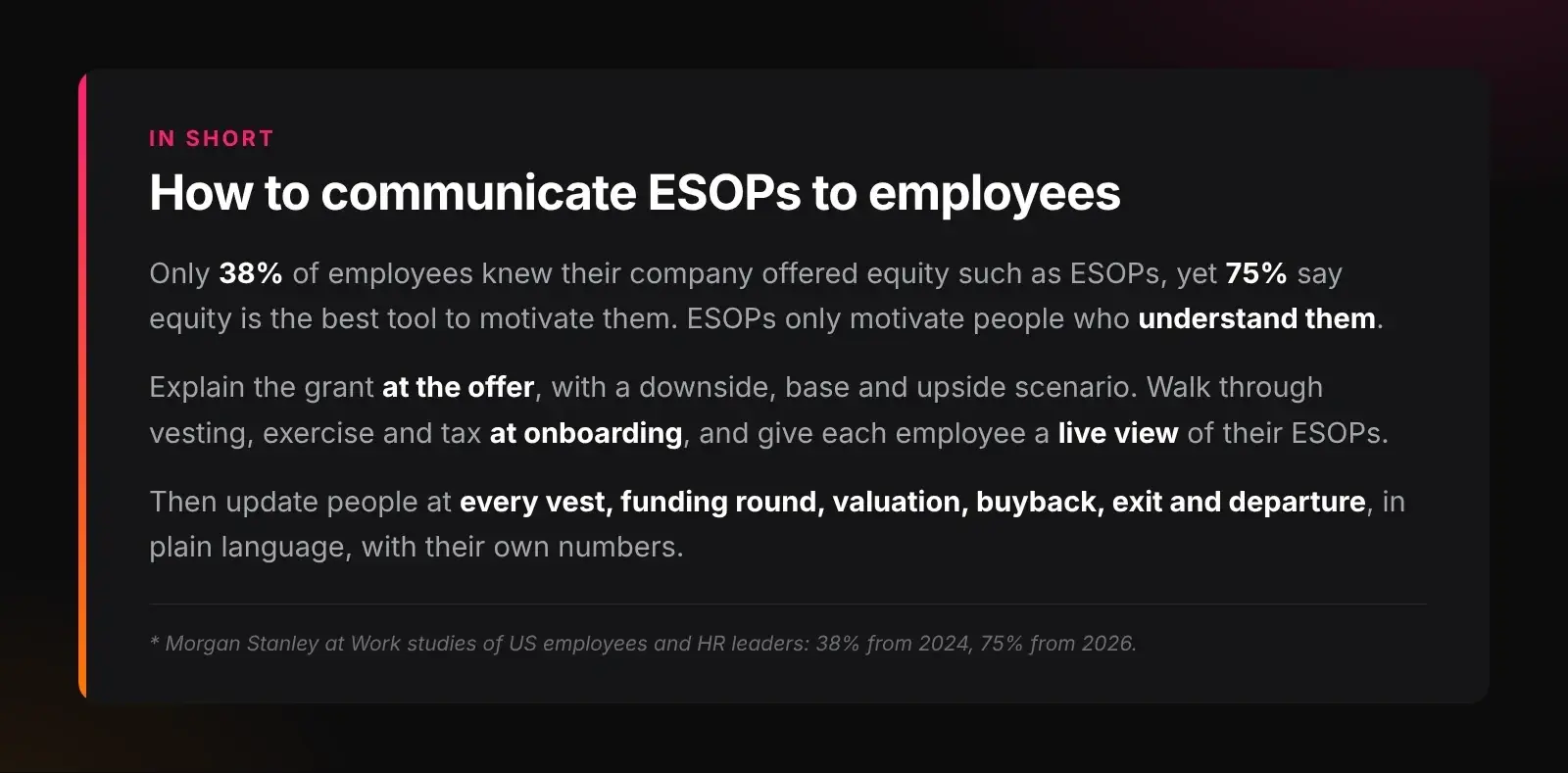
Communicate ESOPs early, in plain language and at every moment that changes their value:
- At the offer, explain the grant with a downside, base and upside scenario.
- At onboarding, walk through vesting, exercise and tax.
- Throughout employment, give each employee a live view of their ESOPs.
- At each event, update people: every vest, funding round, valuation, buyback, exit and departure.
Why don’t employees understand their ESOPs?
Most companies grant ESOPs and then go quiet. The result is a gap between what ESOPs cost the company and what employees think they are worth.
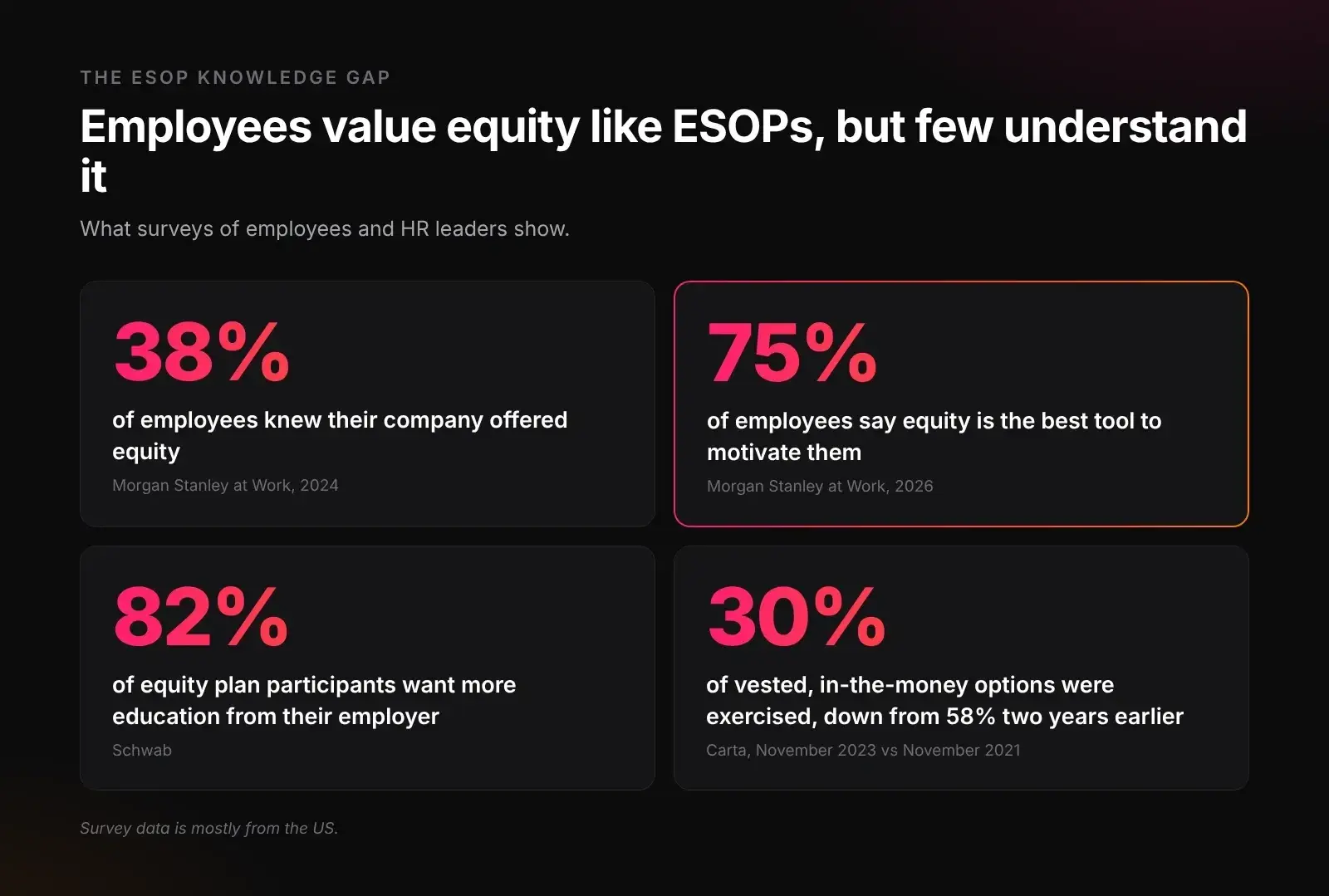
- Many do not know they have it. Morgan Stanley at Work’s 2024 study surveyed 1,000 US employees and 600 HR leaders. Only 38% of employees knew their company offered equity, such as stock options or ESOPs. Only 45% of both groups rated their company’s equity education “very effective”.
- Yet they believe in it. In the 2026 edition:
- 75% of employees and 85% of HR leaders said equity is the best tool to motivate employees.
- 48% of employees at companies that offer equity wanted more help with it.
- They want to be taught. In a Schwab study of 1,000 equity plan participants, 82% wanted more education on equity from their employer (Schwab).
- And they leave value on the table. Among employees at companies on Carta, fewer people chose to exercise vested, in-the-money options. The share fell from 58% in November 2021 to 30% in November 2023 (Carta).
The evidence is mostly from the US. In India, a survey of 268 startups found that lack of knowledge about ESOPs was the biggest barrier to using them (Inc42). We found no comparable survey for the UAE or Saudi Arabia.
What do employees most often get wrong?
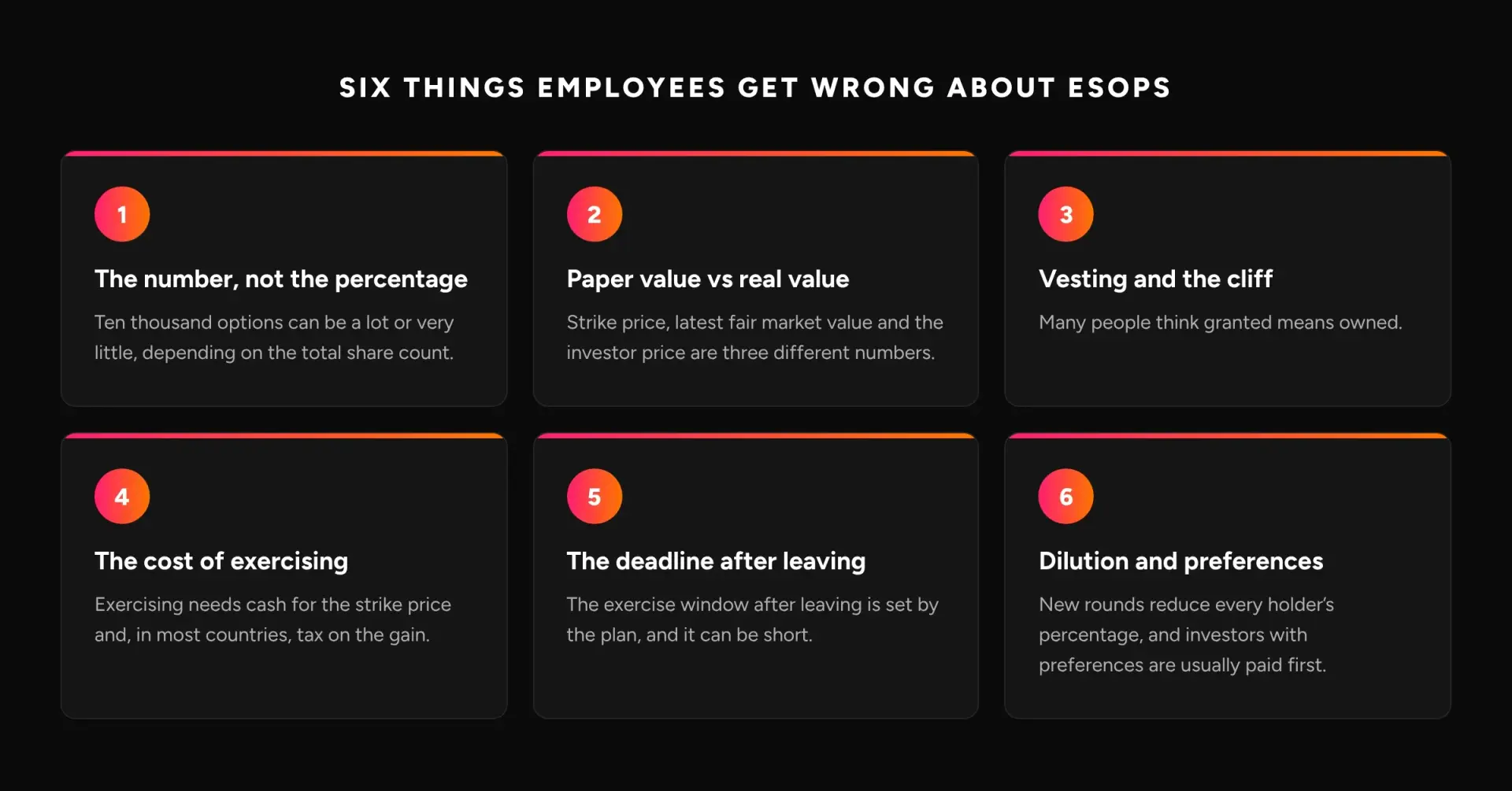
- The number of options instead of the percentage. Ten thousand options can be a lot or very little, depending on the total share count.
- Value instead of paper value. The strike price, the latest fair market value and the price investors paid are three different numbers.
- Vesting and the cliff. Many people think granted means owned.
- The cost of exercising. Exercising needs cash for the strike price and, in most countries, tax on the gain.
- The deadline after leaving. In the US, 80% of option grants on Carta that ended because someone left in early 2024 had the standard 90-day window to exercise (Carta). In India, the scheme sets the window.
- Dilution and preferences. New rounds reduce every holder’s percentage, and investors with liquidation preferences are usually paid first in a sale.
8 best practices for communicating ESOPs to employees
Each practice fixes a specific gap.
Practice | The gap it fixes |
|---|---|
1. Talk about ESOPs before the offer is signed | Unrealistic expectations from day one |
2. Give every employee the numbers that matter | Not knowing the percentage or the cost |
3. Turn the plan document into plain language | Legal terms nobody reads |
4. Communicate at every moment that changes the value | Silence between the grant and the exit |
5. Pair group sessions with personal data | Messages that feel generic |
6. Teach exercise and tax before people need it | Tax surprises at exercise |
7. Make buybacks, tender offers and exits clear | Missed or misunderstood liquidity |
8. Measure whether it is working | No feedback on what landed |
Caption: Eight practices for communicating ESOPs, and the gap each one fixes.
1. Talk about ESOPs before the offer is signed
Show candidates what the grant could be worth with a downside, base and upside scenario, and say plainly that the downside may be zero.
Amplitude gives every hire a scenario spreadsheet. Its CEO walks candidates through it while warning that “the most likely outcome” is that the options end up worth nothing. Honesty at this stage builds more trust than a big number.
2. Give every employee the numbers that matter
A grant letter should never stand alone. With every grant, share:
- the number of options and the total fully diluted share count, so the percentage can be worked out
- the strike price and the latest fair market value, each with its date
- the vesting schedule and cliff
- how long the employee has to exercise, including after leaving
- what an exercise would cost, including an estimate of the tax
The total share count is the number companies most often leave out. To explain it, see percentage of fully diluted shares.
3. Turn the plan document into plain language
Plan documents are written for lawyers. Write a one-page summary in everyday words that answers five questions:
- What do you get?
- When does it become yours?
- What does it cost to buy?
- What happens if you leave?
- What happens if the company is sold?
Define vesting, exercise price, fair market value and fully diluted the first time they appear.
4. Communicate at every moment that changes the value
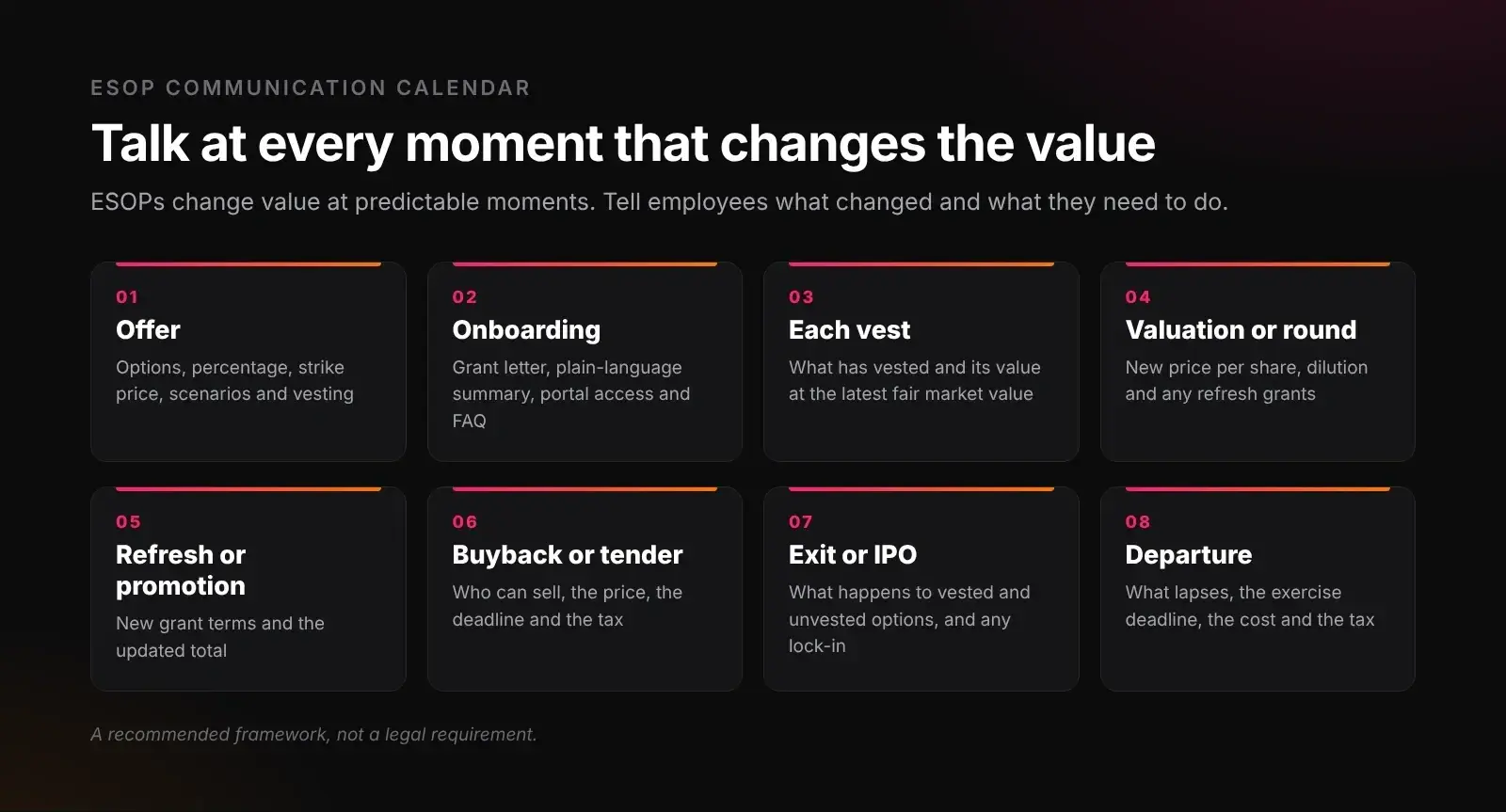
ESOPs change value at predictable moments. Plan a message for each one.
Moment | What to tell employees |
|---|---|
Offer | Number of options, percentage, strike price, scenarios, vesting and exit rules |
Onboarding | Grant letter, plan summary, portal access and an FAQ |
Each vesting date | What has vested and its value at the latest fair market value |
New valuation or funding round | New price per share, effect of dilution and any refresh grants |
Refresh or promotion grant | New grant terms and the updated total |
Buyback or tender offer | Who can sell, the price, the deadline and the tax |
Exit or IPO | What happens to vested and unvested options and any lock-in |
Departure | What lapses, the exercise deadline, the cost and the tax |
Caption: An ESOP communication calendar. A recommended framework, not a legal requirement.
Aon’s Zoe Denny-Thomas puts the principle simply (Ledgy):
“If you spend time creating a plan, you should spend time telling people you created it.”
5. Pair group sessions with personal data
A town hall explains the rules. A personal view shows each employee what the rules mean for them.
Mixpanel is one example. When it extended its exercise window in 2017, its head of legal explained the change at an all-hands meeting. Employees then reviewed their own positions on their equity platform before opting in (Mixpanel).
An employee portal that shows grants, vesting, exercise cost and value does this every day, not once a year.
6. Teach exercise and tax before people need it
Tax is where most surprises happen. Explain, before anyone exercises, how the gain is taxed and when.
- India: The gain at exercise is taxed as salary, and tax is deducted through payroll. For unlisted shares, the gain is based on a fair market value from a SEBI-registered merchant banker. Shares sold later are taxed again as capital gains.
- US: Non-qualified options are taxed as wages at exercise. Incentive stock options can trigger alternative minimum tax, and Form 3921 reports the exercise.
- UAE and Saudi Arabia: There is no personal income tax on employment income in either country. Employees who are tax resident elsewhere may owe tax at home.
Do not give individual tax advice. Give clear examples and point people to an adviser.
7. Make buybacks, tender offers and exits clear
Liquidity is the moment employees learn whether their ESOPs were real. In India, 12 startups ran ESOP buybacks for about 9,265 employees in 2025, worth over INR 1,409 crore, about USD 158 million (Inc42).
Each buyback needs its own message, covering:
- who is eligible
- the price per share
- how much can be sold
- the deadline
- the tax
8. Measure whether it is working
There is no published benchmark, so set your own and track it after each communication. Useful measures are:
- portal logins after each vest or new valuation
- a pulse question: “I understand what my ESOPs are worth and what I need to do to exercise them”
- the share of leavers who exercise before their deadline
- take-up in buybacks or tender offers
- regretted attrition around vesting cliffs
What can you legally disclose?
The law sets the minimum. In most cases you can explain far more than you do today, as long as you label scenarios as illustrations, not forecasts.
United States
- Always: Rule 701 requires the company to give employees the plan.
- Above USD 10 million: Once sales under the rule pass USD 10 million in 12 months, the company must provide more, a reasonable time before exercise (eCFR, Rule 701):
- a plan summary
- risk factors
- financial statements no more than 180 days old
- Avoid: Anything that reads like a projection of share value.
India
- Unlisted companies: The special resolution approving the scheme must already disclose the vesting period, exercise price, exercise period and what happens on leaving. Under Rule 12, the board’s report discloses options granted, vested, exercised and lapsed.
- Listed companies: They must also make stock exchange disclosures under the SEBI (Share Based Employee Benefits and Sweat Equity) Regulations, 2021.
- The practical point: Translating these terms into plain language carries little risk.
UAE and Saudi Arabia
- DIFC and ADGM: Firms regulated in financial services face their own remuneration disclosure rules (Kayrouz & Associates).
- Saudi Arabia: Offers of unlisted shares to employees have been treated as exempt offers under Capital Market Authority rules (Al Tamimi).
- Phantom shares and cash-settled awards: Explain clearly that they pay cash and give no shares or votes.
- Before you publish: Check the current rules with a local adviser.
Where does a total rewards statement fit?
A total rewards statement is one of the best single tools for this. It sets ESOPs next to salary and benefits, values them at fair market value and shows the cash needed to exercise.
It works best as one part of the calendar above, sent once a year and after each new grant. For a full template, see how to show ESOPs in a total rewards statement.
Frequently asked questions
1. How do you explain ESOPs to employees simply?
Say it in one line: “You have the right to buy a number of shares at a fixed price, once they vest, and they are worth something only if the share price is higher than that.” Then show the employee’s own numbers.
2. Why don’t employees value their ESOPs?
Usually because nobody explained it. Many employees:
- do not know they have ESOPs
- cannot work out what percentage of the company they represent
- do not know what exercising would cost
3. When should you tell candidates about ESOPs?
Before the offer is signed. Explain the grant, the percentage and realistic scenarios, so candidates can weigh it against salary.
4. What should an ESOP grant letter include?
- the number of options
- the strike price
- the grant date
- the vesting schedule and cliff
- the exercise period, including after leaving
- a reference to the plan
Send a plain-language summary with it.
5. How do you show employees what their ESOPs could be worth?
Use the latest fair market value for today’s value, and two or three clearly labelled scenarios for the future. Never present a scenario as a promise.
6. Should companies share the total share count with employees?
Yes. Without the total fully diluted share count, an employee cannot work out what percentage of the company they own.
7. How do you explain phantom stock or SARs?
Explain that they track the share price but pay out in cash. They give no shares or votes, and they are usually taxed as salary when paid.
This article is general information, not legal, tax or investment advice. Rules differ by country and change over time. Speak to your adviser before you publish ESOP values or tax estimates to employees.
Give every employee a live view of their ESOPs
Tallect shows each employee their grants, vesting dates, exercise cost and value in one portal, so ESOPs are understood, not just granted.