How to Roll Out a New HR Policy Across Countries Without Confusion
Multi-country policy rollouts fail when they are treated as a communication task instead of a legal, operational and change management one.
A new HR policy designed at headquarters and emailed to thirty countries is not a rollout. It is a notification.
The difference matters. A notification assumes that employees in Bangalore, Berlin and Buenos Aires will read the same document and reach the same understanding of three things:
- what has changed
- what it means for them
- what they are supposed to do next
That assumption is almost always wrong.
Multi-country policy rollouts have more failure modes than domestic ones:
- Local employment law may prevent direct adoption of the global policy.
- A policy that makes sense in one culture may carry different implications in another.
- The local HR team may not have enough context to answer employees' questions.
- Employees may not trust the global team enough to ask them.
All of these problems are foreseeable. Almost none of them are solved by sending a document.
What follows is a framework for rollouts that actually land: the same policy intent, implemented in a way that makes sense locally, and employees who understand what changed and why.
Start with a legal and compliance audit
Most organisations write the global policy first, then check whether it is legally compliant in each country. That sequence is backwards.
What looks like efficient central drafting produces a document that has to be significantly revised for many jurisdictions. The result is several parallel versions, which are harder to maintain and harder to communicate consistently.
The better sequence is to sort the policy before drafting begins, into elements that are non-negotiable globally and parameters that must or should vary by jurisdiction. These all affect what the policy can say and when it can take effect:
- mandatory consultation periods
- works council requirements
- notice obligations
- data privacy constraints
- local equivalency rules
Getting this input early means the global policy is written around the real constraints, instead of revised after the fact.
This means involving local HR and local employment counsel early. That is slower at the start and faster overall. A six-week legal review during drafting is far less disruptive than a compliance problem in three countries discovered during rollout.
Research highlight: where multi-country policy rollouts break down
Post-rollout audits of global HR policy implementations consistently identify three failure points (source needed):
- One document for every jurisdiction. Teams assume a single document can serve all countries without localisation. Local employment law, works council obligations and notice requirements often make this legally impossible.
- Timing. Timelines set by headquarters often collide with mandatory consultation periods in European jurisdictions. That forces either a delay or a compliance risk.
- Manager readiness. Frontline managers who cannot answer basic questions about a new policy spread confusion rather than clarity. In many markets, they are the first people employees turn to.
Map your countries into rollout tiers
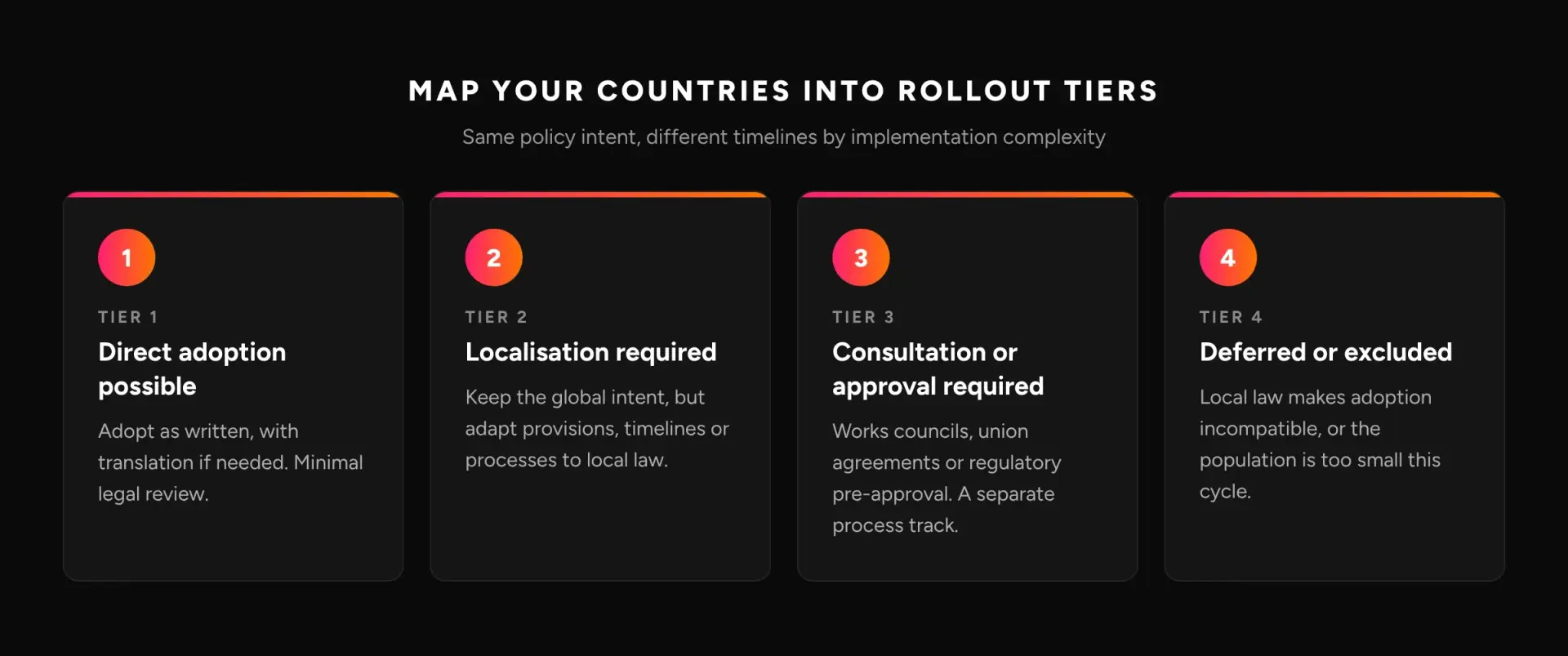
Not every country has the same implementation complexity. A tiered approach lets you handle the most complex jurisdictions properly, without holding up markets where the policy can go live immediately.
Tier | Type | What it means |
|---|---|---|
Tier 1 | Direct adoption possible | The global policy can be adopted as written, with translation if needed. Minimal legal review, and the standard communication process applies. |
Tier 2 | Localisation required | The policy must be adapted to local legal requirements. The global intent is kept, but specific provisions, timelines or processes differ. |
Tier 3 | Consultation or approval required | Works councils, union agreements or regulatory pre-approval apply. These may add weeks or months, and need a separate process track. |
Tier 4 | Deferred or excluded | Local law makes global adoption incompatible, or the employee population is too small to justify localising in this cycle. |
Caption: Four rollout tiers, by implementation complexity.
Mapping countries into tiers before the rollout begins lets you:
- set realistic timelines for each country
- allocate legal and HR resources where they are needed
- explain to business leaders why the same policy has different effective dates in different markets
Translation is only the start
Translated documents are necessary, but not sufficient. A direct translation of an HR policy written in English business idiom is often grammatically correct in the target language but wrong in other ways:
- the tone is off
- the procedure is unclear
- it clashes with local culture
Localisation goes further than translation:
- Examples, process steps and escalation paths are adapted to the actual HR structure and common practice in each market.
- Tone is checked for fit. A policy written in a direct, instructional style may need reframing in markets where such directness from an employer reads as aggressive.
- References to processes or systems are accurate for the local context, not carried over from the headquarters original.
The local HR team should review the localised document, not just translate it. Their sign-off should mean two things. They have read it and are confident employees in their market will understand it. And the processes it describes match what employees will actually experience.
Tallect AI insight: detecting policy adoption gaps across country groups
In the weeks after a policy rollout, Tallect's AI layer tracks how key metrics move by country:
- leave uptake
- benefit utilisation
- policy queries reported by managers
It flags country-level patterns that suggest adoption problems. Two examples:
- leave uptake does not change in a market after a new leave policy rolls out
- manager query volume spikes there without a matching resolution rate
Either pattern points to a problem with understanding or access that aggregate reporting misses. Catching it in the first four to six weeks lets the team step in with targeted communication before the problem becomes entrenched.
Brief managers before employees
Frontline managers are where most employees first meet a new HR policy in practice. A manager may not understand the policy, may be unable to answer basic questions about it, or may be unsure how it applies in specific situations. Whatever the cause, that uncertainty passes straight to the team. Across twenty countries, manager confusion often drowns out the original policy message.
Treat manager readiness as a prerequisite for employee communication, not something that happens alongside it. The sequence that works is:
- Policy design and legal review.
- Local HR briefing.
- Manager briefing, with time for questions.
- Employee communication.
At each stage, the people communicating to the next level should be confident enough not to create new confusion.
Managers do not need the full policy document. They need a one-page summary covering:
- what changed, and what stayed the same
- the most likely employee questions, and how to answer them
- who to escalate to when a question goes beyond what they know
Building and sharing that before the employee communication goes out is not extra work. It is the work that makes the employee communication effective.
Plan a communication cadence
A single company-wide message at policy launch is rarely enough. Employees not affected by a policy at launch often do not read the message carefully. Later they become affected, for example when they want parental leave under the new policy, or their performance cycle falls under the new framework. By then they may not remember what was said or know where to find it.
A planned communication cadence fixes this. It puts policy information in front of employees when it becomes relevant to them, not just at launch. It includes:
- reminders at relevant points in the year
- inclusion in onboarding for new hires
- manager briefings before the cycles where the policy is most likely to come up
- a stable, easy-to-find location for the full policy and a short summary

The most effective multi-country rollouts involve local HR teams as active design participants, not just recipients of communication.
Tallect insight: keeping one policy record across localised versions
Tallect's platform stores global policies alongside country-specific addenda. HR teams and employees in each market see the version that applies to them, without separate documents scattered across different systems.
Version history is kept automatically. When a global policy is updated, local HR teams are notified so they can check whether their addenda need updating. They no longer find the discrepancy months later.
This is particularly useful for organisations operating in several jurisdictions, where employment law changes force policy updates on different timescales.
Build in a feedback mechanism
The launch of a new policy is not the end of the rollout. It is the start of adoption. How employees and managers actually interpret and apply the policy in real situations will reveal gaps and ambiguities that were not visible during design. Without a way to capture and act on this feedback, those gaps last indefinitely.
The feedback mechanism does not need to be complex. Three things are enough to keep the rollout honest:
- a dedicated channel for HR policy questions
- a log of questions received by local HR teams in the first thirty days
- a review at six weeks, to judge whether common questions point to an interpretation problem or a communication gap
What matters is that feedback reaches the people who can act on it. A local HR team may be fielding the same misunderstanding from employees in three countries. It needs a way to raise that with the global team, so the policy itself can be clarified. Otherwise the team answers the same question thirty times without anyone spotting the pattern.
Key takeaways
- Start with legal and compliance review, then write the policy. Discovering jurisdiction-specific constraints after drafting is slower and more expensive than building around them from the start.
- Map countries into rollout tiers based on how complex implementation is. Works council requirements, mandatory consultation periods and local law mean different markets need different timelines and different levels of localisation.
- Translation is the start of localisation, not the end. Local HR teams should sign off localised versions as genuinely fit for their market, not just grammatically correct.
- Brief managers before employees. A manager who cannot answer basic questions about a new policy spreads confusion rather than clarity.
- Plan a communication cadence, not a single announcement. Policy information needs to reach employees when it becomes relevant to them, not just at launch.
- Build a feedback mechanism into the rollout from day one. Common questions and misunderstandings in the first thirty days reveal gaps that need fixing before they become entrenched.
- Treat local HR as a design partner, not a delivery channel. The teams closest to employees in each market know how a policy will land in ways the central team does not.
Frequently asked questions
What is the difference between a global policy and a local addendum?
- A global policy sets the intent, principles and minimum standards that apply to employees in every jurisdiction.
- A local addendum adds to or modifies the global policy to reflect local legal requirements or operating practice. It takes precedence over the global policy in the jurisdiction it covers.
This structure lets the organisation keep one source of global intent while accommodating the legal and operational differences that multi-country employment involves.
When the global policy changes, review the local addenda. Each must stay consistent with both the updated global policy and local law.
How do works councils affect HR policy rollouts in Europe?
In many European countries, works councils have legal rights to be consulted on, or to co-determine, HR policies that affect working conditions. So in Germany, France, the Netherlands and several other jurisdictions, a new HR policy cannot simply be announced to employees.
It must first go to the works council, which has the right to review it. In some cases the council can also approve or negotiate its terms.
How long this takes varies by country and by the nature of the policy, but it typically adds weeks to months. Organisations that do not build it into their timeline either delay the rollout or take on a compliance risk.
Should the global policy lead, or should local requirements shape the design?
The global policy should set the intent. Local requirements should shape the design parameters before drafting begins, not after.
The most effective approach is to decide up front which elements are non-negotiable globally and which can flex. The global policy can then be drafted around the real constraints, instead of written aspirationally and revised repeatedly for each jurisdiction.
It also makes local variations easier to communicate, because they are deliberate design choices rather than emergency fixes.
How should we handle countries where the policy cannot be adopted because of local law?
These situations need an explicit decision between three options:
- defer adoption in that jurisdiction
- design a locally compliant equivalent that achieves the same intent by other means
- state that the global policy does not apply in that market, and document why
Make the decision deliberately and communicate it clearly to local HR teams and business leaders in that market. That way employees do not receive a policy only to be told it does not apply to them.
Uncertainty about which version of a policy applies in a country is a common source of employee complaints and legal risk.
How long does a multi-country policy rollout typically take?
It depends heavily on the complexity of the policy and the number of jurisdictions:
- A straightforward policy with limited legal sensitivity can often roll out across a diverse set of countries in eight to twelve weeks, if the legal audit and local HR briefings are well managed.
- A complex policy may need six months or more from first design to full global adoption. This applies particularly to one that touches pay, leave entitlements or working conditions in jurisdictions with works councils.
Compressing these timelines almost always causes problems during implementation, and those take longer to fix than the time saved.
What should a manager briefing for a new policy contain?
An effective manager briefing covers:
- what has changed and what has not
- why the change is happening
- how the policy applies to the situations managers are most likely to meet with their teams
- the questions employees are most likely to ask, and how to answer them
- what managers should not try to answer themselves, and where to escalate
- the effective date and any transition provisions
- where to find the full policy, and the HR contact for questions
Deliver the briefing before the employee communication goes out. Ideally, leave enough time for managers to ask their own questions and feel confident before their teams start asking theirs.
What if a rollout reveals a local practice that conflicts with the new global policy?
This is common, so expect it rather than treating it as an exception. The process is:
- Document the conflict explicitly.
- Work out whether the local practice exists because of a legal requirement, a historical norm, or simply an undocumented deviation.
- Decide which side moves. Either the global policy needs a local addendum for a legitimate local requirement, or the local practice needs to change to match the global policy.
Conflicts that are not documented and resolved during the rollout tend to stay as sources of inconsistency and employee confusion for years.
Should policy acknowledgements be collected from employees, and how?
For policies where acknowledgement has legal significance, collecting a dated acknowledgement from employees is usually worthwhile. Data protection, anti-harassment and code of conduct obligations are typical examples.
How you collect it varies by organisation and system. What matters is that:
- the acknowledgement is specific enough to be meaningful
- the record is kept and tied to the individual employee
- the process is not so cumbersome that completion rates are low
Where acknowledgement is a legal requirement, local employment counsel should advise on what form it must take to be binding in that jurisdiction.
How do you keep policies consistent when local teams make informal adaptations over time?
Informal adaptations build up in every multi-country HR operation. The best controls are:
- a structured policy review cycle that includes local HR teams
- a single system of record, so the authoritative version of each policy is easy to identify
- a habit of formally updating addenda when a local adaptation is legitimate, rather than letting it exist undocumented
Organisations that audit their policies every two to three years consistently find meaningful gaps between the documented global policy and what is actually applied locally (source needed). This is especially true in markets where the HR team has changed.
What role should local business leaders play in a policy rollout?
Local business leaders bring credibility that HR cannot replicate. When only HR communicates a significant policy change, some employees see it as an HR initiative rather than a company commitment.
When local business leaders back the change, the message carries more weight. Ideally they are briefed in advance, understand the rationale, and are ready to reinforce the message with their teams.
This matters most for policies that need employees or managers to change their behaviour. Leaders' signals about how seriously the change is taken affect how seriously employees take their own compliance.
How does Tallect support multi-country HR policy management?
Tallect stores global policies and country-specific addenda in a single, structured repository, so employees and managers in each jurisdiction see the version that applies to them. The platform also:
- tracks version history automatically
- notifies local HR teams when global policies are updated, so they can check their addenda for consistency
- tracks adoption metrics by country: acknowledgement rates, manager query volumes, and leave or benefit uptake after policy changes
This gives the global HR team early sight of where adoption is lagging, before issues escalate.
Disclaimer: This article is for general informational purposes only and does not constitute legal advice. Employment law obligations related to HR policy implementation vary significantly by jurisdiction. Organisations should consult qualified employment counsel in each relevant jurisdiction before implementing cross-border HR policies.
Manage policies across every country
Tallect keeps global policies and local addenda in one structured repository, with version tracking and country-level adoption metrics built in.