
How to Set Pay for a Brand New Role When You Have No Internal Data
Starting from zero is not the same as guessing. Here is a method for pricing a role your organisation has never hired for before.
Every organisation eventually hires for a role it has never had before. There are three common ways this happens:
- A genuinely new function, like the first data privacy officer or the first head of AI governance.
- A role that existed informally but is now being formalised.
- A position spun out of work that two or three people were each doing in pieces, now combined into one dedicated hire.
In each case, the compensation team faces the same problem. There is no internal pay history to anchor to, no compa-ratio to maintain and no prior offer to use as a reference. The question of what to pay is completely open, which feels like freedom but is really unexplored risk.
The good news is that having no internal data is not the same as having no data at all. It means you have to work from the outside in rather than the inside out. You also have to be more explicit about the assumptions you are making. Done carefully, the result can be more principled than a benchmark drawn from ageing internal precedents.
Start with the job, not the title
The first mistake most organisations make when pricing a new role is starting with the title and searching for it in a compensation survey. If the title is new, it will not appear. You end up doing what you wanted to avoid: guessing at a comparable code.
Start instead with a clear description of what the role actually does. Write out:
- the main decisions this person will own
- the expertise they need to make those decisions
- the scope of their impact
- who they work with
This job content, not the title, is what you match against the market.
Once you have that description, the survey matching question becomes easier to answer. You are no longer asking "what does the survey say about a Head of AI Operations?" You are asking "which survey job codes describe someone who does these specific things at this scope and level?"
You may find a single clean match. More often, you will find two or three codes that together cover the role, which takes you into composite benchmarking territory.
Research highlight: the anchoring problem in new role pricing
Behavioural research on decision-making consistently shows that early numerical anchors shape later judgements, even when the anchor is known to be arbitrary (source needed).
In compensation, this means the first number floated for a new role tends to shape the range built around it, whatever the market data supports. That first number might come from:
- a hiring manager's expectation
- a candidate's stated requirement
- an offhand comparison to an existing role
Organisations that build the market-informed range before any anchor appears make different decisions from those that build it after a candidate has stated their expectations.
The practical implication: finish the benchmarking for a new role, and commit to a range, before the first candidate conversation, not after it. The range shapes the conversation. It should not be shaped by it.
The four sources to triangulate from
When internal data is absent, you need to triangulate from external sources. Using several sources and comparing what they tell you is better than relying on any one of them. Each has limitations that the others partly make up for.
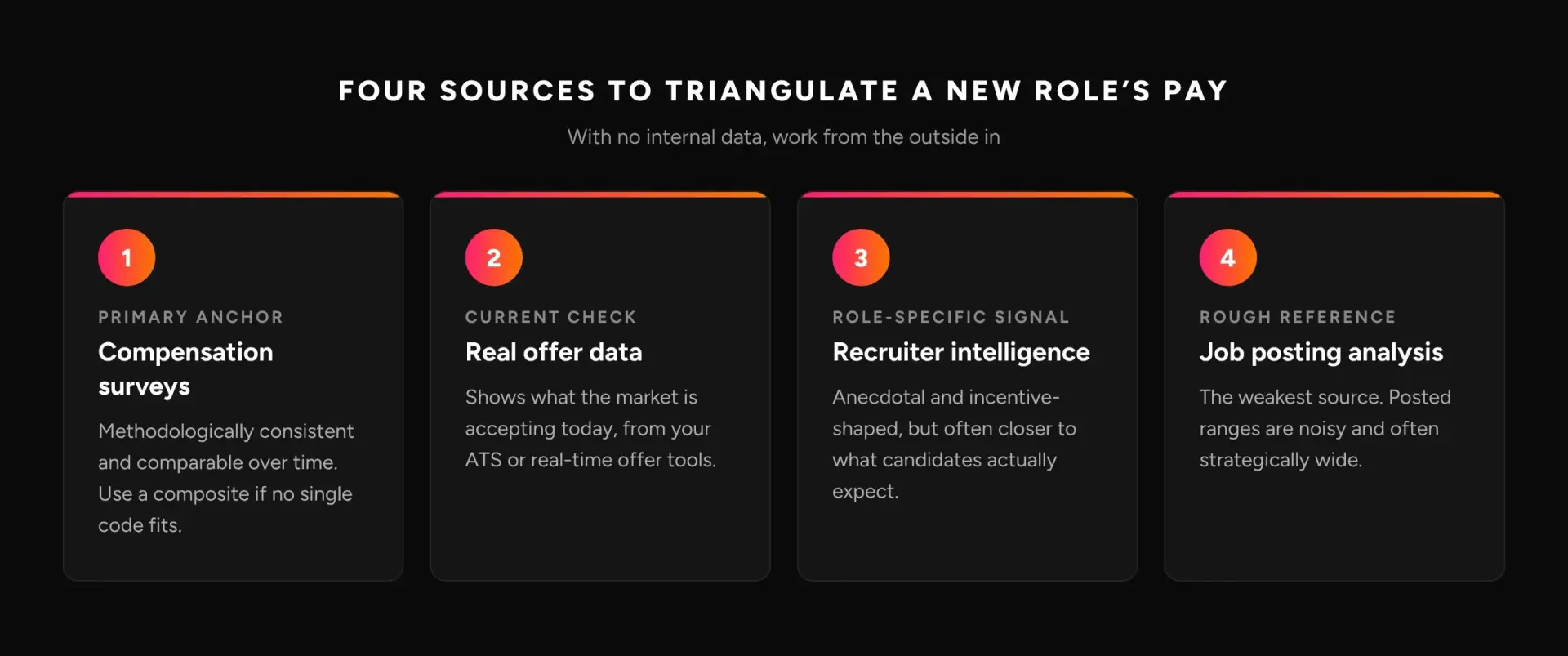
- Compensation surveys are your primary anchor. Even if no code matches the new role exactly, the composite approach above gives you a defensible starting point. Survey data is methodologically consistent and comparable over time. That makes it the foundation, not just one input among many.
- Real offer data tells you what the market is accepting today, rather than what incumbents were paid when the survey was fielded. You might have offer history for adjacent roles in your ATS, or access to real-time compensation intelligence tools. Either is your best check on whether the survey picture reflects current conditions.
- Recruiter intelligence is anecdotal and shaped by the recruiter's incentives. But it is often more role-specific and more current than survey data. A retained search partner who has recently placed people in comparable roles can tell you what candidates in that space actually expect. Survey data cannot capture that until a full cycle later.
- Job posting analysis is the weakest of the four. But it is sometimes the only practical option for roles that are genuinely new to the market. Posted salary ranges are noisy and often deliberately wide. Even so, comparing what several organisations publicly state for comparable roles gives you at least a rough external reference.
Size the role before setting the range
Before you can set a pay range, you need to decide where the role sits in your organisation's hierarchy. This is the job sizing question. It has to be answered before the benchmarking question, because the level you assign decides which survey percentile you compare against.
Most job sizing frameworks evaluate roles along four or five dimensions:
- the breadth and complexity of the work
- the scope of decision authority
- the level of expertise required
- the impact on organisational outcomes
- how far the work is defined rather than self-directed
Applied consistently across all roles, these dimensions produce a level. You can then match that level to a grade and a target market position.
For a brand new role, the temptation is to size it generously, because the person hired is expected to build something from scratch. Building a function from nothing is genuinely harder than stepping into an established one, and that difficulty is real. The question is where to reflect it: in the grade, or in the offer position within the band.
Generally:
- The grade should reflect the work as designed at steady state, not the heroics needed to get there.
- The offer position within the band can reflect how hard it is to find someone who can do both.
Tallect insight: integrating new roles into an existing job architecture from day one
When a new role is built on Tallect, it is sized and graded using the same framework as the organisation's existing positions, with market data attached when the role is created. The role enters the job architecture with three things already documented:
- a pay range
- a target market position
- a benchmark methodology
It is not priced ad hoc and fitted into the structure later.
For roles built on composite benchmarks, the platform records which survey codes went into the range and what weights were applied. When those codes update in a later survey cycle, the composite recalculates automatically. The HR team is told if the range has moved enough to need a review.
This stops new roles from quietly drifting out of line with the market in their first year or two, when drift is hardest to catch.
Deciding where in the range to offer
Once you have a pay range, you need a principled basis for where in it to make an offer. For a new role with no internal precedents, a few factors shape that decision.
- Candidate scarcity. If the pool of qualified candidates is small, the offer should lean towards the upper half of the range from the start. A range that is technically correct at the midpoint is not useful if you keep losing candidates before the offer stage.
- Role criticality. Some new roles are strategic bets, where getting the first hire wrong is very expensive. If the person hired will shape the function for years, paying a premium to attract a strong candidate is justified in a way it might not be for a more interchangeable position.
- Internal equity. The new role will immediately sit alongside existing roles. If its offer creates compression against peers or managers, that is a problem, however defensible the number is on its own. Calibrate the new role's range against the existing structure, not just against the external market.
- Candidate's current compensation. Where the candidate is coming from affects what they need to say yes. Someone leaving a comparable role at a large tech company has a different walk-away number from someone moving from a smaller organisation or another industry. This is a legitimate input to offer positioning. But it should decide where in the range you offer, not set the range itself.

The first offer into a new role sets a precedent. Getting it right from the start is easier than correcting it after the fact.
The first offer sets a precedent
This is worth saying explicitly, because it is often underestimated. What you pay the first person hired into a new role becomes the internal reference point for every later hire and every future review of that role.
- If the first offer is high because the candidate negotiated hard, every later hire will be measured against it.
- If it is low because the first candidate accepted without negotiating, correcting it without creating internal equity problems is complicated.
So be deliberate rather than reactive when setting the first offer, and be willing to hold the range when a strong candidate pushes back. Ranges exist to be ranges, not to be exceeded for every hire who asks.
If the range was built correctly and the candidate's expectations sit outside it, explain clearly what the range is and what it reflects. Do not make an ad hoc exception that quietly becomes a precedent.
Building in a review commitment
No benchmark for a genuinely new role should be treated as final. The first benchmark is a starting estimate. Committing to revisit it after the first year of real offer activity is good process, not an admission of uncertainty.
After six to twelve months, you will have three new inputs:
- actual offer data for the role
- real feedback from recruiting conversations on where the range sits against candidate expectations
- a clearer picture of the market for this specific combination of skills
That data should update the range. If the range has moved materially, it should also update what current incumbents are paid.
The organisations that price new roles well treat it as the start of an ongoing calibration process, not a one-time exercise. The first range is the best estimate available from what is known. Later ranges are informed by what was learned.
Tallect AI insight: flagging when a new role's pay range is being stress-tested by real offers
As hiring progresses, Tallect compares a role's stated pay range with the offers actually made. When a pattern emerges, the platform flags it as a sign that the range may need recalibrating. For example:
- offers consistently landing in the upper quartile of the range
- candidates declining offers that fall within the range
For brand new roles, the AI layer also tracks how the composite benchmark's components are moving in the wider market. It flags cases where one or more of the underlying survey codes has shifted significantly since the first range was set.
This tells compensation teams early that the first range, built without internal history, may need adjusting. It catches the problem before the range has been in use long enough to create its own internal precedent.
What to document and why
Documentation is not a bureaucratic afterthought for new role pricing. It is structurally important. When the range for a new role rests on composite survey codes, weighted assumptions and recruiter intelligence, all of that reasoning should be recorded somewhere.
Future compensation reviews, pay equity audits and hiring manager conversations about why the range sits where it does all become much easier when the original method is on record. Otherwise it lives only in the memory of whoever built it.
At minimum, record:
- the survey codes used and why they were chosen
- the weights applied and the rationale
- any market adjustments made and what they were based on
- the level assigned and the framework used to reach it
- when the range was set
This takes thirty minutes while the analysis is fresh, and can save hours of reconstruction later.
Key takeaways
- Start with the job content, not the title. New titles do not appear in compensation surveys. It is the work the role does that gets matched to market data, and that starts with a clear description of accountabilities and scope.
- Triangulate across multiple sources. Compensation surveys, real offer data, recruiter intelligence and job posting analysis each have limitations. Using several and comparing what they say gives a more reliable picture than relying on any one alone.
- Size the role before setting the range. The level decides which survey percentile applies. Getting the sizing right before benchmarking stops ranges from being anchored to the wrong market position from the start.
- Complete the benchmark before the first candidate conversation. Early anchors from candidate expectations or hiring managers' instincts shape the range if it is not already committed. The range should come before the conversation, not follow from it.
- Calibrate offer positioning against internal equity as well as the external market. A range that is right for the market but creates compression against existing peers or managers needs fixing in its design. It should not be managed around afterwards.
- The first offer sets a precedent that is hard to unwind. Precision at the outset is worth the extra time. The alternative is a precedent that shapes every later hire and review for years.
- Build in a review commitment from day one. The first range is an estimate. Revisit it once real offer data is available, and update it if the market picture has shifted materially.
- Document the method in full while it is fresh. Pay equity audits, future reviews and manager conversations all depend on being able to explain why the range sits where it does. That explanation is much harder to reconstruct six months later.
Frequently asked questions
How is pricing a brand new role different from benchmarking an existing one?
The core difference is the absence of internal anchors. An existing role comes with:
- prior offers
- current incumbents
- pay ratios relative to peers
- sometimes years of market comparisons
For a new role, all of that is missing. Every assumption has to be made explicit, and every number has to come from external sources alone.
This is not necessarily harder. But it needs a more deliberate process and more careful documentation of reasoning, because there is no internal cross-check until after the first hire.
What if the hiring manager already has a number in mind before we start the benchmarking process?
This is the anchoring problem in practice. Hiring managers often have a figure in mind, based on:
- what they paid people at a previous organisation
- what a candidate mentioned in an early conversation
- what they instinctively believe the role is worth
The right approach is to complete the market analysis first and present the range as the starting framework. Ask the manager for input on job sizing, not on the number itself.
If their figure sits inside the resulting range, there is no conflict. If it sits outside, you have an explicit conversation backed by market data. Without that data, it becomes an unspoken negotiation between the manager's anchor and nothing at all.
How do you handle a new role that spans two or three different job families?
Build a composite benchmark:
- Use the survey codes most relevant to each accountability cluster.
- Weight them by how the role actually spends its time and decision authority. A role that is sixty percent technical and forty percent commercial gets a composite weighted that way.
- If the combination of skills is genuinely scarce, add a reasonable premium above the weighted average. Document the premium and the rationale.
Then treat the composite like any other benchmark for ongoing review, updating each component as surveys refresh.
When is it appropriate to offer above the top of the range for a first hire?
Rarely, and with explicit sign-off. Going above the range on a first hire immediately builds a precedent into the structure, before the range has been tested against real recruiting experience.
If the range was built correctly and the candidate expects more, the usual response is one of two things:
- explain the range and negotiate within it
- revisit the range itself, if there is a systematic reason it is too low
It should not be an individual exception.
The exception is a hire of extraordinary strategic importance, where the cost of missing them clearly outweighs the precedent risk. Even then, formally revise the range rather than simply exceed it.
What is the difference between a pay range and a pay band for a new role?
Organisations use these terms differently, but the common distinction is:
- A pay band is a broad grade-level bucket that several roles may share.
- A pay range is the specific minimum-to-maximum for one role within that band.
A new role needs both. The band reflects the level and decides where the role sits in the hierarchy. The range, within that band, reflects what external sources say is right for the specific work.
Setting one without the other leaves gaps that complicate both internal equity management and market comparisons.
How much does candidate negotiation typically affect where in the range an offer lands?
It affects the offer position, but it should not affect the range. A strong negotiator landing at the top of a well-built range is exactly what the range is designed to allow.
Problems start in two situations:
- negotiation pressure pushes offers above the range
- the range is quietly raised in real time to fit one candidate's expectations
Organisations that hold the range firmly and explain it clearly tend to make better hiring decisions over time. That discipline forces early clarity on whether the range reflects the market accurately.
Should the new role's pay range be shared with the hiring manager before the search begins?
Yes. Share the range with the hiring manager and agree it before the search begins, not after a candidate has been found.
When the range arrives late in the process, it often feels like an obstacle rather than a framework. And the pressure to close a candidate who is already deep in the process makes principled conversations about sticking to the range much harder.
Agreeing early means the manager starts the search knowing what the organisation is prepared to pay, and can say so clearly in early candidate conversations.
How do you price a new role that is being created to retain a specific existing employee?
This is structurally different from an open search, and should be treated that way. If a new role is designed around one person's retention, the pay question is partly about the market and partly about a retention premium.
- The market benchmark sets the range.
- Whether to offer above the midpoint depends on the person's current pay, their alternatives and how critical their retention is judged to be.
What matters is that the range is built correctly regardless. Otherwise the role becomes permanently overpriced against the market, just because it was first designed around one person.
What happens if the first few offers reveal that the initial range was significantly off?
Revise the range. The first range was an estimate built without internal offer data. The first few offers are real market feedback.
If candidates keep declining offers at the top of the range, or the range proves impossible to recruit into, that is useful information, not a problem to work around. Then:
- Update the range.
- Document why it was updated and what evidence supported the change.
- Address any internal equity effects for anyone already hired into the role under the old range.
How do you handle geographic variation for a new role that could be filled in multiple locations?
Set a primary location for the benchmark, then apply location-based adjustments for specific candidates as needed. Most major compensation surveys provide geographic differentials you can apply to a national or global base range to get location-specific figures.
For a fully remote role with no primary location, organisations take one of two approaches:
- use a national average as the base, and apply differentials based on the candidate's location
- set the range at the highest-cost market they expect to hire in, and apply it everywhere
Neither is universally right. The choice should follow the organisation's wider remote pay policy, rather than being decided afresh for each new role.
How does Tallect help when setting pay for a role the organisation has never hired for before?
Tallect guides the process from job sizing through benchmark building and range documentation:
- Job sizing uses the same level definitions as the organisation's existing roles, so the new role enters the architecture at a consistent level instead of being sized on its own.
- Benchmarking supports composite benchmarks with weighted survey codes. All the methodology is recorded in the platform for future reviews.
- Offer tracking compares later hires' offers with the stated range, and flags patterns that suggest the range needs recalibrating.
Disclaimer: The information in this article is provided for general educational and informational purposes only. It does not constitute legal, financial, tax, or compensation consulting advice. Organisations should consult qualified advisers when designing compensation programmes.
Price every new role with confidence
Tallect builds composite benchmarks, tracks offer patterns, and keeps new roles calibrated to the market from day one onward.