
How to Benchmark Pay for Roles with No Clear Market Match
Most compensation surveys are built for jobs that have existed for decades. Here is what to do when your role does not fit any of them cleanly.
Compensation benchmarking works reasonably well when a role maps cleanly onto a standard survey job code. A financial analyst, a software engineer, a regional sales manager: these roles have years of data behind them. Even imperfect survey matches give you something defensible to work with.
The problem is that more roles every year do not fit that mould. For example:
- a Head of AI Operations
- a Revenue Enablement Lead
- a Climate Data Scientist
- a Customer Success Engineer whose scope sits between traditional customer success and solutions engineering
These positions are real, the headcount is real, and someone has to price them. But the survey infrastructure mostly was not built for them.
What most teams do in this situation is pick the closest survey job code, note that it is imperfect and move on. That is understandable. It is also worth doing better. The roles that are hardest to benchmark tend to be the ones where competition for talent is highest and a mispriced offer costs the most.
Why standard benchmarking breaks down
Compensation surveys aggregate reported data by job code. For that to produce a useful output, three things need to be roughly true:
- enough companies need to have submitted data for that job code
- the people submitting need to be doing similar work under similar conditions
- the job code needs to exist in the survey at all
All three conditions are often broken for emerging or hybrid roles:
- Thin data. A job code introduced two survey cycles ago may have little data, especially at junior levels.
- Noisy aggregates. A role that exists at ten companies in quite different forms produces noisy averages, even with strong participation.
- No survey equivalent. The benchmarker must either build a proxy or make a judgement call with no reference point at all.
On top of this sits the job title problem. Organisations invent titles for roles that are functionally the same as surveyed jobs but carry different names. "AI Product Lead" and "Senior Product Manager, Machine Learning" may describe identical work at different companies. Survey matching needs someone to recognise that equivalence and code accordingly. That judgement is often inconsistent across the organisations submitting data.
Research highlight: title inflation and its effect on market data quality
Job title proliferation creates a persistent data quality problem in compensation surveys. When organisations create unique titles for roles that perform standard functions, they do one of two things. Both outcomes degrade the market data for everyone:
- Match to the closest survey code, which introduces noise.
- Submit data under a custom title, which shrinks the sample until the data is statistically unusable.
Compensation researchers who have studied survey participation note that title standardisation efforts produce measurably better benchmarking outcomes (source needed). Formal job architecture frameworks are one example of such efforts. Organisations with well-defined job families and consistent titling report fewer cases where no survey match is available, and more confidence in the matches they do find.
The practical implication: good internal job architecture is not just an org-design tool. It is a benchmarking asset.
The skills decomposition approach
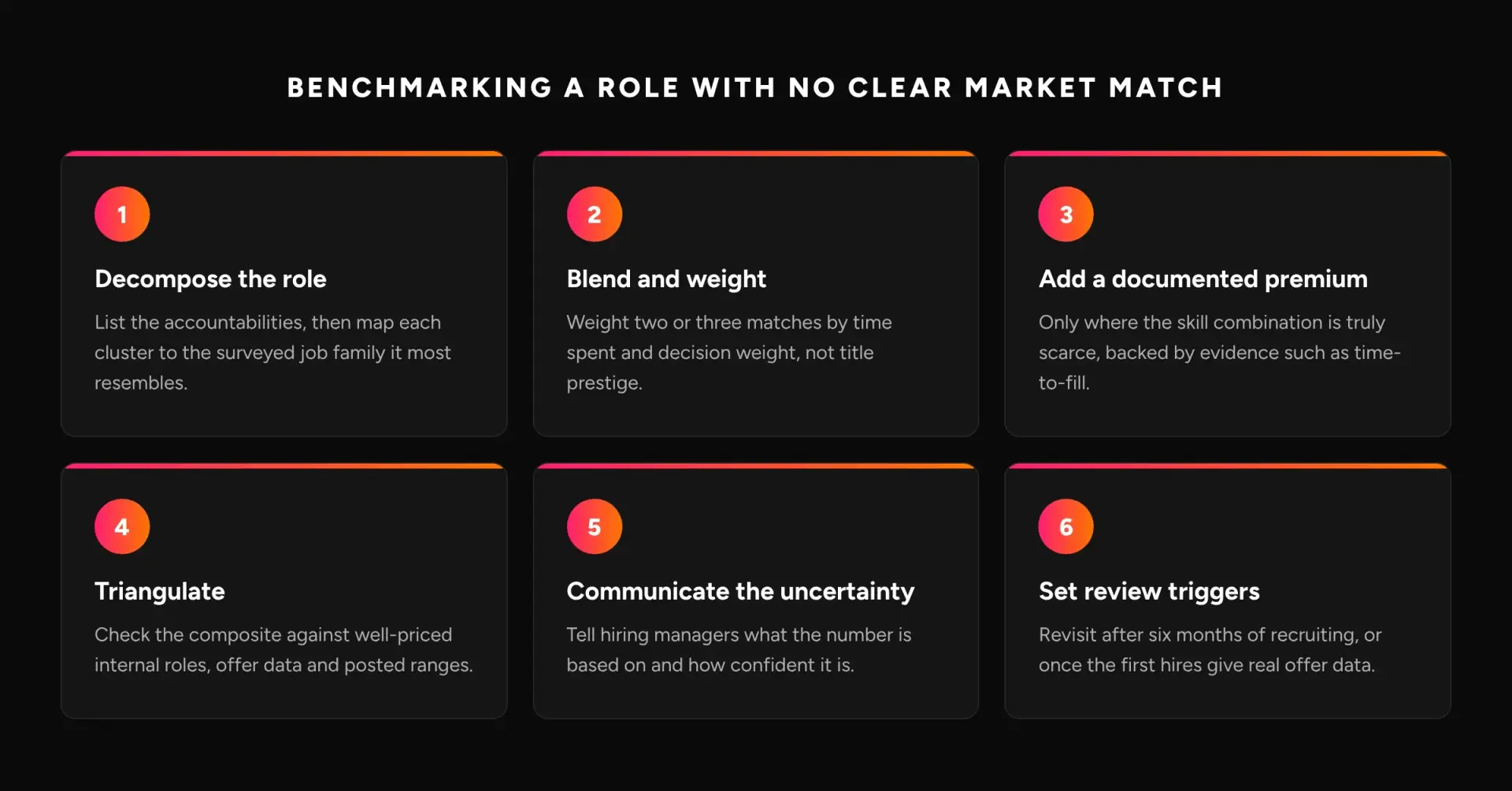
When no survey job code matches a role directly, one of the most reliable methods is to decompose the role:
- Break it into its constituent skills and responsibilities.
- Identify which surveyed roles those skills belong to.
This is not blending for its own sake. It is a structured attempt to anchor the benchmark in something observable and market-priced.
Start by writing out the primary accountabilities of the role, not the job title or the department:
- What decisions does this person own?
- What expertise do they need to exercise it?
- What scope of work do they manage or influence?
Then, for each major cluster of accountabilities, identify which surveyed role that work most closely resembles.
A Revenue Enablement Lead, for example, might have three accountability clusters:
- L&D curriculum design
- sales operations analysis
- go-to-market strategy coordination
Each of those maps to a different survey job family. The benchmark for the role is then a weighted composite of those matches. Each match is weighted by how much of the role's time and decision weight falls in that cluster.
This approach takes more time than a single survey match. But it produces a more defensible number. It also forces clarity about what the role actually involves, which is often missing when teams recruit for a newly created position.
Building a blended benchmark
Once you have identified two or three survey matches that together cover the role's scope, the question is how to weight them. There is no universal formula, but a few principles help.
- Weight by the proportion of time spent, not the seniority of the accountabilities. If a role is sixty percent technical and forty percent commercial, the technical survey match should carry more weight. That holds regardless of which side of the role gets the most attention in a job posting.
- Apply a reasonable premium where the combination of skills is itself scarce. A role that needs deep technical knowledge and strong commercial judgement in roughly equal measure is harder to fill than either alone. The benchmark for a true hybrid should sit above the simple weighted average of the two roles. The market pays for the difficulty of finding someone who does both well.
- Be conservative about the premium you apply, and document your reasoning. A future auditor or pay equity review may ask why a role is priced where it is. This is a defensible answer: "we applied a fifteen percent hybrid premium because we have found empirically that these roles take four to six months longer to fill than either of the base positions." "It felt right" is not.
Tallect insight: building composite benchmarks inside a structured job architecture
Tallect lets compensation teams define blended benchmarks directly in the platform. A role can be linked to several survey job codes, each with its own weight.
The resulting composite sits in the same pay band structure as single-match roles. So the organisation can apply the same grade hierarchy, review cadence and equity methodology across the whole job population, however each benchmark was derived.
When a role's survey codes are updated in a later survey cycle, Tallect recalculates the composite automatically. It flags cases where the weighted result has moved significantly from the prior period. This stops blended benchmarks from drifting unnoticed year after year, which is one of the commonest ways hard-to-match roles fall out of line with the market.
Using internal equity as an anchor
When external data is thin, internal equity gives you something concrete to work with. The question becomes: how does this role compare to roles we have already priced, and does the relationship make sense?
This is not an argument for ignoring market data. It is an argument for triangulating between market data and internal reference points when the market data is noisy or incomplete.
Take an existing role whose market you know well and that you believe you pay fairly. A new role that needs comparable skills, scope and judgement should land in a comparable range, unless there is a clear reason it should not.
Internal equity anchoring works best in organisations with a mature job architecture and clearly defined levels. If your levels are well defined and your existing roles are priced defensibly, you can size a new role against those levels and adjust from there for the market.
The alternative is to price every hard-to-match role in isolation, without reference to internal relationships. That tends to cause consistency problems over time, and they are expensive to unwind.
Survey data vs real offer data
For roles where the market is new, offer data is often more current and more useful than survey data. Compensation surveys are usually based on incumbent pay as of a snapshot date. So they lag market movements by anywhere from six months to two years, depending on the survey cycle and publication schedule (source needed).
For roles in fast-moving areas, where pay has shifted materially in the recent period, that lag matters. Offer data shows what people are actually accepting today, not what they were paid when the survey was fielded. It can come from:
- your own recruiting process
- your ATS
- retained search partners
- real-time tools that aggregate offer intelligence
The limitation of offer data is that it reflects what organisations were willing to pay to win a specific candidate in a specific context. That may not represent the broader market. Using it well means treating it as a directional signal rather than a point estimate, and checking it against whatever survey data you have, even if imperfect.
Data source | Strengths | Watch-outs |
|---|---|---|
Compensation surveys | Statistically robust for established roles; consistent methodology; supports pay equity analysis | 6–24 month lag; sparse data for new or hybrid roles; survey codes may not exist |
Real-time offer intelligence | Reflects current market conditions; role-specific when available | Small sample sizes; selection bias towards accepted offers; variable data quality |
Recruiter or search firm input | Role-specific; reflects actual candidate expectations in real conversations | Incentive to quote high; anecdotal; not statistically comparable |
Internal offer history | Directly relevant to your organisation; available without cost | May reflect past errors or inconsistencies; small n for newer roles |
Job posting salary data | Broadly available; covers many geographies and titles | Posted ranges are often wide and may not reflect actual offers; not standardised |
Caption: Strengths and watch-outs of each benchmarking data source.

Benchmarking roles with no direct survey match requires combining several data sources and documenting the methodology clearly.
Communicating benchmark uncertainty
One of the underappreciated challenges of benchmarking hard-to-match roles is that the output carries more uncertainty than a standard benchmark. That uncertainty has to go somewhere.
If it stays hidden inside the compensation team's modelling, it will eventually surface as a problem. For example:
- a hire who was told they were paid competitively discovers they were not
- an internal promotion creates a compression issue nobody anticipated
When the benchmark for a role is a composite or a judgement call rather than a clean survey match, be explicit with the hiring manager. Tell them what the number is based on and how confident you are in it.
They do not need the methodology in detail. But a manager who knows the benchmark is less certain than usual is better placed to decide where in the range to offer, and how to respond if the market moves.
Some organisations also build formal review triggers into benchmarks that carry high uncertainty. There are two common triggers:
- a commitment to revisit the pricing after six months of recruiting activity
- a review once the first two or three people are hired into the role and actual offer data becomes available
This is good practice for any emerging role. It treats benchmarking as an ongoing process rather than a one-time exercise.
Tallect AI insight: detecting when a blended benchmark has stopped reflecting the market
Tallect's AI layer tracks how composite benchmarks move against the market movement in each of the survey codes behind them. Sometimes one component of a blended benchmark moves significantly while another stays flat. When that happens, the system shows the drift and flags which component is pulling the composite away from where a fresh calculation would land.
For roles benchmarked using offer data or real-time intelligence, the platform tracks the gap between the stated benchmark and actual offer outcomes over successive hiring cycles. Where that gap is consistently in one direction, it raises an alert that the benchmark may need recalibrating.
The alert comes with enough context for the compensation team to judge whether the gap reflects a market shift or a local variation in the candidate pool.
Building a process that scales
Benchmarking hard-to-match roles one at a time works when it happens occasionally. As organisations grow and their job populations become more complex, it becomes a bottleneck. The teams that handle this well tend to have a few things in common.
- They keep a living library of composite benchmarks. Each one records the survey codes behind it, the weights applied and the reasoning. When a similar role comes up again, there is a starting point rather than a blank page.
- They define when a role needs a full composite analysis. Explicit criteria decide whether a role is new enough to need one, or whether it can be sized against an existing internal reference with a market adjustment.
- They treat benchmarking as a cross-functional exercise for novel roles. The hiring manager, a business partner and the compensation team agree scope and level before the benchmark is built. This catches cases where the same title is being used for two quite different jobs. That is surprisingly common, and it causes benchmarking inconsistencies that are hard to unwind later.
- They accept that some benchmarks will carry inherent uncertainty. They build that acceptance into their process rather than covering it with false precision. A range that reflects genuine uncertainty is a better tool than a point estimate that implies a confidence the data does not support.
Key takeaways
- Survey gaps are structural, not solvable. Compensation surveys lag the job market, especially for hybrid and emerging roles. The right response is a principled methodology, not a better survey search.
- Skills decomposition gives you something to anchor to. Break a role into accountability clusters and map each to a survey job family. That gives a more defensible composite than picking the least-bad single match.
- Weight by time and scope, not title prestige. When blending survey matches, the weights should reflect how the role actually spends its time and where its decisions sit. They should not reflect which component sounds more senior.
- Apply a defensible hybrid premium where the combination is genuinely scarce. Document the rationale explicitly, and anchor it in observable data such as recruiting difficulty or time-to-fill.
- Internal equity is a legitimate triangulation point. When external data is thin, comparing with well-priced internal roles keeps the benchmark consistent with the organisation's existing structure.
- Offer data fills the lag that survey data cannot. In fast-moving market segments, real offer intelligence is often more current and more useful than survey data, used as a directional signal.
- Communicate uncertainty explicitly rather than burying it. Managers making offer decisions benefit from knowing when a benchmark is less certain than usual.
- Build review triggers into benchmarks that carry high uncertainty. Committing to revisit a composite benchmark once real hiring data is available turns a one-time guess into an estimate that improves over time.
Frequently asked questions
What makes a role hard to benchmark in the first place?
A role is hard to benchmark when no compensation survey job code reliably captures what the person actually does. This happens most often with three kinds of role:
- Hybrid roles that span two traditional job families, such as a technical account manager who is half solutions engineer and half commercial.
- Emerging roles in new functional areas that surveys have not yet categorised.
- Company-specific titles that reflect unusual organisational structures.
The challenge is not a data problem as such. It is a matching problem: the data exists, but it was not collected for that specific combination of work.
How many survey matches should go into a composite benchmark?
Two or three matches is usually the practical limit. Beyond three, the composite becomes hard to maintain as surveys update each year, and the weighting decisions grow in complexity faster than the precision improves.
Some roles need more than three distinct skill clusters to describe. If so, ask whether the role is too broad to price as one role, or whether the job architecture should split some of its accountabilities into separate positions.
Is it acceptable to price a role above the survey median if the market feels hot?
Yes, with documentation. Your recruiting experience, offer data or retained search feedback may consistently show candidates getting and expecting offers above the survey median for a role or skill set. That is legitimate market evidence.
The key is to document it rather than simply override the survey without a rationale. A formal process for recording market adjustments and their evidence keeps the decision defensible. It also gives you a basis for reviewing it when conditions change.
When should internal equity take precedence over external survey data?
Internal equity matters most in two situations:
- When external data is thin, inconsistent or out of date relative to current market conditions.
- When the organisation's pay philosophy prioritises internal relationships, such as a commitment to consistent grade structures or narrowly defined pay ratios between levels.
Where survey data is robust and reasonably current, it should anchor the benchmark. Internal equity then serves as a consistency check rather than the main reference.
How do you handle roles where the market data varies dramatically by geography?
Geographic variation is common for technical and commercial roles, and surveys usually capture it through location-specific cuts.
Where no location-specific survey match exists, start with the composite benchmark you have built at a national or global level. Then apply the geographic differential from a well-matched comparable role. This is an approximation, but it is more principled than guessing. The differentials themselves are well documented in most major survey providers' methodology materials.
What is the difference between job levelling and job benchmarking?
- Job levelling is the internal process of placing a role in the organisation's grade or level hierarchy. It is based on scope, complexity, decision authority and impact.
- Job benchmarking is the external process of finding out what the market pays for comparable work.
Both are necessary, and they inform each other. The level determines which survey percentile you compare against. Market data shows whether your level definitions are calibrated correctly.
For hard-to-match roles, complete the levelling analysis before you attempt the benchmark. Knowing the internal level narrows down which survey data is relevant.
How often should composite benchmarks be reviewed?
At minimum, every survey cycle, which for most major providers is annual. For roles where the market is moving quickly, a mid-year review using offer data or real-time intelligence is worth the effort.
The practical trigger for an off-cycle review is evidence that the benchmark keeps producing outcomes that feel too high or too low against actual recruiting experience. If you win every offer easily or lose every offer quickly, the benchmark probably needs attention.
How do you benchmark a role that your company created and no competitor has yet?
This is the most challenging scenario. With no external equivalent, you are essentially pricing by analogy:
- Identify the highest-value skills the role needs.
- Find the market rate for those skills in the roles where they are most commonly found.
- Consider what a person gives up by taking this position rather than a conventional one, and price accordingly.
If the role asks someone to leave an established career path for something unproven, the compensation needs to reflect that uncertainty. Usually that means sitting at or above the market median for comparable skills, not below it.
What is title inflation and how does it affect benchmarking accuracy?
Title inflation is the practice of giving senior-sounding titles to roles that do work at a lower level. It is often used as a retention or recruiting tool when cash compensation is constrained.
It affects benchmarking accuracy because survey participants who match an inflated title to a standard survey code are effectively submitting data for the wrong role. Over time, this pulls survey averages for some codes upwards, in ways that do not reflect actual market pay for the underlying work.
Organisations with consistent, well-defined job architecture are less exposed to this problem, because their matching decisions rest on actual job content rather than title.
Can you use job posting salary data as a primary benchmarking source?
Job posting data is useful for triangulation but unreliable as a primary source:
- Posted salary ranges are often deliberately wide, to attract a broad pool of applicants.
- They may not reflect the range at which offers are actually made.
- They are not standardised across organisations the way survey submissions are.
Its best use is as a quick directional check rather than a definitive benchmark. It also shows where the posted market sits against your composite, which helps most for roles where surveys are thin.
How does Tallect handle composite benchmarks across a full job architecture?
Tallect lets organisations link survey codes to a job family, with a weight for each code. It applies those links consistently across every role in that family.
When survey data updates, the platform recalculates composite benchmarks automatically and shows any cases where the resulting market position has shifted significantly.
For roles with high benchmark uncertainty, teams can set review triggers that send alerts when actual offer outcomes move away from the stated benchmark. Benchmarking then becomes a continuously calibrated process rather than a periodic event.
Disclaimer: The information in this article is provided for general educational and informational purposes only. It does not constitute legal, financial, tax, or compensation consulting advice. Organisations should consult qualified advisers when designing compensation programmes and benchmarking methodologies.
Stop guessing on hard-to-match roles
Tallect lets you build composite benchmarks, document your methodology, and get alerted when market drift is pulling a role off target.