What Employees Misread in a Total Rewards Statement
The document is accurate. The problem is how it gets read. Here are the most persistent misreadings and what it takes to fix them.
Every year, HR teams spend real time pulling together a total rewards statement. They verify the numbers, calculate the employer contributions, format the document and send it out. Most employees then do three things:
- glance at the bottom line
- feel vaguely confused about why the number is so much larger than their salary
- move on
The statement is not wrong. The benefits are real, the equity is real, the retirement contributions are real. But the way those elements are presented almost guarantees misreading. Employees routinely walk away with one of three wrong pictures:
- an inflated sense of their immediate compensation
- a distorted view of their benefits
- no clear idea of how their pay sits relative to the market
None of that serves anyone well.
What follows is a close look at the misreadings that happen most often, why they happen and what you can actually do about them.
The five most common misreadings
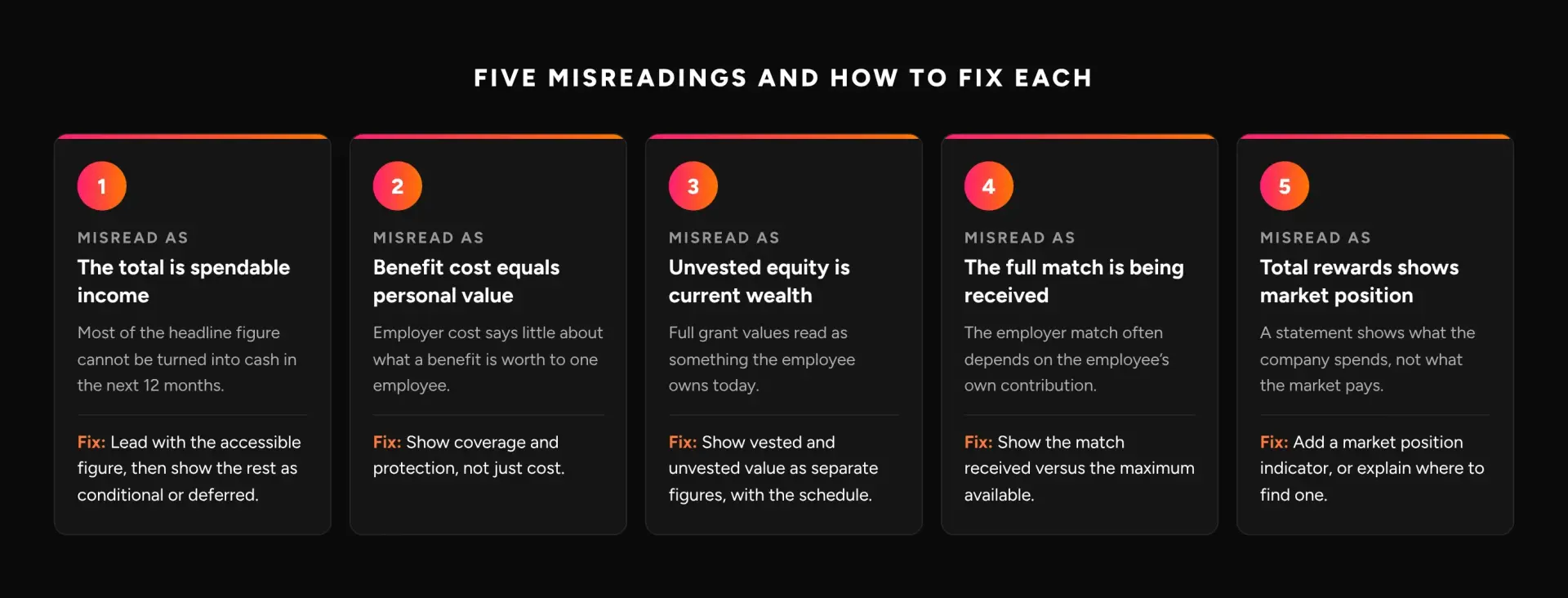
1. The total value figure is taken as spendable income
The headline number on most total rewards statements is a sum of:
- base pay
- benefits
- employer retirement contributions
- equity
- any cash bonuses
The intent is to show employees what the company is actually spending on them. The problem is that most employees read it as money they can access, and most of it is not:
- Employer health insurance contributions go directly to the insurer.
- Unvested equity can still be forfeited.
- Retirement contributions are locked until a qualifying age in most cases.
The gap between the total figure and what someone could realistically convert to cash in the next twelve months is often substantial. The statement typically does nothing to show that distinction.
2. Benefits are valued at cost rather than personal value
Most statements report benefits at employer cost: what the company pays for the health plan, the life insurance premium, the dental cover. This is a defensible number from an accounting standpoint. It is a poor proxy for what a benefit is worth to any individual employee.
Take two employees on the same health plan:
- A young, healthy employee whose spouse has better health cover through their own employer may value your plan at close to zero, even if you pay a significant monthly premium for them.
- An employee managing a chronic condition may value it far more than its cost suggests.
Presenting cost as value flattens all of that. In many cases it produces a number that feels disconnected from lived experience.
3. Unvested equity is read as current wealth
When a statement lists equity compensation without clearly marking vesting status, employees tend to read the full grant value as something they own today. Many do not fully understand:
- cliff vesting
- graded schedules
- the conditions under which unvested equity is forfeited on departure
The statement rarely explains any of this in plain language, and the number itself gives no hint.
The result is that employees overestimate their actual equity position, sometimes significantly. When they later leave the company and discover what they actually had, it creates a trust problem that extends well beyond the equity itself.
Research highlight: financial literacy and the complexity of benefits documents
Research on plain language in financial and benefits communications consistently finds that documents written above a tenth-grade reading level are substantially less understood by the broader population, even among college-educated readers (source needed). Benefits statements are notoriously dense. They use actuarial language, benefit-year terms and contribution structures that assume familiarity most employees do not have.
The core finding, replicated across multiple studies, is about who the documents are designed for (source needed). Comprehension drops not because employees are disengaged, but because the documents are written for the HR professional who built them, not the person who receives them. Structural redesign, not better explanations, is what changes outcomes.
4. Retirement match is treated as future income, not a present decision
Employer retirement contributions are typically shown as an amount or a percentage of salary. What gets lost is that the figure is conditional. In most plans, the employer match only materialises if the employee contributes their own money, up to a certain threshold. Employees who are under-contributing may read the full match figure on their statement without registering that they are not actually receiving it.
Vesting schedules add another layer. An employee who joined two years ago may be reading a fully matched figure. That figure may include employer contributions they could not take with them if they left tomorrow.
5. Total rewards is confused with market competitiveness
Some employees look at their total rewards statement not to understand what they receive, but to judge whether they are paid fairly against the market. A total rewards statement cannot answer that question on its own. It shows what the company spends. It says nothing about what comparable roles pay at other organisations.
Without any market context, employees fill that gap with whatever information they have. That is usually incomplete and sometimes inaccurate.
Why these misreadings keep happening
The common thread across all five misreadings is a document built around completeness rather than comprehension. The goal in most organisations is to:
- include everything
- present accurate numbers
- distribute it once a year
What gets skipped is the question of what an employee needs to understand and what decisions they need to make.
Total rewards statements were originally designed as a retention communication tool, not a financial education tool. They were meant to show employees "look how much the company invests in you." That framing made sense when most employees compared their situation to nothing.
It makes less sense now. Employees have access to salary benchmarks, benefits comparison data and peer conversations, which give them a much richer frame of reference.
Tallect insight: separating what you own from what is conditional
Tallect structures total rewards data into distinct buckets:
- what an employee has access to now
- what becomes accessible under specific conditions
- what requires continued tenure
This separation is reflected in how statements are generated on the platform. Each category is displayed and labelled separately rather than summed into a single headline figure.
The intent is to give employees an accurate picture of their current position, rather than an aggregate that mixes vested and unvested value. HR teams can configure which buckets appear on each statement variant. Threshold-based conditional benefits are flagged automatically when an employee's current contribution falls below the qualifying level.
How to fix the statement itself
Redesigning a total rewards statement does not require starting from scratch. It requires a different set of questions at the design stage.
Lead with the accessible figure, not the total
Rather than opening with a headline total, lead with what an employee can actually use:
- base salary
- any cash bonus received in the past year
- paid time off taken
Then show the fuller picture below, clearly labelled as conditional or deferred. Employees should not have to subtract to understand their own compensation.
Be explicit about vesting
Any equity line on the statement should show vested value and unvested value as separate figures, with a brief note on the vesting schedule. If the company uses a cliff, say so in one sentence.
This does not require a full explanation of equity mechanics. It requires honesty about what the employee owns now versus what they will own if they stay.
Show the retirement match conditionally
If an employee is not maximising their employer match, the statement should reflect that. Showing the full match figure to someone contributing below the matching threshold is misleading. It also misses the moment to prompt a valuable decision.
At minimum, statements should show the match the employee actually received versus the maximum they could have received.
Separate cost from coverage on benefits
Rather than listing employer cost as the proxy for benefit value, consider presenting benefits in terms of coverage and protection:
- What does the health plan actually cover?
- What would an emergency hospitalisation cost the employee under their current plan?
- What would happen to their income if they were disabled for six months?
These are the questions employees are actually trying to answer, and cost figures do not help them.

Rethinking a total rewards statement is as much a communication design problem as a data problem.
The role of timing and channel
Even a well-designed statement fails if it arrives at the wrong moment:
- In January, when employees are thinking about holiday expenses and tax filings, it competes with a lot of noise.
- During performance review season, when compensation changes are top of mind, it gives the conversation a natural anchor.
Some organisations are moving away from the single annual statement towards shorter, more targeted communications:
- a benefits summary at annual enrolment
- an equity update at vesting anniversaries
- a retirement summary mid-year, while contribution changes are still possible
This approach needs more coordination. But it produces much better engagement, because each communication is relevant when it arrives.
Digital delivery helps, but only if the experience is built for understanding. A PDF that copies a paper statement does not improve understanding just because it arrives by email.
Interactive statements are a different category of tool. They let employees:
- switch between scenarios
- model retirement contributions
- see their vesting schedule laid out visually
The difference in understanding tends to be significant.
The trust dimension
None of this is purely a communication problem. Some employees discover that they understood their compensation differently from reality. They do not just update their knowledge. They adjust how much they trust the information they receive from the company. A statement that overstates an employee's equity position, intentionally or not, is a trust event.
The case for clearer total rewards communication is not just operational. It is about whether employees can make good decisions about their own financial lives, based on accurate information from their employer. That is a reasonable thing for people to expect, and most organisations are not quite delivering it yet.
Tallect AI insight: detecting where employees are most likely to misread their statement
Tallect's AI layer analyses patterns in how employees interact with their rewards data:
- where they spend the most time
- which sections generate the most follow-up questions to HR
- where engagement drops off entirely
These patterns show which parts of a statement are causing confusion rather than clarity. They vary by role, tenure band and location.
For equity-heavy compensation structures, the system compares two things: the reported equity value, and what employees appear to understand about vesting timelines, judged by how they query the data. Where that gap is wide, the platform flags it. HR teams can then target extra communication before the information gap becomes a retention risk.
What good looks like
A well-designed total rewards statement tells an employee three things:
- what they have access to right now
- what they will have access to, and when
- what decisions they could make to change their position
It also avoids three mistakes:
- It does not bury conditional benefits in aggregate figures.
- It does not present equity at a value the employee cannot yet realise.
- It does not leave employees to infer their market position from a document that was never designed to answer that question.
Getting there is partly a data and systems question, partly a design question, and partly a question of whether the organisation is willing to be specific rather than comprehensive.
The organisations that do it well treat total rewards communication as a continuous responsibility, not an annual event. They hold it to the same standard as any other employee-facing product. Does the person on the receiving end understand what we intended them to understand?
Most statements, honestly assessed, do not pass that test yet. But the gap can be fixed. Fixing it has a measurable effect on how employees understand, value and talk about their compensation.
Key takeaways
- The headline total misleads. Combining accessible pay with vested equity, unvested equity and employer benefits into one figure produces a number that employees routinely misinterpret as spendable income.
- Benefits at cost is not benefits at value. What the company pays for a benefit tells an employee little about what that benefit is worth to them personally.
- Unvested equity needs its own label. Full grant values without clear vesting status create an inflated picture of current wealth. They cause a trust problem when employees eventually discover the difference.
- Retirement match figures should reflect actual contributions. Showing a full match to someone contributing below the threshold is inaccurate, and it misses the chance to prompt a valuable decision.
- Timing and channel shape understanding as much as content. Statements sent at the wrong moment, in a format that discourages engagement, underperform however accurate they are.
- Trust is at stake, not just clarity. Some employees find a gap between what their statement implied and what they actually had. They then change how they read every communication that follows.
- Structural redesign works better than better explanations. Adding footnotes to a poorly structured statement does not solve the problem. Separating conditional and accessible value does.
Frequently asked questions
What is a total rewards statement supposed to accomplish?
A total rewards statement shows employees the full scope of what the company invests in them beyond base salary. That includes benefits, retirement contributions, equity, paid time off and any other compensation elements.
The practical goal is to help employees understand and value their complete package, rather than comparing jobs on salary alone. Where statements fall short is in achieving understanding rather than just completeness.
Why do employees often feel their total rewards statement overstates their pay?
Because most of it is not pay in the usual sense. Employer health insurance premiums, unvested equity and locked retirement contributions are real commitments from the company. But they are not money the employee can access today.
When all of these are summed into one headline figure, the number looks like compensation but behaves nothing like a pay cheque. The feeling of inflation is a natural response to being shown a number that cannot be spent or transferred.
How should unvested equity be shown on a total rewards statement?
Show vested and unvested value as separate line items, each clearly labelled. Add a brief note on the vesting schedule, covering:
- when shares vest
- whether there is a cliff
- what happens to unvested equity on departure
This does not require a full explanation of equity mechanics. But the statement must be honest about what the employee actually owns versus what they will own if they stay.
What is the right way to communicate employer health insurance contributions?
Employer cost is a reasonable data point to include, but it should not stand alone as a proxy for benefit value. Consider adding coverage information alongside it:
- what the plan covers
- the employee's out-of-pocket maximum
- the key scenarios the cover addresses
This gives employees a better sense of what they are protected against, which is usually the question they are actually trying to answer.
Should total rewards statements include market comparison data?
This is a contested area, and the right answer depends on your pay philosophy. There are two common approaches:
- A market position indicator on the statement, showing where the employee's base salary sits against a benchmark range.
- A separate channel for compensation benchmarking conversations.
What does not work well is presenting total rewards data with no market context. That leaves employees to make their own comparisons using whatever outside information they can find, which is often inaccurate.
How often should total rewards statements be distributed?
Annual distribution is the most common practice, but many organisations are moving to a modular approach:
- benefits summaries at annual enrolment
- equity updates at vesting anniversaries
- retirement summaries mid-year, while contribution changes are still possible for the current year
This needs more coordination. But it tends to produce better engagement, because each communication is relevant when it is received. An annual statement competes with everything else that arrives at the same time.
What is the connection between total rewards communication and employee retention?
Employees who do not fully understand their total compensation are more likely to undervalue what they have. They are also more open to offers from organisations that communicate their packages more clearly.
The retention risk is not just about compensation levels. It is about perceived value. An employee who discovers what their equity was worth only after they leave is not retained by that number.
Clear, timely communication of rewards value has a documented effect on how employees rate their overall compensation satisfaction, which is linked to intent to stay (source needed).
How do retirement plan matching details typically get misread?
The most common misreading is seeing the full employer match on a statement without registering that it depends on the employee's own contribution.
Suppose someone contributes three percent and the match threshold is six percent. The statement may still show the maximum match in a way that implies they are receiving it. The employee then believes they are getting something they are not, and misses the prompt to raise their own contribution to unlock it.
Statements should show the match actually received and the match available, clearly separated.
What makes an interactive total rewards statement better than a PDF?
An interactive statement lets employees work with their own data rather than read a static document. They can:
- model what happens to their retirement balance if they increase their contribution
- see their vesting schedule as a timeline rather than a clause
- filter to the benefits they actually use
The difference in understanding is not about technology for its own sake. It is about meeting employees where their actual questions are, so they can answer them without calling HR.
Can a redesigned total rewards statement help with pay equity communication?
It can, but it has to be intentional. A statement that shows an employee's base salary with no context does not communicate pay equity.
If the organisation has pay bands and wants to show where an employee sits within their band, the statement is a reasonable place to do it. That holds as long as the information is communicated accurately and consistently across the organisation.
What the statement cannot do is replace an actual pay equity analysis. It can communicate the results of one, but it cannot do the underlying work.
How does Tallect help HR teams redesign their total rewards statements?
Tallect generates statements from structured compensation data, with components grouped by how accessible they are:
- immediate cash
- conditional benefits
- deferred equity, or equity that vests over time
- protection-based benefits
HR teams configure which elements appear, how they are grouped and what notes go with each section. The platform also shows engagement signals, flagging which statement sections generate the most follow-up activity. Teams can then prioritise where extra communication is needed.
Disclaimer: The information in this article is provided for general educational and informational purposes only. It does not constitute legal, financial, tax, or compensation consulting advice. Organisations should consult qualified advisers when designing compensation programmes and total rewards communications.
Give employees a statement they can actually understand
Tallect structures total rewards data the way employees actually read it, separating what is accessible now from what is conditional, deferred, or still vesting.