
Seven Benefits Employees Value and What They Cost to Offer
The most valued benefits are not always the most expensive. Smart benefits strategy starts where cost and perceived value diverge.
Conversations about employee benefits often get stuck in the same place. Someone lists everything a good package should include, then everyone pauses when someone asks what it all costs. Benefits strategy is rarely about what employees want in isolation, because almost everyone would like more. It is about where a benefit’s return justifies its cost compared with the alternatives. That return shows up in attraction, retention and engagement.
That is a more useful question than “what do employees want?” It accepts that trade-offs exist and budgets are real. The goal is a package that gets the most from what the organisation spends, not one that includes everything on a market survey checklist.
What follows is a clear-eyed look at seven benefits that consistently come up as meaningful to employees in candidate research, engagement surveys and exit interviews. For each one, we look at what it typically costs to offer and where the value-to-cost balance is most favourable.
The costs are described as ranges, not quotes. Actual costs vary widely by market, workforce, vendor and plan design. The aim is to give HR and finance teams a useful way to think about return on benefit spend, not a procurement guide.
Value and cost often diverge
A recurring finding in benefits research is that employees’ sense of a benefit’s value is often disconnected from what it costs the employer (source needed). The gap runs both ways:
- Taken for granted: some expensive benefits, such as certain health plan designs, are assumed rather than valued.
- Highly rated: some cheap benefits, such as flexible scheduling, are rated as very important.
So spend alone is not a reliable guide to how employees experience a package. How benefits are communicated, structured and made accessible shapes their perceived value at least as much as what is spent.
The seven benefits
1. Flexible and hybrid work
Flexibility in when and where people work has moved from a pandemic-era accommodation to an established expectation in most knowledge work. Employees consistently rate schedule flexibility and remote options among the benefits they value most. When asked what would most affect a decision to join or leave, they often rank flexibility above some health and insurance benefits (source needed).
Flexibility is unusual because its employer cost varies so much. It can be close to zero in roles where remote work has no real operational impact. It can be significant where people need to be physically present and flexibility adds real coordination overhead. For organisations that can offer genuine flexibility, the value-to-cost ratio is among the best of any benefit on this list.
The caveat is that flexibility has to be real to be valued. Employees recognise and discount two kinds of empty flexibility:
- remote-work policies paired with constant pressure to come in
- “flexible” schedules that in practice mean being available at all hours
The value comes from the actual experience of autonomy, not the policy wording.
Cost profile: Low to moderate, and highly variable by role. Mainly an operational and management investment rather than vendor spend. High value-to-cost ratio wherever genuine flexibility is feasible.
2. Comprehensive mental health benefits
Mental health benefits have quickly gone from niche to a near-universal expectation in competitive talent markets. Employees under 40 in particular consistently rank mental health support among their most valued benefits (source needed). The category covers:
- EAP counselling sessions
- mental health apps
- wider therapist networks
- coverage designs that make care genuinely accessible, not just technically covered
Cost depends heavily on design:
- Basic EAP. A few counselling sessions a year can be added at relatively low cost.
- App subscription. Workforce-wide access to a mental health app costs somewhat more but is affordable for most employers.
- Plan redesign. Putting mental and physical health on an equal footing in practice may raise plan or admin costs. It also delivers the biggest improvement for employees.
Employees whose mental health needs go unaddressed show higher absenteeism and turnover (source needed). Both carry real costs that offset much of the benefit spend.
Cost profile: Varies with design depth. App access is low cost; meaningful coverage redesign is moderate to high. Returns show up through lower absenteeism and turnover.
3. Parental leave beyond the legal minimum
Parental leave is one of the most visible signals in a total rewards package. For candidates who are, or expect to become, parents, it often stands in for how the organisation sees the relationship between work and life. Employers whose leave is well above the local legal minimum, and equitable across primary and secondary caregivers, send a message about their values. Employees mention it repeatedly when they describe why they chose an employer.
The direct cost is paying salary during leave while also covering the employee’s work. The cover cost is often underestimated. Backfilling through temporary staff, spreading work across the team or simply deferring it all carry real costs. But so does losing an employee who is planning a family to an employer whose leave policy suits them better.
The retention maths usually works out. Paying a few extra weeks of leave, at a fraction of annual salary, is far cheaper than losing, recruiting and onboarding a replacement, especially an experienced one. The difficulty is that the cost is visible and immediate, while the value of keeping the employee builds slowly.
Cost profile: Moderate direct cost (salary during extended leave) plus the cost of covering the work. Strong retention return among mid-career employees.

4. Professional development and learning stipends
Employees who believe their employer invests in their growth are more likely to stay and to perform well. Several benefits signal that investment:
- learning stipends
- tuition reimbursement
- access to courses and certifications
- dedicated development time
These benefits tend to score well in offer comparisons too, especially with younger candidates and people in technical roles where keeping skills current matters.
A meaningful learning stipend costs a moderate, predictable amount. That means enough for a certification, a few substantial courses or a professional conference each year. Use is usually below full eligibility, so the budget rarely gets fully spent. Tuition reimbursement, where offered, costs more per employee. It also correlates more with retention, because employees halfway through a degree are rarely planning to leave before they finish.
The risk that developed employees will leave is real but often overstated. The alternative is not developing them. Then your best performers leave because they have outgrown their role, and the less engaged, less capable people stay. That tends to be worse.
Cost profile: Moderate and predictable. Use is usually well below 100%, so actual spend stays under budget. Strong signal value for the cost.
5. Emergency savings and financial wellness
Financial stress is a constant drag on performance and engagement. Emergency savings programmes, financial coaching and earned wage access do not remove that stress, but they give employees tools that meaningfully reduce it. The people most likely to benefit are often the ones who would be hardest to replace if a competitor offered better financial support:
- hourly workers
- newer employees with little savings
- those carrying heavy debt
The main cost elements are:
- Emergency savings. These usually run through payroll deductions into a separate, accessible account. The employer cost is mainly admin, plus any match, since some programmes add a small match to encourage participation.
- Financial coaching. A third-party provider adds a per-employee cost that stays reasonable relative to the value it creates.
- Earned wage access. When it is structured without excessive fees, it can be offered at low employer cost. Vendors recover their costs through fees paid by employees who choose to draw wages early.
Cost profile: Low to moderate, depending on any employer match and the vendor model. Outsized impact for hourly, frontline and lower-income employees.
6. Fertility and family planning benefits
Fertility benefits have moved from a strong differentiator to a growing expectation among employers competing for talent, especially for professional and technical roles. Coverage can include:
- fertility treatment
- egg freezing
- adoption assistance
- surrogacy support
These benefits signal inclusion of employees whose family planning situations standard health cover often does not address well.
Cost depends on what is included. Modest coverage with lifetime limits, built into a standard plan, is affordable for most mid-sized and large employers without a material budget impact. Comprehensive coverage, including multiple IVF cycles and surrogacy support, costs considerably more. The decision is partly about what is competitive in your talent market and partly about what the organisation believes employees should have access to.
Fertility benefits carry signal value well beyond how often they are used. Many employees who will never use them still see them as evidence that the organisation takes a broad view of what benefits should cover. They communicate values that resonate beyond the people they directly serve.
Cost profile: Moderate for baseline inclusion, higher for comprehensive programmes. For much of the workforce, signal value far exceeds the value from actual use.
7. Caregiving support (elder care and child care)
At any given time, caregiving affects a large share of the workforce:
- parents of young children
- employees supporting ageing parents
- people managing other dependent care needs
Benefits that genuinely support carers, rather than just acknowledging them, have moved up the list of what employees say would most improve their working lives.
Child care remains one of the highest-cost, highest-value benefits an employer can offer. The main options differ in cost and effect:
- Backup child care. Offered through vendors, priced per day or per use, and highly valued by parents facing gaps in their usual care.
- On-site child care. A larger capital and operating investment, with strong retention effects among the people it serves.
- Tax-advantaged dependent care accounts. In the US, these lower employees’ net cost but do not solve the supply problem.
Elder care support matters more as more employees manage ageing parents during their peak career years. Employer-sponsored elder care resource and referral services are relatively cheap and under-publicised. Richer programmes include backup in-home elder care, an emerging area where employers can still stand out.
Cost profile: Highly variable. Resource and referral programmes are low cost, and backup care is moderate. On-site care is a significant investment, but it produces strong retention returns where many employees are parents.
Finding what works for your workforce
Tallect’s AI analyses workforce composition, utilisation and engagement data. It shows which benefits create the most impact for the people in your organisation, not just what is valued across your industry. It can:
- detect when a benefit with significant spend is used by only a narrow part of the workforce
- identify which life stages and demographic groups engage most with each offering
- flag low-use programmes that may need redesign or replacement
That moves benefits planning away from external benchmarks and towards what actually drives value for the people who work for you.
The cost-value framework in practice
Thinking about benefits in terms of cost and value means being honest about both. Cost is easier to measure, through vendor contracts, claims data and admin overhead. Value is harder to quantify but possible to reason about. These all give a signal:
- offer acceptance rates
- attrition among the groups a benefit serves
- engagement survey scores
- exit interview themes
The clearest lesson from these seven benefits is that perceived value and employer cost do not move together:
- Flexibility has among the highest perceived value of any benefit. It can be offered at very low cost where it is operationally feasible.
- Caregiving benefits are highly valued by the people they serve but remain under-offered. That is partly because their cost is visible, while their retention value takes longer to show up in a spreadsheet.
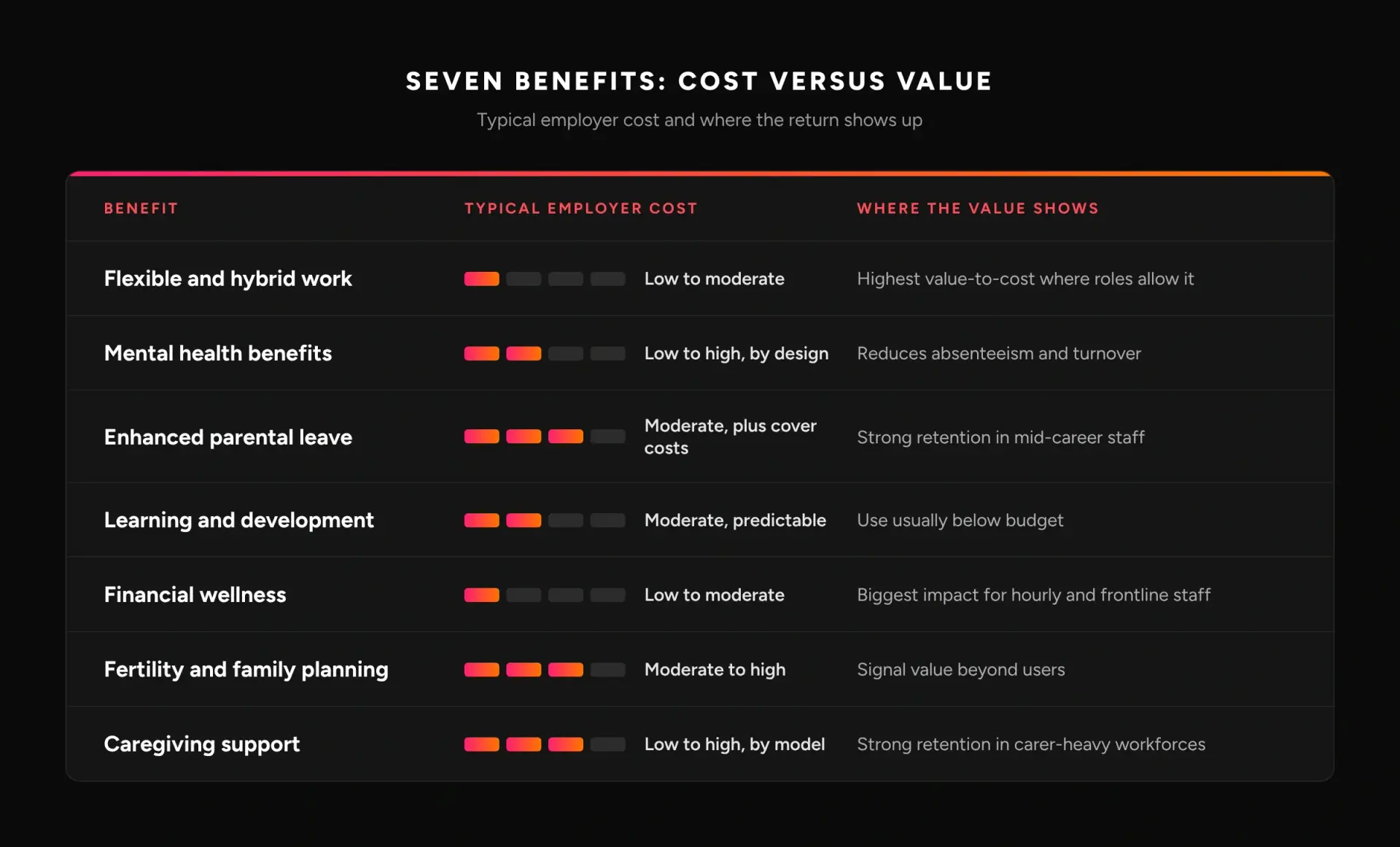
Benefit | Typical employer cost | Where the value shows up |
|---|---|---|
Flexible and hybrid work | Low to moderate | Highest value-to-cost where roles allow it |
Mental health benefits | Low to high, by design | Lower absenteeism and turnover |
Enhanced parental leave | Moderate, plus cover costs | Retention of mid-career employees |
Learning and development | Moderate, predictable | Retention and skills; use usually below budget |
Financial wellness | Low to moderate | Biggest impact for hourly and frontline staff |
Fertility and family planning | Moderate to high | Signal value well beyond those who use it |
Caregiving support | Low to high, by model | Retention in carer-heavy workforces |
Caption: How the seven benefits compare on employer cost and value.
Some benefits are taken for granted, and core health cover is the obvious example. These take up a large share of the budget, but often have less effect on engagement and retention than their cost suggests. That does not make them unimportant. They are a baseline expectation, and lacking them does serious damage. But an extra rupee spent on core health cover often does less than the same rupee spent on flexibility, mental health access or caregiving support.
Employees undervalue what they cannot see
Employees tend to significantly underestimate what their benefits are worth (source needed). Employers spend far more on total rewards than employees perceive. The gap is widest for benefits that are invisible day to day:
- health plan contributions
- employer statutory contributions
- retirement matching
Better benefits alone do not solve this undervaluation. Better communication does. Total rewards statements turn benefits into money terms and make the employer’s investment visible and concrete. They can substantially improve how employees value what they receive, without changing the package at all.
Key takeaways
- Value does not track cost. Flexibility is often among the cheapest options for suitable roles, yet consistently ranks among the most valued benefits. Knowing where the value-to-cost ratio is strongest is the foundation of good benefits strategy.
- Mental health support is now expected. It has moved from differentiator to expectation in competitive talent markets. Meaningful access costs a moderate amount, and ignoring it shows up in engagement and retention.
- Enhanced parental leave pays for itself. Leave above the legal minimum usually justifies its cost when compared with the cost of replacing the people it keeps.
- Learning budgets go further than they look. Learning and development builds both retention and skills. Use is usually below budget, so it is better value than the headline figure suggests.
- Caregiving support is under-offered. Child care and elder care support matter to a large share of the workforce, yet are consistently offered less than that importance warrants.
- Communication shapes perceived value. How benefits are communicated affects their value at least as much as what is offered. Total rewards visibility and clear communication are often the highest-return improvements available, without changing the package.
Frequently asked questions
Which employee benefits offer the best value for cost?
Flexible and hybrid work often offers the best value-to-cost ratio, where roles allow it. Employees rate it very highly and it can cost little. Financial wellness tools and learning stipends also tend to deliver strong value for moderate cost.
Are the most expensive benefits the most valued?
Not necessarily. Some expensive benefits, such as certain health plan designs, are taken for granted. Some cheap ones, such as flexible scheduling, are highly valued. Spend alone is not a reliable guide to how employees experience a package.
How much do mental health benefits cost?
It depends on design. A basic EAP with a few counselling sessions is relatively cheap, and workforce-wide app access costs a little more. Redesigning health cover so mental health care is genuinely accessible costs more but improves the employee experience most.
Is enhanced parental leave worth the cost?
Usually, yes. A few extra weeks of paid leave cost far less than losing, recruiting and onboarding a replacement, especially an experienced one. Remember to budget for covering the work during leave, which is often underestimated.
Do learning stipends lead employees to leave?
The risk is real but often overstated. Not developing employees tends to be worse, because top performers leave once they outgrow their role. Tuition reimbursement in particular correlates with retention while employees finish their degree.
Why offer fertility benefits if few employees use them?
They carry signal value well beyond their use. Many employees who will never use them still see them as evidence that the organisation takes a broad view of what benefits should cover.
What caregiving benefits can employers offer?
Options include:
- backup child care, priced per day or per use
- on-site child care
- elder care resource and referral services
- backup in-home elder care
Resource and referral services are low cost. On-site care is a significant investment with strong retention effects.
Why is core health cover less effective at driving retention?
Employees treat it as a baseline expectation, so it is rarely what makes them stay, even though it takes a large share of the budget. Lacking it does serious damage. But extra spend beyond the baseline often has less effect than the same spend on flexibility or caregiving.
How can employers measure the value of a benefit?
Use offer acceptance rates, attrition among the groups a benefit serves, engagement survey scores and exit interview themes. Compare these with the benefit’s cost, including vendor contracts, claims and admin.
Why do employees undervalue their benefits?
Many benefits are invisible day to day, such as employer health contributions, statutory contributions and retirement matching. Total rewards statements that show the value in money terms can improve how employees see their package without changing it.
Build a benefits package that works
Tallect shows which benefits create the most value for your employees, so every rupee of benefits spend goes further.