How to Present Pay Equity Results to Your Leadership Team
A rigorous analysis only matters if it moves people to act. How to frame and sequence pay equity findings so they produce decisions, not defensiveness.
Pay equity analysis is technical work. Presenting its findings is not. Preparing a pay equity report and presenting its conclusions to a leadership team are two entirely different skills. Organisations that handle the analysis well often stumble on the second.
The stumble is usually not about the data. It is about the conversation that pay equity findings tend to trigger. Three things commonly go wrong:
- Defensiveness. Leaders who feel they are being shown evidence of their own failures get defensive.
- Methodology disputes. Leaders who do not understand the methodology dispute the conclusions rather than engaging with them.
- No follow-through. Leaders who understand both the analysis and the problem, but have no clear path to action, leave the meeting energised but unable to act.
All three of these failure modes are preventable. Preventing them means thinking deliberately, before the meeting starts, about how the findings are framed, sequenced and connected to decisions. It cannot be improvised during the meeting.
Know what you need to achieve
The most important question to answer before presenting pay equity results is not "what do the findings show?" It is "what do I need this group to decide?"
A leadership presentation that informs without producing a decision is not a success. The findings matter because they create an obligation to act, and the presentation should be designed around what that action looks like.
Organisations are at different stages of the pay equity journey, so what a leadership team needs to decide varies:
- First conversation: agree on a framework for analysis and a commitment to investigate.
- Analysis done: approve remediation budgets.
- Several cycles in: decide how to maintain progress and what to disclose externally.
The presentation that works for one of these situations will not work for the others.
Be specific about the decision before you draft the first slide. Write it down. If you cannot state clearly what you need the room to agree to by the end of the meeting, the presentation is not ready.
Start with methodology, not findings
This is counterintuitive but important. If a leadership team does not understand how the analysis was done before they see the results, the conversation will keep sliding back to methodology. Someone will ask whether the analysis controlled for performance ratings. Someone else will ask why certain roles were grouped together.
If those questions come up after the findings have been shown, they feel like challenges rather than genuine curiosity, and the conversation derails.
Spend five to ten minutes at the start explaining:
- what the analysis measured
- what it controlled for
- what it cannot tell you
That builds a shared understanding before the numbers appear. It does not need to be a statistics lecture. It needs to give the room enough to trust the numbers when they see them.
Be explicit about what pay equity analysis does and does not capture. A controlled analysis asks whether people in comparable roles, with comparable experience, performance and tenure, are paid differently based on demographic characteristics. It does not:
- explain why gaps exist
- settle whether the factors controlled for are themselves equitable
Saying this up front sets realistic expectations for what the findings can support.
Research highlight: the role of framing in how equity data is received
Research on how decision-makers respond to organisational data consistently finds that framing shapes interpretation at least as much as the finding itself (source needed). The same data can be received in two very different ways:
- Presented as evidence of systemic failure, it tends to trigger defensive responses and arguments about who is to blame.
- Presented as a diagnostic tool for seeing where systems produce unintended outcomes, it tends to produce more constructive engagement and clearer accountability for change.
For pay equity, this suggests framing findings as "gaps the organisation now has the opportunity to close", not "discrimination the organisation has committed". That framing is not spin. It is accuracy.
Pay equity gaps in well-run organisations are almost never the result of intentional bias. They are the cumulative result of decisions made within systems that were not designed with equity as an explicit constraint. Presenting them that way is both more accurate and more likely to lead to productive action.
Separate the raw and controlled gap
One of the commonest mistakes in pay equity presentations is leading with the raw pay gap without immediately explaining what it does and does not mean.
- The raw gap is the difference in average pay between demographic groups before any controls are applied. It is real and worth understanding, but it is a starting point for analysis, not its conclusion.
- The controlled gap, often called the adjusted pay gap, isolates the part of the difference that remains after accounting for legitimate factors like role, level, tenure and performance. This is the number equity analysis is designed to surface. It is typically smaller than the raw gap, sometimes much smaller.
If you present the raw gap without this context, two things happen:
- Defensive leaders will immediately cite legitimate explanatory factors and use them to dismiss the finding entirely.
- Constructive leaders will anchor on the wrong number, and may push to remedy the full raw gap rather than the portion that is actually within reach.
Show both numbers, explain the difference, and be clear about which one the organisation is being asked to act on and why.
Prepare for four predictable reactions
Pay equity findings tend to produce a small set of predictable reactions from leaders. Preparing a response to each before the meeting is not manipulative. It is professional preparation.
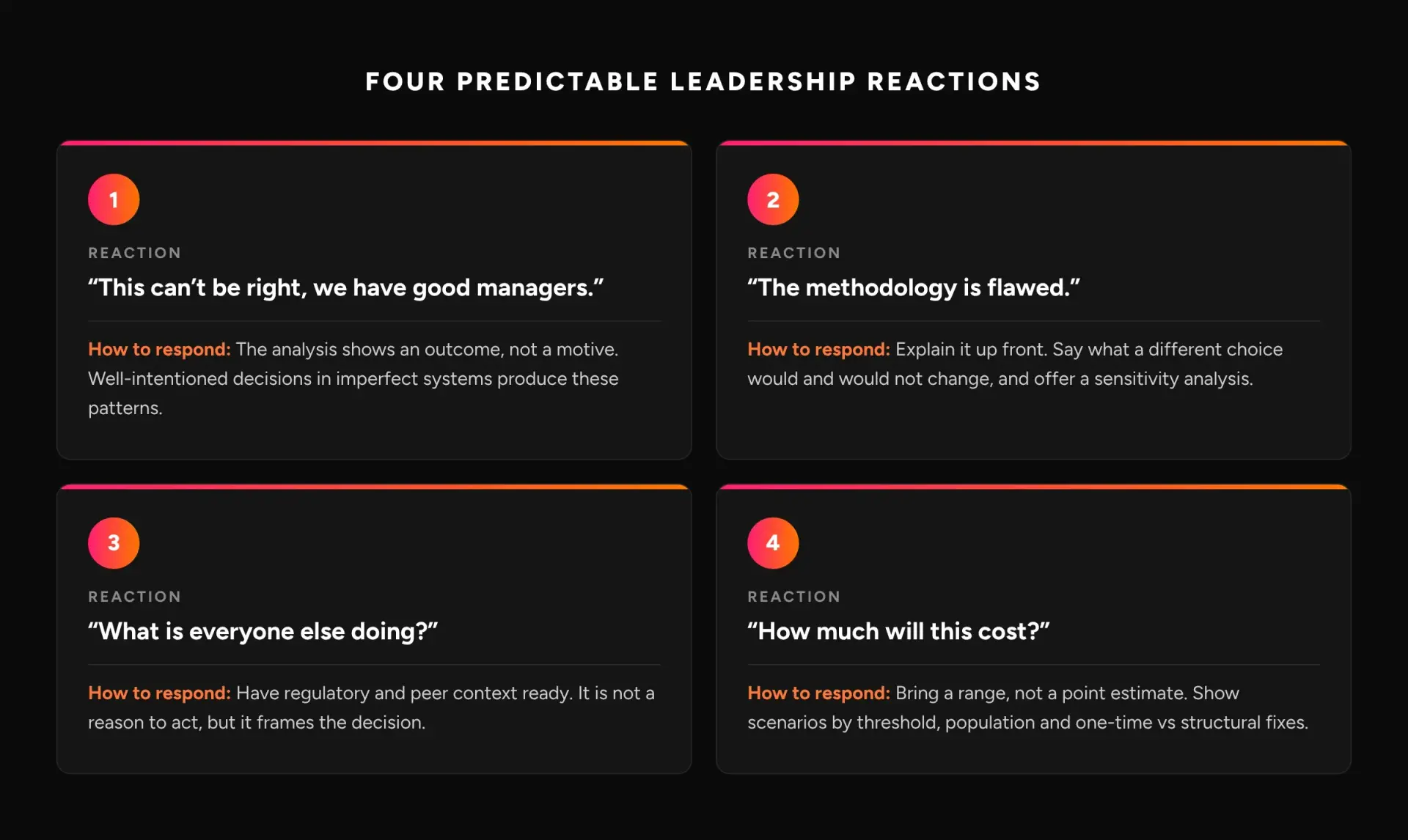
Reaction 1: "This can't be right, we have good managers"
Acknowledge that the gaps are not evidence of intentional bias. Explain that well-intentioned decisions made within imperfect systems produce these patterns consistently across industries. The analysis shows an outcome, not a motive.
Reaction 2: "The methodology is flawed"
Explaining the methodology up front reduces this response but does not eliminate it. Be specific about what a different methodological choice would change and what it would not. Have the technical documentation available, but do not make the room work through it live.
Reaction 3: "What is everyone else doing?"
This is a reasonable question. Have context ready:
- what regulatory requirements look like
- what industry peers have committed to
- where voluntary disclosure is heading
This is not a reason to act, but it puts the decision in context.
Reaction 4: "How much will this cost?"
Have a range ready, not a point estimate. The cost of remediation depends on three choices:
- how the organisation defines the population of employees receiving adjustments
- what threshold of statistical significance triggers action
- whether the adjustment is one-time or structural
Present scenarios rather than a single number.
Structure findings around decisions
Pay equity analyses typically look at several demographic dimensions: gender, race and ethnicity, age and sometimes others. The temptation is to present each dimension's findings in turn. That gives a comprehensive picture, but no clear line through to action.
A more effective structure groups findings by the decision they require:
- The biggest gap is in one job family, and largely explained by a structural feature of that family's pay bands. The question for leaders is whether to redesign the bands.
- The gap is concentrated in one business unit or geography. The question is whether to adjust the manager calibration process there.
- The gap is spread across the organisation with no clear structural cause. The remediation approach is different again.
When findings are presented around the decisions they require, the room can focus on "what do we do about this?" rather than "what does this mean?" That is a much more productive place to spend time.
Tallect insight: building the leadership narrative directly from the analysis
Tallect generates pay equity summaries designed for leadership audiences alongside the full technical report. The leadership summary:
- shows controlled and raw gaps side by side, with plain-language explanations of the difference
- groups findings by the type of action they require, not by demographic dimension
- includes scenario modelling of remediation cost ranges under different threshold and population assumptions
So the HR or compensation team presenting the findings has a document built for the audience, rather than a technical report adapted on the fly. The underlying analysis is linked for anyone who wants to go deeper. The meeting itself is built around decisions, not a walk through the methodology.
Present a path forward
No pay equity presentation should end with the findings. It should end with a recommended path forward and the specific decisions needed to pursue it.
The path forward typically has three parts:
- Immediate remediation for employees whose pay falls below what the analysis suggests it should be.
- Structural changes to stop the same gaps reopening.
- A cadence for ongoing monitoring and reporting.
Each part needs a different kind of decision. Presenting them as a package helps leaders see they are not just approving a one-time cost. They are committing to an ongoing practice.
Be specific about what each part needs from the people in the room:
Decision | Who owns it |
|---|---|
Budget approval | Finance and the CEO |
Policy changes in how managers make pay decisions | HR and business unit leaders |
External reporting | Legal and Communications |
Caption: Map each decision to its owner before the meeting.
Mapping decisions to decision-makers before the meeting stops it ending in vague collective agreement that fades once people are back at their desks.

The most effective pay equity conversations happen when everyone has seen the numbers in advance and the meeting is structured around decisions, not discovery.
What to send before the meeting
Pay equity findings should not be seen for the first time in the meeting room. The first reaction to surprising data takes time to work through. That processing should happen before the group meets, not during the conversation.
- Send the leadership summary at least forty-eight hours before the meeting, with key findings and the proposed path forward. Say explicitly that you are sharing it in advance, so attendees can review it and come with questions rather than reactions.
- Talk to strong reactors first. For leaders you expect to react strongly, a short one-to-one conversation before the full meeting is worth the time. It brings out the concerns that will dominate the discussion, and lets you address them while the stakes are lower.
The meeting itself should assume the room has read the material and move straight to discussion. Walking through material people have already read, as if they had not, wastes time and signals a lack of confidence in the audience.
The disclosure question
At some point in the pay equity conversation, the question of external disclosure will come up. Organisations tend to be in one of three positions:
- they have already committed to voluntary disclosure
- they are dealing with regulatory requirements in jurisdictions that now mandate it
- they are watching the landscape and deciding whether, and when, to get ahead of it
This is a governance decision more than a compensation decision. It usually belongs in a conversation that includes Legal, Communications and senior leadership, not the first pay equity findings meeting.
The HR or compensation team can usefully contribute clarity about three things:
- what the analysis shows
- what level of confidence the analysis supports
- what a disclosure would accurately say
The judgement about whether to disclose, and when, belongs with the people accountable for external relationships and regulatory exposure.
Tallect AI insight: detecting patterns that need different communication strategies
Not all pay equity gaps have the same cause, and the communication strategy should reflect the underlying pattern. Tallect's AI layer sorts gaps by their most likely structural origin:
- pay band design that systematically disadvantages certain groups
- patterns in manager discretion, concentrated in specific business units
- variation in starting salaries, driven by how candidates negotiate
- earlier gaps compounding over tenure
Each category has a different remediation story and a different conversation for leaders. For example:
- A gap driven by starting salary variation needs changes to offer practices, not band redesign.
- A gap driven by tenure compounding may need a different calibration approach at merit review.
Knowing which category applies before the presentation means the conversation can be built around the right solution, rather than starting from first principles in the room.
Key takeaways
- Decide what decision you need before you decide what to present. A pay equity presentation that informs without producing a decision is a missed opportunity. The findings should anchor the conversation, and the structure should drive towards the specific approvals or commitments needed.
- Lead with methodology, then findings. If leaders understand how the analysis was done before they see the numbers, methodology questions are less likely to derail the results conversation once it starts.
- Present both the raw and controlled gap, clearly labelled. Leading with only the raw gap invites misreading in both directions. The controlled gap is what the analysis is designed to surface. The distinction matters for both the remediation target and the cost estimate.
- Frame findings as systemic outcomes, not evidence of intent. Pay equity gaps in well-run organisations almost always come from unexamined system design, not deliberate discrimination. Presenting them accurately gets more constructive engagement from leaders than framing them as failures.
- Prepare for the four predictable reactions. Defensive responses, methodology challenges, comparisons with peers and cost questions are all foreseeable. Prepared answers make it less likely they hijack the meeting.
- Structure findings around the decisions they require, not the demographic dimensions analysed. Organising by decision type keeps the conversation focused on what happens next rather than on analysis.
- Send the material in advance and treat the meeting as a discussion, not a reveal. Leaders who see findings for the first time in the room react. Leaders who have had time to process them engage more constructively.
- End with a concrete path forward, mapped to specific decision-makers. Vague collective agreement does not survive the return to normal work. Specific decisions owned by specific people do.
Frequently asked questions
What is the difference between a raw pay gap and a controlled pay gap?
- The raw pay gap is the difference in average pay between demographic groups before any factors are accounted for. It reflects the full disparity in pay outcomes, including differences driven by job type, level, tenure and performance.
- The controlled (or adjusted) pay gap removes those factors statistically. It isolates the part of the gap that remains after accounting for legitimate factors.
The controlled gap is what pay equity analysis is designed to measure, and it is typically smaller than the raw gap. Both are worth reporting, but they answer different questions:
- the raw gap describes the overall pay landscape
- the controlled gap shows where the organisation may have an equity problem that remediation can fix
How do you handle a situation where leadership disputes the methodology?
Acknowledge that methodological choices affect results. Be specific about what a different choice would and would not change. Having the technical documentation available, without putting it on screen, signals that the analysis can stand up to scrutiny.
The most effective response to a methodology dispute is usually not to try to settle it in the main meeting. Instead:
- Agree to a specific follow-up question.
- Offer to run a sensitivity analysis with the alternative assumption.
- Schedule a short session to review the results.
This keeps the main conversation moving and deals with the technical concern in a better setting.
Should pay equity findings be shared with the full leadership team or only with the CEO and CHRO first?
There is no universal answer, but a staged approach often works better than revealing the findings to the full room first. Sharing them with the CEO and CHRO first lets them:
- work through their first reactions privately
- ask the questions that might otherwise dominate a larger meeting
- arrive at the leadership discussion already agreed on the basic facts
It also signals that pay equity is an executive priority rather than an HR agenda item, which affects how the wider leadership team engages with it. The full leadership presentation can then focus more on decisions, because the discovery phase has already happened.
What remediation cost scenarios should be prepared for the leadership presentation?
Prepare at least two scenarios:
- A minimum-action scenario that addresses only statistically significant gaps above a defined threshold.
- A comprehensive scenario that addresses all identified gaps, including those below the significance threshold.
The cost difference between the two is often substantial, and it shows the trade-off clearly.
Some organisations also prepare a third scenario. It addresses the structural causes of gaps rather than only how they show up today. It may cost more upfront, but it reduces the risk of gaps reopening in future review cycles.
Presenting scenarios rather than a single number keeps the discussion strategic rather than immediately transactional.
How should you respond if a leader says the gaps are explained by performance differences?
Deal with this in the methodology section up front, rather than as a reaction later. A well-built pay equity analysis controls for performance ratings, so performance differences within the analysed population are already accounted for. If a controlled gap persists after controlling for performance, the finding is specific: people in comparable roles with comparable ratings are paid differently.
It is also worth noting, separately, that performance ratings may themselves carry bias. That is a reason to analyse ratings alongside pay equity, not a reason to dismiss the pay findings.
How often should pay equity results be presented to the leadership team?
At least once a year, ideally timed to inform the annual merit review so that decisions about increases can take equity findings into account.
Organisations with active remediation programmes benefit from a mid-year check-in, to track whether structural changes are having the intended effect.
The cadence should also reflect external commitments. An organisation that has made public pay equity disclosures will want internal reporting to happen well before external reporting. Leaders then have time to understand and respond to the findings before they are published.
What is the right way to communicate pay equity findings to employees?
This decision belongs with leadership and Legal, not HR alone. Without putting specific analysis in front of employees, you can generally say that the organisation runs regular pay equity reviews and is committed to closing identified gaps.
For employees who receive pay adjustments as a result of a review, say openly that the adjustment reflects an equity review. That is better than a vague explanation, because it puts the increase in context and reinforces the organisation's commitment.
What to avoid is communicating findings in enough detail to create legal exposure, or to invite questions the organisation is not ready to answer publicly.
How do you present pay equity findings in a way that does not feel like an attack on individual managers?
The framing that works best is systemic rather than individual. Pay equity gaps are not mainly the result of individual managers making biased decisions. They come from systems, processes and decision frameworks that do not have equity built in as an explicit constraint.
Present the findings at system level, and focus remediation on changing systems rather than holding individuals to account for historical patterns. That keeps the conversation constructive.
Some managers or business units may show patterns that differ from the organisation as a whole. Have those conversations separately and privately, not in the leadership forum.
What documentation should be prepared alongside the leadership presentation?
The minimum package includes:
- A leadership summary: two to three pages, covering findings and the proposed path forward.
- A technical appendix: methodology, data sources, statistical approach and full results by dimension.
- A remediation cost model with scenarios.
- A proposed governance calendar for future review and reporting.
Legal should review the full package before it is shared. This matters most if the organisation operates where pay data must be reported by law, or where pay equity litigation is an active risk. Attorney-client privilege considerations may affect what is documented and how.
How do you present pay equity results when the findings are genuinely good?
Good results deserve the same rigorous presentation as poor ones:
- present the methodology
- show the controlled and raw gaps
- explain what the results do and do not tell you
- discuss the monitoring that will continue
A clean analysis one year does not mean the organisation can stop looking. It means the current structure is working and needs to be maintained.
Resist the temptation to treat a good result as a reason to analyse less often. In organisations with good current results, the remaining gaps tend to be structural and slow-moving rather than immediately visible.
How does Tallect support the pay equity reporting process for leadership teams?
Tallect generates a leadership-ready summary alongside the full technical pay equity report, with findings structured around the decisions they require rather than a walk through the methodology. The platform:
- models remediation costs under different threshold and population assumptions
- tracks changes in controlled and raw gaps across review cycles
- flags patterns by structural category, to support the story of why gaps exist and what changes will fix them
- formats outputs to map to common disclosure frameworks, for organisations with external reporting commitments
Disclaimer: The information in this article is provided for general educational and informational purposes only. It does not constitute legal advice. Organisations should consult qualified legal counsel when designing pay equity analyses and communications, particularly in jurisdictions with mandatory pay transparency or reporting requirements.
Turn pay equity analysis into leadership action
Tallect generates leadership-ready pay equity summaries with scenario modelling and decision-mapped findings, so your presentation produces commitments rather than questions.