Eight Questions to Ask Before Changing Your Benefits Provider
Vendor pitches look compelling in the room. These eight questions surface what usually only comes up during implementation.
Switching benefits providers is disruptive even when it goes well. When it goes badly, it generates complaints at exactly the moment employees most need their benefits to work smoothly: during illness, life changes and financial stress. The stakes of a poor selection decision are high, and the buying process rarely makes them visible.
Benefits vendors are skilled at demos. They know which features read well on slides, and which friction points to leave out until after the contract is signed. The questions below are designed to close that gap. They force specific answers on the things that separate a genuinely capable provider from one that presents well.
None of these are trick questions. A strong vendor will have clear answers to all of them. What the questions do is make it harder to mistake a smooth sales process for a smooth implementation.
Research highlight: why benefits switches fail to deliver expected value
Post-implementation reviews of benefits provider transitions consistently identify the same failure patterns (source needed):
- underestimated integration complexity
- employee confusion during the transition period
- hidden administrative costs that erode the savings projected in the business case
- network gaps that only became apparent once employees started making claims
These issues are almost never raised during vendor selection. They are raised by asking the right questions before signing, not after.
The selection processes that lead to these outcomes share a common structure. Too much time goes on evaluating features and pricing, and too little on stress-testing onboarding, integration and service delivery. The questions in this article are built around the second category.
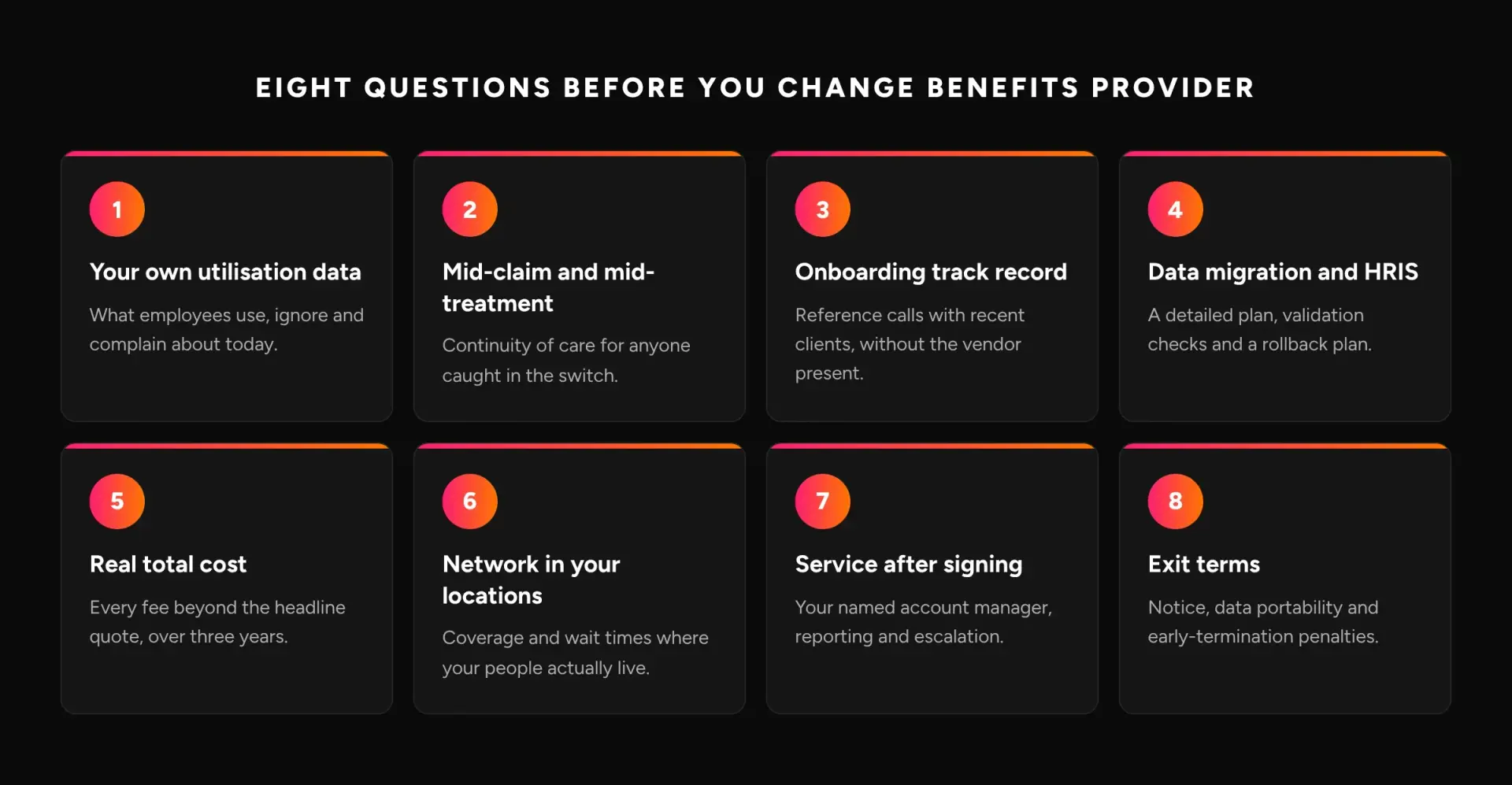
1. What does your utilisation data show?
What does your current utilisation data actually tell you? Before evaluating any vendor, run the analysis on your existing programme. Three things should shape what you look for in a new provider:
- which benefits employees use heavily
- which are barely touched
- which generate the most claims complexity
Low utilisation on a benefit can mean four different things:
- the benefit does not meet employee needs
- it is too hard to access
- employees do not understand it
- it is genuinely not valued
Those are four different problems with four different solutions, and only one of them is switching providers. Without this analysis, you may optimise for the wrong things, or switch away from a programme element that employees actually use heavily.
Ask your current provider for a full utilisation report before you start any vendor conversations. If they cannot or will not produce one, that is itself useful information about the relationship you are in.
Questions to run internally:
- Which benefits have the highest and lowest utilisation by employee segment?
- Where do most claims complaints come from, and what are the top reasons for claim rejection?
- What would employees say if you asked them what is missing from the current programme?
2. What happens to employees mid-claim?
How will the transition affect employees who are mid-claim or mid-treatment? This is the most consequential operational question in any benefits switch, and vendor presentations often gloss over it.
An employee may be receiving treatment under a health plan, going through a claims process or partway through a reimbursement cycle. A provider change can interrupt or invalidate that process. To the employee, it can feel as if the company has simply stopped covering them.
Get specific. Ask:
- what happens to in-progress authorisations, ongoing prescriptions, and open mental health or physiotherapy referral chains
- how the vendor handles continuity of care
- what notice employees would receive, and in what format
The answers show whether the provider thinks about employees as people or as a data migration problem.
Questions to put to the vendor:
- How do you handle continuity of care for employees mid-treatment at the point of switch?
- What happens to open claims that have not been settled when the transition date arrives?
- What employee communication does your onboarding team produce, and can we see examples?
3. What is their onboarding track record?
What does the provider's onboarding track record actually look like? Every vendor describes its onboarding process in positive terms. What you need is evidence.
Ask for a list of customers of comparable size and complexity who have gone through onboarding in the last eighteen months. Ask to speak with two or three of them without the vendor present.
What you want from reference customers is not general satisfaction but the specific friction points:
- what went wrong
- what took longer than expected
- what surprised them
- whether the support during onboarding matched what was promised during the sales process
Some vendors are unwilling to provide reference calls, want to choose which customers you speak to, or insist on being present. That signals something about how confident they are in what those customers would say.
Questions for reference customers:
- What was the most difficult part of onboarding that you were not warned about in advance?
- Did the account management team change between the sales process and implementation?
- Knowing what you know now, what would you do differently in the selection process?
4. How will data migration work?
How does data migration and HRIS integration actually work? Benefits data is some of the most sensitive employee data HR holds. Moving it between providers, and keeping the benefits platform integrated with the HRIS, are both technically complex and high-risk.
Data errors here translate directly into employees who are:
- not enrolled
- enrolled in the wrong plans
- recorded with incorrect beneficiary information
Ask for a detailed data migration plan, not a summary slide. Ask:
- who from the vendor's technical team will be responsible for the integration, and what their qualifications are
- what escalation path exists if issues arise
- what has gone wrong in previous migrations, and how it was resolved
A vendor with strong integration experience will have clear answers. One that has not done this many times will not.
Questions to ask the technical team, not the sales team:
- What HRIS platforms do you have pre-built connectors for, and what does custom integration require?
- What data validation checks run before the migration completes, and who reviews the exceptions?
- What is the rollback plan if critical data issues are found after go-live?
Tallect insight: mapping benefits spend against utilisation before the switch
Tallect's total rewards platform shows benefits spend and utilisation side by side, broken down by employee segment, tenure band and location. Running this analysis before a provider switch identifies:
- which programme elements are driving value
- which are carrying cost without being used
- which employee groups have gaps in benefit access that a new provider should address
This turns vendor selection from a comparison of features and pricing into a conversation about what the programme actually needs to do differently.
5. What is the real total cost?
What are the real total costs, including everything that is not in the headline quote? Benefits vendors quote what they want you to compare. What they do not always show upfront:
- set-up fees
- data migration charges
- per-transaction administration fees
- costs for adding new benefit types
- fees for additional reporting
- charges for adding new locations or legal entities
- renewal pricing that looks different from year-one pricing
Ask for a comprehensive fee schedule, not a summary. Ask:
- what is included in the annual fee and what is billed separately
- what happens to pricing if your headcount grows or changes
- what the typical cost trajectory looks like for clients in years two and three
The difference between the headline quote and the actual three-year total cost is often material, and a standard vendor proposal almost never shows it.
Costs to get in writing before you proceed:
- implementation and data migration fees, including any third-party integration costs
- annual administration fees, and any per-employee, per-transaction or per-claim charges
- charges for adding benefit types, locations or reporting beyond the standard package
6. Does the network fit your people?
How does the provider's network compare in your actual employee locations and demographics? Network adequacy is not a single number:
- A provider with strong coverage in your headquarters city may have thin coverage in secondary locations where many of your employees work.
- A network that works well for employees in their thirties may have gaps in care categories that matter more to other age groups or health profiles.
Ask for a network analysis against your actual employee postcode or location data. Then ask:
- about the care categories your employees use most
- what the average in-network appointment wait time is in your key locations
- how the network has changed in the last two years
These questions need real data to answer. They will show quickly whether the vendor's network strength is genuine or only headline-level.
What to validate before accepting network claims:
- provider density by postcode or location, against your actual employee distribution
- wait times for in-network specialists in the care categories your employees use most
- out-of-network claim rates from comparable clients, as a sign of whether the network is sufficient in practice
7. What service do you get after signing?
What reporting, analytics and account management will you get after the contract is signed? The service model that matters is the one you get twelve months after implementation, not the one you get during the sales cycle.
Benefits providers often assign their most experienced account managers to prospects during selection and to new clients during onboarding. What those clients experience eighteen months later can be quite different.
Ask:
- who your account manager will be, what their caseload is, and what experience they have with clients of your size and complexity
- what reporting you will receive, how often and in what format
- how issues escalate when the account manager cannot resolve them
- for a sample quarterly business review agenda, to see how the relationship is managed once the novelty of a new client has worn off
Service model questions that separate vendors:
- Can you name the account manager who will be assigned to us and tell us about their background?
- What is your average response time for account issues, and how is that tracked?
- What standard reports do we receive, and what does custom reporting cost?
8. What are the exit terms?
What are the exit terms if the relationship does not work out? This question makes some vendors uncomfortable, which is part of why it is worth asking. A provider confident in its service will have reasonable exit terms. One nervous about retention will have contract terms that make switching difficult and costly.
Ask for the full contract terms, not a summary. Look at:
- notice periods
- data portability provisions
- early termination fees
- what happens to employee data at the end of the relationship
Ask specifically how data is returned to you, in what format, and how long the vendor keeps it after the contract ends. These terms are negotiable at signing in ways they are not later.
Contract terms to review before signing:
- the notice period required to terminate, and whether it lines up with your renewal windows
- data portability: format, timeline and completeness of data return at contract end
- any lock-in provisions, minimum term clauses or penalties for early termination

The most productive conversations with benefits providers happen when HR teams arrive with specific questions and data, not open-ended requests for a pitch.
Tallect AI insight: detecting benefits gaps before you go to market
Tallect's AI layer analyses utilisation patterns across your current benefits programme to identify:
- where employees underuse benefits because of access friction
- where claim patterns suggest the network is inadequate
- where cost per use is highest relative to how much employees value the benefit
This gives HR teams a data-based brief for vendor selection. Conversations with new providers can then start from "here is what we need to fix" rather than "show us what you offer".
The platform also tracks benefits spend against budget projections each quarter. It flags where administration fees or claim volumes are running above forecast, so the team can correct course before year-end rather than explaining variances afterwards.
Key takeaways
- Start with your own data, not a vendor pitch. Run your utilisation and claims analysis before going to market, so you know what you are actually trying to solve.
- The transition is the highest-risk moment. Employees mid-claim or mid-treatment are the most exposed. Push hard on continuity of care before you sign.
- Reference calls without the vendor present are essential. A vendor that wants to choose or sit in on reference conversations is not confident in what those customers would say.
- Get a detailed data migration plan, not a summary slide. Integration is where switches most often go wrong, and a sales process almost never explains it properly.
- The headline quote is not the total cost. Set-up, migration, extra reporting and renewal pricing can all look very different from the number you signed up for.
- Network adequacy is local and demographic, not just national. Check coverage against your actual employee locations and the care categories your employees use most.
- Ask who your account manager will be, by name. The service that matters is the one you get eighteen months after implementation, not during onboarding.
- Negotiate exit terms before you sign. Data portability, notice periods and termination clauses can be negotiated at contract stage and are very hard to change later.
Frequently asked questions
How long should a benefits provider selection process typically take?
It depends on the scope:
- A straightforward switch of one benefit with a well-defined scope: six to eight weeks from first outreach to contract is achievable.
- A full programme transition with several benefit types, HRIS integration and multiple locations: four to six months is more realistic, once you allow for proper due diligence, reference checks, contract negotiation and migration planning.
Organisations that rush this to hit an arbitrary year-end deadline consistently report more implementation problems than those that give selection proper time (source needed).
Should we tell our current provider that we are evaluating alternatives?
There is no universal right answer:
- Not telling them preserves negotiating leverage, and avoids an awkward relationship while you still need them to serve your employees well.
- Telling them sometimes produces a better offer or service commitment.
What matters more than timing is making sure your current provider keeps serving employees properly throughout the evaluation. That means keeping the relationship professional, whatever you are exploring elsewhere.
What is the best time of year to switch benefits providers?
Aligning the switch with your annual benefits renewal is by far the cleanest option. It:
- avoids mid-year proration complexity
- lets employee communications go out with annual enrolment
- reduces the risk of employees being caught between two providers' coverage periods
If your renewal window does not leave enough time for proper due diligence, it is usually better to wait for the next renewal than to rush. The cost of a rushed switch almost always exceeds the savings from moving one cycle earlier.
How do we evaluate vendors when their products look very similar?
When features converge, the differences are operational:
- how onboarding is actually delivered
- how account management works month to month
- how the claims process feels to employees
- how quickly issues are resolved
These are very hard to judge from a demo, and much easier to judge through reference conversations with clients who have been with the provider for more than a year. If two vendors look identical on features and pricing, spend more time on references and less on extra demos.
What should be in the RFP we send to benefits providers?
An effective benefits RFP includes:
- your current programme structure and employee demographics
- your specific requirements for coverage types and network
- your HRIS platform and integration requirements
- your timeline and transition constraints
- the reporting cadence and format you need
- a clear description of what has not worked well in your current arrangement
That last point invites vendors to show how they would solve your actual problems, rather than presenting generic capabilities. The quality of their answers to it is itself a useful way to tell vendors apart.
How do we handle employee communication during a provider switch?
Start earlier than feels necessary and be more specific than feels comfortable. Employees want to know:
- what is changing, and what is staying the same
- what they need to do, and by when
- who to contact if something goes wrong
- what happens to anything in progress under the current provider
A single all-company email does not cover this for a benefits switch. Manager briefings, a dedicated FAQ page or document, and a clear escalation path for employees with specific concerns about their own cover are all worth the extra effort.
What are the most common reasons benefits switches get delayed?
- Data migration issues that were not anticipated during planning are the most common cause.
- HRIS integration complexity is a close second.
- Late or incomplete data from the outgoing provider is frequent and underestimated.
- Contract negotiation often takes longer than expected, particularly around indemnification and data provisions.
Building four to six weeks of buffer into any implementation timeline is not pessimistic. It reflects the real experience of organisations that have been through the process.
Should the same team that selects the provider also manage the implementation?
Continuity from selection through implementation matters. The team that led the evaluation knows what commitments were made and what assurances were given during the sales process. The vendor will not necessarily carry those forward on its own.
Where full continuity is not possible, hand the implementation lead a detailed transition document that records:
- what was agreed
- what was promised informally
- what concerns were raised during due diligence
- what the implementation plan is supposed to cover
How do we evaluate a vendor's financial stability before signing?
For large, established providers this is less of a concern, but still worth a basic check:
- look at the ownership structure and any recent change of control
- review public financial filings, if available
- ask directly about the company's financial position
For smaller or newer providers, particularly those offering innovative point solutions, financial due diligence deserves more attention. A provider that goes out of business or is acquired mid-contract creates a benefits continuity problem that is very hard to manage. Asking for audited accounts and understanding the ownership structure are standard procurement due diligence for any significant contract.
What happens to employee data when we switch away from a provider?
Address data portability explicitly in the contract before you sign. At minimum, you should have the right to a complete export of all employee data:
- in a readable, standard format
- within a defined time after the contract ends
- at no extra cost
You should also know how long the outgoing provider keeps data after the contract ends, and what its obligations are on deletion. These provisions are easier to negotiate before signing than after. They matter if you ever need to dispute a claim or audit programme delivery once the relationship has ended.
How does Tallect help with benefits vendor selection and ongoing management?
Tallect's platform brings benefits spend, utilisation and cost data together across your programme, so you can see what is working and what is not before going to market. During a vendor switch, the platform:
- tracks benefits cost projections against actuals
- monitors employee enrolment rates under the new provider
- flags unusual claim patterns early, in case they point to network or administration problems
HR and Finance get a continuous view of programme performance, rather than a once-a-year snapshot at renewal.
Disclaimer: The information in this article is for general educational purposes and does not constitute legal, procurement, or benefits advice. Organisations should consult qualified advisers when managing benefits provider transitions, particularly regarding data protection obligations and contractual terms.
See your benefits programme clearly before you switch
Tallect consolidates utilisation, spend, and cost data across your benefits programme so your next vendor conversation starts from the right place.