How to Run an ESOP Buyback: A Step-by-Step Playbook for HR and Finance
Pick the route, set the price, get approvals, run the offer and pay out: a 10-step ESOP buyback playbook with India, US and UK rules.
An ESOP buyback rarely goes wrong on price. It goes wrong in the details:
- a vested balance that doesn't match the grant letter
- a former employee nobody remembered to invite
- an option holder who learns at payout that exercising triggered a tax bill they hadn't planned for
The price gets the board's attention. The process decides whether employees trust the next one.
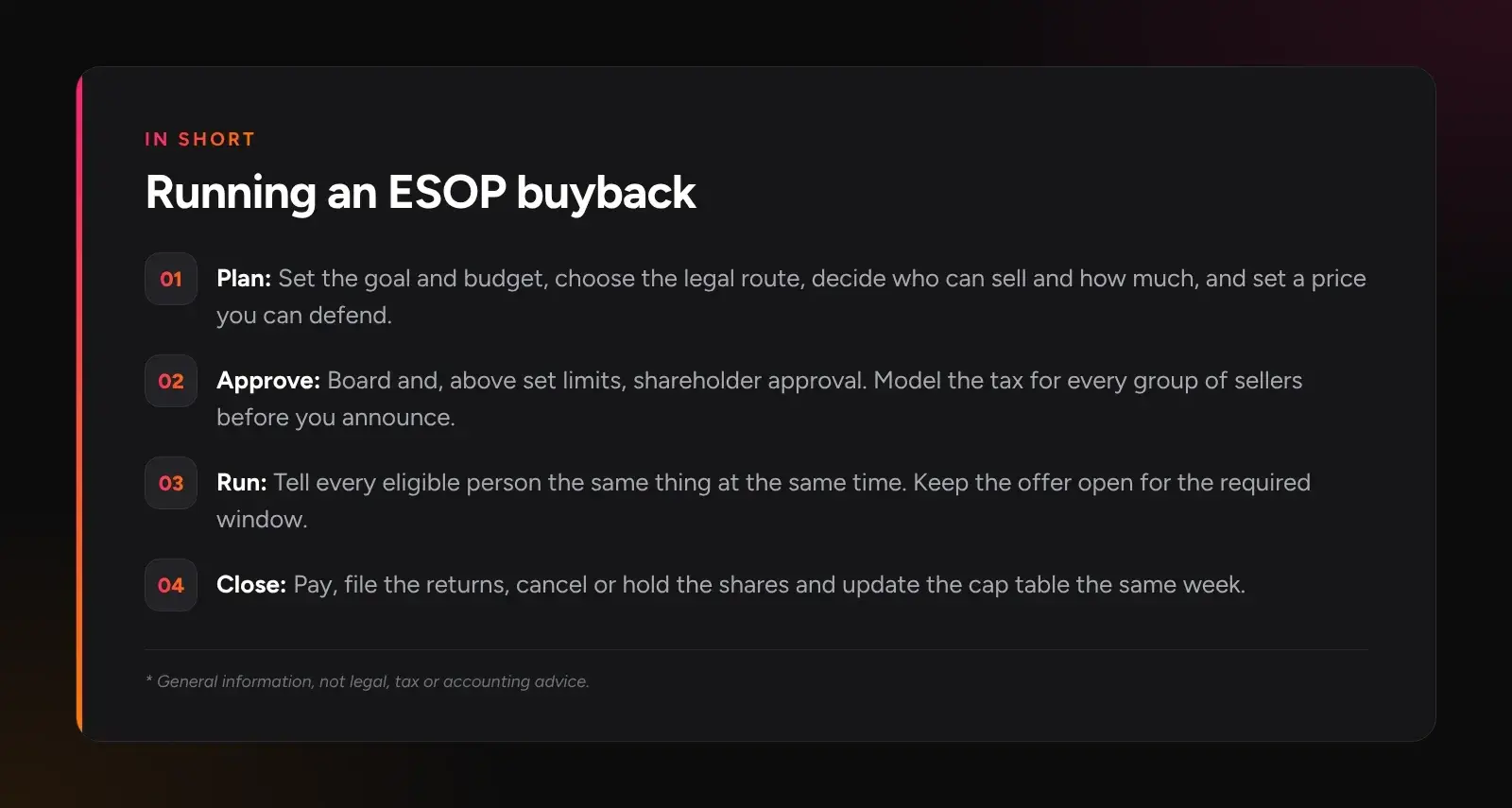
The short version:
- Decide who pays and which legal route you'll use.
- Set a price you can defend to employees and to the tax authorities.
- Get board and shareholder approval, and model the tax for every group of sellers before anything is announced.
- Run the offer window, then pay, file and update the cap table in the same week.
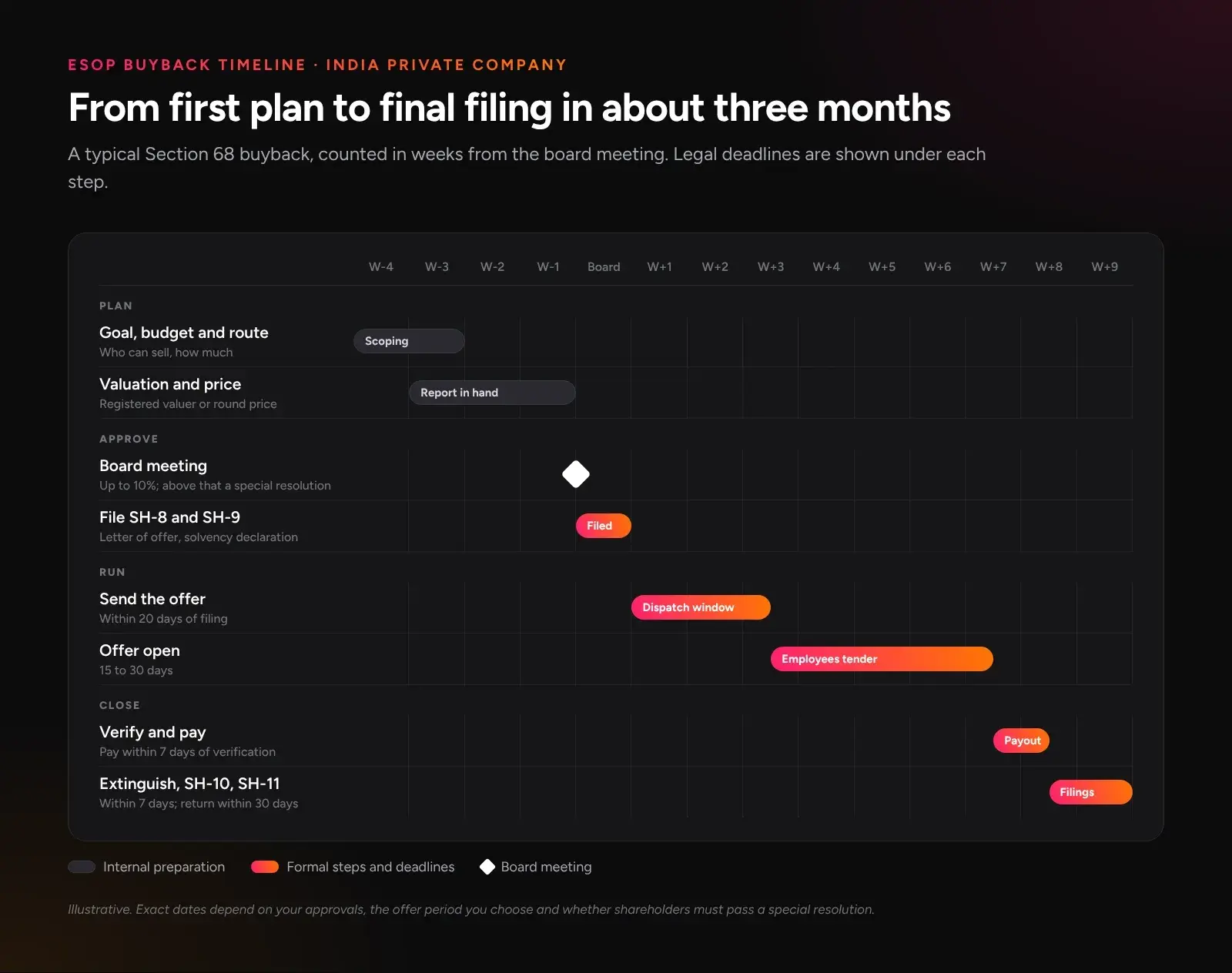
Allow two to three months from the first board conversation to the last payment.
What is an ESOP buyback?
The phrase covers three or four different transactions, and people mix them up all the time. A founder says "buyback", the CFO hears "Section 68" and HR tells employees they'll be "cashed out". Agree on which one you mean before the first meeting ends, because each has its own approvals and its own tax.
Route | What employees sell | Who pays | What happens to the shares |
|---|---|---|---|
Company buyback of shares | Shares they got by exercising ESOPs | The company | Cancelled |
Cash-out of vested options | Vested options they haven't exercised | The company | No shares exist yet; the options are cancelled |
Purchase by an ESOP trust | Shares they got by exercising ESOPs | The trust, usually funded by the company | Held by the trust and reused for future grants |
Secondary sale or third-party tender | Shares | One or more investors | Move to the investor |
Caption: The four transactions people call an "ESOP buyback".
In the US, the company-led version is usually run as a tender offer. In India, "buyback" in the strict legal sense means a company buying its own shares under Section 68 of the Companies Act, 2013. A trust purchase or an option cash-out isn't a Section 68 buyback at all, which changes both the filings and the tax.
Why run a buyback, and how common is it?
The stated reason is usually reward. The real reason is often credibility. Candidates who have watched ESOPs at other startups come to nothing aren't persuaded by a grant letter alone. A buyback, even a small one, shows the equity can turn into cash.
It's now a regular event in both India and the US:
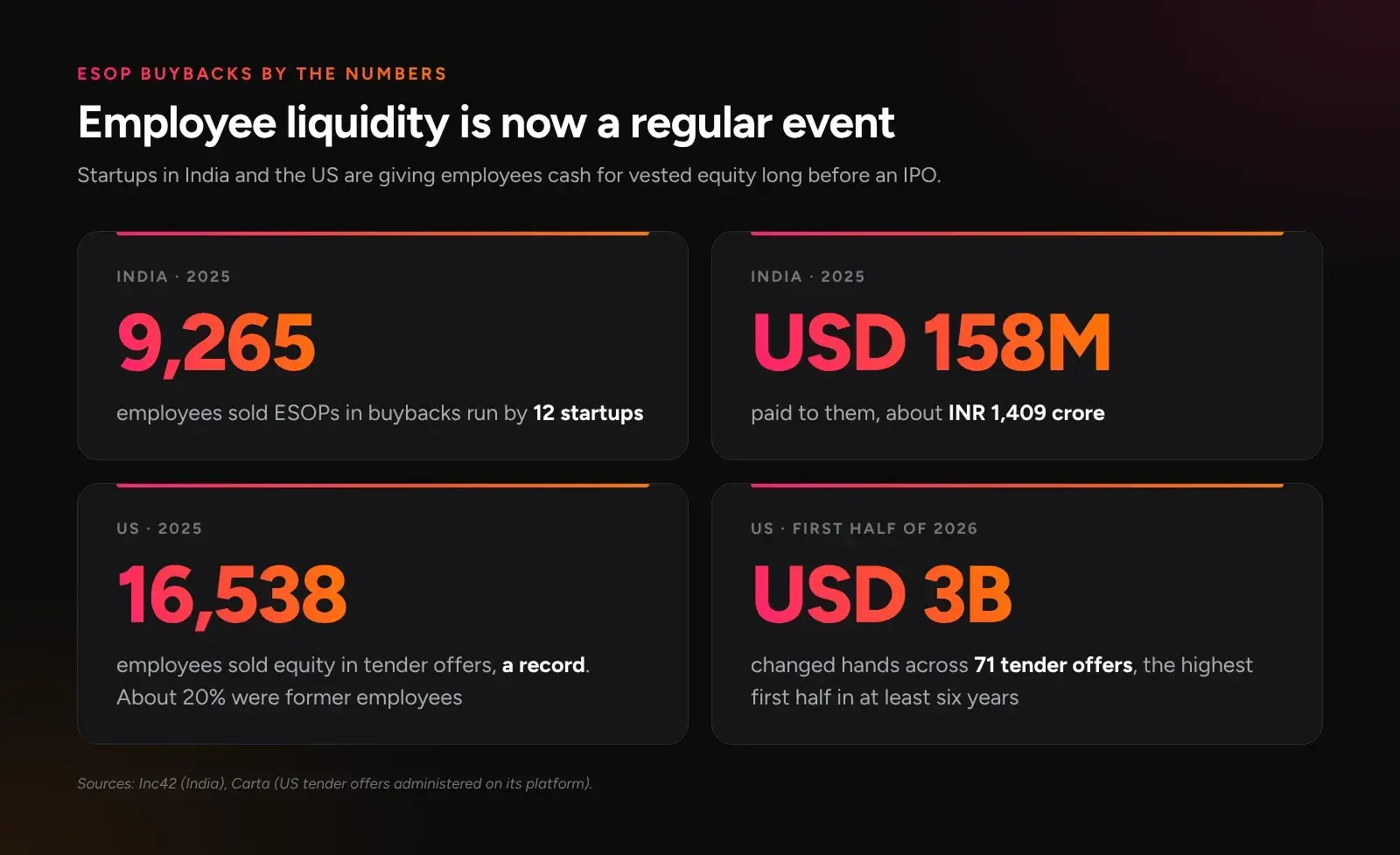
- India, 2025: According to Inc42, 12 startups ran ESOP buybacks, letting more than 9,265 employees realise about INR 1,409 crore (about USD 158 million). In 2024, 23 startups bought back about INR 1,448 crore from more than 3,000 employees.
- India, early 2026: Nearly USD 220 million in buybacks in the first quarter alone, led by BrowserStack's USD 125 million programme and Innovaccer's USD 75 million.
- US, 2025: A record 16,538 employees sold equity in tender offers on Carta. About 20% of them were former employees.
- US, first half of 2026: Carta administered 71 tender offers worth about USD 3 billion, its highest first-half total in at least six years.
A buyback is the moment employees find out whether their ESOPs were ever real.
Two other reasons come up often:
- tidying up small holdings from former employees before a funding round
- giving long-serving people some cash while the company stays private longer than anyone expected
Phase 1: Plan the buyback
Step 1: Set the goal and the budget
Write one sentence on why the company is doing this and who it's for. It sounds obvious. It's also the sentence you'll come back to every time someone asks for an exception.
- Budget: The total cash the company or investors will spend.
- Funding: The rules on what the money can come from differ by country:
- India: A Section 68 buyback can only be paid from free reserves, the securities premium account or the proceeds of a different kind of issue. Bank borrowings are out.
- UK: The company generally needs enough distributable reserves.
- US: State corporate law limits buybacks that would impair capital.
- Per-person cap: The share of each person's holding they can sell. In the median Carta buyback, eligible employees can sell up to 25% of their shares.
For a first programme, a cap of 20% to 25% of each person's vested holding is a sensible starting point. The cash reaches more people, and employees keep enough upside that the buyback doesn't read as a hint to leave.
Step 2: Choose the route
Country | Main routes | Key limits |
|---|---|---|
India | Section 68 buyback, ESOP trust purchase, cash-out of vested options, secondary sale | Section 68: up to 25% of paid-up capital and free reserves, one buyback a year, debt no more than twice capital and reserves afterwards. Trust: company funding and shares bought capped at 5% of paid-up capital and free reserves (Rule 16) |
US | Company tender offer, third-party tender offer, option cash-out | Regulation 14E applies to private company tender offers too, including a 20 business day minimum offer period |
UK | Company purchase of own shares, purchase by an employee benefit trust | Shareholder approval of the purchase contract, payment in full on purchase, enough distributable reserves |
Caption: The main buyback routes and their key limits in India, the US and the UK.
For most Indian startups, the real choice is between two routes:
- A Section 68 buyback is the cleaner option when the reserves are there, because the shares are cancelled and the cap table gets simpler.
- An investor-funded secondary costs the company nothing. But it only works if an investor wants common shares at a price it can justify to its own partners.
Step 3: Decide who can sell, and how much
This is where fairness complaints start. Write the rules down before the announcement, not after the first email asking for an exception.
- Current or former employees: Company buybacks are usually stricter with former employees. In the median Carta buyback over the past three and a half years, no former employees were eligible.
- Tenure: A minimum period of service, for example two years.
- Vested only: Unvested options can't be sold. In India, nothing can vest earlier than one year after grant anyway.
- Options or shares: Option holders must either exercise first or be offered a cash-out. If they exercise, allow a cashless exercise, so they don't need to find the exercise price.
- Oversubscription: Decide how you'll scale back. Under India's Rule 17, acceptances are proportionate when more shares are tendered than the offer covers.
Here's how it plays out. A product manager at a Series B company resigned three months ago, with 6,000 vested options she never exercised.
- If former employees are excluded, she can't sell.
- If they're included, she has to exercise, fund the exercise price and pay tax on exercise, all inside the offer window.
Decide which of those outcomes the company can defend, then apply it to everyone.
Step 4: Set and support the price
Employees will compare the price with the last funding round. The tax authorities will compare it with the valuation report. You need an answer for both.
- India: Section 68 and Rule 17 require the price to be fair and reasonable. An ESOP trust buying unlisted shares must use a price set by a registered valuer. If any seller is a non-resident, foreign exchange pricing rules apply as well.
- US: If the price is above the latest 409A valuation, the premium may be treated as compensation and taxed as wages, with payroll withholding. Advisers such as Fenwick and Baker McKenzie point to two deciding factors: who the buyer is and why the premium is paid. The price can also move your next 409A valuation.
- UK: A price above market value, paid to an employee because of their job, can be taxed as employment income.
A modest discount to the last round is usually the easiest price to defend. A premium sounds generous, but it creates more questions than goodwill. In the US it can turn part of the payout into wages. Anywhere, it sets an expectation the next round may not meet.
Phase 2: Approve and prepare
Step 5: Get the approvals and check the documents
India:
- Check that the articles of association allow a buyback.
- The board can approve up to 10% of paid-up equity capital and free reserves. Anything above that, up to 25%, needs a special resolution.
- Only fully paid shares qualify.
- The buyback must finish within one year of the resolution, and there must be a year between offers.
- Private companies that aren't small companies must move their promoters', directors' and key managerial personnel's holdings into demat form before the offer (Rule 9B).
US: You need board approval, investor consents under the financing documents, an offer to purchase with full disclosure, and a check of state law limits.
UK: You need an ordinary resolution of shareholders approving the purchase contract. The contract must be available for inspection before the vote.
Everywhere: Check the shareholders' agreement for investor consents, rights of first refusal and pre-emption, and check any lender covenants.
The approval that's most often missed isn't the board's. It's an investor consent sitting in the shareholders' agreement's list of reserved matters. Read that list before the board pack goes out.
Step 6: Model the tax for every group of sellers
Tax depends on the route, the country and whether the seller holds shares or options. Model it before the price is final, not after.
Country | Shares bought back | Options cashed out | Watch out for |
|---|---|---|---|
India | From 1 April 2026, capital gains. Cost is the fair market value already taxed at exercise. Long-term gains on unlisted shares held over 24 months are taxed at 12.5% | Usually salary, with tax deducted by the employer | Holders of more than 10% of an unlisted company count as promoters and pay extra: an effective 22% for companies and 30% for others |
US | Capital gain if held over a year | Wages, with payroll withholding | A premium over the 409A value may be compensation. Selling incentive stock options early is a disqualifying disposition |
UK | Income (a distribution) unless the conditions for capital treatment are met | Employment income through payroll | Stamp duty of 0.5% on the SH03 form above GBP 1,000. HMRC offers advance clearance |
Caption: How ESOP buyback proceeds are taxed in India, the US and the UK.
India's rules have changed twice since 2024:
- Until 30 September 2024: the company paid a buyback tax, and shareholders received the money tax-free.
- 1 October 2024 to 31 March 2026: the whole payment was taxed as a dividend.
- From 1 April 2026: the Finance Act, 2026 moved it back to capital gains under the Income-tax Act, 2025.
Option cash-outs are less settled. A 2026 ruling of the Bangalore Income Tax Appellate Tribunal treated a payment for vested options as a capital gain. Tribunal rulings don't bind other cases, though, so most employers still deduct tax as salary.
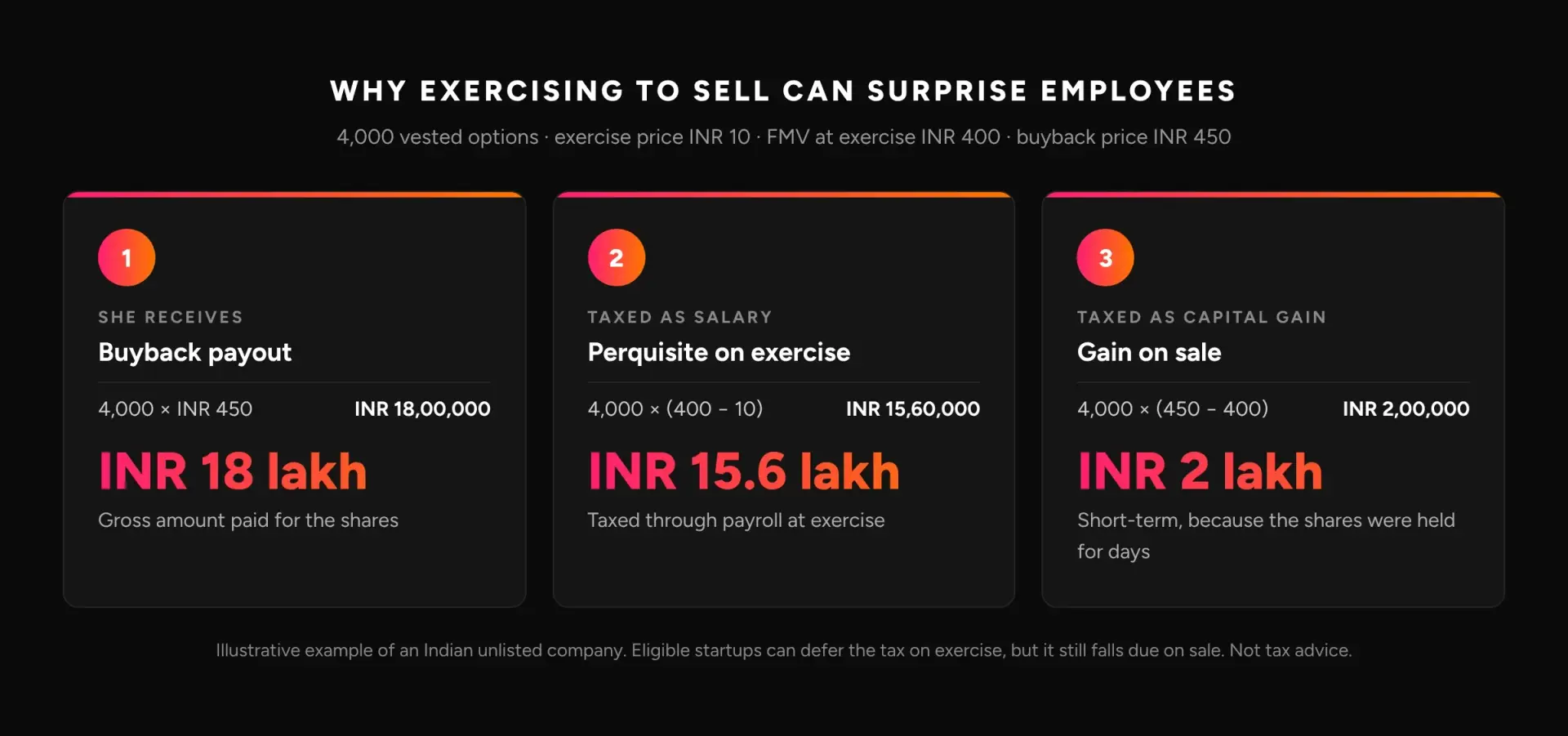
The tax that surprises people most falls on option holders who exercise to sell. Take an engineer in Bengaluru:
- She has 4,000 vested options at an exercise price of INR 10.
- The fair market value at exercise is INR 400, and the buyback price is INR 450.
- She receives INR 18 lakh.
- About INR 15.6 lakh of it is taxed as salary on exercise.
- The remaining INR 2 lakh gain is short-term, because she held the shares for days, not years.
Eligible startups can defer the tax on exercise, but it still falls due when the shares are sold. Put an example like this in front of employees before they decide.
Phase 3: Run the offer
Step 7: Tell employees, clearly and equally
Everyone eligible should get the same information at the same time. Tender offer rules in the US prohibit misleading statements, and in every country unequal information breeds distrust.
Expect the same three questions in every Q&A session:
- "Should I sell?" You can't answer this one.
- "How much tax will I pay?" Answer it with a worked example.
- "Will there be another one?" Be honest, because a vague yes becomes a promise in people's minds.
The offer pack should cover:
- the price and how it was set
- who can sell, and how much
- the timeline
- how to take part
- where to get help
Say plainly that taking part is voluntary, and that the company can't give personal tax advice. For more on getting the message across, see how to communicate ESOPs to employees.
Step 8: Run the offer window
- India: File the letter of offer (Form SH-8) and the declaration of solvency (Form SH-9) with the Registrar. Send the offer to shareholders within 20 days, and keep it open for 15 to 30 days, or less if all members agree.
- US: Keep the offer open for at least 20 business days, and for at least 10 business days after any change in the price or the number of shares sought.
- UK: Sign the purchase contracts after shareholder approval. Payment is due in full on purchase.
- Everywhere: Track elections daily, answer questions in writing and keep a log. Freeze the cap table data you used, so it can be reconciled later.
Most elections arrive in the last 48 hours. Send a reminder three days before the close, and another on the final morning.
Phase 4: Pay, file and close
Step 9: Pay, file and update the records
India:
- Pay within seven days of verifying acceptances.
- Extinguish the bought-back shares within seven days of completion.
- Record them in Form SH-10 and file the return in Form SH-11.
- Deduct tax where required.
The company then can't issue more shares of the same kind for six months, except bonus shares and existing ESOP obligations.
US: Withhold on any amount treated as compensation, and issue the right tax forms.
UK:
- Pay the stamp duty.
- File the SH03 with Companies House within 28 days, and the SH06 if the shares are cancelled.
- If capital treatment is claimed, report it to HMRC within 60 days.
Cap table:
- Cancel the shares.
- Update the outstanding and fully diluted share counts.
- Return any lapsed options to the pool.
Step 10: Review and decide whether to repeat
The participation rate tells you more than the cost. Low participation at a fair price usually means people didn't understand the offer, not that they didn't want the cash.
Look at three things:
- the subscription rate
- the cost
- what employees said
Then decide whether this was a one-off or the first of a regular programme. If it's going to repeat, keep the eligibility rules and the pricing method consistent, because people compare.
A proposed Corporate Laws (Amendment) Bill, 2026 in India would allow up to two buybacks a year, six months apart. It hasn't been enacted, so plan on one a year for now.
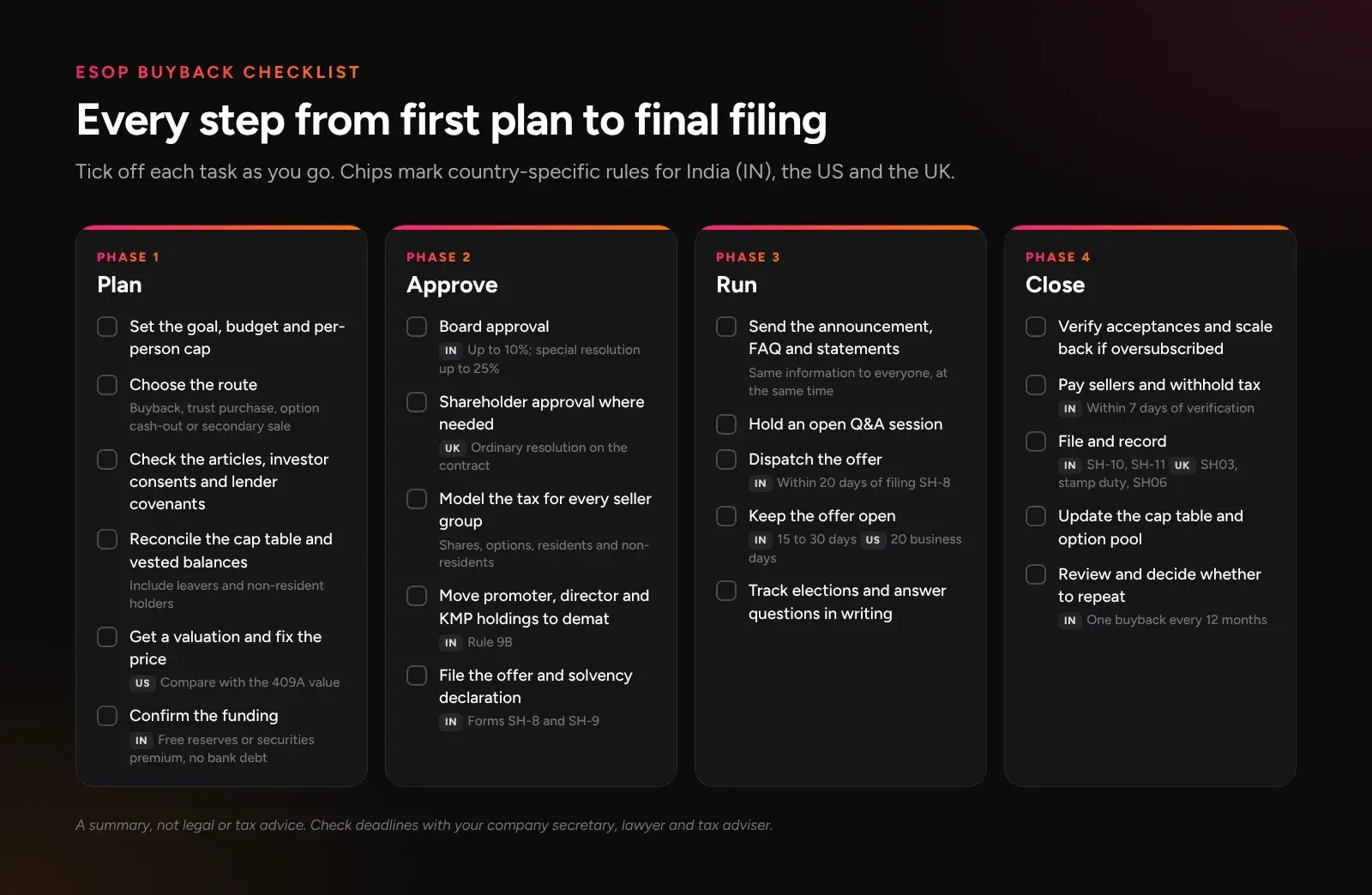
The ESOP buyback checklist
Use this checklist to track the 10 steps from planning to the last filing. Country-specific deadlines are marked against each task.
Common ESOP buyback mistakes
Ignoring the premium question. Paying above the 409A value without structuring advice can turn capital gains into wages.
- Forgetting the cash option holders need. In India, exercising before a sale triggers tax on exercise. Offer a cashless exercise and show the numbers.
- Inconsistent eligibility. One exception for a well-liked leaver becomes the precedent everyone cites next year.
- Missing non-resident sellers. Former employees who moved abroad bring withholding, foreign exchange and pricing rules with them.
- Stale cap table data. Reconcile vested balances, exercises and leavers before a single statement goes out.
- Leaving the cap table for later. Record cancelled shares and recycled options the week you pay, not at year end.
A good ESOP platform turns the statements, elections, cap table updates and registers into routine work. For who should own that work, see who administers your equity.
Frequently asked questions
1. What is an ESOP buyback?
A transaction in which the company, an ESOP trust or an investor buys employees' vested ESOPs, or the shares they got by exercising them. Employees get cash before an IPO or a sale.
2. Do employees have to take part in an ESOP buyback?
No. A buyback is an offer. Each eligible employee decides whether to sell and how much, up to the limit.
3. How is an ESOP buyback taxed in India from April 2026?
A company buyback of shares is taxed as capital gains for the seller. The cost is the fair market value taxed at exercise. Holders of more than 10% of an unlisted company pay an extra promoter tax.
4. Can unvested ESOPs be bought back?
Generally no. Buybacks cover vested options and shares already acquired. Unvested options would have to vest first under the plan's terms.
5. How long does an ESOP buyback take?
Usually two to three months from the first board discussion to the last payment. The offer itself stays open for:
- 15 to 30 days in an Indian private company
- at least 20 business days for a US tender offer
6. What price should a company pay?
A price it can support with evidence, such as:
- the latest funding round
- a discount to that round
- an independent valuation
In the US, compare it with the 409A value, because a premium may be taxed as wages.
7. Can former employees take part?
It depends on the programme. Many company buybacks exclude them, while third-party tenders include them more often. Whatever the choice, apply it consistently.
8. What is the difference between a buyback and a tender offer?
- A buyback is the company buying its own shares.
- A tender offer is the formal offer process, which the company or an outside investor can run.
Many company buybacks are run as tender offers.
This article is general information, not legal, tax or accounting advice. Buyback rules depend on the company's constitution, its agreements and local law, and tax rules change often. Speak to a lawyer, company secretary and tax adviser before approving a buyback.
Give your people liquidity without the scramble
Plan the buyback, collect employee elections and update the cap table on Tallect, with Tallect's experts on hand for pricing, approvals and filings.