
What Is a Flexible Benefits Plan? Meaning, Types and Examples
A clear guide to flexible benefits plans: what they mean, how they work, the main types and real examples employees choose.
A flexible benefits plan gives employees a set budget, allowance or menu and lets them choose the benefits that suit them, instead of giving everyone the same fixed package. In most plans, this choice sits on top of a core set of benefits that the employer guarantees for everyone. The employer sets the budget, the options and the rules. Each employee decides how to use their share.
This guide covers:
- what a flexible benefits plan means
- how one works in practice
- the main types of plan
- real examples of the benefits employees choose
- how the idea differs around the world
- the advantages and risks for employees and employers
- the steps to set up a plan of your own
What a flexible benefits plan means
A flexible benefits plan is a way of structuring employee benefits so that each employee chooses part of the package, rather than the employer fixing all of it. The employer decides how much value to offer, which benefits are available and what the rules are. The employee then picks the mix that fits their life, within those limits.
Most plans have two layers:
- Core benefits are what every eligible employee receives, whatever they choose. They often include protection the employer wants everyone to have, such as a base level of health cover, life insurance or a retirement contribution. Some core benefits may also be required by local rules, which vary by country.
- Flexible benefits are the part employees control. Employees might use a budget to add to their core cover, pick from a menu of extra benefits, or spend an allowance on approved categories such as wellbeing or learning.
The difference from a traditional package is simple. A fixed, one-size-fits-all package gives every employee in a group the same benefits, whether or not they use them. Picture three employees:
- a single employee in their twenties
- a parent of young children
- an employee caring for an older relative
Under a fixed package, all three receive identical cover. A flexible plan accepts that these people value different things, and lets each of them direct the same budget towards what matters most to them.
Employers use flexible benefits plans for several reasons:
- More diverse workforces. Workforces are more varied than when fixed packages became the norm, with different ages, family situations, health needs and ways of working.
- Multiple countries. Many companies now employ people across several countries, where both employee expectations and local benefit rules differ.
- Consistent value. A flexible plan lets an employer offer the same level of value to everyone, while the details vary by person and, where needed, by country.
- Cost. When employees choose their benefits, money is less likely to be spent on benefits nobody uses. The employer can set a clear budget and keep control of it, while employees get more of what they value from that budget.
How a flexible benefits plan works
Every flexible benefits plan is built from the same few building blocks. How each block is designed decides how the plan feels to employees and how much it costs to run.
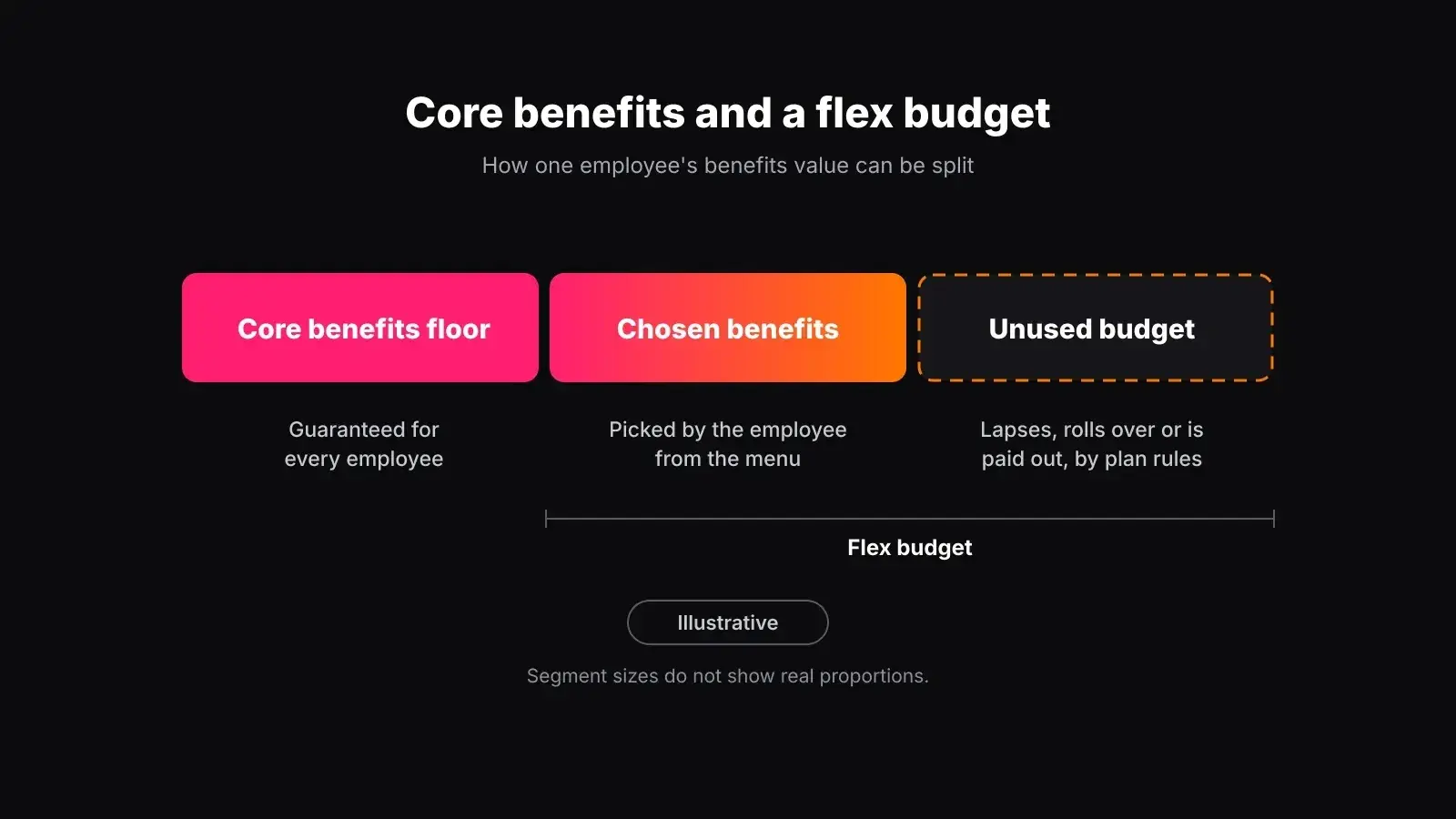
The core floor
The core floor is the set of benefits everyone keeps, whatever their choices. It protects employees from choosing too little cover. It also protects the employer from gaps it does not want, such as an employee with no life or health cover at all.
Some plans let employees reduce certain core benefits to a minimum level and use the savings elsewhere. Others keep the core fixed.
The flex budget
The flex budget is the value each employee can allocate. Plans express it in different ways:
- Credits or points, which employees spend on options that each carry a price in credits.
- A cash allowance, set as an amount of money per year or per month.
- A menu without a separate budget, where employees choose options and pay any extra cost themselves.
The budget may be the same for everyone, or it may vary by grade, country, length of service or family situation.
The menu of options
The menu lists the benefits employees can choose from, with the price of each option and any limits, such as a maximum level of cover or a cap on a particular allowance. A good menu is broad enough to offer real choice, but short enough for employees to understand.
The choice window and life events
Most plans ask employees to make their choices during a set period, often called the enrolment or choice window, usually once a year.
Outside that window, employees can typically change their choices only after a life event, such as:
- marriage
- the birth or adoption of a child
- a divorce
- a move to a new country
The rules on which events allow changes vary by plan and by country.
How choices are paid for
There are three common ways to fund choices:
- Employer funding. The employer provides the budget and employees spend it.
- Salary sacrifice. A term used in the UK and some other countries, where an employee gives up part of their salary in exchange for a benefit. In Australia, a similar approach is called salary packaging.
- A mix. The employer funds part of the budget, and employees can add to it from their own pay.
How each of these is treated for tax depends on the country, the benefit and the plan design. Check local requirements and take advice before you choose an approach.
What happens to unused budget
Plans handle unused budget in one of three ways:
- it lapses at the end of the plan year
- it rolls over to the next year, up to a limit
- it is paid out to the employee, often through payroll
Each approach has a different cost, and different tax and administrative consequences, which vary by country.
A worked example
Here is how one employee might use a flex budget. All figures are illustrative. They are not a recommendation or a typical plan.
A hypothetical employee receives an annual flex budget of $2,400 on top of their core benefits. During the choice window, they make four choices.
Choice | What it covers | Illustrative cost | Remaining budget |
|---|---|---|---|
Extra dental cover | A higher level of dental cover than the core plan | $600 | $1,800 |
Wellbeing allowance | Gym, fitness classes or wellbeing apps | $600 | $1,200 |
Learning budget | Courses, certifications or books | $800 | $400 |
Two extra days of leave | Bought leave on top of standard time off | $300 | $100 |
Caption: Illustrative figures only. They are not a recommendation, a benchmark or a typical plan.
The employee uses $2,300 of the $2,400 budget. Under this example plan's rules, the remaining $100 lapses at the end of the plan year. Another plan might let it roll over or pay it out instead, depending on the plan design and local rules.
![Four cards show one employee spending an illustrative $2,400 flex budget, leaving $100 unused.]](/img/1920/75/api/media/file/flex-budget-worked-example.webp)
Types of flexible benefits plans
Flexible benefits plans range from a small amount of choice on top of a fixed package to a fully personalised budget. The six types below are the most common. Many real plans combine more than one.
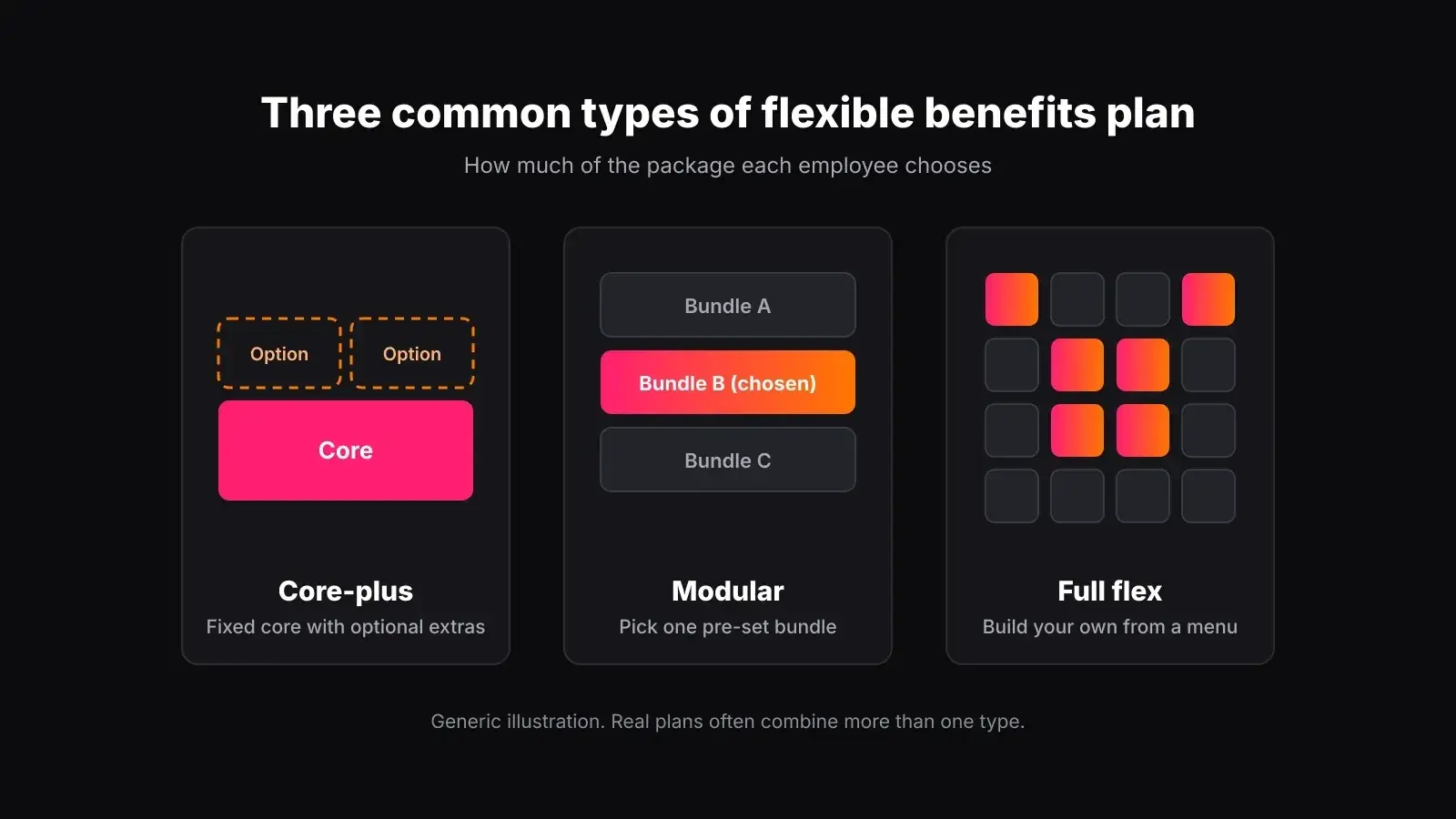
Core-plus plans
What it is. A fixed core package with a set of optional extras on top.
How it works. Every employee receives the core benefits. They can then add options from a menu, using a flex budget, their own money or both.
Who it suits. Employers moving from a fixed package to flexible benefits for the first time. The core stays familiar, and the choice is limited and easy to explain.
Modular plans
What it is. A plan built from a small number of pre-set bundles, or modules, each designed for a different type of employee.
How it works. Instead of choosing benefit by benefit, the employee picks one module, such as a family-focused bundle, or one weighted towards savings and wellbeing. Some plans let employees add a few extras on top.
Who it suits. Employers who want to offer choice while keeping administration and communication simple. Modules also reduce decision fatigue for employees.
Full flex or credit-based plans
What it is. A plan where most or all of the benefits value is converted into credits or a budget that employees allocate.
How it works. Each benefit on the menu has a credit price. Employees build their own package above a minimum core. They may be able to take unused credits as cash, or buy extra benefits through payroll.
Who it suits. Employers with a diverse workforce, a mature benefits function and the systems to manage many individual choices.
Cafeteria plans
What it is. A US term for a plan that lets employees choose between benefits, often with pre-tax treatment.
How it works. Employees choose from a list of qualified benefits, and may pay for some of them from their pay before tax.
A flexible spending account is a specific US pre-tax account that employees can use for certain eligible costs. It is often offered alongside or within a cafeteria plan, but it is not the same thing as a flexible benefits plan.
Who it suits. Employers with employees in the US. The rules are specific to that country, so take local advice before you design or change a plan.
Allowance and lifestyle spending account plans
What it is. A plan that gives employees an employer-funded budget to spend on approved categories. It is often called a benefits allowance or a lifestyle spending account.
How it works. The employer sets the amount and the eligible categories, such as fitness, learning or home working. Employees spend the money directly, often with a benefits card, or claim it back with receipts.
Who it suits. Employers who want simple, visible choice, including for distributed teams. Tax treatment of allowances varies by country, so check local rules.
Salary sacrifice and salary packaging schemes
What it is. A scheme where employees give up part of their salary in exchange for a benefit. Salary sacrifice is the term used in the UK and some other countries. Salary packaging is the common term in Australia.
How it works. The employee agrees to a lower cash salary, and the employer provides a benefit of equivalent value, such as a higher pension contribution, a car lease or certain equipment. These schemes often run alongside an employer-funded flex budget.
Who it suits. Employers in markets where these arrangements are common. Rules on eligible benefits and their treatment vary by country, so take advice before you set one up.
Type | How choice works | Best for | Main trade-off |
|---|---|---|---|
Core-plus | Optional extras on top of a fixed core | First-time flexible plans | Limited choice |
Modular | Employees pick one pre-set bundle | Simple choice with low admin | Less personal than full flex |
Full flex or credit-based | Employees allocate credits across a menu | Diverse workforces with mature systems | Most complex to run and explain |
Cafeteria plan (US) | Choice between qualified benefits | Employers with US employees | Specific to one country's rules |
Allowance or lifestyle spending account | Budget spent on approved categories | Simple, visible choice for distributed teams | Less suited to insured benefits |
Salary sacrifice or salary packaging | Salary exchanged for a benefit | Markets where these schemes are common | Rules vary widely by country |
Caption: The six main types of flexible benefits plan compared.
Examples of flexible benefits
Almost any benefit can be offered flexibly. The examples below are grouped by category, and most plans draw on several categories. To see which benefits tend to matter most to employees, read our guide to the benefits employees value most.
Health and insurance
- Higher levels of medical, dental or vision cover
- Adding a partner or children to health cover
- Extra life insurance or income protection
- Critical illness cover
- Health screening
Wellbeing and fitness
- Gym memberships or fitness classes
- Wellbeing and mental health apps
- Counselling or coaching sessions
- Sports equipment
Family and caregiving
- Childcare support or vouchers
- Support for caring for an older relative
- Fertility and family-planning support
- Extra cover for dependents
Financial wellbeing and retirement
- Extra retirement or pension contributions
- Financial advice or education
- Savings or emergency fund schemes
- Employee share purchase options, where offered
Learning and development
- Courses and certifications
- Language lessons
- Conference attendance
- Books and online learning subscriptions
Some employers turn this category into a dedicated budget. See our guide to learning stipends for how that works.
Lifestyle, mobility and remote work
- Commuting or transport support
- Car leasing or bike-to-work schemes
- Home office equipment
- Internet or phone allowances
- Meal or food allowances
Time off
- Buying extra days of leave
- Selling unused days of leave, where allowed
- Volunteering days
- Sabbatical options
Category | Examples | What employees value it for |
|---|---|---|
Health and insurance | Higher cover, family cover, life insurance | Protection for themselves and their family |
Wellbeing and fitness | Gym, wellbeing apps, coaching | Physical and mental health |
Family and caregiving | Childcare, elder care, fertility support | Support at key life stages |
Financial wellbeing and retirement | Extra pension, financial advice | Security now and later |
Learning and development | Courses, languages, conferences | Career growth |
Lifestyle, mobility and remote work | Commuting, home office, car or bike schemes | Everyday convenience and cost |
Time off | Buying leave, volunteering days | Balance and personal time |
Caption: Flexible benefits examples by category, and what employees value each one for.
Flexible benefits around the world
The idea behind flexible benefits is the same everywhere, but the way it shows up varies by market. Local rules, tax systems and employee expectations shape which benefits are offered and how choices are paid for. The overview below is general and descriptive. Rules vary by country, so check local requirements and take advice.
- UK: Flexible benefits schemes are well established, often built around a flex budget, and salary sacrifice for benefits such as pension contributions.
- Australia: Salary packaging is widely used, with employees receiving certain benefits as part of their pay package.
- US: Choice is often delivered through cafeteria plans and different kinds of spending accounts, alongside employer-funded allowances.
- Some Asian markets: Flexibility appears inside the salary structure itself, with flexible benefit plan components that employees can allocate across set categories.
- The Gulf: Packages are often led by health insurance, with perks, discounts and wellness programmes added on top.
For employers working across several of these markets, the challenge is to keep a consistent principle while letting the details follow local practice. One such principle is giving everyone choice within a fair budget.
Term | Where it is used | What it means |
|---|---|---|
Flexible benefits plan | Widely, as a general term | A plan that lets employees choose some of their benefits |
Cafeteria plan | US | A plan that lets employees choose between benefits |
Flexible spending account | US | A specific account used for certain eligible costs |
Lifestyle spending account or benefits allowance | Widely | An employer-funded budget for chosen categories |
Salary sacrifice | UK and some other countries | Giving up part of salary in exchange for a benefit |
Salary packaging | Australia | Receiving certain benefits as part of the pay package |
Caption: Common flexible benefits terms, where they are used and what they mean.
Advantages for both sides
When it is well designed and well explained, a flexible benefits plan can work for both employees and employers.
For employees
- Choice. Employees can match their benefits to their own life stage, health, family and interests, instead of receiving cover they do not need.
- Perceived value. Benefits people choose for themselves tend to feel more valuable than benefits handed to them, even when the budget is the same.
- Inclusion. A flexible plan can support a wider range of needs, such as different family structures, caring responsibilities or ways of working. The employer does not have to design a separate package for each group.
- Control and understanding. Making active choices helps employees understand what their benefits are worth and how to use them.
For employers
- Budget control. The employer sets the budget and the rules, so costs are easier to predict and manage, and less money goes on benefits nobody uses.
- Recruitment and retention. A plan that offers real choice can help an employer stand out to candidates, and gives current employees a reason to stay.
- Consistency across groups and countries. A single flexible framework can give every employee a fair level of value while allowing local differences.
- Clearer insight. Choices show what employees actually value. That helps the employer refine the plan over time and explain the full value of the rewards package.
Drawbacks and risks to manage
Flexible benefits plans also bring challenges. None of them is a reason to avoid flexibility, but each needs a plan.
- Added complexity. More choice means more rules, more pricing and more options to maintain. Employers usually reduce this by starting with a core-plus or modular design and adding choice over time.
- Communication and decision fatigue. Faced with too many options, some employees choose nothing or choose badly. Several things help:
- clear guidance
- sensible defaults
- a short menu
- modules for employees who prefer not to build their own package
- Tax and compliance differences by country. The same benefit can be treated differently from one country to the next, and some benefits may not be allowed everywhere. Employers manage this by setting a global principle, then designing locally with tax, payroll and legal advisers in each country.
- Uneven take-up. Some groups may use their budget fully while others leave it untouched. Reviewing take-up by group, and targeting communication where it is low, helps make sure the plan works for everyone.
- Adverse selection in insured benefits. When employees can opt in or out of insured benefits, people who expect to claim are more likely to choose more cover, which can push up premiums. Employers and insurers usually manage this with:
- a core level of cover for everyone
- limits on how much cover can change each year
- rules on when changes are allowed
- Admin load. Running individual choices, life events, payroll changes and reporting takes more effort than a fixed package. Clear processes, good data and the right system for your scale keep the load manageable.
How to set up a flexible benefits plan
Setting up a flexible benefits plan is a design project first and an administration project second. These steps give a practical order of work.
- Set goals and a budget. Agree what the plan should achieve, such as more choice, better perceived value, cost control or consistency across countries. Set a total budget and decide how it will be shared.
- Understand your workforce. Look at the ages, family situations, locations and working patterns of your employees, and ask them what they value. Employee surveys and focus groups help here.
- Define the core floor. Decide which benefits everyone must keep, including any that local rules require, and at what level.
- Choose the plan type. Pick the approach that fits your goals and capacity, such as core-plus, modular or full flex. Decide whether to use salary sacrifice, salary packaging or allowances where they fit.
- Build the menu. Select the options, price each one and set any limits. Keep the menu focused enough for employees to understand.
- Set the rules and the choice window. Decide:
- who is eligible for what
- when employees can choose
- which life events allow changes
- what happens to unused budget
- Decide how the plan will be run. Smaller plans are sometimes run on spreadsheets at first. Plans covering many employees or countries usually need a system to manage budgets, choices, claims and payroll data. Our guide to flexible benefits platforms explains the options. As one example, Tallect's Benefits & Insurance module offers:
- Standard and Flex benefit options
- a spending account or wallet
- centralised budget and spend management
- a globally consistent benefits framework that stays regionally compliant
- Communicate and launch. Explain the plan in plain words, and show employees what their budget is worth. Give them tools and support to make choices before the window opens.
- Review take-up each year. Look at what employees chose, what they ignored and what they asked for. Adjust the menu, prices and communication for the next plan year.

Frequently asked questions
What is a flexible benefits plan in simple terms?
A flexible benefits plan lets employees choose some of their benefits, instead of receiving a fixed package. The employer sets a budget, a menu of options and the rules, and each employee picks the mix that suits them. Most plans also include core benefits that everyone keeps.
The result is a package that fits each person better, while the employer keeps control of the overall budget.
Is a cafeteria plan the same as a flexible benefits plan?
Not exactly:
- "Cafeteria plan" is a US term for a plan that lets employees choose between benefits, often with pre-tax treatment. It is one form of flexible benefits plan, shaped by US rules.
- "Flexible benefits plan" is the wider, general term used around the world for any plan that gives employees choice.
If you have employees in the US, take local advice on how cafeteria plan rules apply.
What is the difference between a flexible benefits plan and a flexible spending account?
- A flexible benefits plan is the overall approach of letting employees choose their benefits.
- A flexible spending account is a specific US pre-tax account that employees can use for certain eligible costs.
An FSA can be one option within a wider benefits offer, but it is not a flexible benefits plan on its own. The two are often confused because they share the word "flexible".
Are flexible benefits taxable?
It depends on the country, the benefit and how the plan is set up:
- some benefits may be treated as taxable income
- some may be funded from pay before tax
- others may create costs for the employer
Rules vary by country and can change. Check local requirements with your tax and payroll advisers before you design the plan or add a new benefit.
What happens to unused flexible benefits credits?
It depends on the plan's rules. Unused credits may:
- lapse at the end of the plan year
- roll over to the next year, up to a limit
- be paid out to the employee, often through payroll
Each option has different cost and tax consequences, which vary by country. Make the rule clear to employees before the choice window opens.
Can employees change their flexible benefits during the year?
Usually only at set times. Most plans ask employees to choose during an annual choice window. They allow changes outside it only after a life event, such as:
- marriage
- the birth or adoption of a child
- a move to a new country
Some allowance-based benefits are more flexible. The exact rules depend on the plan and local requirements, so check your plan documents and ask HR.
Are flexible benefits worth it for smaller companies?
They can be, if the design matches the company's size. A smaller employer does not need a full credit-based plan. A simple core-plus design or a single benefits allowance can give employees real choice with modest admin.
The key is a clear budget, a short menu and simple rules. As the company grows, it can add options and move to a more structured plan.
How do you communicate a flexible benefits plan to employees?
Start with what employees gain: the value of their budget and the choices they have. Then:
- use plain language, short guides and real-life examples, such as a new parent or someone planning for retirement
- give people time and tools to compare options before the choice window opens
- offer a contact for questions
After launch, remind employees about their benefits through the year, not only at enrolment.
Turn flexible benefits into a working plan
Tallect helps you offer Standard and Flex benefit choices within a centrally managed budget, under one benefits framework across your countries.